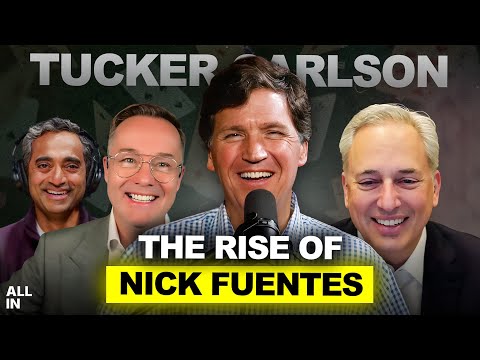
Tucker Carlson: Rise of Nick Fuentes, Paramount vs Netflix, Anti-AI Sentiment, Hottest Takes
Tucker Carlson: Rise of Nick Fuentes, Paramount vs Netflix, Anti-AI Sentiment, Hottest Takes
Summary
Tucker Carlson joins the All-In Podcast as a guest for his fourth appearance, filling in for David Friedberg. The episode covers major media consolidation with the bidding war between Netflix ($83B offer) and Paramount/Sky Dance ($108B hostile offer) for Warner Bros Discovery, analyzing how legacy media brands like CNN and CBS have become “husks” while user-generated content on YouTube and TikTok dominates attention.
The discussion moves to Nick Fuentes and the America First movement, where Tucker explains his interview approach and argues that identity politics inevitably breeds counter-identity politics. The hosts explore why Fuentes resonates with disaffected young men despite his controversial views, with Chamath emphasizing the importance of American national identity and shared values over multiculturalism.
A substantial portion focuses on anti-AI sentiment, particularly among conservatives. Tucker articulates the common perception that AI’s risks (job loss, surveillance, power concentration) far outweigh its announced benefits. The hosts debate actual vs. predicted job displacement, with Sacks presenting data showing only 4.7% of 2024 layoffs attributed to AI, while Jason warns of coming disruption in taxi, customer service, and entry-level jobs. The episode concludes with rapid-fire “Tucker in 20” takes on Venezuela, Europe’s immigration crisis, NATO, Israel, and Tucker’s new gold-selling venture Battalion Metals.
Highlights
”These brands are husks”
Clip command
yt-dlp --download-sections "*7:01-8:00" "https://www.youtube.com/watch?v=cY5UFw2AIZo" --force-keyframes-at-cuts --merge-output-format mp4 -o "cY5UFw2AIZo-7m01s.mp4"“Buying CBS News is like buying RCA Records or something. It just doesn’t have any effect. These brands are husks. In fact, all they are is brands at this point.” — Tucker Carlson, 7:21
”Universal principles or the mafia”
Clip command
yt-dlp --download-sections "*29:00-30:00" "https://www.youtube.com/watch?v=cY5UFw2AIZo" --force-keyframes-at-cuts --merge-output-format mp4 -o "cY5UFw2AIZo-29m00s.mp4"“We’re governed by universal principles or we’re governed by the mafia. Those are our choices. Your principles have to apply to every human being or certainly every American citizen, period, or they’re not principles.” — Tucker Carlson, 29:00
”Identity politics breeds counter-identity politics”
Clip command
yt-dlp --download-sections "*47:33-48:40" "https://www.youtube.com/watch?v=cY5UFw2AIZo" --force-keyframes-at-cuts --merge-output-format mp4 -o "cY5UFw2AIZo-47m33s.mp4"“If you have identity politics, at some point you’re going to get white identity politics. I wrote a book about this almost 10 years ago, which was totally ignored, but that’s inevitable.” — Tucker Carlson, 47:33
”No one has explained why we should be excited about AI”
Clip command
yt-dlp --download-sections "*53:00-54:00" "https://www.youtube.com/watch?v=cY5UFw2AIZo" --force-keyframes-at-cuts --merge-output-format mp4 -o "cY5UFw2AIZo-53m00s.mp4"“No one has explained why we should be excited about AI. I’m a gold buyer and ammo buyer and freeze-dried food buyer as I already told you. But like, what’s the answer? How is this great for the average person?” — Tucker Carlson, 53:00
”I do bury gold in my yard”
Clip command
yt-dlp --download-sections "*93:45-94:40" "https://www.youtube.com/watch?v=cY5UFw2AIZo" --force-keyframes-at-cuts --merge-output-format mp4 -o "cY5UFw2AIZo-93m45s.mp4"“I do bury gold in my yard because that’s the kind of man I am, primitive. I’ve also scattered millions of ball bearings around my backyard. So good luck with your metal detector.” — Tucker Carlson, 93:52
Key Points
- White House Christmas Party (1:07) - President Trump gave shoutouts to David Sacks and Chamath, improvising different speeches at each of the 25+ holiday parties
- Paramount vs Netflix Bidding War (4:15) - Netflix offered $83B for WBD streaming assets; Paramount countered with $108B hostile bid for the entire company
- Legacy Media as “Husks” (7:21) - Tucker argues CBS News and CNN are merely brand names with no real power to influence hearts and minds
- Deal Size Predicts Future Relevance (8:17) - Chamath explains billion-dollar deals (Instagram, YouTube, OpenAI) signal the future; hundred-billion deals are about the past
- User-Generated Content Dominance (9:43) - YouTube and TikTok dwarf paid streaming in audience; young people uninterested in traditional movies and Marvel
- Netflix’s Showrunner Economics (11:31) - Netflix pays well but offers no equity/backend; traditional studios let creators be entrepreneurs
- Ellison Family Influence Concerns (19:42) - Jason raises concerns about quid pro quo appearance with Ellisons supporting Trump while pursuing TikTok and WBD deals
- Nick Fuentes Origin Story (27:47) - Started at Boston University; Ben Shapiro allegedly tried to get him kicked out of Republican club for Israel criticism
- Identity Politics Breeds Counter-Identity Politics (28:58) - Tucker argues white identity politics was inevitable response to years of identity-based political discourse
- America First Definition (31:56) - Simply means government should act on behalf of its own citizens; anything else is illegitimate
- Melting Pot vs Toss Salad (43:22) - Chamath contrasts American assimilation with Canadian multiculturalism, arguing the latter creates confusion and slows GDP
- Bot Amplification of Fuentes (39:47) - Discussion of foreign actors and domestic “Groper” army using VPNs to artificially boost engagement
- AI Benefits Not Communicated (50:37) - Tucker criticizes AI industry for announcing “this will change everything” without explaining consumer benefits
- Geopolitical AI Stakes (51:40) - Chamath frames AI as existential: countries will be exporters, strategic partners, or vassal states
- AI Industry’s Messaging Failure (53:23) - Jason articulates benefits: 80-90% cheaper education, healthcare breakthroughs, lower goods prices, longer lives
- AGI Timeline Pushed Back (56:09) - Original 2027 AGI predictions now pushed to 2030s; Sacks notes once timelines exceed 10 years, no one really knows
- Construction Workers 30% Pay Increase (67:47) - WSJ reports data center buildout boosting construction wages; electricians earning $500-800K annually
- AI Job Loss Data Debunked (74:27) - Challenger Gray reports only 4.7% of 2024 layoffs attributed to AI; Yale study found no discernible labor disruption
- End Federal Student Loan Underwriting (72:58) - Chamath proposes letting market price education to shift people toward in-demand skilled trades
- Tucker’s Gold Business (92:47) - Battalion Metals launched to sell gold at near-wholesale prices online, countering commemorative coin scams
Mentions
Companies
- Warner Bros Discovery (4:21) - Target of bidding war; owns HBO, DC, CNN, TNT, Discovery with $30B debt
- Netflix (4:21) - Offered $83B for streaming assets; $400B market cap; the 800-lb gorilla of Hollywood
- Paramount/Sky Dance (5:03) - Ellison family’s $108B hostile bid including $41B equity financing
- Disney (13:14) - Started streaming decade after Netflix but got significant subscribers
- YouTube (8:37) - Google’s $1.6B acquisition cited as example of visionary small deal
- TikTok (9:50) - Dominates short-form video; Australia banned for under-16s
- Meta (17:15) - Scale AI deal structured to avoid HSR filing requirements
- OpenAI (8:51) - Microsoft’s $1B initial investment cited as visionary bet
- Amazon (71:11) - Leaked estimates of eliminating 600,000 jobs
- Waymo (57:29) - Robotaxis being vandalized in San Francisco; third of rides in SF/LA now autonomous
- Service Titan (69:41) - Founder interviewed on CNBC about cognitive vs physical+cognitive job safety
- Battalion Metals (92:47) - Tucker’s new gold-selling business offering near-wholesale prices
- Rumble (26:05) - Platform where Nick Fuentes has 500K subscribers
Products & Technologies
- ChatGPT (75:47) - Yale study examined first 33 months post-release; found no discernible labor disruption
- Starlink ([Not timestamped]) - Referenced in context of AI infrastructure
- AI 2027 Project (79:35) - Originally predicted AGI by 2027; now pushed timelines to 2030s
- Polymarket (6:01) - Shows Paramount at 51% favorite, Netflix at 36% for WBD deal
People
- Tucker Carlson (0:12) - Fourth appearance on podcast; filling in for Friedberg
- David Sacks (0:22) - AI Czar getting shoutouts from Trump; defending AI industry with data
- Chamath Palihapitiya (1:59) - Shares immigrant perspective on American identity
- President Trump (0:59) - Hosts 25+ White House Christmas parties; compared to Dave Chappelle for never repeating material
- Nick Fuentes (25:59) - 27-year-old white nationalist; followers called “Gropers”; gained hundreds of thousands recently
- David Zaslav (4:26) - WBD CEO leading company with $30B debt
- David Ellison (5:20) - Son of Larry Ellison; leading Paramount/Sky Dance bid
- Larry Ellison (5:20) - Oracle founder; family providing $41B equity for WBD deal
- Bari Weiss (5:30) - Running CBS News; would potentially also oversee CNN in Paramount deal
- Ted Sarandos (15:28) - Netflix co-CEO praised by Trump as “genius”
- Ben Shapiro (27:58) - Allegedly attacked Fuentes as a freshman and tried to block his career
- Piers Morgan (26:31) - Interviewed Fuentes but Tucker says it enhanced rather than diminished him
- Andrew Tate (41:27) - Had affiliate scheme for Twitter revenue sharing
- Sam Altman (51:17) - Named as one who should be marketing AI benefits
- Jim Cramer (69:30) - CNBC host interviewed Service Titan founder
- Teddy Roosevelt (18:29) - Historical precedent for presidential involvement in antitrust
- Tony Hinchcliffe (97:15) - Did live Kill Tony roast at All-In holiday party
Surprising Quotes
“Buying CBS News is like buying RCA Records or something. It just doesn’t have any effect. These brands are husks. In fact, all they are is brands at this point.” — Tucker Carlson, 7:21
“Hundred billion dollar deals are typically about things in the past. What is the future? Billion dollar deals. When Facebook bought Instagram for a billion dollars, that turned out to be a huge bet about the future.” — Chamath Palihapitiya, 8:25
“We’re governed by universal principles or we’re governed by the mafia. Those are our choices. Your principles have to apply to every human being or certainly every American citizen, period, or they’re not principles.” — Tucker Carlson, 29:00
“If you have identity politics, at some point you’re going to get white identity politics. I wrote a book about this almost 10 years ago, which was totally ignored, but that’s inevitable.” — Tucker Carlson, 47:33
“No one has explained why we should be excited about AI. I’m a gold buyer and ammo buyer and freeze-dried food buyer as I already told you. But like, what’s the answer? How is this great for the average person?” — Tucker Carlson, 53:00
“I do bury gold in my yard because that’s the kind of man I am, primitive. I’ve also scattered millions of ball bearings around my backyard. So good luck with your metal detector.” — Tucker Carlson, 93:52
Transcript
0:02 All right, back with us in place of David Friedberg who’s busy this week is the one, the only on his fourth appearance here on the All-In podcast, Mr. Tucker Carlson. How are you, Tucker? Thanks for having me. Hey, Tucker. Good to see you. David, David, how do you have time for every time I turn on my phone, there’s like David Sacks on something incredibly complex. Like, are you sleeping? Usually people attacking me for something, but it’s not just like, oh, your views are this or that geopolitical conflict. It’s like the details of something very complicated. And I’m just like, wow, man. That’s a lot. That’s a lot to digest.
0:45 Yeah. There’s not a very high bar in Washington, as you know. You’re a giant among pygmies, but still, it’s a lot of work. In the land of the blind, the one-eyed man is king. Exactly. Exactly. Are you still enjoying it? Yeah, it’s been a lot of fun. Well, you know, President Trump’s a lot of fun to work for. He’s the most fun. I mean, the best, right? He got a big shout out yesterday. It was really awesome, actually. David did. Yeah. Huge shout out.
1:07 That’s right. We were at the White House Christmas party. I think they do like 25 of these. Yeah. Literally. Literally, cuz they got so many thousands of people, but they can only fit a couple hundred people in the White House and they’re doing like two a day. And the president comes down and gives a speech and every speech is different. You know, it’s like a Dave Chappelle comedy routine where he never does the same set and he does it with so much enthusiasm and gusto. You would think that you were the only holiday party crowd that he ever addressed. He never expresses any irritation at doing that. He loves it. It’s like amazing.
1:42 It’s unbelievable. But in any event, he gave me a shout out during the speech and then he called me up there to like, hey, can you say a couple words about AI? And I’m like, well, this isn’t exactly Christmas party conversation. So, I just kind of talked about how great he was and how much fun it was to work for him. And then he gave Chamath a shout out as well. No way. And he just starts talking about the All-In Pod. Like, we’re in the audience and he just starts having a conversation with us about the All-In Pod and how’s it doing?
2:10 The funniest part was he says to me, “Oh,” and then Nat was behind him. So, he goes, “Hey, Nat.” And he says, “I hope everything’s going well. How’s your relationship?” He looks at me and I’m like this and then Nat’s behind her. Oh, it’s so awesome. I’m going this weekend cuz I miss him. You’re going to see him this weekend? You guys are on good terms. Tucker with Trump. Oh, yeah. The best. I mean, the best. I mean, of course, people have told him, many people that he’s not allowed to talk to me. So, that just makes him like me much more cuz like all he hears is, “Oh, he’s” People be like, “He’s the worst human being who’s ever lived.” And all Trump hears is who’s ever lived, you know, and he’s just that he’s just he’s you can’t control him that way. Period.
3:00 So, no, I get along with him literally in 25 years better than I ever have. That’s good, too. It’s hilarious. Yeah. The last part of that story is so after he calls up me and Chamath, actually, he calls me up to speak and then calls David up to speak. He went on a little bit of a riff saying, you know, I don’t like the term artificial intelligence because why would you want to call it artificial? It sounds bad. Why don’t they call it something else? Superior intelligence. Organic intelligence.
3:23 And then he calls up Chamath. He’s like, Chamath, what do you think? And Chamath says, well, I think AI is too late to change, but maybe it could be American intelligence. And then he says, yeah, but you know, we want this to be used by the whole world. Sell it to the whole world. Anyway, we start workshopping this branding exercise in front of the entire Christmas party. How about we call it Trump super intelligence? Okay, it’s Trump intelligence. No, but you know what? Calling AI American intelligence is actually the smartest and best one could do around AI.
3:55 We got a lot to talk about, Tucker, you’ve been on a run, huh? You’ve been on I mean, not in my world. I mean, I’m off social media mostly, so it’s like nothing’s actually really happening in my world. You don’t open X at all. It’s all about me, man. And I’m not going to I don’t like to read about myself, so I don’t look at it. No.
4:15 All right. For topic number one, Paramount versus Netflix. They’re in a bidding war over the future of Warner Brothers and all that amazing IP. The assets obviously many of us know Warner Brothers is led by Zaslav, David Zaslav, but he owns currently HBO, DC, and the Warner Brothers collections of films. Also, they have that great studio a lot. On the cable side, they own CNN, TNT, Discovery, and they just saddled that company up with $30 billion of debt.
4:45 And they had a little bit of a competition for who would buy it. Netflix and Paramount Sky Dance, run by the Ellison family. Netflix offered $83 billion to purchase just the streaming assets, which would put the number one and the number three player together. And WBD publicly accepted Netflix offer last Friday. This has created a bit of a kerfuffle. Paramount now is coming in with a hostile offer, 108 billion in cash for the entire company. That includes the cable assets.
5:20 That would be interesting because then David Ellison, son of Larry Ellison, would own not just CBS, which is being run CBS News by your favorite Tucker Carlson, Bari Weiss. She would also, I guess, own and run CNN in this instance potentially. We’ll get to that. The $108 billion offer includes two vehicles, 41 billion in equity financing by the Ellison family and then a bunch of other folks coming including some Middle East sovereign wealth funds.
5:56 Polymarket interestingly has Paramount as the favorite at 51% and Netflix has dropped to 36% even though they say they have a done deal and 14% chance of no deal. I think that might be the free money the 14% chance of no deal. What’s your take on this, Tucker? And just broadly speaking, consolidation in media having pulled the rip cord and left traditional media and now yeah, the understanding is you’re doing better than ever. You control your destiny and I think you’re making probably as much or more money now than you did when you were working for the men.
6:32 Yeah, I don’t I actually haven’t checked, but I’m not much of a money guy, but I’m fine and can pay my non-existent mortgage. I’m against monopoly power in general because I think it stifles creativity. I’m not that worried about this because these, you know, these things never move in exactly the direction you imagine. I’ve been in media my entire life and none of the big changes I anticipated. In fact, almost all of them I made fun of.
7:01 I just don’t think that we’re really threatened by, you know, a conglomerate of CNN and Netflix and all. So it’s like, okay, you can assemble huge companies. Can you make people consume and believe the product? You know, buying CBS news is like buying RCA records or something. It like just doesn’t have any effect. And only people who are not paying attention are pretty cut off think you’re going to win hearts and minds by buying CBS News or CNN. These are these brands are husks. In fact, all they are is brands at this point.
7:37 And I just am not at all convinced that this will have a material effect on anyone’s attitudes at all. You know, if you started to mess with what YouTube is allowed to air or the ownership of X, you know, then I think you could really change the country and the conversations that we’re allowed to have. But I don’t see any of this as especially meaningful on the society. I mean, is the product going to get, you know, I don’t know, more subversive than it already is? I mean, is Netflix going to be worse for American society? Probably not. You know, I think this is a business story, not a cultural story.
8:14 Chamath, your thoughts. I’ll give you two. The first is that whenever you see deals, it’s important to look at the amount of money that is at risk. And that is the best tell about whether this is important for the future or not. Hundred billion dollar deals are typically about things in the past. What is the future? Billion dollar deals. So for example, when you look at when Facebook bought Instagram for a billion dollars, that turned out to be a huge bet about the future, it was right.
8:43 When Google bought YouTube for a billion six, that was a huge bet on the future. They were right. When Microsoft invested a billion dollars in OpenAI, that was a huge bet on the future. It was right. But when you look at assets that trade at hundred billion dollar plus valuations, they’re so undergirded by debt. All of that debt is only ever bought by looking at the past. Meaning how much money have they made and then it’s a best guess about how much money could they make in the future.
9:12 So these multi-hundred billion dollar assets to Tucker’s point, they don’t really matter that much. I don’t think it’s super anti-competitive. These are financial transactions. The reality in media, so specifically about this deal. So that’s a general statement about deal quantum and you can just judge the importance based on that. People should be spending much more time looking at billion dollar transactions than hundred billion dollar transactions. That’s my takeaway there.
9:38 But at the very specific thing about this deal, the reality is that the future is unscripted, uncontrolled, user-generated content. You see it on YouTube. It is already the 800 lb gorilla in the space. And then separately, it’s now becoming about shorter form video. And you see that with things like Instagram reels and TikTok. None of that landscape will change based on this deal. If anything, if those trends accelerate, the value of historic IP is going to erode even faster.
10:07 Meaning, this generation of kids will have no idea or care about the Marvel Cinematic Universe, about Star Wars, and that may upset those of us who are nostalgically tied to it. So, I don’t know. I would let the deal happen. I don’t think it’s particularly that important.
10:22 Sacks, obviously you don’t speak for the administration on these issues, but I’m curious your thoughts on this. Yeah, just my personal view on this is that we’re going to get meaningful consolidation in the industry either way because either Netflix and Warners are going to merge or Paramount and Warners are going to merge. So either way, you’re going to get consolidation.
10:43 But that being said, if Netflix is allowed to buy Warners, the antitrust concerns are a lot more serious because Netflix really is the 800 lb gorilla in Hollywood right now. It’s the number one streamer by far. It’s got the biggest market cap. And they’re the party who the rest of Hollywood is freaked out about right now. And so you saw that the Hollywood unions like the WGA, SAG. They oppose the deal because they’re fearing job cuts, lower wages, worsened conditions due to reduced demand for talent.
11:15 And then the content creators and distributors are worried about this too because Netflix is known for making tougher deals I think than the traditional studios. I’ve got a friend who’s a showrunner in Hollywood, and he’s done projects with both Netflix and with the studios, traditional studios, and he says the big difference is Netflix will pay you pretty well, but you don’t get any equity in your show.
11:35 Like whatever you get is sort of agreed to at the beginning and that’s it. So, you’re not really an entrepreneur when you do a show for them. But when you then work for a studio, you actually get a backend. Now there’s all sorts of, you know, Hollywood accounting associated with that, but he kind of misses the days that are going away where he got to be a little bit of an entrepreneur and have real upside in his shows.
12:02 And if Netflix now is allowed to acquire Warner Brothers and that’s just another nail in that whole coffin. And so I think it is a big change and if the antitrust regulators look at this, I do think that Paramount has a better chance. The other big factor is just that Paramount’s offering more. They up the bid. It’s 108 billion versus around 80 or was like $30 a share versus 27. And they’re also buying the whole company whereas Netflix just wants Warner’s studio assets and streaming assets like HBO as opposed to the cable assets which are considered a little bit of a carcass.
12:37 So, I think if you’re a shareholder in Warners, you probably want to sell the whole thing. You don’t want to just be stuck with the bad assets. So, yeah, I’m a little surprised actually that the Warner board went with Netflix when they had Paramount as an option, assuming this Paramount offer was on the table, because it seems like a better deal, and it’s probably a little bit more likely to get through the regulators. So, I guess I’m a little bit surprised they chose Netflix, but I guess Netflix is the more bonafided party, right? It’s $400 billion market cap and maybe they thought that they’re more able to execute this transaction.
13:14 Yeah, I have only three points on this. Number one, it really depends on how you frame competitors in this space. Here’s your paid streaming platforms, Netflix, Disney, and HBO. Disney’s done an amazing job after starting a decade after Netflix with streaming of really getting a lot of subscribers and consolidating one in three here obviously puts Disney way behind.
13:37 But if you start looking at TikTok, Instagram, YouTube, these properties have the majority of the audience. They dwarf the audience of these paid services. And young people are not interested in movies anymore. They want obviously TikToks and YouTube. If you look at the revenue, it’s a slightly different picture here these paid services are doing extremely well and they are juggernauts in terms of making money and profitability now. And UGC obviously is much larger especially on a global basis.
14:58 The more important third thing here is how we do antitrust in the country. Trump wants to be involved in this. He said he’s going to be very involved in it, you know, which as an 80-year-old, he’s involved in everything. Why not be involved in this? He shouldn’t be. Put that aside. I think we need to have a way to prevet these and then just let the highest bidder win.
15:15 I don’t know how this concept is getting convoluted, but the Ellisons are compromising Trump a bit here. I think that’s why Trump gave a lot of shine to Ted Sarandos. I don’t know if you saw his quotes about that Sacks, but he was praising what a genius Ted Sarandos is and how amazing Netflix is. The Ellisons coming out and, you know, basically saying that they’ve got this in and, you know, they’re going to basically have the inside track here, I think is one of the issues.
15:45 I propose we have a prevetting of these large deals because we want M&A to be vibrant in this country. We want more M&A after the wrath of Lina Khan. So I think you should be able to prevet. You should be able to go to the government and say, “Hey, we’re considering selling this asset, whatever it happens to be, you know, YouTube back in the day. Is there anybody who’s not able to participate in this auction and then just have the FTC prevet some of these and then highest bidder seems like what’s in the best interest of shareholders.”
16:15 That’s kind of untenable. And the reason why is you have multiple facets of antitrust that can come up from any number of organizations in the United States. And that’s just but one part of the complexities you have to navigate because if you do business in any other country, all of these other countries are in a position to opine. If you think about doing a deal where you’re in China and that other asset is in China, it can slow down for a very, very, very long time and never happen for reasons that have nothing to do with the industrial logic of the merger.
16:50 So I don’t think you can prevet these things because it’s not scalable and I think the government would get frustrated because you’d have a thousand people outside the door. They’d have no time to do anything else. They have to govern.
17:00 The different thing that we have to figure out is how these deals are getting done. The two biggest transactions that have happened thus far this year that I’ve taken note of happened as total raw asset sales to work around antitrust. The best example was Meta and Scale AI. Okay, I’ll say this thing is worth 30 billion. I’ll give you 15 billion in cash, but what am I really doing? I’m carving out these assets so that I don’t have to file even an HSR filing.
17:25 So, I think the future is that if the government has to have an opinion, not just America, but the Europeans, the Chinese, what’s going to happen instead is that very smart lawyers who get paid, you know, 10, 20, $30 million a year, the NBA salaries now, they’re going to find workarounds. They’ve already done so for big tech and I think it’ll spill over to other industries.
18:04 An enormous sign of confidence about how there isn’t going to be a competitive threat for Paramount to just say, “We’ll take the whole thing.” Because they’re subjecting themselves to a level of scrutiny that they wouldn’t if they felt there was any shred of a good argument for competitive antitrust.
18:20 I just want to address the gratuitous potshot at President Trump. Which one? Well, your claim that he shouldn’t get involved and somehow antitrust is better if the presidents don’t get involved. You may remember that Teddy Roosevelt was known as the trustbuster because he directed the DOJ to sue 45 companies under the Sherman Act, including the whole Northern Securities Company. His successors, William Howard Taft, Woodrow Wilson, FDR, they were just as aggressive using antitrust. Anyway, a lot of presidents have gotten involved in mergers and antitrust actions. So, it’s just not that unusual.
19:00 Yeah, I just check brought to you by Grok. Oh, yeah. That’s great. We need to have like a Grok fact check part of the show. We need a Grok fact check.
19:05 No, the reason I would say it’s problematic for Trump to get involved in it is because the Ellisons have also been major supporters of Trump and made commitments for buying TikTok. Now you have one family who is a major supporter of Trump, massive donators basically getting the inside line on TikTok and now after a deal has been closed with Netflix being able to lobby to get Trump to let them buy CBS and CNN. So if we start thinking about the influence that the Ellison family is having on the Trump administration, whether it’s quid pro quo or it’s the appearance of quid pro quo, it’s best for Trump to stay out of these deals.
25:40 Basically, it’s an interesting discussion. For those of you who don’t know Nick Fuentes and have been living under a rock. He’s a 27-year-old white nationalist with a very popular show on Rumble, about 500,000 subscribers, which isn’t actually that big when you think about it. His followers call themselves Gropers, and he’s gained hundreds of thousands over the past six months. He’s on quite a heater.
26:11 He’s got a bunch of controversial opinions. I’ll just give you the quotes. This is nothing to do with my opinion on him. He was asked by Piers Morgan if he described himself as a racist. And he said, “Totally, I think everybody, if we’re being honest, is racist. The only people that aren’t racist or pretend not to be are white people to their detriment on women.” Piers asked Nick if he was gay. Nick said, “No, but I will say women are very difficult to be around.” Piers then asked, “And do you think they should have the right to vote?” Nick said, “I do not. Absolutely not.”
27:00 On Israel, Fuentes is very critical and what he calls organized jewelry in America. So now you interviewed him. Couple of different ways to take this, but you did a good job of telling his origin story. He was part of PragerU. He’s got this really activated base. Why is he resonating at this moment in time?
27:34 Well, there’s a struggle over what those terms mean. It’s very ugly and probably necessary because you need to define terms. Like that’s the first thing you do, I would say, when you think through what you should be doing with your life. So, as for Fuentes, his origin story is a little more precise. He tweeted something as a freshman at BU, critical of, pretty mildly critical of the Congress for doing the bidding of this foreign country, Israel.
28:05 And somehow Ben Shapiro saw that and attacked him and tried to get him kicked out of his Republican club and made sure he didn’t get an internship with some conservative organization. And I’m not attacking Ben Shapiro, but that kind of tells you what attempts to shut people down, to shut conversations down result in. They don’t go away. They just fester in the darkness and they can sometimes become really ugly.
28:32 So what Fuentes is, among other things, is saying a lot of true things. That’s why he’s popular. He’s funny. He’s smart. He’s a good broadcaster. But Fuentes on some macro level is troubling because his platform is an expression of something that has kind of taken over all political discourse which is identity politics, tribalism. And I’m just opposed to that. Period and always will be.
29:00 I just think that we’re governed by universal principles or we’re governed by the mafia. Those are our choices. And so your principles have to apply to every human being or certainly every American citizen. Period. Or they’re not principles. They’re just a justification for tyranny. So Fuentes, you know, has a different kind of identity politics, but there are all kinds of different identity politics.
29:30 We lived under it during the Biden years. We’ve lived under it most of my life actually in one form or another. And so if anything, Fuentes reminds us that we have to come up with some kind of principle that every American can ascribe to something called national identity. That is not a dirty phrase. That’s actually necessary to keep the country from disintegrating, which it is.
30:00 Like what does every American, all 350 million have in common with every other? And that’s the conversation we need to have. And in its absence, then we get a lot of people popping up and being like, well, all white people over here and all black people or Jewish people or whatever. That’s not going to work. That will end in violence. Everyone knows that.
30:28 I didn’t platform him. I in first of all platform is not a verb and anyone who says it is a verb is probably opposed to my core interests I would say and bad language. Yeah. I interviewed him like I interview everybody you know and my general belief is you should let people say what they think and others can decide whether they mean it or not whether they’re being false or sincere and what they think of what the person is saying. But that’s my job. I’m not ashamed of it despite a lot of efforts to make me ashamed of it.
31:00 I do disagree with Fuentes on the question of universal principles. I think it’s first of all it’s against my religion to hate any group and I told him that. But I didn’t do a lot of other posturing designed to make me seem like you know the good person. Piers unfortunately fell into that trap as an older man you know well isn’t it you are bad and it’s like okay I don’t even disagree with some of that but you don’t elevate yourself. You look like an out-of-touch buffoon.
31:30 And that’s exactly the trap that was awaiting Piers Morgan. And if you watch that interview and if you watch the reaction to it, that did not diminish Nick Fuentes in any way. It enhanced Nick Fuentes. What diminishes Nick Fuentes is asking him straightforward questions, particularly about women. Not have you had sex with anybody, but like why are you so mad at women? And that, you know, letting people talk a lot reveals who they are.
31:56 If you were to give the top two or three reasons why he’s resonating with it seems like young men and this America this burgeoning America first movement which I guess it would be good for you to define right now as best you can recognizing you’re not the leader of it but you have said this concept resonates with you so maybe why is Fuentes resonating and what is America first versus MAGA? Like explain that.
32:18 Just in reverse order. I mean, I would argue that the premise of MAGA is America first, but I wouldn’t say that America first is a movement. I would say it’s the only legitimate reason to run a government. And it’s very simple. The government of your democratic republic ought to act in broad terms on behalf of its own citizens. I mean, it’s not more complicated than that. There’s nothing sinister about it. In fact, anything other than that is sinister because it’s illegitimate. For what other reason would you run a Democratic Republic? Treasonous?
32:55 There isn’t one actually. So of course this has to be America first. You could think of a new name for it if that name makes you uncomfortable. But the idea has to be the reason we have a government or else we have to get rid of the government because there’s no other justification for having a government.
39:14 The other thing I’ll say is that Sacks and I are in a couple of these group chats with some folks and some of the chatter there is that who is paying for and who is activating all of these bots and fake accounts in all of these developing world countries and why did they pick him? Some of that conspiracy basically points to a handful of nations who would love to foment that kind of dissent and chaos and uprising. I mean this has been clear for a long time.
40:14 So I think it’s very important from here on out that if people are to listen to him I think the longer form content exposes what he really thinks so that you can judge it for yourself. But I would not discount the fact that this moment is happening is not entirely organic. There is a deep inorganic effort to put this on the front page of the news.
41:27 In fact, Andrew Tate had one where there was an affiliate scheme put up for it when Twitter started sharing revenue with accounts and you start looking at these like accounts that are anonymous but get to massive scale. And they’re regurgitating stuff. They’re doing it for the money obviously. They’re making 10, 20 grand a month. It becomes a full-time job to do that. But we’ve got the Russians, we’ve got the Chinese, everybody in between doing this kind of pumping.
42:18 By the way, we should mention just tangentially because I want to get Tucker’s take on this, but Australia just passed a law that under 16, you’re now not allowed to use social media. Instagram, Facebook, TikTok, all banned until you turn 16. And in part, I think it’s because these coordinated mis and disinformation or amplification campaigns are on all kinds of characters, not just Nick.
43:00 The one thing that we have to agree is that there is an American culture and set of values and we should not lose it and we should ask the people that want to be here to embrace it. We all embraced it. Sacks embraced it. If you talk to Sacks’s parents, they’ve embraced it. If you talk to Friedberg, Friedberg’s parents, we all came from different countries, but we are fundamentally American.
43:35 I want to be American. I don’t consider myself Canadian American. I don’t consider myself Sri Lankan Canadian American. I consider myself American. I want to absorb and I want to reflect the values of this country. I want to know and be able to talk to you about the constitution of this country. I want to be able to celebrate the cultural heritage of this country. That’s part of the compact that I think I’m making.
44:08 When I immigrated from Canada, what I will tell you is Canada took the opposite view. We used to call America a melting pot pejoratively, even in textbooks, and the textbooks would call Canada a toss salad. And we would celebrate that that form of multiculturalism was better. But when you fast forward the clock 20 years, all it did was create confusion.
44:42 For example, if you go to school in Canada, there’s like a bajillion holidays. Every culture gets their day off. Then all of a sudden, what happens? The kids don’t get educated because you have to have every longtail country get recognized in some way, shape, or form. All of a sudden you lose this very standard form of basic organization. You know the forms are in 50 languages. All that does is create chaos. It should have been in English and French because those are the two official languages of the country.
47:00 If you wanted to discredit America first say a foreign policy then you would put it in the mouth of someone who is pro-Hitler. Of course, anytime I hear someone endorsing Hitler, I love Hitler. Then I’m like, you know, the fed alarm goes off or the inorganic alarm goes off, right?
47:33 He is the product of a system that the rest of us tolerated and certain among us created and we shouldn’t be surprised. You know, if you have identity politics, at some point you’re going to get white identity politics. I think I wrote a book about this almost 10 years ago, which was totally ignored, but that’s inevitable. It’s inevitable. And so to fix it, it’s not a matter of censoring Nick Fuentes or anyone who likes Nick Fuentes. It’s a matter of deracializing our society and making it a fair society where rewards or condemnation are not given on the basis of your DNA.
49:13 I have an AI question for Tucker. I’m increasingly surprised by the number of people on the right who I would describe as ardent free market low regulation to no regulation folks who are very anti-AI and I’m just curious where do you think that comes from and what do you think it comes from?
49:45 So far as I can tell the perception that the risks outweigh the benefits. So the risk would include, you know, massive job loss, chaos where nobody sort of knows if anything is real and the fabric of reality itself begins to tear. You know, of course the massive energy draw and the huge and expensive infrastructure changes that will require the disruption that will inevitably cause.
50:15 So like the downsides are super obvious. Not even to mention the potential this gets completely away from us and eats us or something. As weighed against the potential benefits which are what? And I don’t doubt that there are some you know coming to faster you know diagnostic conclusions in medicine or organizing you know getting rid of tedious tasks that no one wants to do, elimination of clerical work, etc.
50:47 I guess those are upsides, but it’s disproportionate in the view of most people, I think who aren’t experts in this, not daily involved in it, the risks far outweigh not just the upsides, but the announced upsides. So, typically when we roll out a new product, we tell the people we hope to buy it like, “This is going to be amazing. It’s going to blow you away. Everything about your life will be better once you get the iPhone 27 or whatever.”
51:17 There’s been none of that with AI. Like, none. The announcement has been, “Holy, this is going to change everything. Stop.” How exactly? Well, it just is. I mean, I don’t know who’s in charge of the marketing for this. Seriously, Sam Altman, Sam Altman, and David Sacks.
51:40 Okay, so Tucker, here’s just a thought exercise and just tell me how this factors into that opinion, if it should at all. So let’s say in a world in 10 years where you have these super intelligent computers and systems and models. In my thinking what that does is it reorders the geopolitics of all countries in the world where you’re in one of three buckets.
52:05 In bucket number one, you’re an exporter of that intelligence. And I think right now steady state it’s going to be China and America, right? China will have one version of exported intelligence and we will have one version of exported intelligence. Then there’ll be these strategic partner countries of which I suspect there’s less than 10 who are the enablers, the facilitators.
52:35 They have specialized skills that wrap either the Chinese version or the American version with energy, with money, with knowhow, etc. And then I think there’s everybody else. And it almost creates this thing where if you are an importer of intelligence in the future, you theoretically are at risk of becoming essentially a vassal state. And so if you think about it at that level, isn’t AI something that is almost existential that we must win?
53:00 I mean, for sure. At that level, for sure. And I would just point out that like almost every single state in the world is already a vassal state. So like no change there. But yeah, I mean, you don’t want to be the wrong side of it. That’s clear. Is it containable to nation states? That’s not clear to me at all. But whatever I get the argument. I’m just saying at the consumer level, no one has explained why we should be excited about this.
53:27 You are 100% correct, Tucker, on this. We have done a terrible job as an industry communicating. What’s the answer? What’s the answer? Like how is this great? It’ll wind up being great for you because the prices of goods and services will get much lower. You’ll live much longer. And listen, I’m not saying this is mine, but this is what the industry should be saying.
53:47 The price of education is going to go down 80 or 90%. You’re going to have customized, adaptable education versus, you know, paying for $50,000 a year degrees. You’re going to be able to learn anything in half the time at 90% less. All of these deliveries coming to your home are going to be delivered at half the price, twice as fast, because it’s going to be in a drone or it’s going to be in a self-driving car.
54:15 And we’re going to make breakthroughs in healthcare that will reduce suffering. And you will not die of cancer. You’re going to live to 120. We will have job displacement, but we believe the lower cost of living and the greater services that are going to be available to you in healthcare and education will make up for that. And if it doesn’t, we’re going to put in ways to pace out the job displacement.
54:50 In China, they’re doing this. In China, they’re proposing and Sacks and President Trump, the amazing President Trump, will be doing an AI national edict soon, I believe, or an executive order. But in China, in Wuhan, paradoxically, they are talking about giving out licenses to self-driving cars in a paced rollout so that young men don’t lose their jobs en masse, which is what we’re about to see in America.
55:32 Well, there’s a lot of things going on here, but I think one of them is that humans are really attracted to either utopian or dystopian narratives. I think liberals are probably more attracted to utopian narratives and conservatives are attracted to dystopian ones. And I think the future is going to be more in the messy middle. I don’t think it’s going to be to either one of those extremes.
55:58 And I agree that the industry has not done a good job. They’ve created a lot of fear. The whole AGI narrative didn’t help because you had a lot of people in the industry saying we’re going to get to AGI in two or three years. Those time frames have all been pushed back by the way or eliminated. People were saying a few years ago that we’d have AGI by now. Now no one is saying that. They’re basically pushing that was exactly a function of the immaturity of our industry.
56:45 Tucker, one way to frame it is the abundance of Star Trek versus the dystopian nature of Terminator 2. One of the great paradoxes here, we will have massive job displacement, destruction, whatever term you prefer in entry-level jobs already happening in, what I’ll call chores like dishes and driving cars. Entry-level jobs. Those are going away. And they’re going to go away in the millions. And they’re going to go away in the millions in the short to midterm. 2, 3, 4, 5 years.
57:29 You’re going to have people protesting in the streets over this issue. I don’t know you agree with it. You say it every time. You interrupt me every time I say it. But I will be right on this one. You will be wrong because you’ll see taxi drivers are going to be the first group to do it. And it’s already happening in different places in the world as I mentioned in China and it’s already starting to happen in places like San Francisco where they’re burning the Waymos.
58:10 The abundance argument is something we need to get on and we need to get on it quick or we need to get on some sort of promises about re-education and retraining. And you don’t hear rich people and these rich companies talking about that half as much as they did.
58:30 But you know what could be the great paradox, Tucker, is that the America First movement is acutely aware of this and shutting the border and deporting people, which I’m fine with deporting criminals. That actually might be the solution to the problem. As we deport people, as we don’t let people in, unemployment might stay at a low enough level that we could manage giving the dishwasher jobs, the nanny jobs, the ones that maybe were being done by illegals, construction jobs, and we’re just going to have to pay more for those.
66:24 Their economic power, their political power, the power of their vote, the power of the dollar in their pocket like have all been really reduced and all of a sudden you have a technology that promises to concentrate power still further in the hands of people other than them. And so they’re touchy about it. I mean they’re definitely just freaked out in general.
66:52 People who feel panics like that and I have power but I still I sympathize with it and I feel it to some extent. You’re more open to doomer scenarios when you feel that way and so it would be helpful just to reassure people you will be protected and yes there is an upside for you.
67:47 There’s an article in the Wall Street Journal talking about how construction workers have seen their wages increase 30%. Because of the data center buildout, I mean, we are seeing a huge infrastructure boom throughout the country on energy production and construction that’s related to this. And so it’s not just software where people are benefiting.
68:25 But the other thing I think that’s very visceral on the right is that the hatred of big tech quite frankly. I mean a lot of conservative influencers were directly censored and shadowbanned during this COVID period especially where the big tech companies in the Biden administration were really coming down on them and censoring them and there’s still a lot of hatred towards big tech.
69:30 I turned on CNBC and it was Jim Cramer and he was interviewing this wonderful guy who I’d never heard speak before, but he’s the founder and chairman of Service Titan. And he had this very elegant way of describing it, which is AI will put the jobs that are purely cognitive at risk. But when you marry cognitive ability with physical dexterity, those jobs are thriving.
70:05 And he talked about construction workers, plumbers, electricians. In fact, this week when I was in Abu Dhabi, we were talking about the transformation of power, and these electricians now get paid $500,000, $600,000, $700,000, $800,000 a year which by the way just FYI is more than most engineers in Silicon Valley. Okay, these guys are the ones that are actually winning but the stories are not told and then the incentives aren’t there.
74:05 Look, I think first we just need to start with some accurate facts here. And we need to explain what’s happening. And part of that is debunking some myths around this. Now, I remember about a month ago there was a whole wave of very scary headlines, including in a publication I really like, the New York Post, claiming that AI was wreaking havoc on US jobs.
74:45 This was a headline from the New York Post last month based on the October report from Challenger Gray, which basically tabulates announced layoffs in the economy. And we had a spike in October and about 20% of those were attributed to AI. It wasn’t even the majority. It was actually a relatively small number. It wasn’t even the number one reason. But based on this, you got a wave of scare headlines that AI was wreaking havoc on US jobs.
75:20 Well, lo and behold, the November Challenger Gray report has come out and it makes clear that October was an anomalous spike. The number fell by 53% and only about 6,000 of the layoffs that were announced in November in the entire country were attributable to AI. This is only layoffs, by the way. It doesn’t include job creations.
75:45 So only 6,000. And if you look at the year to date in the Challenger Gray report, AI has only accounted for 4.7% of total layoffs. And that number is self-reported by CEOs. So my guess is it’s inflated because if you’re a CEO, you’d rather blame AI for your company’s non-performance rather than yourself. So 4.7% is probably the high number.
76:15 So what we’re actually seeing in the data is a very small number of actual layoffs related to AI and that was corroborated by a new study by Yale Budget Lab which looked at the first 33 months after the release of ChatGPT and it said there is no discernible disruption in the labor market.
76:42 So that’s I think a really important fact is regardless of what you want to claim will happen in the future, job loss has not happened yet. Not in any meaningful numbers and in fact AI has been responsible for about half of GDP growth this year. So GDP growth is about 4%. That number would be at 2% if it weren’t for AI. So within that is a lot of job creation. You see that again with construction workers.
79:35 There was one called a famous project called AI 2027 where they were predicting AGI in 2027 and now they’ve pushed their timeframes back into the 2030s. Look, you know, once your timeframes are over 10 years, we know from the tech industry then you have no idea. You have no idea.
80:02 Final chart, Nick, you can pull it up here. This is just FRED. Unemployment rate 16 to 24 year olds. This is the one I think you should watch. 9% in January, now 10.5%. I think this chart’s going to explode in the next couple years. So keep an eye on entry level and young people job stats. That’s where we’ll see the damage first.
92:47 Listen, when Tucker has a new product or service in the world, he calls his boy J-Cal and we do a little mutual support. You’re today launching some silver or gold apparently. Basically, we are selling gold as close to wholesale as we possibly can.
93:08 Okay. And it’s as usual a reaction against all the gold scams going on. But people should be able to easily buy physical gold with a minor transparent markup on the internet. You shouldn’t have to call a number so you’re fooled into buying a commemorative coin for, you know, eight grand an ounce or whatever, twice spot price. So that’s the idea. And it’s gone really well in the two weeks we’ve been open.
93:45 What’s the form factor? Are they 1 oz coins or? Well, you can buy any kind of precious metal. I am personally a 1oz coin buyer of long-standing. Turned out to be a pretty good route. I would say I was much mocked by everyone I know. All the finance sophisticates I went to college with were, you know, making fun of me. You’re a gold bug. You’re crazy. And yeah, I do bury it in my yard because that’s the kind of man I am, primitive.
94:10 But it has turned out to be a good thing. No, you can buy with a shovel. Oh, well, I’ve thought that through, Chamath. I’ve also scattered millions of ball bearings around my backyard. So, good luck with your metal detector. That’s so awesome. I’m not kidding.
94:35 Also coming in 2026, Tucker Carlson’s baked beans and fat. When you’re prospecting out in the Wild West, you can get your Can I hear something weird? I used to work in a baked bean factory, actually, B&M baked beans in Portland, Maine in 1988, and for the summer, and I’ve never eaten a baked bean since because I made them and I ODed on baked beans, but in general, they’re good.
95:15 Go buy yourself a gold coin at Battalion Medals. I think this is a great idea. I have to be really honest with you. I do think that having this as a practical hedge, there’s like a whole set of elements that we all have to be educated on to hedge the status quo and there are lots of reasons to own cryptocurrencies, gold.
95:40 I’m glad you’re doing this because the way that this is done for most people is completely bonkers and these sites unlike yours that typically sell direct to retail do not do a good job. So, I’m glad you’re doing it. I hope it’s a success. Thank you. And let me also put in a good word for firewood and ammunition. I don’t think those are better if you want to diversify your portfolio.
96:00 Also, two wells. You got to have two wells, not just one. Different depths. That’s what I have on the ranch. Two wells. Look, I think this is going to be very successful. Congratulations, Tucker. I think this will be a very successful venture because you have a lot of trust with your audience and if you’re going to sell gold, like that’s the most important thing is people just want to know that this is like 100% legit pure gold and the lowest price they can get.
96:20 What’s your daily carry? What do you carry around the ranch or whatever? What’s your daily? How much do I carry in gold? No. What’s your pistol? What’s your piece? What do you keep on your side? Oh, I carry a Ruger LCR in 38 special. I like the revolver cuz it doesn’t go off accidentally and castrate you. So, yes, that’s personally. 100% Ruger. It’s a great.
96:47 Okay, so people like these high-capacity striker fire handguns and I just I’m a revolver man. Everyone makes fun of me, but that’s how I feel. No, you know what? You leave that revolver in the bottom of a pool for three years, take it out, hammer some nails, and then fire it. Still fires, dude.
97:00 I’m the liberal here. Really? You don’t say I’m a I’m a moderate. They say liberal to keep people tuning in. All right, everybody. When he’s selling ads, he’s a liberal. When he’s spending his money, he’s a conservative. I live I’m the only guy who lives in Texas on a ranch and carries a firearm. So, we’ll just leave it at that. But, you never know. I might have some. This guy moving to Texas. He’s living two lives. Every time he gets on a PJ, he’s a conservative, but every time he has to talk to people, he’s living in the PC24 and the Phenom 300 are great planes.
97:35 And we had our holiday party last weekend. Wish you were there, Tucker. Tony Hinchcliffe burned the place down. We did a live Kill Tony. A little bit of roasting. A good time was had by all. Major thanks to our three partners. OKX hooked up the gifting suite, custom candles that fans loved. Also, they had a really classy milk and cookie bar. Iran sponsored all the VIP spaces with great cocktails. And Google Cloud built out an amazing lounge with spiked hot chocolate and other holiday drinks.
98:04 Well done to our friends at Google Cloud. We will see you all next week on your favorite podcast, The All-In Podcast. Love you boys. Thanks, Tucker. Bye-bye. Thank you guys. See you.