Thomas Laffont: The $4T AI IPO Wave Is Coming… and We've Never Seen Anything Like It
Thomas Laffont: The $4T AI IPO Wave Is Coming… and We’ve Never Seen Anything Like It
Summary
Coatue co-founder Thomas Laffont opens the Liquidity Summit with a slide deck on the “unicorn economy” — the ~four trillion dollars of value now concentrated in what he calls the Magnificent 8: SpaceX, Stripe, Anthropic, Databricks, Revolut, ByteDance, OpenAI, and Anduril. The unicorn economy is up 70% since September 2024, AI is taking a structurally rising share of fundraising, and the funding-per-unicorn ratio has gone up 5x since 2021 because there are dramatically fewer new unicorns. The centerpiece chart shows that the 2021 ZIRP cohort of 479 unicorns has had less than 20% exit 20 quarters in, versus 80% for the pre-ZIRP cohort of 73 — a structurally broken vintage.
Laffont’s framework for SpaceX is the most novel idea in the deck: launch cadence drives valuation, but value-per-launch is now rising because the quality of the business model improves with scale. Phase 1 (pre-constellation) is one-time government revenue; Phase 2 adds Starlink’s recurring revenue; Phase 3 layers multiple constellations as nations and companies buy their own; Phase 4 is the platform layer — space data centers, Moon, Mars. He pegs the global telco profit pool at $200-400B and argues Starlink is positioned to eat it. On Anthropic and OpenAI specifically, he shows the revenue trajectory passing Workday, ServiceNow, Adobe, Salesforce, Google Cloud, and Azure in less than two years from chart-start — and projecting bigger than AWS by end of year, bigger than all of Microsoft by 2028.
The Q&A surfaces the deck’s most counterintuitive finding: at $100B+ centacorn status, your odds of a further 10x to $1T jump from 8-13% to 31%. Sacks extrapolates: if 31% of centacorns become trillion-dollar companies, what fraction of trillion-dollar companies become $10T? Chamath calls it greater than 30%. Friedberg attributes it to durability of earnings as the filtering mechanism. Laffont closes on the most interesting unanswered question: with $200B+ in cash sitting at OpenAI and Anthropic, will we see a Uber-vs-Lyft style price war between the frontier model companies — a possibility Sacks and Chamath both agree is rationally inevitable.
Highlights
”We Don’t Even Have Superintelligence Yet”
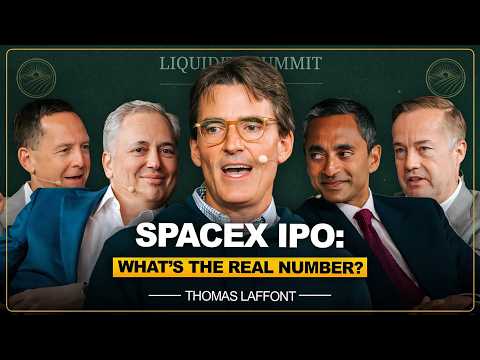
“Disruption is impacting every part of the global economy. And by the way, we don’t even have superintelligence yet.” — Thomas Laffont, 18:11
Clip command
yt-dlp --download-sections "*18:05-18:35" "https://www.youtube.com/watch?v=UIoV8rG_25s" --force-keyframes-at-cuts --merge-output-format mp4 -o "no-superintelligence-yet.mp4"The Magnificent 8 vs the Mag 7
“Look at the diversity: SpaceX, Stripe, Anthropic, Databricks, Revolut, ByteDance, Anduril… It represents almost four trillion dollars of value and has really crushed the traditional kind of Mag 7. Almost every single one of these names has outperformed that index.” — Thomas Laffont, 3:31
Clip command
yt-dlp --download-sections "*3:31-4:30" "https://www.youtube.com/watch?v=UIoV8rG_25s" --force-keyframes-at-cuts --merge-output-format mp4 -o "magnificent-8-vs-mag-7.mp4"Anthropic + OpenAI: Bigger Than All of Microsoft by 2028
“These companies passed Workday… Then it was ServiceNow, it was Adobe by the end of the year, Salesforce on the way just in January, now even bigger than Google Cloud and Azure… we estimate that — not only is it bigger than Azure, but by the end of the year could be bigger than AWS and potentially bigger than all of Microsoft by 2028.” — Thomas Laffont, 6:53
Clip command
yt-dlp --download-sections "*6:33-7:25" "https://www.youtube.com/watch?v=UIoV8rG_25s" --force-keyframes-at-cuts --merge-output-format mp4 -o "ai-bigger-than-microsoft.mp4"The Counterintuitive Centacorn 10x
“If you’re a unicorn, the odds of you one day becoming a decacorn are about 8%. If you’re a decacorn… the odds of you becoming a 100 billion dollar company, not much better. 8% to 13%. But how interesting that if you’re a centacorn, 100 billion or more… you now have a 31% chance of having had a 10x.” — Thomas Laffont, 11:53
Clip command
yt-dlp --download-sections "*11:20-12:12" "https://www.youtube.com/watch?v=UIoV8rG_25s" --force-keyframes-at-cuts --merge-output-format mp4 -o "centacorn-31-percent.mp4"Could There Be a Price War Between OpenAI and Anthropic?
“Could we see a price war between OpenAI and Anthropic? As a question, right? If these companies have so much capital, is one of them ever gonna pull a price lever to try and compete with the other?” “Rationally they should.” — David Sacks “They should.” — Chamath Palihapitiya — Thomas Laffont, 30:08
Clip command
yt-dlp --download-sections "*29:47-31:25" "https://www.youtube.com/watch?v=UIoV8rG_25s" --force-keyframes-at-cuts --merge-output-format mp4 -o "openai-anthropic-price-war.mp4"”The Public Market Is the Great Antiseptic”
“It will be the great antiseptic, it will not care about my bullshit presentation… I love that these companies are going to have to face the scrutiny both SpaceX, OpenAI and Anthropic of the market.” — Thomas Laffont, 23:13
Clip command
yt-dlp --download-sections "*23:13-23:50" "https://www.youtube.com/watch?v=UIoV8rG_25s" --force-keyframes-at-cuts --merge-output-format mp4 -o "public-market-great-antiseptic.mp4"Key Points
- Unicorn economy up 70% since Sept 2024 (0:46) — On par with the Nasdaq’s same-period move
- AI rising share of fundraising (1:14) — Multi-year structural trend
- Funding-per-unicorn up 5x since 2021 (1:36) — Fewer new unicorns, each raising more
- 2021 ZIRP cohort is structurally broken (1:59) — 479 unicorns, <20% exited 20 quarters in (vs 80% for pre-ZIRP cohort of 73)
- The Magnificent 8 (3:31) — SpaceX, Stripe, Anthropic, Databricks, Revolut, ByteDance, OpenAI, Anduril; ~$4T total
- Exits are thawing in 2026 (4:32) — Not quite 2021 levels but on a good trend
- SpaceX + Anthropic + OpenAI alone (5:17) — Will exceed the prior 10 years of liquidity combined
- Anthropic just submitted S-1 confidentially (5:17) — Per same-day headlines
- OpenAI/Anthropic revenue eclipsing SaaS giants (6:33) — Passed Workday, ServiceNow, Adobe, Salesforce, Google Cloud, Azure in ~18 months
- Projecting bigger than AWS by year-end; bigger than Microsoft by 2028 (6:53)
- Hyperscalers are funding their own disruption (7:22) — Truly unprecedented capex
- SpaceX framework: cadence drives value, but value-per-launch rises (8:11) — Market is rationally repricing the business-model quality
- Four phases of SpaceX (9:15) — Pre-constellation → ramp → scale → platform (data centers, Moon, Mars)
- Each nation wants its own constellation (9:50) — Recurring revenue per customer
- Anthropic scaling unlike anything ever seen (10:39) — Faster than PC, internet, mobile
- Unicorn → decacorn odds: 8% (11:20)
- Decacorn → centacorn odds: 13% (11:36)
- Centacorn → trillion odds: 31% (11:53) — Counterintuitive jump
- Two companies hit $1T in weeks (12:27) — Vs the historical multi-year journey
- Cerebras case study (12:44) — Years of grind; OpenAI contract quintupled value pre-IPO
- Semis on a generational run (13:31) — Massive outperformance since 2024 All-In Summit
- Memory per user could quintuple (14:23) — AI personalization needs much more memory
- AI ecosystem revenue forecast (15:00) — $140B today, $300B by year-end, doubling in 2027
- Three revenue pillars (15:17) — Consumer (subs × ARPU), Ads (~25% of Meta/Google ads AI-enabled, going to 100%, ~$150B), Enterprise (Cloud Code, Codex)
- Starlink eats global telco profit pool (16:13) — $200-400B in play; Nikesh Arora’s profit-pool framework
- Ferrari’s failed electric/autonomous launch (16:36) — Auto franchises being repriced
- GLPs reshape consumer (17:07) — Food, alcohol, diet composition, wellness
- Lockup mechanics: T+1 won’t work anymore (23:45) — Massive passive buying; real price discovery only at six-month-plus-one
- Anthropic pre vs post Claude 3 (24:28) — One product event “dented the trajectory of almost that entire industry”
- Memory has no TSMC (26:47) — Pricing implication vs ASIC chips
- Sacks extrapolates: what’s the trillion-dollar-to-$10T rate? (27:29) — Chamath: greater than 30%
- Friedberg: durability of earnings is the filter (27:52) — Ben Graham-style analysis applies
- Trading strategy: bot that buys when companies hit $1T (28:46) — Backtest implication
- Top-10 Nasdaq rebalance: 3x in a decade (29:05) — Friedberg’s note
- Will $3-4T of liquidity recycle to California real estate? (29:47) — Sacks’s mausoleum joke
- SpaceX IPO at $1.75T floated as a number (30:08) — Laffont “no clue” if it’s right
- The unanswered question (30:08) — Will OpenAI/Anthropic deploy excess capital in a price war? Sacks and Chamath: “rationally they should”
Mentions
Companies
- Coatue (0:09) — Laffont’s firm; $55B AUM
- SpaceX / Starlink (3:31) — Multi-phase platform thesis; $1.75T IPO valuation floated
- Anthropic (3:31) — S-1 just submitted; Magnificent 8; Claude 3 inflection
- OpenAI (3:31) — Cerebras customer; one of the three mega-IPOs
- Stripe (3:31) — Magnificent 8
- Databricks (3:31) — Magnificent 8
- Revolut (3:31) — Magnificent 8
- ByteDance (3:31) — Magnificent 8
- Anduril (3:31) — Magnificent 8
- Workday, ServiceNow, Adobe, Salesforce (6:33) — Surpassed by AI revenue in 18 months
- Google Cloud / Azure / AWS / Microsoft (6:53) — Trajectory targets
- Meta (15:17) — ~25% AI-enabled ads
- Google (15:17) — ~25% AI-enabled ads
- Cerebras (12:44) — Series B led by Coatue; OpenAI contract 5x’d value
- Ferrari (16:36) — Electric/autonomous launch flop
- Apple (28:46) — First company to hit $1T
- TSMC (26:47) — No equivalent in memory
- Craft Ventures (18:54) — Series A-focused
- Andreessen Horowitz (19:14) — “Indexing venture”
- Palo Alto Networks (0:46) — Public performance example
Products & Technologies
- Claude 3 (24:28) — The product event that “dented” Anthropic’s trajectory
- Cloud Code / Codex (15:17) — Enterprise AI revenue drivers
- Starlink (16:13) — Constellation-as-platform model
- GLPs (Ozempic-class) (17:07) — Disrupting food, alcohol, wellness
People
- Thomas Laffont (Coatue co-founder) (0:00) — Presenter
- Brad Gerstner (Altimeter) (13:31) — Discussed semis with Laffont
- Bill Ackman (21:18) — Cited on venture-style valuations of trillion-dollar companies
- Nikesh Arora (Palo Alto Networks CEO) (16:13) — Profit-pool framework reference
- Lina Khan (27:09) — “The wrath of Lina Khan” on monopoly extrapolation
- Ben Graham (27:52) — Friedberg’s framework for durability filtering
Surprising Quotes
“Why do you think I waited to make my world podcast premiere for All-In? All the ankle biters called and I said no.” — Thomas Laffont, 0:00
“We’re in an idea business, and when you have a truly revolutionary idea, it can get really big.” — Thomas Laffont, 0:25
“Anthropic pre-Claude 3 was a completely different company than post-Claude 3, right? So one — one event completely dented the trajectory of almost that entire industry.” — Thomas Laffont, 24:28
“Could we see a price war between OpenAI and Anthropic?… If these companies have so much capital, is one of them ever gonna pull a price lever to try and compete with the other?” — Thomas Laffont, 30:08
“Rationally they should.” — David Sacks on AI price war, 31:21
“If I want to make memory, well there is no TSMC. So what should the memory multiples be versus ASIC chips as an example?” — David Friedberg, 27:00
“Anybody interested in a 40,000 square foot mausoleum? Yes. Protesters not included.” — Jason Calacanis on Sacks’s SF home, 30:00
Transcript
Thomas Laffont: 0:00 Why do you think I waited to make my world podcast premiere for All-In? All the ankle biters called and I said no. I’m just gonna wait. I’m gonna wait till the besties call.
Jason Calacanis: 0:09 Coatue is one of the most successful hedge funds of the last two decades. $55 billion under management. This is their flagship hedge fund.
Thomas Laffont: 0:16 The reason we decided to kind of get into this business is to find great entrepreneurs and find great companies.
Jason Calacanis: 0:21 And they’re looking to raise a whole billion dollars more to invest in AI.
Thomas Laffont: 0:25 We’re in an idea business, and when you have a truly revolutionary idea, it can get really big. I hope to do something a little bit different. Besties, you’ve been on for a couple hours so you can take a break now for a few minutes. Sit back. We are going to show you some slides and we’re going to walk you through really an update on the unicorn economy.
Thomas Laffont: 0:46 So the markets are back. We can see that the unicorn economy on average since September of ‘24 is up 70%. I think that’s intuitive to a lot of us. But what’s even more amazing is that the public market has really made the same move up. So if we look at the share of the unicorn economy of the Nasdaq, which had a significant move up since 2015, it’s really kind of plateaued over the past few years and I think it speaks to the performance of public companies like Palo Alto and others.
Thomas Laffont: 1:14 So AI is dominating fundraising. What’s kind of interesting in this slide is you can see the share continues to increase. So multiple years in a row now that AI is increasing its wallet share of fundraising.
Thomas Laffont: 1:36 But the composition of that funding has changed. If you look at the unicorn factory, which really peaked in the ZIRP era of 2021, we’ve now really normalized at a much lower level, pre-COVID. So mathematically if you put both together, you can see that the funding per unicorn has increased 5x since 2021. So we have fewer unicorns that are each raising more.
Thomas Laffont: 1:59 Now I’m going to spend a minute on this slide because this slide is really about the health of our ecosystem. So the way to interpret this is if you look at the green line, which is the pre-ZIRP era unicorn cohort, of which there’s about 73, you can see that 20 quarters after becoming a unicorn, 80% of them had either raised a new round or exited, which is I would say pretty healthy. Now if we look at the 2021 cohort which is the red line, two things stand out. First that 20 quarters in, you can see less than 20% less had either exited or raised. But look at the number: 479 versus 73 in the prior cohort. So now here comes this new cohort, what we’ll call our 2024 cohort of AI companies, and the key question is what will happen. In the future, which of these cohorts will they resemble the most?
Thomas Laffont: 3:07 So we talked about how AI is concentrating the funding base of unicorns, but what we also see is that top 10 is capturing a significant share of funding. So it’s not just AI companies, it’s a small number of AI companies, which probably makes sense since we know Anthropic and OpenAI are raising massive rounds.
Thomas Laffont: 3:31 And so what I like to think is we kind of have a new index. If we really thought about what the index of the future is, what for now I’ll be able to call the Magnificent 8, but that number’s gonna shrink as these companies go public. The first thing that jumps to my mind is wow, what an incredible group of companies. And look at the diversity: SpaceX, Stripe, Anthropic, Databricks, Revolut, ByteDance, Anduril. We have internet, we have AI, we have fintech, we have space tech. I’d feel pretty comfortable owning this index if I could for the next decade plus. And obviously the performance of this index has been incredible. It represents almost four trillion dollars of value and has really crushed the traditional kind of Mag 7. Almost every single one of these names has outperformed that index.
Thomas Laffont: 4:32 Now, another positive sign is that if we look at the exits, the exits are thawing. So one of the things that we’ve talked a lot about with the Besties over the years is we know the unicorn economy is great at consuming cash, but how much cash is it really returning? We need to have a balance between the amount of cash consumed to the amount of cash returned. That’s how an ecosystem stays in balance. And if we look, 2026 is actually on a pretty good trend. Not quite where 2021 was, but pretty good. And we still have half a year to go.
Thomas Laffont: 5:17 But that doesn’t include three companies that we know will be coming public pretty shortly. SpaceX obviously in the next few weeks, and we know Anthropic just today the headlines hit that they’ve submitted confidentially for their S-1. And if you add up the totality of just those three companies, you can see that it’s basically going to be more than the 10 years kind of combined. Which ultimately means, if you remember and you were there when I presented the first All-In Summit in 2024, we knew our ecosystem was out of balance. We were consuming way more cash than we were returning, which is just a fundamental… balance, and you can see that now, even pre- the liquidity events that I just mentioned, our ecosystem is significantly more balanced and that will continue to improve.
Thomas Laffont: 6:16 Part of it is that the growth rates of OpenAI and Anthropic are unlike anything that we’ve ever seen. So if you look at this chart, just remember this chart starts in January of 2023. That was only a year and a half ago. Just a few months in, these companies passed Workday, a pretty incredible HR company. Then it was ServiceNow, it was Adobe by the end of the year, Salesforce on the way just in January, now even bigger than Google Cloud and Azure.
Thomas Laffont: 6:53 So what can that look like in the future? Well, this is just based on kind of some assumptions and some forecasts, but you can see that we estimate that only — not only is it bigger than Azure, but by the end of the year could be bigger than AWS and potentially bigger than all of Microsoft by 2028.
Thomas Laffont: 7:22 Now these hyperscalers aren’t sitting still; they’re seeing the disruption. But actually, they’re doing more than seeing it, they’re actually funding it. Because if you look at the ChatGPT moment that we know happened, look at how much these companies, the largest in the world, have invested in enabling and creating this change. Truly unprecedented.
Thomas Laffont: 7:50 So, I know SpaceX, a lot of people are going to talk about SpaceX, so I thought I would share a little bit of how we as investors think about SpaceX, so that as you think about whether it’s a stock that you want to own or you just want to seem smart at a cocktail party, you can benefit from our knowledge. The first thing that pops out when we look and study SpaceX is that the number one driver correlated to the valuation of SpaceX is cadence of launches. Which intuitively makes sense. If your business is the launch business, the more you launch, the higher your value should be. So I think we see that in the data.
Thomas Laffont: 8:38 But there’s another fundamentally different ratio that I’m going to point to you, which is: what if we took the valuation and we divided it by the number of launches? What would that look like? Well, you can see it was kind of in a fixed range for a while and then it’s really started to move up. And we believe that markets are rational, and so we started thinking, well, why is it that the market is valuing SpaceX higher on a per launch basis when it’s launching more than when it was just starting out?
Thomas Laffont: 9:00 And my fundamental view and we’ll kind of call this our Coatue framework is that the reason is that the quality of SpaceX’s business model increases the more you launch. So in phase 1, which we call pre-constellation, you’re just trying your rockets. And we know rockets are hard and maybe you have a few government customers and that’s a one-time revenue business and it’s unpredictable. Then you get into your initial ramp and now you might have one constellation. So why is a constellation important? Well, it’s an end market and it’s a recurring revenue business. The more satellites you put up, the more subscribers you have, the more revenue, etc.
Thomas Laffont: 9:50 Now, you can move from ramp into scale. Now you don’t just have one constellation, you have multiple constellations. And ultimately we believe that a wide variety of companies and governments and militaries will want to own their own constellation so they can control their own destiny. So now you move into being a scale business which ultimately becomes a platform. And we know how valuable these platforms are in this technology age. And platform means not only do you have many more customers in your core business, but you also have new businesses. It could be space data centers, it could be the optionality of the moon and Mars and other space applications.
Thomas Laffont: 10:39 Now, we know one defining feature of this era has been how quickly these companies are scaling and if we just look at whether it’s the PC or the internet or the mobile, Anthropic in particular is scaling like no other company that we’ve ever seen.
Thomas Laffont: 10:58 Now this was kind of an interesting analysis and this is one I’m curious to kind of discuss with the besties, but we looked at essentially three buckets of companies. And we said okay within each bucket, what is the likelihood that you will have a 10x, which I would view as an investor, maybe not a seed investor like J-Cal, but for us as growth investors, wow, a 10x is pretty good. They’re hard to find. So the data showed us that if you’re a unicorn, the odds of you one day becoming a decacorn are about 8%. If you’re a decacorn, so that means you’re over 10 billion, the odds of you becoming a 100 billion dollar company, not much better. 8% to 13%. But how interesting that if you’re a centacorn, 100 billion or more, the odds and by the way we’re putting in public and private companies, you now have a 31% chance of having had a 10x. This kind of flies, in my opinion, in different than maybe what we would have expected.
Thomas Laffont: 12:12 And if we look at how quickly these companies are creating value, this is a chart that I kind of added at the last minute because the data is so fresh, but you can see it typically takes multiple years to go from 500 billion to a trillion of market cap. Well, something happened very recently in the public markets, which is that not only did we have three companies do it in the same year, but we had two companies do it in a matter of weeks. So we can talk about what conclusions to take from that.
Thomas Laffont: 12:44 Now, even as these companies were scaling incredibly quickly from 500 billion to a trillion, we had other companies take a long time to succeed. And this is a company called Cerebras that just went IPO, so I thought it’d be a good candidate. I was very proud to be a board member for a long time and led the Series B. But if you look at the company’s funding history, you can see why I put the little construction icon, that it took a long time and there were some dark periods, multiple years of no new capital, of hard grind to develop their technology, all of that time leading up to a massive OpenAI contract, which then quintupled the value of the company.
Thomas Laffont: 13:31 But we know Cerebras has been successful and frankly, it’s not just Cerebras, Semis are on a generational run. I was just talking about this with my friend Brad Gerstner earlier. This is just since 2024, the All-In Summit. You can see how much the semiconductor industry has outperformed the index.
Thomas Laffont: 13:55 What will happen in the future? Well, one takeaway from having listened to a lot of speakers this morning is that there seems to be wide agreement that the more an AI system knows about your business or you as a user, the more useful it is. You want to know when you go and book a restaurant that it knows already your preferences, whether it’s what time you like to eat or what food you like to have, etc. So we think ultimately that in this era, the amount of memory per user could quintuple just based on the demand that these AI systems are requiring to provide their services. That helps explain why we’ve seen some of these moves in these memory companies.
Thomas Laffont: 14:44 And then I want to finish on a point that I think has a lot of controversy, which is where’s the revenue? If we remember over the past 12 to 24 months, there’s been a lot of discussion about is there revenue, is there ROI, where’s this associated with? So we tried to look and say okay, what is the size ultimately of the AI ecosystem? We believe that it’s about 140 billion today, it’ll be about 300 billion this year, and it’ll double in 2027. So where is that revenue coming from?
Thomas Laffont: 15:17 Well, if we break it down we can see we kind of estimate three key pillars to this industry. One we know, consumer. Number of subs times an ARPU, that gives you your consumer revenue. One that I think a lot of people forget, but it’s ads. We estimate currently that about a quarter of the ads served by Meta and Google are AI enabled. We think that penetration will eventually go to 100%. That’s 150 billion. And then obviously we all know about the breakthroughs in enterprise and what Cloud Code and Codex are doing inside of those businesses. So if you add all these together, you get a good sense of the size of this ecosystem.
Thomas Laffont: 16:00 So, this’ll be kind of my second to last slide. One thing that’s different to me about this era versus the prior eras in which I was an investor is that almost every sector of the economy is being transformed at the moment. So we know some of the obvious ones, software, but look at Telco. I believe that within a few years Starlink will power a device which will actually enable you to make a phone call anywhere in the world. And we think that’s a solved problem but every time we get a drop call we get reminded that there’s a better technology out there. So back to Nikesh’s framework on profit pools, I think the Starlink profit pool is the Telco global profit pool of broadband and wireless.
Thomas Laffont: 16:36 We know compute is driving massive changes in semis. We had senators earlier on telling us how data centers have changed the energy equation in Pennsylvania. Just think about the auto business, I’m sure a lot of us followed what happened to Ferrari last week trying to introduce a new technology of electric and autonomous, begging the question of what is the future of that franchise in an autonomous and electric world and I think the response to that car kind of fed into this narrative.
Thomas Laffont: 17:07 And then obviously in consumer we know GLPs are having a profound impact on consumption of food, alcohol, composition of diet, and a huge focus kind of on wellness.
Thomas Laffont: 17:23 So, if we put all that together, what are our takeaways? Well, my first takeaway is that the new unicorn economy is healthier. And we really have kind of AI to thank for that. The winners are compounding faster than ever before. Ever, which means the costs of not being in a winner are higher than ever. Disruption is impacting every part of the global economy. And by the way, we don’t even have superintelligence yet. So if I think that it was about two years since my last All-In summit, I started thinking, well gee, what could this look like in two years? And we know it’s going to be a really interesting time and thankfully, we have a great group to help us navigate what the next two years will look like.
Jason Calacanis: 18:32 We’re going to give this a title: the power law rules our lives. All the great gains are being consolidated into a small number of companies, but we’re still seeing strength in those. How do you see the private market ecosystem, the game on the field, evolving because of the stay-private-longer and these extraordinary outcomes? Obviously, I operate at the earliest stages. You have people who are doing Series A’s like Craft Ventures. You have yourselves dipping down into private, but I was talking to Brad Gerstner who you discussed earlier. He was like, ‘I have to figure out where to put my time.’ You know, we have early stage and they do obviously public like yourself. And then add to that, you have people like Andreessen Horowitz maybe going for the average in a major way and indexing venture. What — what is the playing field going to look like for people who are LPs, angel investors, venture firms? How does this all sort out into a cohesive strategy over the next decade or two because it’s clearly the private markets are operating much differently than the playbook 20 years ago.
Thomas Laffont: 19:51 Yeah, so I think the first breakdown I would — I would submit is on the positive side of the ledger, the outcomes are big, right? We’re seeing outcomes that we never thought possible in private companies, and I think that’s good just generally for our ecosystem. So we have big outcomes. It’s really why I wanted to kind of show that SpaceX slide. It was somewhat counterintuitive to me on the launch business, why is it that the company would be valued more as it launched more? So I think at least we have a number of big outcomes and those outcomes will be public within, it seems like, a twelve-month period. So if I think about, you know, the ZIRP era where the outcomes were smaller and companies were not going public, I think at least in this era, we have big outcomes and a desire of these companies to go public, right? I think both Anthropic and OpenAI are both publicly saying that they want to be public, so I would say that’s good. I’d say the biggest issue is — the — it seems like we’re talking about K-shape and power law in every aspect of life, and it seems like that’s the case in startups as well. So we’ve seen, if you looked at my centicorn slide, we’ve really kind of been stuck.
David Friedberg: 21:00 Look at this number for a little bit now. So I think J-Cal, I think the point that you’re asking is if we were to see no new centacorns, right, in the next decade, we basically not really seen any new ones in the past couple of years, I think that’s going to be a warning sign kind of for us.
Jason Calacanis: 21:18 What does this mean for where capital allocators should be thinking about putting their money? Because what you’re showing here, a rational person who’s an LP would just say, wait for whoever gets to 100 billion and YOLO every dollar you can in there because it’s the most sure thing, it’s the least brittle, it’s the least amount of effort and it’s the quickest return. But as we know, supply demand equals valuation, these valuations are disconnecting from any valuation metric we’ve ever had. We had it explained to us today by Bill Ackman, I think, quite accurately. You’re making venture investments in trillion-dollar companies and giving them 50 times revenue, 100 times revenue valuation. So talk a little bit about where people should rationally as a limited partner, as a private investor, a high net worth individual, ultra high net worth, where should they be putting their money to work? And do you worry about this everybody racing to be in three names?
Thomas Laffont: 22:22 Yeah, look, that obviously was the right strategy for the past five years. The question is about the next five years.
Jason Calacanis: 22:38 No, absolutely not.
Thomas Laffont: 22:40 Right? So I think we have to, I remember the bubble in 2000, I also remember 2021, right? These are companies generating substantial revenue at scale that are growing faster than anything we’ve ever seen. So, you know, these businesses are real in their performance and I think it was widely shown that Anthropic even had a profitable month, I believe is what was reported. So, you know, they’re also kind of profitable. But ultimately, and I think Chamath, you agree with this, the public market is the great test…
Jason Calacanis: 23:04 Correct.
Thomas Laffont: 23:05 Right? So the one pushback I would have just on the valuation argument is these are not fake companies.
Chamath Palihapitiya: 23:09 Equalizer.
Thomas Laffont: 23:11 Yes.
Chamath Palihapitiya: 23:12 The scale.
Thomas Laffont: 23:13 It will be the great antiseptic, it will not care about my bullshit presentation or, you know… And so I love that. I love that these companies are going to have to face the scrutiny both SpaceX, OpenAI and Anthropic of the market, right? And ultimately, I’m a big believer in the market. And so I’m very excited to see these companies go public, withstand the scrutiny of short sellers, pontificators, debaters, politicians, kind of etcetera.
Jason Calacanis: 23:45 Let me ask you two questions on that. The first is very tactical which is normally we would say that the antiseptic or the disinfectant happens on T equals one day, right? Now the rules are changing, there’s going to be a lot of passive buying…
David Friedberg: 24:00 So it’s going to move out that date because you’re going to have to wash through a lot of supply demand. So that’s — that could maybe —
Thomas Laffont: 24:06 Six month plus one.
David Friedberg: 24:07 Six month plus one is when you’d say we can really start to get a sense of what these companies are. Okay, so that’s a tactical question. The more strategic question, Thomas, is do you think that there’s something structurally inefficient or wrong that’s allowing these compounders to accelerate at scale? Like, is that a market efficiency problem, or do you think that’s just a survivor bias and we shouldn’t look too much into that? How do you look at that?
Thomas Laffont: 24:28 I don’t want to read too much into it because the N of those companies is so small and look at Anthropic, right? Anthropic pre-Claude 3 was a completely different company than post-Claude 3, right? So one — one event completely dented the trajectory of almost that entire industry. So it’s hard for me to know whether that’s truly, you know, whether these companies were like the Mule in the Foundation series, something that could never be predicted and just came out of nowhere and it was just a one-time thing. You know, we’ll see. I do think that the narrative of, ‘Oh, these models are commodities and these companies are going to get…’ I think that’s been pretty thoroughly disproven now, right?
David Friedberg: 25:13 How do you as Coatue, you know, your asset base has swelled, you’ve gone into — you’ve expanded strategy, you’re now doing, you know, data centers, you’re doing many things. How do you keep it all organized when maybe a slide like that would say, ‘Hold on a second, maybe we should have just plowed $10 billion into Anthropic?’ Like, how do you balance that?
Thomas Laffont: 25:34 But the — the reason I — I make a deck like this, and in some ways I should thank you guys, because when we — when I do something like this for you guys, and it is tremendous amount of time from myself and our team and we really want to present you with accurate information. So the past two weeks has pretty much been a full-time job doing this. But for me, it re-anchors my conviction around what to do. You know, I — I can’t go and listen to a thousand people and then I get distracted and I — I don’t know what I’m thinking anymore. So going back to these ground truths of numbers and valuation bring me back to a point of, okay, conviction, right? So for me, whenever I try and understand the world, I go back to, okay, what do I understand? I understand models, I understand numbers. Let me go back and kind of peel this out. What I think hopefully the deck will show is, look, there is substantial reasons for why, right, if you look at the — the trillion-dollar companies that became trillion-dollar companies in a matter of weeks, these are not fake companies. Like these companies have been around for decades, right, and they trade at the lowest multiple of earnings of the S&P 500 of almost any other company.
David Friedberg: 26:44 A lot of pent-up energy there that just got released.
Thomas Laffont: 26:47 Correct. And now it’s like well, someone made a point to me on — on — you’ll like this, on memory, right? They said, ‘Well, if I want to design a chip like OpenAI, I can go to TSMC.’ And I know it’s hard, but at least I have TSMC to help me.
David Friedberg: 27:00 If I want to make memory, well there is no TSMC. Right. So what should the memory multiples be versus ASIC chips as an example?
Jason Calacanis: 27:09 The wrath of Lina Khan can be seen clearly in this, and Sacks, I want to get your input into how policy and elections matter when it comes to outcomes.
David Sacks: 27:18 As I saw, I don’t know if it was this chart, but the chart where you show the odds of each category reaching the next level…
Jason Calacanis: 27:27 Would you have predicted that out of curiosity?
David Sacks: 27:29 No, it’s very counter-intuitive. Where my mind went was extrapolating one more, which is what are the odds that the trillion dollar market cap companies get to 10?
Jason Calacanis: 27:36 Yeah.
David Sacks: 27:37 And the last one was 31%. I mean, it seems to me what would it be, like 50%?
Jason Calacanis: 27:42 100%?
Thomas Laffont: 27:43 100%? I don’t know.
Chamath Palihapitiya: 27:45 It seems to me, and I’m thinking, is it going to be greater than or less than 30? And it seems to me it’s greater than 30% are going to hit that.
David Friedberg: 27:52 It’s probably the filtering mechanism of what’s the compounding advantage or the durability of earnings of that company. And for every step, you have a filter that says, do you have a compounding advantage? Do you have a stronger durability of earnings? And if so, you’re going to accelerate to the next phase. It’s almost like fundamental to business valuation analysis, like Ben Graham style analysis.
Thomas Laffont: 28:16 To get to that level, let’s call it the trillion dollar club, you have to have a dominant business. And then the question is just at what point do you hit saturation? And it seems like all of these markets have ended up being so much bigger than anyone would have predicted.
David Friedberg: 28:31 And monopoly or government intervention. Because fundamentally, if you think about the break up of the Bell system, I mean, who knows where that would have gone over time? They could have had a monopoly on the internet, they could have had a monopoly on commerce, they could have had a monopoly on e-commerce, and on and on and on.
Thomas Laffont: 28:46 But as a trading strategy, what you’d like to do is have a bot that just starts buying up shares of a company once it hits one trillion. And actually, if you had done that, I mean, a lot of the… I mean, I remember who was the first company to hit a trillion? Was it Apple?
David Friedberg: 29:03 I believe so.
Thomas Laffont: 29:04 Yeah, and then everyone was like, ‘Oh my God, wow!’ And now there’s what, like five or something?
David Friedberg: 29:05 But what was that study that showed, if you bought — I’m sorry to interrupt — but if you bought the Nasdaq over a 10-year period, you get like a 3X multiple or something quite significant if you just rebalanced every year on the top 10 companies in the Nasdaq. So just buy the top 10 companies by market cap, and you outperform over a decade by like 3X.
Jason Calacanis: 29:21 Yeah, Thomas, why didn’t you do that? What is your… maybe just the last question so we make sure we wrap up about something that I think you’re uniquely positioned to tell us. What happens when all this money gets distributed back? Like what do you think happens to your competitive dynamics? What do you think happens to entrepreneurial dynamics? What happens in Silicon Valley when three or four trillion dollars gets put back to GPs, then to LPs, and then the recycling happens?
Thomas Laffont: 29:47 Well, the first thing that comes to mind is I remember when David was so bearish California real estate. We’ll see whether this influx of capital… time to sell… San Francisco.
Jason Calacanis: 30:00 A home for sale? Yeah, the one by the mausoleum. Anybody? Anybody? Anybody interested in a 40,000 square foot mausoleum? Yes. Protesters not included.
Thomas Laffont: 30:08 The one thing I’ll say on SpaceX. And look, I don’t know whether 1.75 is the right price for the IPO and, you know, frankly, I have no clue. What I do know is that the global profit pool of Telco and service providers across the world is anywhere between 2 to 400 billion depending on who you want to address, right? So you do have to think about a company that just in a core business, which by the way wasn’t even in a couple of years ago, is addressing a profit pool of multiple hundreds of billions of dollars with a substantially better product, right? I think all of us when you think about Starlink, works all the time, no radio towers, you know, etc. So I go back to it and I think it’s hard to know Chamath because we’ve never had anything like this before, right? The ultimate question would be if you look a bit in the, in the ridesharing wars and in food delivery wars, at some point that excess capital was used to have a price war. Right. Could we see a price war between OpenAI and Anthropic? As a question, right? If these companies have so much capital, is one of them ever gonna pull a price lever to try and compete with the other?
David Sacks: 31:21 Rationally they should.
Chamath Palihapitiya: 31:22 They should.
Thomas Laffont: 31:23 So, we might see things that we can’t predict today, right? Where companies might say well I have my 200 billion of cash. Now the issue is they’re spending so much on infrastructure, right, so it’s not obvious, but I do think we’re gonna see some counter-intuitive changes. You guys’ll discuss them on the show every week and hopefully I’ll come back in two years and, and analyze what went right and what went wrong.
Jason Calacanis: 31:49 Honestly I think what should happen is you should come back here every year and we should get the benefit of…
Chamath Palihapitiya: 31:53 Yeah let’s lock it in. We’ll lock it in.
Jason Calacanis: 31:55 4% we’ll pay, we’ll pay for the two weeks of work that’s done.
David Sacks: 31:57 We really, we really do appreciate it by the way.
David Friedberg: 31:58 No, it was great. Yeah.
Chamath Palihapitiya: 31:59 Yeah. It was tremendous. Yeah. And it’s, it’s really great to have you bring that to the audience.
David Sacks: 32:04 It just shows also the power of sometimes slowing down and to meditate on, you know, the actual state of reality and it was incredibly grounding.
Jason Calacanis: 32:14 Incredibly rich coming from you. Incredibly grounding.
David Sacks: 32:17 I think it’s a compliment or an insult, I’m… not enough to tell.
Chamath Palihapitiya: 32:21 Compliment to Thomas.
Jason Calacanis: 32:22 Thank you. I’ll just say thank you to you Chamath for that incredible compliment and for you Thomas for coming. Thanks guys, thank you.