Sequoia's Roelof Botha: Why Venture Capital is Broken & How Great Companies Are Built
Sequoia’s Roelof Botha: Why Venture Capital is Broken & How Great Companies Are Built
Summary
Roelof Botha, managing partner of Sequoia Capital, delivers a wide-ranging interview covering the state of venture capital, Sequoia’s investment philosophy, the firm’s separation from China, and what makes great founders. He makes a striking mathematical argument that the venture industry is fundamentally broken: with $150-200 billion invested annually, the industry needs aggregate exit values north of a trillion dollars per year to deliver even modest returns — equivalent to “40 Figmas a year” — which he calls “return-free risk.”
Botha reveals key Sequoia data points: the Scouts program launched in 2010 (with Jason Calacanis and Sam Altman in the first cohort) has become a 26x fund; Sequoia’s best-ever funds (Venture 12 with Airbnb and Venture 13 with Stripe/Square) were both north of 20x; and companies Sequoia backed as private companies now represent over 30% of the total NASDAQ value. He explains the Sequoia Capital Fund, launched in 2022, which holds shares of portfolio companies beyond their IPOs rather than distributing them to LPs who would immediately sell — generating $6.7 billion in additional gains by simply being patient.
The interview also covers Sequoia’s consensus-based investment process (any partner can veto), the dramatic 98% decline in Chinese startup creation (51,000 in 2018 to 1,200 in 2023), lessons from mentors Doug Leone and Michael Moritz, Don Valentine’s insight that the best investments come from “exceptional people who are not so easy to get along with,” and why Sequoia won’t invest in biotech despite their success with Natera (now $22B market cap from a $1M seed).
Highlights
”Investing in venture is a return-free risk”
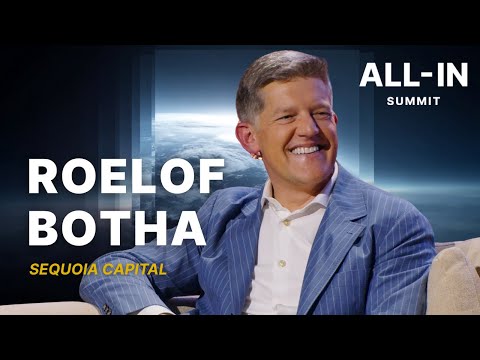
Clip command
yt-dlp --download-sections "*4:49-5:40" "https://www.youtube.com/watch?v=TKtIoF4yLos" --force-keyframes-at-cuts --merge-output-format mp4 -o "TKtIoF4yLos-4m49s.mp4"“You need 40 Figmas a year for the industry to make the returns work, which means that they don’t. So in my opinion, investing in venture is a return-free risk.” — Roelof Botha, 4:49
”Over 30% of the total value of the NASDAQ”
Clip command
yt-dlp --download-sections "*16:03-16:50" "https://www.youtube.com/watch?v=TKtIoF4yLos" --force-keyframes-at-cuts --merge-output-format mp4 -o "TKtIoF4yLos-16m03s.mp4"“The companies in which we were private investors when they were little companies today account for over 30% of the total value of the NASDAQ.” — Roelof Botha, 16:03
”98% reduction in companies founded in China”
Clip command
yt-dlp --download-sections "*10:23-11:05" "https://www.youtube.com/watch?v=TKtIoF4yLos" --force-keyframes-at-cuts --merge-output-format mp4 -o "TKtIoF4yLos-10m23s.mp4"“In 2018 there were 51,000 companies started in China. In 2023 it was 1,200. You had a 98% reduction in the number of companies founded in China.” — Roelof Botha, 10:23
”Exceptional people who are not so easy to get along with”
Clip command
yt-dlp --download-sections "*20:18-21:10" "https://www.youtube.com/watch?v=TKtIoF4yLos" --force-keyframes-at-cuts --merge-output-format mp4 -o "TKtIoF4yLos-20m18s.mp4"“Don Valentine said: people are exceptional or not exceptional, easy to get along with or not so easy to get along with. Roelof, we normally make money in one of those four quadrants. Your job is to figure out which one. And it’s the exceptional people who are not so easy to get along with.” — Roelof Botha, 20:18
”$6.7 billion in gains by doing nothing except being patient”
Clip command
yt-dlp --download-sections "*18:00-18:40" "https://www.youtube.com/watch?v=TKtIoF4yLos" --force-keyframes-at-cuts --merge-output-format mp4 -o "TKtIoF4yLos-18m00s.mp4"“Since we launched this 3 and a half years ago, we’ve accumulated another $6.7 billion in gains by doing nothing except being patient.” — Roelof Botha, 18:00
”Doug showed up at my house with a homemade pesto jar”
Clip command
yt-dlp --download-sections "*22:20-23:20" "https://www.youtube.com/watch?v=TKtIoF4yLos" --force-keyframes-at-cuts --merge-output-format mp4 -o "TKtIoF4yLos-22m20s.mp4"“I was really having a lot of self-doubt and Doug showed up at my house with a homemade pesto jar. He just wanted to tell me that he was there to support me through this dark period.” — Roelof Botha, 22:20
Key Points
- Sequoia Scouts Program (1:08) - Launched 2010 with Jason Calacanis (helped source Uber) and Sam Altman (helped source Stripe); now a 26x fund
- Best Funds in History (3:18) - Venture 12 (Airbnb, Dropbox) and Venture 13 (Stripe, Square/Block) both north of 20x
- VC Industry Math is Broken (3:58) - $200B/year invested needs $1T+ in exits; only about 20 companies per decade get billion-dollar exits
- Return-Free Risk (4:49) - Botha’s term for the venture industry overall; more money doesn’t create more great founders
- Too Much Money, 20 Years Running (5:47) - This problem has persisted for 20 years and Botha sees no fix
- Sequoia Stays Small (7:41) - Chose not to build a big organization; as many developers as investors building internal tools
- AI-Powered Deal Analysis (8:30) - Internal app summarizes business plans, rates teams, analyzes competitive dynamics
- China Separation (9:21) - Separated China business into independent Hongshan over 2 years ago
- China Startup Collapse (10:23) - 51,000 companies started in China in 2018 dropped to 1,200 in 2023 — 98% reduction
- AI Regulation Warning (10:44) - China’s collapse is a warning sign for US AI policy; uncertainty represses entrepreneurship
- Private Partnership in Perpetuity (12:28) - Sequoia structured to never go public; each generation passes partnership without charge
- Consensus Investment Decisions (13:49) - Every partner must agree; one person can veto any investment
- 30% of NASDAQ Value (16:03) - Companies Sequoia backed as private companies now represent 30%+ of total NASDAQ market cap
- Sequoia Capital Fund (16:20) - Launched 2022 to hold shares post-IPO; $6.7B in additional gains through patience
- Don Valentine’s 2x2 Matrix (20:18) - Best returns come from exceptional people who are not so easy to get along with
- Doug Leone’s Heart (22:00) - Showed up at Roelof’s house with pesto during his valley of despair; showed up when his son was hospitalized
- Michael Moritz’s Imagination (23:15) - Imagined Yelp stickers in restaurant windows 10 years before it happened
- Natera: $1M to $22B (26:26) - Seed investment of $1M in 2007 now worth $22B market cap
- No Biotech Expertise (27:06) - Despite Natera success, Sequoia won’t invest in biotech because they lack MD PhDs
Mentions
Companies
- Sequoia Capital (0:04) - Over 1,000 investments worth trillions in public market value
- Stripe (2:57) - Sourced via Scout program through Sam Altman; in 20x+ Venture 13 fund
- Uber (2:51) - Sourced via Scout program through Jason Calacanis
- YouTube (0:26) - Roelof wrote the deal memo; acquired by Google for $1.6B; standalone would be $400-500B
- Airbnb (3:19) - Part of Sequoia’s best-ever Venture 12 fund
- Figma (4:49) - Recently went public at $25-26B; used as benchmark for industry return math
- Apple, Nvidia, Google, Cisco (16:15) - Part of Sequoia’s 30%+ of NASDAQ portfolio
- Palo Alto Networks, ServiceNow, HubSpot, MongoDB (16:40) - Recent 10x+ public company compounders
- Natera (26:26) - $1M seed in 2007, now $22B; leading prenatal and oncology testing
- Bridge Bio (27:00) - Sequoia investment in rare genetic disease drug development
- Hongshan (10:15) - Independent business that was formerly Sequoia China
- General Catalyst (7:21) - Referenced as example of VC firm industrialization
People
- Roelof Botha (0:04) - Managing partner of Sequoia Capital
- Don Valentine (12:48) - Sequoia founder; backed Steve Jobs; created the 2x2 matrix of exceptional founders
- Doug Leone (22:00) - Sequoia legend; taught Roelof about heart and supporting people in dark periods
- Michael Moritz (23:15) - Sequoia legend; had unbelievable imagination; stepped back in 2012 for health reasons
- Sam Altman (2:55) - Was in first Sequoia Scouts cohort; helped source Stripe investment
- Jason Calacanis (1:19) - First Sequoia Scout; helped source Uber investment
- Steve Jobs (20:50) - Don Valentine backed him when he walked Sand Hill Road without shoes
- Peter Thiel (24:45) - Quoted: when an acquisition happens, one side was orders of magnitude off
- Jack Dorsey (18:58) - “Companies have multiple founding moments” — Cash App came 5 years into Square’s life
- Jeremy Stoppelman (23:40) - Yelp co-founder; Moritz imagined Yelp stickers in restaurant windows years before reality
Surprising Quotes
“More money doesn’t create more great ideas or more great founders. So, I think there is way too much money in the industry.” — 5:25
“We literally want to be the best net IRR and net multiple for our LPs and we’re not interested in maximizing fees or maximizing share of industry value creation.” — 12:11
“Every single time my mistakes come down to a failure of imagination, that I didn’t think big enough.” — 23:25
“It’s very dangerous when people think that your success in one domain naturally gives you the right to compete in other domains.” — 27:15
“He backed Steve Jobs when Steve would walk around Sand Hill Road without shoes. He’d come back from a trip to India. Allegedly, he didn’t smell too great.” — 20:50
Transcript
0:04 Sequoia is the most sought-after name in the venture capital business. The firm has made over a thousand investments now worth in the trillions in public market value. There’s a list of five VCs who I think can really transform a company and you’re one of those five. When I joined Sequoia, it was clear that if I wanted to make it as a partner, you needed to produce meaningful wins. YouTube, Instagram, Square. Our ambition is to build a partnership that endures and that means we need to leave it in a better place than we found it.
1:08 Everybody wants to know who’s your favorite Sequoia Scout of all time. Jason Calacanis. You came to me 15 years ago and said, “I have an idea for a program called Sequoia Scouts.” We conceived of this program in 2010. The idea was that there were contemporary founders who had interesting access to up-and-coming founders. You were in that program, you helped us with the investment in Uber. Sam Altman was in that group as well. He helped with an investment in a little company called Stripe. So at this point that fund is a 26x fund.
3:18 What’s the best fund in the history of Sequoia? I think Venture 12, which has Airbnb, Dropbox, and a couple of other companies. And then Venture 13 which has Stripe and Square. Those were both north of 20x funds.
3:58 Tell us about the venture industry. I’m glad you called it an industry, not an asset class. There’s a huge problem: there’s too much money. The venture industry invests between $150 to $200 billion a year. If you think about reasonable assumptions for returns, 12% per annum net, the math implies you need 3.5 to 4x funds. So the industry needs to give back $700-800 billion a year. VCs don’t own 100% of the company, so the aggregate exit value is north of a trillion a year. Figma went public at $25-26 billion. You need 40 Figmas a year for the industry to make the returns work.
5:03 So in my opinion, investing in venture is a return-free risk. If you look at every single decade, there are only about 20 companies that end up getting exit values north of a billion dollars. Actual IPOs or M&As. Not paper write-ups. More money doesn’t create more great ideas or more great founders. There is way too much money and too many people who want to be investors.
7:21 How has Sequoia reacted to the industrialization of venture capital? We’ve decided to not build as big an organization. Most of the operating teams we have at Sequoia help us. We have about as many developers as we have investors and they’re building products for us so that we are much more effective and productive.
8:30 On my phone I can pull up an app that tells me who my team last met, how we rated any company, data on their hiring, how many vouched employees they have, how good their engineering team is. If we get business plan submissions, we have an AI system that summarizes it with a quick analysis of team quality, competitive dynamics, and comparable companies.
9:21 When we first went into China, it was 2007. The world was flat. China gained admission to the World Trade Organization in 2001 and we all believed it would integrate into the global economy. That premise proved wrong. We embarked on global separation just over 2 years ago and what used to be China is now an independent business called Hongshan.
10:23 There’s a real challenge in China right now. In 2018 there were 51,000 companies started in China. In 2023 it was 1,200. A 98% reduction. If you’re an entrepreneur in China, why would you want to start a company when government regulations are so uncertain? Which is an interesting warning sign for us in America as we think about AI policy. The more uncertainty we create for founders, the more difficult it is for them to take that leap.
11:53 We stick to our knitting. Our funds today are no bigger than they were 5, 6, 7 years ago. Our aspiration is to be the number one investment manager for our limited partners. We literally want to be the best net IRR and net multiple and we’re not interested in maximizing fees. We’ve structured ourselves to be a private partnership in perpetuity. Don Valentine didn’t call it Valentine Ventures when he started it. He handed the partnership over to the next generation. We didn’t have to pay to get it and nor will we charge the next generation.
13:08 How would you describe the culture? The most important characteristic we look for is an insatiable curiosity. We look for people who are extremely driven but they need to have a heart of gold. We cherish individualism and teamwork. When you make investment decisions at Sequoia it’s a consensus decision. Everybody has to agree. One person can veto an investment.
15:23 Can you tell us about the holding company transition? True compounders compound for decades. Amazon, Nvidia was a Sequoia investment, Google — these are multi-trillion dollar companies. The companies in which we were private investors today account for over 30% of the total value of the NASDAQ. Apple, Cisco, Nvidia, Google, Palo Alto Networks, ServiceNow, the list goes on.
16:20 In 2022, we launched the Sequoia Capital Fund. We realized that when we distribute shares prematurely to LPs, they don’t know any better, they sell. So for companies that we believe can compound longer term, 6-12-18 months after the IPO, we move those shares into this fund. Since we launched this 3.5 years ago, we’ve accumulated another $6.7 billion in gains by doing nothing except being patient.
20:18 Don Valentine pulled me aside in the early days. He drew a 2x2 matrix: people are exceptional or not exceptional, easy to get along with or not so easy to get along with. We normally make money in one of those four quadrants. And it’s the exceptional people who are not so easy to get along with. This is a guy who backed Steve Jobs when Steve would walk around Sand Hill Road without shoes.
22:00 What did you learn from Doug Leone and Michael Moritz? From Doug, I learned heart. In 2009 I was in a funk, I nearly quit the business. I’d had YouTube as a great success but then the valley of despair. Doug showed up at my house with a homemade pesto jar on a Saturday afternoon. He just wanted to tell me he was there to support me. Another time my son was in hospital and Doug showed up. Didn’t have to.
23:15 From Michael, it’s imagination. Michael just has an unbelievable ability to imagine how a company can succeed. Every single time my mistakes as an investor come down to a failure of imagination. I remember an early meeting with Yelp and Michael said, “I imagine that one day restaurants will put a Yelp sticker in the window just like a Zagat or a Michelin star.” He saw that 10 years before it became a reality.
26:06 Does life sciences work as a venture investment? We made a seed investment of a million dollars in 2007 in Natera. It’s a $22 billion market cap today. They’re the leading provider of prenatal testing, oncology recurrence monitoring, organ transplant testing. But we don’t have the expertise for biotech. We have no MD PhDs on our team. I think it’s very dangerous when people think that your success in one domain naturally gives you the right to compete in other domains. Ladies and gentlemen, Roelof Botha.