Inside Orlando Bravo's Private Equity Playbook: How to Build a Top Firm
Inside Orlando Bravo’s Private Equity Playbook: How to Build a Top Firm
Summary
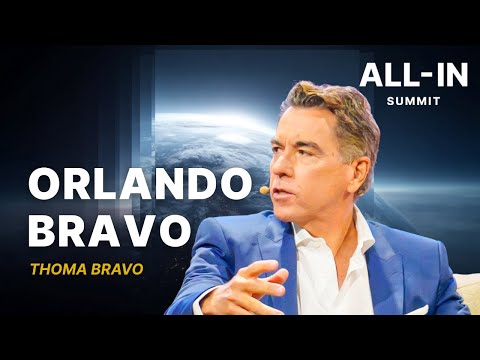
Orlando Bravo, founder of Thoma Bravo, sits down with the All-In hosts at their summit to discuss how he built one of the most successful private equity firms in history. Starting from a small town in Puerto Rico, Bravo shares his journey from being nearly fired by his mentor Carl Toma after the dot-com bust to building a firm that now manages nearly $200 billion in assets and has owned over 500 software companies. He raised $34.4 billion in a single fundraise and returned $13 billion to investors in a single year.
The conversation covers Thoma Bravo’s distinctive approach to software buyouts: keeping the team small (230 people), buying only 10-12 companies per fund, and focusing on turning “great innovators into great businesses” through operational improvements. Bravo explains the firm’s playbook of acquiring public software companies trading at revenue multiples, cutting 15% of costs at closing, and transforming them into profitable growth businesses targeting 50% margins. He also discusses the $10.5 billion acquisition of Boeing’s Jeppesen avionics business and the risks AI poses to SaaS companies.
The interview concludes with Bravo’s thoughts on why Thoma Bravo will remain private rather than going public, his commitment to mentoring the next generation of partners, and his personal view that Puerto Rico should become the 51st U.S. state.
Highlights
”The industry is taken”
Clip command
yt-dlp --download-sections "*5:50-6:50" "https://www.youtube.com/watch?v=R1q4wcV-ImY" --force-keyframes-at-cuts --merge-output-format mp4 -o "R1q4wcV-ImY-5m50s.mp4"“I got one interview with one of the largest private equity firms at the time and the head of the firm said, ‘There’s not much opportunity in our industry anymore and the industry is taken.’ Now our firm is multiples bigger than they are.” — Orlando Bravo, 5:50
”The deal’s not in the office”
Clip command
yt-dlp --download-sections "*7:35-8:35" "https://www.youtube.com/watch?v=R1q4wcV-ImY" --force-keyframes-at-cuts --merge-output-format mp4 -o "R1q4wcV-ImY-7m35s.mp4"“If you have too big of a team, you become internally focused and start dreaming about conversations internally. The deal’s not in the office, the company’s not in the office, and the buyer of your company’s not in the office. So, you always have to be outward facing.” — Orlando Bravo, 7:35
”Carl Toma was going to fire me”
Clip command
yt-dlp --download-sections "*11:46-12:40" "https://www.youtube.com/watch?v=R1q4wcV-ImY" --force-keyframes-at-cuts --merge-output-format mp4 -o "R1q4wcV-ImY-11m46s.mp4"“Carl Toma was going to fire me and this is also true. He talked about it in his 70th birthday and he gave me another chance and I said, ‘Okay, I’m not good at what we were doing then. I’m gonna go for existing management, really established companies and software.’” — Orlando Bravo, 11:46
”There is a big risk of AI in this business”
Clip command
yt-dlp --download-sections "*13:46-14:30" "https://www.youtube.com/watch?v=R1q4wcV-ImY" --force-keyframes-at-cuts --merge-output-format mp4 -o "R1q4wcV-ImY-13m46s.mp4"“There is a big risk of AI in this business. I mean in a big big way. There’s so many verticals that are going to get disrupted, there’s so many areas that are very confusing and you don’t want to touch, so it limits the space significantly.” — Orlando Bravo, 13:46
”Eliminate the reason for the call altogether”
Clip command
yt-dlp --download-sections "*21:20-22:20" "https://www.youtube.com/watch?v=R1q4wcV-ImY" --force-keyframes-at-cuts --merge-output-format mp4 -o "R1q4wcV-ImY-21m20s.mp4"“Many people look to offshore support and now maybe AI would get on that. What we say is eliminate the reason for the call altogether because there’s nothing you can do in product.” — Orlando Bravo, 21:20
”Puerto Rico should be a state”
Clip command
yt-dlp --download-sections "*27:40-28:40" "https://www.youtube.com/watch?v=R1q4wcV-ImY" --force-keyframes-at-cuts --merge-output-format mp4 -o "R1q4wcV-ImY-27m40s.mp4"“I’m going to say something I’ve never said before. I do believe it’ll be better for Puerto Rico to be a state if the US would allow that.” — Orlando Bravo, 27:40
Key Points
- Thoma Bravo’s Scale (1:55) - Firm manages nearly $200 billion, raised $34.4 billion in one fundraise, has owned 500+ software companies
- Puerto Rico Origins (2:37) - Bravo grew up in a small town in Puerto Rico; his Cuban immigrant mother pushed him to travel and compete in tennis
- Hurricane Maria Response (3:13) - Flew from San Francisco to Puerto Rico the day after the hurricane to deliver food and water to shelters
- Nearly Fired After Dot-Com Bust (11:46) - Carl Toma nearly fired Bravo after mistakes in 1997-2000; pivoted to established software companies
- Small Team Philosophy (7:35) - Only 230 people at Thoma Bravo to stay outward-facing and enable mentorship
- Concentrated Portfolio (16:29) - Buy only 10-12 companies per fund; focus on “buy the best and operate the best”
- Deal Economics (11:08) - Pay 7-8x revenue, finance with 30% debt / 70% equity, target 50% margins
- Cost Cutting at Close (19:24) - Cut 15% of costs at closing, then focus on bookings growth and add-on acquisitions
- Boeing Jeppesen Deal (17:25) - Acquired Boeing’s avionics/Jeppesen business for $10.5 billion; every airline needs it to fly
- AI Disruption Risk (13:46) - Acknowledges big risk of AI to SaaS but believes enterprise adoption will be evolutionary, not revolutionary
- IPO Exit Challenge (15:10) - $10B deals must be sold for $25B to make money; starts 50% in the hole due to premium paid
- Talent Assessment (21:50) - Evaluates leaders on openness, caring about numbers, employee/customer following
- Twitter/X Comparison (20:40) - Elon proved you could cut 85% of Twitter’s workforce and it would still work
- Won’t Go Public (26:16) - Going public doesn’t help get deals, improve returns, or mentor next generation
- Puerto Rico Statehood (27:40) - For the first time publicly states Puerto Rico would be better off as the 51st state
Mentions
Companies
- Thoma Bravo (1:55) - Bravo’s PE firm, nearly $200B AUM, 500+ portfolio companies
- Boeing (17:25) - Sold Jeppesen avionics business to Thoma Bravo for $10.5B
- Jeppesen (17:25) - Boeing’s avionics division; every airline needs it to fly
- SonicWall (8:47) - First Silicon Valley acquisition in 2010 for $550M
- Dynatrace (14:52) - $2.5B deal from Compuware acquisition; sold to NASDAQ
- DayForce (22:55) - Recently announced $12B deal; tracked since 2008
- Blackstone, Apollo, KKR, Carlyle (26:16) - Public multi-strategy PE firms mentioned as comparison
- Twitter/X (20:40) - Referenced re: Elon Musk’s acquisition and workforce cuts
- Pinterest (5:35) - Ben Silbermann started Pinterest after not being hired at Facebook
- Robinhood (5:22) - Vlad started Robinhood after not getting a job at Climate Corp
Products & Technologies
- SaaS (11:08) - Core of Thoma Bravo’s investment thesis; became irreversible around 2005
- AI (13:46) - Recognized as major disruption risk to software PE investments
People
- Orlando Bravo (0:02) - Founder of Thoma Bravo, first Puerto Rican billionaire
- Carl Toma (6:45) - Bravo’s mentor who hired him and gave the company to next generation
- Marcel Bernard (20:18) - Greatest operator Bravo ever met; 35 years at Motorola
- David Sacks (0:51) - Host, helped assess talent during Twitter acquisition
- Elon Musk (20:40) - Referenced for Twitter acquisition playbook
- Holden Spade (22:55) - Thoma Bravo partner who first met DayForce CEO in 2008
- Brian Utko (18:30) - Put in charge of new plane development at Boeing
Surprising Quotes
“Private equity firms, the good ones, definitely beat the public markets. We are in the business of turning great innovators into great businesses.” — 0:20
“No matter how profitable you are, you can always cut 10%. No matter how unprofitable you are, it’s difficult to cut more than 20%.” — 20:18
“Technology is evolutionary, not revolutionary, because our customers are buying this stuff for cost. They want the ROI.” — 14:05
“Now we’re doing $10 billion deals. We have to sell those for 25 to make money. We kind of start 50% in the hole.” — 15:10
“I’ve never created anything new, but I always had my mom who was a Cuban immigrant. The only thing I give myself credit for is at a young age I really listened.” — 4:22
Transcript
0:02 With one of the best track records in private equity, Bravo manages 179 billion in assets, Bravo has grown at a blistering pace. Last year, the firm returned over $13 billion to investors. In 2019, Orlando became the first Puerto Rico born billionaire. Private equity firms, the good ones, definitely beat the public markets. We are in the business of turning great innovators into great businesses. Ladies and gentlemen, please welcome Toma Bravo’s Orlando Bravo.
0:44 See you. Thanks for coming. How are you, David? Good to see you. For those that don’t know, let me just do a couple of data points and then we’ll just jump into the story because Orlando has an incredibly inspiring story. But let me just set the backdrop of what Thoma Bravo is. Thoma Bravo started in 2008, so what is that, 17 years now, and now has just a little under 200 billion which is incredible. But here are the two stats that stunned me: in June you raised $34.4 billion in basically like a set of fund vehicles, which is I want to understand how that is even possible. And then you basically have owned now over 500 companies and many of the big software companies that you know we probably interact with and have to deal with.
2:37 But before we get into all those details, I think what’s inspiring is you are a child of Puerto Rico, a small town in Puerto Rico. How does a guy, from literally the middle of nowhere, get here? How does that happen? Your parents, your family, like how does that happen?
2:55 Well, by the way, thanks so much for having me. That touches my heart that you asked that question because when Hurricane Maria hit Puerto Rico, kind of everything stopped for me because my best friends are there, my family’s there, cousins, my whole upbringing. I got there on a plane the day after from San Francisco. And we had gotten a message from Puerto Rico saying there’s some shelters that had only two days supply of food and water. And there were all these kids and everything else. So we said, “We’ll go from San Francisco and bring you a bunch of food and water and we’ll be there tomorrow.”
4:05 When I landed, three of my best high school friends, one of them asked me, “Oh, now you’re doing all this business stuff. How did that happen?” And I said, “Well, the odds are one of us had to get lucky.” But was that something like your parents gave you? Yes. At every turn, I tell you this, how exactly I got here. I’ve never created anything new, but I always had my mom who was a Cuban immigrant. She was always giving me a road map. She would put me in positions where I would always have to be traveling to San Juan to play tennis. I was lucky that I wasn’t that good to go pro, so I went into business.
5:17 You were also the beneficiary of an incredible mentor. And there’s these great stories. Yesterday we heard Vlad tried to get a job at Climate Corp, couldn’t, started Robinhood. Famously, my HR lead at Facebook introduced me to her then boyfriend Ben Silbermann. We interviewed Ben. We ended up not hiring him. He immediately started Pinterest. And when you graduated from Stanford, you only got one job offer from like a three-person firm basically.
5:49 Yeah, in 1997 there was not much private equity and the venture business didn’t hire a lot of people. I got one interview with one of the largest private equity firms at the time and the head of the firm said, “There’s not much opportunity in our industry anymore and the industry is taken.” Now our firm is multiples bigger than they are. And then Carl Toma hired me. There were a few private equity firms that opened up a position for me to do Latin American private equity. And I’m like, “No, I’ve spent too much time in the south. The money’s in the north. I want to do US buyout tech.”
7:13 And so, tell us about how the decisions you’ve made to build this business. How many people do you have? How do you run 200 billion effectively? So we are very focused on keeping the team very small. We have about 230 people at Thoma Bravo. The reason is if you have too big of a team, you become internally focused. As I always say, the deal’s not in the office, the company’s not in the office, and the buyer of your company’s not in the office. So, you always have to be outward facing.
8:09 I got the benefit of incredible mentorship. I can tell you so many stories about Carl Toma spending time with me in 1998 on the deal we were going to lose. He wanted to teach me how to sell. How do we raise that money? Look, our first deal was 50 million. The second deal was 100 million enterprise value. The third was data at 250 million. We didn’t buy a company in Silicon Valley till 2010. That was SonicWall that we paid 550 million to take private.
9:04 What is the role of private equity in the US economy? I think it’s a great change agent. It’s a business similar to venture where what matters is the returns that you put up and you have incredible alignment with the sources of capital. They give you the money and if you make the return, you can stay in business. These software companies are not meant to be owned by the same group for 30 or 40 years. Management gets tired. It’s exhausting to run.
10:23 What’s fair or unfair about the PE reputation of being too cutthroat? That is 100% fair in the 80s, 90s, and maybe early 2000s. Private equity has nothing to do with that now. About 50% of the private equity deal volume is in technology. If you look at any software deal we’ve done in the last 12-13 years, you’re paying 7-8 times revenue and the financing is maybe two turns of revenue, so you’re putting in five to six turns of equity. If you’re not building and growing that business, nobody’s going to buy it from you.
11:46 After I personally made a lot of mistakes from ‘97 to the internet bubble bursting, Carl Toma was going to fire me. He gave me another chance and I said, “Okay, I’m not good at what we were doing then. I’m gonna go for existing management, really established companies and software.” In 2000, you could buy recurring revenue and software cheaper than in all the other categories. But in 2010, most of our competitors left the business because software became super expensive. So we said, instead of complaining, now we have the wherewithal to buy the best.
13:05 When you sit there with your partners in 2025, is there a risk of SaaS being cannibalized by AI? Our investors don’t love to hear this, but there is a big risk of AI in this business in a big big way. There’s so many verticals that are going to get disrupted. We always say technology is evolutionary, not revolutionary, because our customers are buying this stuff for cost. But we have another equally big challenge: now we’re doing $10 billion deals. We have to sell those for 25 to make money. We kind of start 50% in the hole.
15:23 I asked a friend about you who was competing with you to get the Boeing business and he said Orlando’s incredibly difficult to compete with because he’s so ready to buy the thing he wants to buy and he doesn’t nickel and dime at the edges. 100%. It all fits together with having a small team. We also have a small portfolio. In every fund we’ll buy 10 to 12 companies. We strive for two core competencies: buy the best and operate the best.
17:19 Can you take us behind the Boeing asset? It basically runs — you cannot fly an airplane without Jeppesen and its system. We called the CEO of Boeing, sent him an email saying, “Hey, we could buy this division.” There were about 15 private equity groups involved in the deal. But why would Boeing want to sell its avionics business? I think Boeing is in this incredibly difficult position where they had to make a real rationalization. Getting the 737 Max program back online was a clear bet. But when you do that, you have all kinds of debt that you need to clean out.
19:24 What is the playbook for coming into one of these technology companies? It’s almost always the same. We try to turn what we call a good innovator into a good business. We try to turn a revenue multiple day one, say six or seven times, to an EBITDA multiple in year four. If that company grew 20% and you achieve a 50% margin, you’ve done that. We talk to management very openly and say, “Can you cut 15% of the cost of the company at closing?” If you don’t do that at closing, why are you going to shock the employees afterwards?
21:20 As my mentor Marcel Bernard used to say, he was the greatest operator I’ve ever met, 35 years at Motorola: no matter how profitable you are, you can always cut 10%. No matter how unprofitable you are, it’s difficult to cut more than 20%. We evaluate all that through retention, support margins, and architecture. What we say is eliminate the reason for the support call altogether.
23:15 We recently announced we were doing the DayForce deal for $12 billion. My partner Holden Spade met with the CEO of DayForce in 2008 and we’ve tracked that company for so long. You get so much information to make those choices. For example, a company cannot say it has really good product if its gross margins on support are very low.
26:16 Is there an impetus to go public? Going public does not help any of those things for us. I’m just so grateful for my mentors. Carl Toma gave me and my partners the company. So, we want to do the same thing for the next generation. We actually feel we’ll make more money by investing behind the next generation than by going public.
27:20 You’re the first Puerto Rican billionaire. Should Puerto Rico become the 51st state? It’s such a divided place. The turnouts in elections used to be like 90%. I’m going to say something I’ve never said before: I do believe it’ll be better for Puerto Rico to be a state if the US would allow that. Ladies and gentlemen, Orlando Bravo.