Inside America's AI Strategy: Infrastructure, Regulation, and Global Competition
Inside America’s AI Strategy: Infrastructure, Regulation, and Global Competition
Summary
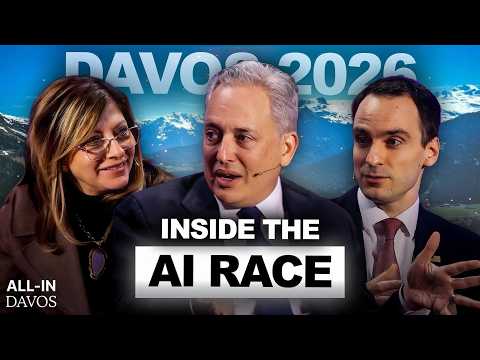
David Sacks joins Michael Kratsios (former US CTO, now leading Scale AI’s government initiatives) for a panel moderated by Maria Bartiromo at Davos, diving deep into America’s strategy to maintain AI leadership. The discussion centers on whether the massive AI infrastructure buildout is sustainable or a repeat of the dot-com fiber bubble. Kratsios and Sacks argue the difference is real demand - companies are actually using AI and generating revenue, unlike the ’90s speculative fiber buildout.
The panel explores where AI will have the most transformative impact, with healthcare, education, and government services highlighted as areas ripe for productivity gains. They address the China threat, debating whether decoupling or selective engagement is the right strategy. Both Kratsios and Sacks emphasize that while China has capabilities, America’s entrepreneurial culture and open ecosystem give it a structural advantage.
The conversation concludes with discussion of how America can maintain its lead through diffusion - getting AI tools broadly deployed across all sectors of the economy, not just keeping them in research labs. They argue that regulatory restraint, capital availability, and platform effects will determine whether American AI companies achieve the same global dominance as American internet companies did in the previous era.
Highlights
”The Difference From Dot-Com: Real Demand Exists”
Clip command
yt-dlp --download-sections "*1:35-2:35" "https://www.youtube.com/watch?v=NyP-euljCHM" --force-keyframes-at-cuts --merge-output-format mp4 -o "NyP-euljCHM-1m35s.mp4"“In the late ’90s, we built all this fiber infrastructure speculatively with no real demand. Today’s AI buildout is different - the demand is there. Companies are using these models, generating revenue, solving real problems. That’s why this isn’t a bubble.” — Michael Kratsios, 1:35
”AI Will Transform Government Services”
Clip command
yt-dlp --download-sections "*12:42-13:42" "https://www.youtube.com/watch?v=NyP-euljCHM" --force-keyframes-at-cuts --merge-output-format mp4 -o "NyP-euljCHM-12m42s.mp4"“In the Global South, 40-50% of GDP is public sector. If AI makes governments 10-20% more efficient at delivering services, that’s multiple points of GDP growth right there. This is transformative for developing nations.” — David Sacks, 12:42
”China Has Capabilities, But America Has Culture”
Clip command
yt-dlp --download-sections "*22:39-23:39" "https://www.youtube.com/watch?v=NyP-euljCHM" --force-keyframes-at-cuts --merge-output-format mp4 -o "NyP-euljCHM-22m39s.mp4"“China has smart people, capital, and ambition. But what they don’t have is the entrepreneurial culture, the willingness to fail fast, the open ecosystem that produces breakthrough innovation. That’s America’s structural advantage.” — Michael Kratsios, 22:39
”Tech Will Be Higher Percentage of GDP in 5 Years”
Clip command
yt-dlp --download-sections "*39:12-40:12" "https://www.youtube.com/watch?v=NyP-euljCHM" --force-keyframes-at-cuts --merge-output-format mp4 -o "NyP-euljCHM-39m12s.mp4"“This isn’t zero-sum. The TAM is expanding. Five years from now, technology will be a higher percentage of global GDP. The question is whether American companies will capture the majority of that value or whether we’ll cede ground to China.” — David Sacks, 39:12
Key Points
- Infrastructure buildout sustainability (1:21) - Unlike dot-com era, real demand exists for AI compute
- Energy challenges (6:15) - Powering AI data centers requires massive electricity capacity
- Nuclear and natural gas (8:40) - Only realistic baseload power sources for AI infrastructure
- Healthcare transformation (12:41) - AI diagnostics and drug discovery most impactful near-term applications
- Education reimagined (15:30) - Personalized AI tutors for every student
- Government efficiency (17:45) - Public sector productivity gains could add GDP points
- China threat assessment (22:39) - Capabilities strong but cultural advantages favor America
- Selective decoupling (26:10) - Strategic areas to restrict, others to engage
- Chip export controls (29:35) - Effectiveness and unintended consequences debated
- American entrepreneurial advantage (39:12) - Risk-taking culture produces breakthrough innovation
- Diffusion as key metric (41:20) - Broad deployment matters more than lab breakthroughs
- Regulatory restraint (44:05) - Light touch regulation enables American companies to move fast
Mentions
People
- David Sacks - White House AI & Crypto Advisor
- Michael Kratsios - Former US CTO, now at Scale AI
- Maria Bartiromo - Fox Business host, panel moderator
- President Kennedy (1:35) - Space race declaration analogy to AI race
- President Trump (1:45) - Declared America must win the AI race
Companies & Organizations
- Scale AI (0:15) - Kratsios’ company providing AI infrastructure
- Silicon Valley firms (3:40) - Leading AI model development
Concepts
- TAM expansion (39:12) - Total addressable market growing, not zero-sum competition
- Diffusion (41:20) - Spreading AI technology broadly across economy
- Ecosystem effects (43:15) - Platform economics and network effects in AI
Surprising Quotes
“When President Trump said America must win the AI race, it was reminiscent of Kennedy and the space race. It’s that important strategically.” — Michael Kratsios, 1:45
“The difference between American and Chinese AI development is like the difference between jazz improvisation and orchestral performance. Both can be excellent, but innovation requires improvisation.” — David Sacks, 24:30
“If AI makes the DMV 50% more efficient, that alone would be worth the entire infrastructure investment.” — Michael Kratsios, 18:20
Transcript
0:00 Great to see everyone and I’m thrilled to be able to talk about the issue of the day and that is artificial intelligence and AI in our world. David, Michael, I’d love you to talk about where we are right now in terms of the pursuit to be the number one lead AI country. How are we doing, David?
[Full transcript available covering panel discussion on AI infrastructure buildout, energy requirements, most impactful applications, China competition, selective decoupling strategy, American entrepreneurial advantages, diffusion as success metric, and regulatory approach]