SpaceX IPO, Iran War Fallout, Quantum Bitcoin Hack, The Space Opportunity
SpaceX IPO, Iran War Fallout, Quantum Bitcoin Hack, The Space Opportunity
Summary
The besties open with the bombshell: SpaceX has confidentially filed to IPO at a $1.75 trillion valuation. Sacks is missing this week, leaving Chamath, Friedberg, and Jason to unpack what may be the largest IPO in history and Chamath’s “99.999%” conviction that SpaceX and Tesla ultimately merge. Chamath argues the IPO is necessary to clean up Tesla’s shareholder lawsuits, give Elon a real mark-to-market, and lay the foundation for “the railroads of space” — a coming explosion of FedExes, Maersks, and waste-management companies of orbit.
Friedberg pulls the conversation upward with Artemis II just having returned humans to the moon, autonomous mining for platinum-group metals on asteroids, and reentering payloads behind 15-cm slabs of moon rock. Chamath warns that the appetite for follow-on IPOs is finite (“the Thanksgiving plate problem”) — SpaceX should go first, OpenAI and Anthropic next, and everyone else is fighting for scraps. The crew also tackles a coming risk to U.S. capital markets if Iran-war disruption pushes Middle Eastern LPs to retreat from American venture and PE.
The episode’s sharpest segments cover the Iran war’s second-order effects — urea fertilizer doubling from $350 to $700/ton, food security risk for hundreds of millions of farmers — and Chamath’s warning that the timeline to a functional quantum chip is no longer 25–30 years and Bitcoin’s leadership must answer whether the network is quantum-resistant. The pod closes with shout-outs to Athena assistants, Friedberg’s Ohalo potato shipments, and Chamath’s recurring TAO/Folding@Home Jensen interview moment.
Highlights
”99.999%” SpaceX-Tesla Merger Bet
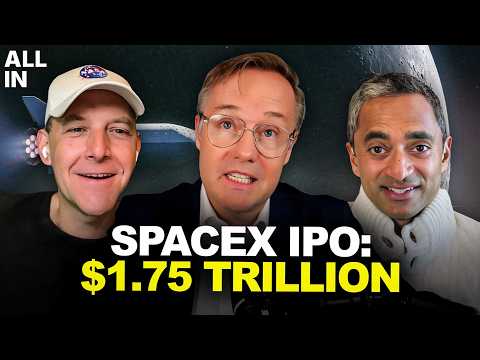
“100%. … Okay sorry, let me be clear. 99.999%.” — Chamath Palihapitiya, 2:10
Clip command
yt-dlp --download-sections "*2:10-3:30" "https://www.youtube.com/watch?v=N-pust8qtGI" --force-keyframes-at-cuts --merge-output-format mp4 -o "spacex-tesla-merger-bet.mp4"Space as the New Railroads
“SpaceX is demonstrating its capacity at being effectively the railroads. You know, what the railroads were to the West and to the frontier…” — Chamath Palihapitiya, 10:59
Clip command
yt-dlp --download-sections "*10:59-11:50" "https://www.youtube.com/watch?v=N-pust8qtGI" --force-keyframes-at-cuts --merge-output-format mp4 -o "spacex-railroads.mp4"Urea Doubles, Crops Get Re-Planted
“Urea was trading at about 350 bucks a ton before the conflict kind of took off, and it continues to spike up. It reached over $700 a ton in the last two days.” — David Friedberg, 44:29
Clip command
yt-dlp --download-sections "*44:29-46:00" "https://www.youtube.com/watch?v=N-pust8qtGI" --force-keyframes-at-cuts --merge-output-format mp4 -o "urea-fertilizer-doubles.mp4"Quantum Bitcoin Time-Bomb
“We’ve started to see is an increasing amount of research that says that the scheduled eventuality of a quantum chip, a functional chip, is probably not 25 or 30 years…” — Chamath Palihapitiya, 1:04:13
Clip command
yt-dlp --download-sections "*1:04:13-1:05:30" "https://www.youtube.com/watch?v=N-pust8qtGI" --force-keyframes-at-cuts --merge-output-format mp4 -o "bitcoin-quantum-risk.mp4"Middle East LP Pullback Risk
“We’re so dependent on Middle [East LPs] … and suddenly everyone’s going to be like, whoa, and the shockwave will hit.” — Chamath Palihapitiya, 34:54
Clip command
yt-dlp --download-sections "*34:54-35:45" "https://www.youtube.com/watch?v=N-pust8qtGI" --force-keyframes-at-cuts --merge-output-format mp4 -o "middle-east-lp-shock.mp4"Key Points
- SpaceX confidentially files for IPO (0:13) — Targeting a $1.75T valuation; would be the largest IPO ever
- Sacks absent this week (0:00) — Trio format
- Chamath’s 99.999% Tesla-SpaceX merger conviction (2:10) — Public mark-to-market needed to silence shareholder suits
- “Shake-down” framing (4:13) — Sacks-aligned view from Chamath on Tesla shareholder lawsuits
- Artemis II returns humans to moon (7:34) — Four-astronaut launch
- Garbage collection in space (14:33) — Nets, magnetic plates; whole earthly economy gets rebuilt in orbit
- PGMs from asteroid mining (15:55) — Palladium, platinum-group metals; downstream effect of unlimited supply
- Moon-rock heat shields (18:00) — 15cm slab on payload front for autonomous moon-mined returns
- Robotics revolution undeniable (10:19) — Friedberg: even if Earth bans them, they’ll roam Mars and the moon
- Thanksgiving plate problem for IPOs (22:29) — Limited investor appetite; later issuers eat scraps
- OpenAI at $800B is real (30:00) — Chamath: “I’ve never seen a business like this”; same for Anthropic
- Two-thirds of farmers pre-bought fertilizer (45:26) — Spring planting cushioned; one-third pivoted to soybeans
- Middle East LP pullback risk (34:54) — Iran-war disruption could push Gulf capital home; shockwave for U.S. PE/VC
- Markets shrug on Iran (35:22) — Sacks via Chamath: real event risk is whether AI is real
- Trump as anti-war president (55:54) — Sacks frame; “most consistent anti-war president in modern history”
- Trump pivot prediction (49:59) — Jason: 100% he wraps up Iran soon, citing approval-rating chart
- Helium criticality (49:08) — MRIs, semiconductors, mass spec — global supply shock
- China benefits from US distraction (35:10) — Force majeure clauses could unwind LP commitments
- Quantum Bitcoin reckoning (1:04:13) — Chamath: leaders must answer whether protocol is quantum-resistant
- Both AGI and quantum can’t be true (1:09:31) — Jason: software stocks vs crypto — pick one
- Athena EAs (1:10:00) — Pre-agent agent shoutout, multiple besties have one
- Ohalo potato shipping (1:14:18) — Friedberg shipping seed to North American farmers
- TAO and Folding@Home (1:17:26) — Chamath’s Jensen interview moment; not long TAO
Mentions
Companies
- SpaceX (0:13) — $1.75T IPO target
- Tesla (2:10) — Probable merger candidate
- OpenAI (30:00) — $800B; needs to IPO ASAP per Chamath
- Anthropic (30:00) — Same imperative as OpenAI
- Athena (1:14:04) — Executive assistants service
- Ohalo (1:14:09) — Friedberg’s potato seed company
- NASA (7:34) — Artemis II launch
- FedEx / Maersk (15:04) — Analogues for forthcoming “FedEx of space”
Products & Technologies
- Artemis II (7:34) — Four-astronaut return-to-moon mission
- Urea fertilizer (44:29) — Doubled to $700/ton
- Helium (49:08) — MRI, semiconductor, mass-spec input
- Quantum chips (1:04:13) — Threatens Bitcoin cryptography
- Bitcoin (1:04:13) — Quantum-resistance unresolved
- TAO (1:17:26) — Bittensor; Chamath’s controversial Jensen interview mention
- Folding@Home (1:17:34) — Distributed compute for health problems
People
- Elon Musk (0:13) — SpaceX/Tesla; subject of merger discussion
- Donald Trump (49:59) — Predicted Iran wrap-up; “anti-war president” framing
- Barack Obama (59:13) — Sacks: shouldn’t have let Iran out, China deal commentary
- Jensen Huang (1:17:26) — Subject of Chamath’s TAO/Folding@Home interview moment
- Marc Andreessen (1:19:14) — Chamath: “go retard max with us”
- Roger the Dirt Farmer (1:14:22) — Recurring Ohalo potato test farmer
Surprising Quotes
“100%. … Okay sorry, let me be clear. 99.999%.” — Chamath Palihapitiya on whether SpaceX and Tesla merge, 2:10
“Urea was trading at about 350 bucks a ton before the conflict kind of took off … It reached over $700 a ton in the last two days.” — David Friedberg, 44:29
“If quantum is real, a bunch of these crypto projects are not what we thought they were. And so you can’t have both, guys, you gotta choose. Pick one.” — Jason Calacanis, 1:09:44
“Trump is and has been the most consistent anti-war president of modern history.” — David Sacks, 55:54
“Just enjoy your life and work hard and don’t think it through because look what happened to Friedberg. He starts ruminating. Love you boys. Don’t ruminate.” — Chamath Palihapitiya, 1:19:04
Transcript
Jason Calacanis: 0:00 All right everybody, welcome back to the number one podcast in the world, the All-In podcast. David Sacks couldn’t make it this week, but we have the trio.
David Friedberg: 0:09 David Friedberg is here, your Sultan of Science.
Chamath Palihapitiya: 0:11 Chamath Palihapitiya.
Jason Calacanis: 0:13 SpaceX filed confidentially to go public on April 1st, targeting a 1.75 trillion with a T valuation. When SpaceX goes public, if it’s at that 1.75 trillion dollar valuation—it’s so weird to say trillion dollar valuation for an IPO—they would be the eighth largest company in the world right behind TSMC and Saudi Aramco, they’re both worth 1.7X at the taping of this podcast. Tesla is number 10 with 1.37 trillion dollar valuation. Hey, if you were to combine those two as many people are speculating will happen at some point and you can buy the stock ticker ELON, that would be a 3.1 trillion dollar company and that would make them the fourth largest company ahead of Microsoft. They’re aiming to raise, Chamath, 75 billion, which would be the by far the biggest raise ever in an IPO, expected to go out in June. I think they were trying to hit the 4/20 date because that would have been even more hilarious, but they’re not going to be able to do that. SpaceX recently acquired X.AI for 250 billion, that includes X and Twitter and the X-AI large language model AI company. Starlink generating between 50 and 80 percent of SpaceX’s revenue, we’ll have all those details shortly, and it’ll be close to 20 billion dollars a year, according to reports. Launch of rockets is the other 40 percent of the business, 5 billion in 2024 according to reports. Total revenue 2025, 15 to 16 billion with 8 billion in profit according to Reuters. So let’s stop there and we’re going to talk about all the other IPOs that could be coming. Chamath, I think people really want to know, and you may have mentioned this on an earlier episode, what are the chances that Tesla, after—if this IPO goes well, that Tesla and SpaceX could wind up being the same company? We saw them collaborating on a fab.
Chamath Palihapitiya: 2:10 100%.
Jason Calacanis: 2:11 100% is what you’re putting it on? Okay.
Chamath Palihapitiya: 2:15 Okay sorry, let me be clear. 99.999%.
Jason Calacanis: 2:19 Okay. What will that mean when if those two companies or when those two companies merge?
Chamath Palihapitiya: 2:26 One of the great things that happened in my career was there was a point where, you know how like you grind at a level and then, you know, you just get exposed to things at a different level, and then you grind for years and you get exposed to things at yet another level. In one of those steps, I was very fortunate to be introduced by Thomas Laffont actually to the head of Wachtell Lipton. It’s a law firm.
Jason Calacanis: 2:54 Law firm.
Chamath Palihapitiya: 2:55 Law firm. And his name is Ed Herlihy. And he said, ‘This is the most important, well-known, well-run, powerful law firm in America.’ Then I looked at the transactions and they’re just in the middle of everything. And now, you know, my lawyer, Raj Narayan, who does everything for me, one of the senior partners at Wachtell, I can attest is incredible. And they said to me in the middle of all of this stuff when I was doing a bunch of deals, they said, ‘Chamath, just get ready to pay a tax.’ And I said, ‘What does that mean?’ They said, ‘The way that the American capital markets are set up is both that you can be incredibly creative and do incredible things, but—’ —and we talked about this a little bit last week, there’s a bunch of tort that allows folks to hang around the hoop and get paid no matter what. You see this in all IPOs. Shareholder lawsuits abound. And they try to create a class out of it. And the reason they do that is that there’s D&O insurance that then will pay out some number of millions of dollars. The attorneys take 40 or 50 percent, and then these plaintiffs get a few bucks. You saw how egregious this tort manipulation was when this guy with 10 shares sued Elon’s comp package at Tesla and won. And what was that really? That was the trial lawyers trying to get paid hundreds of millions of dollars by exploiting a seam.
David Sacks: 4:13 It was a shake-down. Call it what it was.
Jason Calacanis: 4:15 It was a shake-down.
Chamath Palihapitiya: 4:16 Why am I bringing this up? If you take the Raj and Ed example of this, this SpaceX IPO is going to set up a couple of things. The first is there’s just going to be the natural noise in the market, and Elon will have to sort through all of the little ticky-tacky things. But the most important positive thing that will happen from the IPO is a validated external mark-to-market valuation of SpaceX. And the market every day in real time gives you a valid mark-to-market assessment of the value of Tesla. And this allows you to put these two things together to minimize these lawsuits. Yes. And I think that that’s what Elon really needs. It’ll make his life tremendously simpler from a governance perspective. It’ll make the companies and this quibbling about his time a non-issue because, again, nobody talks about Zuck or Satya or Sundar or Jensen allocating time across various projects inside of Meta or Google or Microsoft or Nvidia. Nor should they really make this claim from Elon because, as you’re seeing, there’s actually an enormous overlap and commonality to the various things that he is doing. He’s building the robots, but they’re used inside of SpaceX. He’s building a Terafab, they’re used inside of Tesla. He’s building xAI, they’re used across both. So I think we need to do this, it’ll minimize the shareholder noise because it’ll give less room to somebody that says, ‘Hey, he set a valuation out of thin air.’ But dollars to donuts, these things are going to merge.
Jason Calacanis: 5:53 Well, and it speaks to the singularity that’s going on right now. You know, you had a car company, you had a space company. Okay, it was a pretty—how do they—
David Sacks: 6:00 those two things overlap, and it’s like AI, data centers in space, where do you get chips from? And then actually going to raw materials inside of one factory, going out the other and having discussed it with Elon many times, what he learned, you know, at Tesla or SpaceX about advanced materials informed different products at the different companies. And now you just’ll have all of that in one place. And then you think about the brain trust that he built at those two companies plus Boring Company plus Neuralink. If they’re all in there…
Chamath Palihapitiya: 6:29 …and then you think about all this cross-disciplinary learning is going to compound and compound and compound. Elon knows more about factories than probably…
Jason Calacanis: 6:39 …anybody.
Chamath Palihapitiya: 6:40 …anybody. Like, there’s some people in China who have, you know, Foxconn knows a lot about factories, you know. So there are some people who know as much or probably even a little bit more about some aspects of it, but that’s a true advantage of bringing those two teams together. And you saw it, people would go from one company to the other.
Jason Calacanis: 6:53 Friedberg, my question for you, very acutely with your NASA hat and, uh, you know, your background today is, 20 years ago he started trying to get to space with SpaceX and here we go. There’s more rockets going off in a month now than there are days in the month for the entire country and he’s got rockets going up every two or three days. You can just basically hop on a SpaceX flight and get to space. Maybe you could just use your vision there to tell the audience what could things look like in another 20 years if SpaceX continues at this cadence or even, you know, goes faster because of AI?
David Friedberg: 7:34 Well, this week’s a pretty important milestone for that point because we just launched Artemis II yesterday, which is man’s returning to the moon. So the United States shipped this rocket with four astronauts on board, they’re going to do an orbit around the Earth, head to the moon, come back around and come back to Earth in anticipation of landing on the moon in about two years. And getting to the moon I think is going to be very important, not just because there’s this important social milestone and race happening right now with China, but I think the moon could end up being kind of the next industrial frontier for humanity. And the reason is, if you can get to the moon, the moon has an extraordinary abundance of material that we can mine, process, and manufacture into goods. And ultimately the cost to ship those goods back to the Earth is zero. It will cost less to move goods, manufactured goods, processed ore, precious metals from the moon to a specific point on Earth. It will cost less to do that than to ship it using any other terrestrial conventional method, whether that’s a boat, an airplane or a railroad. And the reason is that on the moon you can take advantage of the low gravity, it’s about 1/6 the gravity, and the complete lack of an atmosphere, meaning that it’s frictionless to move material off of the moon. And very low energy to move it off of the moon, you do not need to use a rocket propellant with high energy like we have to do to move things off of the Earth. In fact, the design for moving material off the moon is to use what’s called a mass driver, which is like a train track, like a rail, like an electric rail. You kind of see these in, you know, high-speed trains that work on kind of magnetic levitation. And you could put a package on that rail and use electricity to accelerate that package to 100 G-force, shoot it back to the Earth or theoretically shoot it to Mars, and it will go to the exact point on the Earth you want it to go to, re-enters the atmosphere, and lands with a simple parachute where you wanted it to go. So we could run continuous mining, continuous manufacturing processes on the moon at a fraction of the cost of what it would take to do it here on Earth. The biggest limiting factor: getting people to the moon. And that is largely solved or will be solved in the next few years by robotics. So I think that there’s this pretty profound intersection with what’s going on in robotics with this moment for space industrialization and moving to the moon. So, you know, Tesla, I think 20 years from now is actually a more interesting story, whether they’re the same independent company or the same company. I think we’re going to look back one day and have this kind of laughing observation that Tesla started out as an electric car company…
Jason Calacanis: 10:18 100%.
David Friedberg: 10:19 …ended up becoming an autonomous car company, and the autonomous competency is what led to the robotics revolution. And the robotics revolution, even if the socialists ban robotics on Earth and tell us no robots allowed, they’re taking all the jobs, you could ship all those robots to the moon and they could get to work and create an entirely new manufacturing frontier for our civilization, for humanity. That frontier can manufacture precious metals and other goods and ship them back. You could manufacture semiconductors on the moon. All that’s missing is the robots. So moving the robots to the moon or setting up the materials for robots to build themselves on the moon is kind of the first phase of this transition, you know, asking about 20 years from now. And then the next phase is—
Chamath Palihapitiya: 10:59 So look, I mean, I think that this may not be, and it certainly won’t be limited to just SpaceX, but SpaceX is demonstrating its capacity at being effectively the railroads. You know, what the railroads were to the West and to the frontier in the West in the last generation, SpaceX will be to the moon and ultimately to Mars. And there’s going to be an extraordinary abundance of production that’s going to come out of the moon. The moon has everything, by the way. And I’ll say one more thing about SpaceX. SpaceX has also created, and this is going to be a big part of the valuation analysis that many are doing, they’ve created a backup to the internet. You know, the internet is fundamentally limited by all of the nodes on the network and the connectivity amongst all those nodes. And that connectivity is largely driven by copper and fiber optic cable. So in space, with the number of satellites going up with Starlink and to actually deploy data centers that can output data on those nodes on that network, SpaceX has largely built a backup internet. And that backup internet can coincide with the Earth’s internet, but it creates this extraterrestrial communication network that— gives us theoretically the ability to think about, hey, if governments collapse, if there’s civilizational upheaval, etc., etc., etc., this becomes, I think, a fundamentally kind of important technology infrastructure that’s going to exist in parallel. So, I’m pretty excited about like these two separate paths for SpaceX and where they intersect with Tesla, I think is pretty profound at the moment.
Jason Calacanis: 12:21 Yeah, and it can’t be understated what lowering the cost per kilogram to get to space has done to entrepreneurs around the company. There’s multiple entrepreneurs who are now doing asteroid mining or Varda doing experimentation in space. And I have a— I’ve been doing some late-stage stuff to mop with my syndicate, and one of the interesting companies we syndicated— we did Zipline, which is a great company, but we also did this company called Vast. Vast Space. Jed is the founder. He— he created Ripple and— and some other crypto projects, and he put a lot of his money, hundreds of millions of dollars, into this company Vast Space, and they’re designing a space station. How did they do it? Well, they just bought carriage on SpaceX rockets, and they paid in advance, they have their slot, and now they’re doing this massive innovation to make modular space station components. And the— and the thesis is, ‘hey, what if Google or Amazon want to have a space station in space?’ You know, it’s completely possible they may want that.
Chamath Palihapitiya: 13:25 Here’s what I’ll say. I think sometimes it’s better to be lucky than good. There are all of these ways that so many people will end up with participation into SpaceX. I think we all owe Elon an enormous thanks. I think that this is going to unleash just an unbelievably large economy of things that we have no idea about. And when I see this thing, that video that you just showed, what it reminds me is that we have an very rudimentary capability in space. What does that mean?
David Friedberg: 13:59 If you take, if you catch a ride on Falcon 9 or Falcon Heavy, basically it’s dropping you off at 550 kilometers, I think. You have a different set problem if you’re trying to get to GEO. But even if you get dropped off at 500 or 550, how do you get to your actual orbital plane? Right? So meaning, if you think of Elon as like the big container ships that go from China to America, once it gets to Long Beach, you need FedEx. There’s an entire infrastructure there that’s going to get all of this logistics built last mile. There’s a huge garbage collection problem that’s getting built up. We still haven’t technically solved how to do garbage collection in space. There’s nets, there’s magnetic plates, all of that is getting fixed. Then there’s going to be an explosion in actual power generation. The cell composition of solar cells up in space are materially different. It’s a really incredible thing. You look at these thin sheets, they are like one millimeter thick. You— if you carried it on your hand, the glass breaks. Yet you can smash a meteor into it…
Chamath Palihapitiya: 15:00 and it’s laid and laminated and nothing happens. It’s like the cr- it’s like So, my point is in every single dimension of what the earthly economy looks like, it’s now going to go and get rebuilt in space. There’ll be a FedEx of space, there’ll be a Maersk of space, there’ll be a… I don’t know what the garbage collection companies are, Allied Waste of space. There’s going to be everything of space that exists in the United States. Friedberg just talked about the Freeport-McMoRan of space. Like, everything.
Jason Calacanis: 15:33 Yeah.
Chamath Palihapitiya: 15:34 And that we owe to him. And I hope he gets that credit because the amount of businesses I think that can get created and the amount of value that will be created on top of SpaceX’s shoulders is vast. It’s the beginning of the beginning of the beginning. And it’s going to create enormous opportunities for people who are smart and resourceful.
Jason Calacanis: 15:55 And Friedberg, maybe you could comment on the PGMs, the palladium that’s on asteroids and just how they’re rare here on Earth. If we had an unlimited supply or a continuous supply of those minerals, you know, what could the downstream effect of that be? And then what if we find things in space that we are unaware of? There are unknown unknowns, correct Friedberg, when you start to conceptualize this?
David Friedberg: 16:21 I do think like the asteroid mining is an interesting concept, but I do think it’s going to be more likely that we’ll have the need for infrastructure so we can produce ores and refined and so on, versus, you know, bringing a chunky rock back. I think that you could do this very effectively on the moon. The primary elements that are missing from the moon that we have on the Earth are, you know, carbon, nitrogen, hydrogen and oxygen, basically these things that make life on Earth. But that’s because they primarily exist in a gaseous form and the Earth has enough gravity to retain those gases and have an atmosphere. The moon is too small to maintain an atmosphere, the gravity’s too little, so those gases all kind of went away, they evaporated away in the early formation of the Earth and the moon. But on the moon there’s everything else. There’s aluminum, there’s silicon, there’s palladium, there’s platinum, there’s gold, there’s everything you possibly need. So I think as we do the calculus on all of this, we’ll end up realizing that the moon is probably the best frontier. One of the biggest issues is dissipating heat because you don’t have an atmosphere, but theoretically you could recapture that heat and use like helium gas or something to turn a turbine and actually run production of even more electricity. You just put a couple solar panels out, I did the math on this, it’s like 500 square meters of solar panels will let you run a four-kilometer mass driver to ship material back to the Earth every 10 to 15 minutes, one ton of material every 10 to 15 minutes.
Jason Calacanis: 17:46 On the sled you described earlier that Elon’s been talking about as well, yeah.
David Friedberg: 17:51 Yeah. So you could think about having autonomous mining vehicles deployed on the moon, processing the ore, and then sending completely processed material back and then for a heat shield for reentry to the the Earth, you just use moon rock. You only need about 15 centimeters of moon rock at the front of the package. And then that’ll burn up when it re-enters the atmosphere and the package, you know, kind of parachutes down and lands where you want it to land, in your industrial shipyard or whatever. So there’s just like, you know, I think we’ll continue to kind of iterate on this. I’m speculating in a bunch of different ways.
David Sacks: 18:18 the beginning of the beginning, the beginning of the beginning.
David Friedberg: 18:21 That’s right.
Jason Calacanis: 18:22 Gosh, I mean, can you imagine having a moon base and Americans permanently present on the moon? It’s just, and factories on the moon, it’s just wild to consider.
Chamath Palihapitiya: 18:31 Wild.
Jason Calacanis: 18:32 Can you guys just imagine like the middle or the early 19th century, like the late 1700s, early 1800s in America and there’s like all this land out on the West and like whatever people were contemplating in that moment about what they were going to go do with that land on the West and they started to travel West, their minds would have been blown to see what happened 100 years later or now 150 years later. You know, like it’s just that’s the moment that we’re at right now and the railroads are being built to get us to this next great frontier, they’re being laid out before us. And the opportunity is really limited only by our imagination and before we would have never been able to tackle these great frontiers, but this magical new technology came about called robots and these robots are what are going to allow us to actually make use of these frontiers and explore them and develop them. And that’s why this is such an incredible moment where this intersection of autonomy and robotics and space traversal kind of drive forward humanity into this new era. And it’s again, this is not a zero-sum game,
David Sacks: 19:42 Zero-sum game.
Jason Calacanis: 19:43 this is expanding humanity’s potential, expanding production, which is so different than the way the socialists on Earth are talking about it where everyone’s fighting against progress because they think that progress is some people taking things from other people. And the truth is it’s about everyone building stuff that’s new and everyone benefiting from this.
Chamath Palihapitiya: 19:52 I’m going to open a hotel casino in space.
Jason Calacanis: 19:55 I would love that! Oh, that’d be so great.
Chamath Palihapitiya: 19:56 No, I’m serious.
David Sacks: 19:57 Absolutely.
Jason Calacanis: 19:58 I would love that.
David Sacks: 19:59 Yeah, and no rake, no rake, no gravity. No rake, no gravity.
Chamath Palihapitiya: 20:04 Jackpots!
David Sacks: 20:05 No tax! No tax on chips or poker winnings.
Jason Calacanis: 20:10 I love it! Whoever implements the red light district in space is going to become a trillionaire.
Chamath Palihapitiya: 20:16 Oh, wow. That’s, yeah, with the robotics and the pleasure droids, replicants. Oh man, it could get crazy. Alright, well let’s just hope we’re not the Donner party on the way there.
Jason Calacanis: 20:26 2026.
David Friedberg: 20:28 Don’t worry, you’ll be safely on the ground, shipping syndicates. You’ll be fine.
Jason Calacanis: 20:33 I’ll tell you something. Thank you. Shout out thesyndicate.com. Apply to join me in great companies.
David Friedberg: 20:40 Do you own thesyndicate.com?
Jason Calacanis: 20:42 Listen, I’m still working. You guys might be retired but I’m in the game. I’m in the arena trying things.
David Sacks: 20:47 I am… I’m selling. I’m selling enterprise software every day. That’s what I do.
Jason Calacanis: 20:51 I mean, he literally, Chamath said, ‘Hey J-Cal, can we wrap this up real quick because I gotta get on a sales call. I got a discovery call.’
Chamath Palihapitiya: 20:57 Listen, I like the fact that we’re all working. We’re working into our 50s.
Jason Calacanis: 21:00 I love it. Hey, 2026 could be an all-time record for IPOs. Looks like it will be. Anthropic, OpenAI, Databricks. I mean, these are all nine and possibly ten-figure IPOs in terms of the valuations. Long tail of other companies. Stripe, Cerebras, Canva, Discord. Lots of people waiting. Here’s your Polymarket. SpaceX 94% obviously, that looks like it’s… we just talked about that for 20 minutes. Anthropic 41% and people were saying 70% in February. OpenAI 38%, Databricks 32%. People are wondering what could derail this. Obviously, we have a very pro-business group of people in Washington, D.C., but you have potentially this Iran war, and we’ll talk about that later in the program, could potentially push us back if, God forbid, it was to spiral or there was a recession, maybe the Democrats taking control of Congress, Senate, etc. What are your thoughts here on the flurry of potential IPOs? We’re talking about trillions of dollars of companies, Chamath. And if that does happen, let’s start talking second and third-order impact of that kind of distribution change that could happen for LPs. And then just also all these employees, you know, and then a currency for these companies. Go from a Mag 7 to a Mag 17, it looks like.
Chamath Palihapitiya: 22:29 I think that we have a bit of a risk problem. And I think this is why it makes so much sense for Elon to get out first. If you think about appetite as equivalent to like a person at a Thanksgiving dinner, when you first come in and you see all of this stuff, it’s so plentiful, your eyes are bigger than your stomach. And I think in a moment like that, you want to be the one that is consumed first. And I think the risk increases when you are at the tail end because the risk is that the diners will run out of space.
Jason Calacanis: 23:04 Plate fills up, yeah.
Chamath Palihapitiya: 23:07 And if you use that analogy, I think the reason why people’s plates will get full are probably twofold and maybe threefold. The first and most important thing is there’s enough tactical event risk that people generally want to be risk off and have more margin of safety. I think the Iran thing is kind of in there, but I think the big tactical event risk is that we have a lot of these really important financial moments tied to this concept of AGI, ASI. I don’t know if you saw the OpenAI announcement on their final terms, but, you know, a huge slug of Amazon’s capital is tied to a 2028 IPO or a moment that calls for this. Then there was a bunch of leaked text messages or whatever that said that there’s a version of some AGI running inside of… Topic, then there was the fact that, you know, the leak of Claude code basically demonstrated that they had feature flagged away a bunch of improvements. So if you stack up all these improvements, they’re actually much further ahead than the models realized. If you take all of that as a basket, it goes back to what I said last week, which is we have a real pricing problem. If AGI is real, the durability of most companies is slim to none. If AGI is not real, then the fundraising capacity of these companies that are now raising hundreds of billions of dollars needs to get questioned and inspected thoroughly. History will sort out which one is right, but both cannot be right.
David Friedberg: 24:40 So in that vein, I actually think J-Cal, I don’t think we’re going to have like these quote-unquote blockbuster stream of IPOs. I think what happens is SpaceX is going to get out, they’re going to do great. And then maybe the next one does good to great. Then the next one will do good, and then the appetite runs out because you just can’t absorb incrementally trillions of dollars of new demand. And if you think about it, where is it going to come from? Is it going to come from the sidelines? I don’t know, I think it’s more of a reallocation exercise. But if you look at the S&P, well, most people are now defensively moving away from these kinds of things towards the things that are more protected, what the industry calls halo, right? High asset, low obsolescence kind of businesses. Those things trade for zero today, Jason. You could buy hundreds of millions of dollars of year of cash flow for two to five times right now in the stock market. And so why are you going to go way out on the risk curve and buy something at 200 times revs, let alone earnings? So I don’t know, I’m more in the camp of I think it’s good to be first, it’s pretty decent to be second, but if I were you, I would get the heck out and get public and get your money and fortify your balance sheet ASAP because I think the risk builds the further down the IPO chain you’re in.
Jason Calacanis: 26:00 Yeah, there’s going to be a competition for investor dollars, whether it’s retail or institutional or sovereign wealth funds. They’re going to have a lot of choices here. Do you want to be in NVIDIA? Do you want to be in SpaceX? Maybe you have to rotate out of Amazon or Google or Disney in order to take on those opportunities. And that’s going to be a great competition. Problem? Probably. We could see a lot of these IPOs, Friedberg, trade below their IPO price in the year or two after they come out and get repriced, yeah?
David Friedberg: 26:35 And I think the market’s going to need to find a price. Remember, the shareholders in a lot of these companies have held on to these shares for long periods of time and the valuations are extraordinary. I mean, hundreds of billions of dollars in market value coming to market liquid for the first time. Some of these investors, regardless of whatever their entry price was, are going to be looking for liquidity. So there’s only so much capital to absorb.
David Sacks: 27:00 Those shares on the buy side, meaning if the buyers and the bid is not there to fulfill all of this selling then you’re going to see the share price decline and the market’s going to find a price. And so I think this idea that like an IPO is, you know, just a step in driving the price or value of a company up is a pretty false sense and I think we’ll realize it’s pretty false as some of these IPOs take place because there is so much pent-up selling demand, there is so much value that’s been created, there’s going to be so much selling pressure and then there’s going to be very little buying activity on some of these because anyone that could have bought at scale on the buy side post-public were already in a lot of these companies pre-public as private companies. And so I don’t know who the big buyers are that everyone’s expecting are going to show up, they’re probably thinking it’s going to be…
Jason Calacanis: 27:47 Retail.
David Sacks: 27:48 Retail, yeah. I mean, it’s like…
Jason Calacanis: 27:49 Yeah, but how much money does retail have left?
David Friedberg: 27:52 I mean you look at retail investors, they have a certain amount of powder and it’s probably deployed. It’s not like they have unlimited places to look for that.
Jason Calacanis: 28:05 And you know there’s some evidence of this. Bloomberg ran an article on Wednesday—we tape on Thursday folks, and you get to listen to the pod on Friday. OpenAI is falling out of favor with secondary buyers. According to a report, OpenAI investors can’t find buyers at the new 80 billion dollar valuation that Chamath referenced earlier. Investors Bloomberg spoke to are looking to sell $600 million worth of shares. People are looking for liquidity and said they were institutional investors. Anthropic, currently valued at 18 billion, is seeing major secondary bids at a 30 billion dollar valuation. So I think Chamath what this shows us is your correct. There, you know, OpenAI and Anthropic are the two next cards. That’s your turn and river, folks, if SpaceX was the flop. And maybe they’re massively overvalued right now. Maybe they’re three, four, five, ten billion dollar companies, not trillion dollar companies. And if you look at the amount of revenue, two billion for OpenAI at 80 billion, that’s 40 times price to sales ratio and that is a absurd price-to-sales ratio depending on if the growth keeps happening. And I should reference Chamath, what if we are at artificial general intelligence, AGI, and the moats on these things is de minimis or or there is no moat? Anthropic just got hacked. All their secrets are out. Somebody transmuted the code into another language, posted it on GitHub, can’t be stopped. I don’t know if you saw that story, Friedberg, but this was kind of mind-blowing. Somebody took the Anthropic code—I don’t know what it was written in—and then basically just put it into another language, reposted it. If Anthropic comes and says, ‘Hey, you can’t do that,’ well, that negates their argument, Chamath, that they’re allowed to train on other people’s data and then spit out a different output. So this is a very weird moment in time, right?
Chamath Palihapitiya: 29:56 It is. I think you’re bringing up a bunch of different points, so let me just sort them out. I think… The order that I think is important. Is there a market for OpenAI at 800 billion? Yes, and there should be. When I read that press release, my mind was blown. This is a—I’ve never seen a business like this. And I’d say the same thing of Anthropic. What an incredible thing that both of these two companies have been able to create. Nobody in the history of the world has ever seen two businesses like this at this scale, okay? It’s unbelievable. These are trillion-dollar companies. They both are, and they both deserve to be. How profitable they are, I don’t know. What their terminal valuation is, I don’t know. What will people pay for it at IPO? I don’t know. But Nick, I just shared something with you. These two companies need to get out as quickly as possible. And the reason is every single company that comes after it, all those companies that you just named, Jason, are not nearly as important and do not need the money nearly as badly as these guys do. And where will it come from? The specific answer to your question when you look at this chart is, the tech sector PE is going to shrink faster, in my opinion, than the non-tech PE. And the reason is because as these companies come out, the combination of SpaceX, OpenAI, and Anthropic, all three are baking an AI technology that first and foremost will go after the tech sector. It will eliminate and it will cannibalize and it will erode most of the moats that support this differential trading. So if I were a betting man, my first bet is as those three companies come out, these software businesses are going to approach the rest of the non-tech PE. Okay, that’s the first step that has to happen. So the rate of change of the multiple erosion will basically say to the world, ‘Hey, these tech companies are—I don’t know, I’ll buy the first five or six years of this story, but I’m not buying year 15 of this anymore because these three guys are going to build something.’ So that’s where the money comes from. That’s why I think after SpaceX, these two guys need to get their act together, file quickly, get out, and just get the money, fortify their balance sheets, and be in a position. Everything that happens after that is a total coin toss because once these three companies are public, I think the blue line will converge to the orange line and it’s going to be nasty.
Jason Calacanis: 32:40 Yeah. I mean, Friedberg, just looking at this, do you believe that secondary market is a canary in the coal mine here with OpenAI? Because if we—and we’ve gone through this year after year here. These are exceptional businesses, they’ve grown incredibly, customers love their products, but the burn is brutal. The circular financing problem is still out there, like what’s reality here? And that’s going to all come out when these S-1s get filed and they’re publicly traded companies and have quarterly earnings reports. Market share for these could be flipping, Anthropic and Gemini and… the players coming into the market. What are your thoughts here, on Anthropic and OpenAI, post the SpaceX IPO?
Chamath Palihapitiya: 33:09 Like I said, there’s only so much capital in the world. So I do think one of the things that’s probably being underestimated at the moment is the liquidity crunch that’s ahead for capital-intensive technology businesses given the conflict in the Middle East. I don’t think that Qatar and certain Saudi offices and certain offices in UAE and Oman are as eager as they were or, you know, have been to provide large slugs of capital to support these initiatives. And remember that capital moves its way through the markets, whether it’s through JPMorgan and a loan to SoftBank, which then gets paid to OpenAI, at the end of the day, there has to be unencumbered debt-free capital that’s being provided to these systems from somewhere in the world. And the if you trace all of it back, like a large chunk of it has historically in the last couple of years come from Middle East sovereigns and family offices. And I think that those are likely going to tighten up in the near term. That being the case, there’s probably less demand. I do think that there’s a lot of secondary demand coming from family offices in Europe and Singapore, places like that, that generally have not had great access or early stage access to private companies, but at some point, there’s only so much demand there. So I don’t know what like how far this is going to go or when this capital crunch that’s going to emerge, I think, from the Middle East. I don’t think we’ve really felt the shockwave yet on what’s happening because remember a lot of these Middle East capital commitments were made in the last cycle as LP commitments or whatever and, you know, if they stop, if they downscale LP commitments or they stop doing primary and secondary transactions, you know, takes a little bit of time before the market feels that and then it’s like, oh, the reliable go-to are gone. And a lot of the big funds, the megafunds that are out there—
David Sacks: 34:52 Totally. Totally.
Chamath Palihapitiya: 34:54 —that have Middle East LPs are gone. And suddenly everyone’s going to be like, whoa, and the shockwave will hit. So let’s see. It is a risk for the United States because China, I don’t think, is going to be as challenged. We’re so dependent on Middle East capital, it may be that China has a capital advantage actually going into this next phase.
Jason Calacanis: 35:10 Maybe. Yeah. I mean and we talked about force majeure coming into play here if this Iran thing spirals, God forbid, out of control or gets worse, people could say, you know what, we’re going to downscale our commitment and hey, there’s a war, so we don’t have to fund this.
David Sacks: 35:22 I think the markets are going to shake that off, Jason. I don’t think that they view this Iran thing as a big thing. I think the big event risk in the market is, is AI real or not real? And if it’s real, what are all of these companies worth? That is the big sword of Damocles over the stock market.
Jason Calacanis: 35:34 Yeah. Alright, well that’s a good segue, I think, into talking a bit about Iran. We took the week off from it last week, and we’re going to catch up this week.
Chamath Palihapitiya: 35:45 By the way, not because we—just to be clear—not because we intended to, which all the comments railed us on, but we literally just—
Jason Calacanis: 36:00 He did a terrible job moderating. It was on the freaking docket. We were supposed to talk about it. We didn’t get to it. And we went right by it.
David Friedberg: 36:06 He dodged it.
David Sacks: 36:08 He dodged it. It’s clearly my fault.
David Friedberg: 36:11 He DMV’d it. He, you know, it’s like come back later.
David Sacks: 36:13 Yeah, I know, I’m just protecting Trump. I’m out here getting cover for Trump’s mistakes. Everybody knows I’m in the pocket of President Trump. It’s like take a ticket, take a ticket. Oh, you have an issue? Okay, well your issue number 17. Trump DM’d me and said, ‘Can you please take this off the docket?’ I was like, ‘You got it, boss.’
Jason Calacanis: 36:29 And then you’re like, ‘Oh, sorry, office is closed. Come back tomorrow.’ Today is day 34 of the Iran War / military operation. Trump addressed the nation Wednesday night for a brisk 18 minutes. Here’s a 40-second clip. We’re now totally independent of the Middle East, and yet we are there to help. We don’t have to be there. We don’t need their oil. We don’t need anything they have, but we’re there to help our allies. For years, everyone has said that Iran cannot have nuclear weapons, but in the end, those are just words if you’re not willing to take action when the time comes. Our objectives are very simple and clear. We are systematically dismantling the regime’s ability to threaten America or project power outside of their borders. And tonight, I’m pleased to say that these core strategic objectives are nearing completion. All right, the costs here are mounting. A war is a very serious business. 13 American service members have tragically died. Over 200 have been injured. On the other side of the ledger, 3,500 Iranians have died, including 1,600 civilians and over 200 children. 1,200 people in Lebanon have died from Israeli strikes. And we now have 50,000 troops deployed to the Middle East. Chances of a ground invasion are increasing. War has cost $70 billion so far. That’s assuming $2 billion a day, which there seems to be consensus on via the Department of War. Pentagon has asked Congress for another $200 billion. To put that in context, the war in Ukraine was $113 billion in the first year. This could quickly exceed it when we hit 50 days. This isn’t cheap. There are lots of costs. Here’s your Polymarket on a ceasefire: 25% chance of a ceasefire by the end of April, 47% chance by the end of May. The sharps are thinking this could wrap up, but ground invasion, which would be just really impactful, I think, 63% chance by the end of April, 71% chance by the end of December. Going to get into the second-order effects, but what do you think, Chamath?
Chamath Palihapitiya: 38:57 Uh, this obviously is super unpopular war. I think two things, and the President kind of alluded to one that I think is very important.
David Sacks: 39:00 important which is if you are not energy independent you are at risk and I don’t know how many more examples now that world leaders need to be shown to get their acts together so if the Ukraine Russia conflict didn’t show Europe then this should show not just Europe but the rest of the world you need to be in control of your own energy infrastructure and energy independence because stuff happens in the world and you’re not always in control or can shape how that stuff can indirectly or directly affect you the United States has energy independence it’s an incredible situation what was interesting to me is if you look at Europe you know they gutted a couple of their energy markets and they essentially ceded control to a combination of very expensive imports and China they did that in markets like nuclear where they just went out of it they did that in things like nat gas where again we can debate but where where did Nord Stream 2 go we don’t know and they did that in things like solar where they just gutted all of the credits but what’s interesting is they’re starting to turn that around I think Italy just reintroduced effectively what’s called investment tax credits Spain just did as well Germany is restarting nuclear so if you just look at the last few months just that change is incredibly important because our largest ally Europe should be fundamentally energy independent so that they preserve complete and total optionality like we do in how we respond to these situations that I think is a critical thing that is a positive outcome of what’s happening
Chamath Palihapitiya: 40:45 And then the second Jason which I think is a huge question mark and it builds on what Friedberg said before the Middle Eastern states specifically the UAE and Saudi Qatar Kuwait they are our most important financing and banking partner in the future and I think we need to see a conclusive end to this war because they need to be in a position to monetize these critical assets because at the same time if you see these big pools of demand start to become energy independent by either accelerating nuclear but I again that’s just problematic and slow but frankly if they’re just going to ramp up solar that’s the only way that you can dispatch energy quickly I think what that does is it decreases hydrocarbon demand over the long run that then decreases the monetization capacity for these countries so if you put these two things together all of these folks in the region want safety security and they need a quick end to this thing now and I think that they’re more incentivized to put boots on the ground Jason than America is that’s the point I was trying to make
Jason Calacanis: 41:48 Okay Friedberg let’s talk a little bit about fertilizer you had brought up when we had the start of the Ukraine war hey this is the bread Ask it, we could have a massive famine. Thankfully that was avoided. There were carve outs for getting wheat and other crops out of Ukraine. But here we are again with a significant amount of fertilizer comes out of that region and it’s not flowing right now. Do you have concerns this time around that we could see something similar?
David Friedberg: 42:23 Fertilizer is made up of three elements. There’s different fertilizers. One element is N for nitrogen, P for phosphorus and K for potassium. Ukraine is the largest producer of the K, the potassium, the potash. But the N in fertilizer is nitrogen, and that is about 60% of what goes into the ground. That’s 60 to 65% of global fertilizer is the nitrogen. That’s what really drives agricultural productivity. And we need nitrogen fertilizer to grow crops everywhere on earth that we’re growing crops to feed people at scale. That nitrogen is primarily made where natural gas is produced and processed. And the reason is that they use the natural gas as an input to the production process. They get the carbon, the hydrogen, the oxygen and then they compress, remember 70% of our atmosphere is made up of nitrogen gas. So they compress the nitrogen in the air to 200 times atmospheric pressure, run it over a electrical current with a metal catalyst and you break apart the N2s you have just single nitrogen atoms and then you combine it back and you end up getting ammonia out of the other end. That’s why nitrogen fertilizers are produced where natural gas is processed. So the Middle East obviously is a massive producer, particularly in Qatar, of natural gas. And that’s why so much of the world’s nitrogen fertilizer is made in the Middle East. In fact, about 35% of the world’s nitrogen fertilizer goes through the Strait of Hormuz. And it is then shipped to countries around the world that farm and that need it to grow their crops. The swing producer in the world is China. China historically makes about 15% of the world’s nitrogen fertilizer and when the war started, a few days after it began, China shut down exports of their nitrogen fertilizer. And so they basically choked off the rest of the world and so when the Strait of Hormuz shut, the nitrogen stopped flowing. Here you can see the price spike that happened. So as the war began, this is urea, urea is the solid form of nitrogen fertilizer. So urea was trading at about 350 bucks a ton before the conflict kind of took off, and it continues to spike up. It reached over $700 a ton in the last two days. And this is really, really, really impactful. It’s not just like oh, the price is doubled. Number one, there’s a supply deficiency, so farmers in places like Africa and South Asia are not getting the urea that they need to farm. That is going to have a massive follow-on problem. And in markets where they have access, because the price is… Right, like in the United States, our biggest crop is corn. You need about 200 pounds of that urea per acre for corn, and that cost basically makes you unprofitable. There is no way you can make a profitable crop of corn. The other thing that China did at the same time is they stopped buying corn. So corn prices would normally spike up, and corn prices have remained low while the input prices have spiked for American farmers. So American farmers are in a real pickle. Fortunately for this spring planting, which is happening right now, about two-thirds of American farmers had already secured their fertilizer before this began. But a third did not, and they’re switching crops, typically to soybeans. But we have a fall planting coming up in a couple of months here, and the choke point on production is going to keep prices very high. In the United States, we make a lot of our own ammonia at our natural gas facilities in places like Oklahoma and Texas and Wyoming and other places, and then it ships directly to the farms. But the cost is so high because of the global market that it’s going to become very hard for farmers to make a profit. And around the world, there are many farmers, millions and millions of farmers that can’t access this fertilizer now. So the choke point in the Strait of Hormuz is turning out to be a real critical global food supply crisis yet again, similar to Ukraine. And remember, there was about 400 million people following the Ukraine war globally that we saw enter into a state of malnourishment. This means more than one year of 1,200 calories or less per day for a year. 400 million people after Ukraine. So coming out of this crisis, it could be even more severe given the criticality of nitrogen-based fertilizers and the shutdown of the strait. Let me make two more points on this. You would think, okay, we’ll make more nitrogen fertilizer. The facilities take at least three to five years to fix when they break, which is what just happened in Qatar. That facility got damaged, the main facility that’s being used to make fertilizer. So that is the largest producer of urea in the world that’s now going to be incapacitated for three to five years. And if you want to build a new facility, it takes about seven years. All the facilities around the world that make urea and ammonia, these nitrogen fertilizers, typically run 24/7/365 at full capacity. There is no downtime where you can just turn on excess production in the world. So, you know, the world is very delicate in its balance of inputs and food production outputs. The whole world has like less than 30 days of food, of calories stored up. So as these kind of supply chain problems start to percolate, there’s shockwaves that start to get felt around the world. So it’s a pretty serious crisis ahead, and it’ll take a few months before it’ll be fully realized. In the meantime, US farmers are getting their asses handed to them. They can’t make money, and China is using this as a moment for extraordinary leverage over America and taking advantage of the situation by shutting down exports of their fertilizer and at the same time not buying American production of corn.
Jason Calacanis: 47:46 We probably need Friedberg to have some sort of resiliency here and address this like we did with pharmaceuticals, PPE, all these other things. Yeah, we should have some sort of stockpile of fertilizer.
David Friedberg: 48:00 Point is absolutely correct. Natural gas reservoirs exist around the world. And we’ve been loath to exploit them or develop them because of the climate change carbon risks initiatives. But I think what we’re realizing is that those are luxury beliefs to an extent. You can only say let’s not exploit carbon resources until you hit a shockwave like this and then people are like wait a second, we really do need to have these systems up and running and we need to have excess capacity and local capacity in the system. Because a single point of failure for the whole world’s food supply is not going to cut it anymore. Particularly as the world is becoming more fragmented and multipolar and there’s less US policing of the world that’s going to happen and so on. It’s going to be very critical that everyone starts to think about doubling down not just on energy production but some of these other critical inputs like fertilizer. And another output just as a quick side story on nat gas production is when you pull nat gas out of the ground, that’s the primary place we find helium. And helium we’re all waking up to the fact, you know we never really think about helium, we think about kids’ balloons at birthday parties.
Chamath Palihapitiya: 48:02 Yeah, we should have some sort of stockpile of fertilizer.
Jason Calacanis: 48:06 Chamath, please. Yeah.
David Friedberg: 49:08 But helium goes into MRI machines. Helium goes into semiconductor manufacturing. Helium goes into mass spec machines that are used in chemical analysis with a lot of applications around the world. Helium is a critical input to medical equipment, to manufacturing equipment and all of a sudden a third of the world’s helium coming out of Qatar is not making it out. And so we’re now going to have a helium supply shock that’s going to affect the world. So we’re starting to wake up to the fact that perhaps these nat gas fields that we’ve allowed to kind of turn a blind eye and say let one country exploit them and let them make all the nat gas, the US is actively developing, you know I went down and visited that Cheniere facility in Louisiana with Doug Burgum a couple months ago, which was an amazing sight to see where we do all the LNG exporting. But the US has extraordinary nat gas reserves, so do many other places in the world that have failed to take advantage of developing them and I think we’re realizing the criticality of doing so at this moment.
Jason Calacanis: 49:59 Looking at this I think we’ll have Trump pivot extremely soon. I’ve brought this chart up now. This will be the fourth time I’ve brought it up.
David Friedberg: 50:07 Is that your prediction J-Cal? You think he’s going to wrap this up?
Jason Calacanis: 50:10 He’s 100% going to wrap this up and I can show why. I mean this just basically look at the history of this. You guys remember I brought up this chart with Trump’s net approval rating and you look at how this has changed over the three times I brought it up, first time in June last year, then October and again I’m going to bring it up here. The stuff with ICE, the you know the Epstein files and just going right down the line of unpopular decisions, Trump’s net approval rating now has just plummeted to negative 17. This is the least popular he’s ever been and he’s had to pivot here. Pam Bondi at the time we are recording this as I predicted on a previous episode, then Kristi Noem and…
Chamath Palihapitiya: 51:00 Pam Bondi would be fired, or in I guess Trump’s terms, he likes to get them a new job and give them a window seat. This is absolutely going to result in a quick pivot. Who knows what the downstream effects are, but the inflation three handle is coming back according to Polymarket. Gas is over four dollars a gallon. And then, you know, it’s easy to mock like we did earlier these like no kings protests, but eight million people came out for that. That’s a large number. And if you look at the Polymarket for what’s going to happen in the midterms, 51 percent chance now that the Dems take the Senate, 86 percent that they take the House, and you know, what you’re going to take from that is…
Jason Calacanis: 51:41 Wait, sorry, Polymarket is now showing the Democrats winning both houses?
Chamath Palihapitiya: 51:46 Yeah, pull it up, significant chance of that. And you know when this happens…
David Sacks: 51:50 How much money is being bet on that? Let’s just see.
Chamath Palihapitiya: 51:52 51 percent they take the Senate, 86 percent they take the House, and four and a half million volume. There’s four and a half million dollars on this.
David Sacks: 51:58 Oh gosh.
David Friedberg: 52:01 Yeah, and I tend to filter how seriously I take Polymarket just based on the total quantum, but this is a big number.
Chamath Palihapitiya: 52:09 Yeah, and I… you know listen, this is not me trying to dunk on Trump and my personal beliefs. I think when you lose Tucker, when you lose Megyn Kelly, when you lose Joe Rogan, you know, and people are looking at who Trump’s surrounding himself with, there’s really just two groups. You have these super highly qualified people, Bessent, Lutnick, obviously David Sacks, you got really highly qualified people, JD, you know, who I think the world of. I think these people are great. But then he puts some people in positions that I think weren’t up to the task, Pam Bondi, Kristi, I’ll put Stephen Miller and Kash in that as well, my personal belief in that case. And those people have not served him well. And they need to get this presidency back on track because what’s going to happen is we’re going to have two more years of impeachments and investigations and the whole thing’s going to be derided. And we really need to start thinking about what… who’s making these decisions? Who made this decision to go into Iran and why? Who made these decisions to have ICE go into Minnesota and why? And I think a lot of it goes back to Stephen Miller. I got mocked a bit here on the pod for like blaming him, but you can correlate Stephen Miller, Kristi Noem, Kash Patel, and Pam Bondi with all of the downside of this presidency and the plummeting ratings. Trump’s going to need to clear house. He’s cleared out two of four. I predict he’s going to clear out the other two and get great leadership in there and turn this presidency around because listen, this is going to be socialism now and AOC’s going to win. This is going to cause massive chaos if he doesn’t get out of Iran and do it soon. Just my handicapping of the situation. Hegseth, I’m not so sure. I’m not sure what I think of him yet, but you know, we don’t have information on why Trump did this. That’s going to be the next shoe to drop.
Jason Calacanis: 53:56 On why, why he did it? Friedberg, I think, you know… This is the point I made the second this war happened, or military operation - I mean, let’s call it what it is, this is a war. When you kill the top 100 people, it’s a war. I said, I don’t have the information of why he did this. Like, he might have information, Friedberg, that we don’t have that made this an absolute must for us to do, but we haven’t revealed that information. He hasn’t explained it well to the American people, and I think that’s why the ratings are - and I don’t want to make the ratings like a TV ratings - his popularity’s getting crushed here. The way this was explained to Americans - and again, I’m not inserting my position here, I’m just talking about the disconnect right now - is that Operation Midnight Hammer was supposed to have just decimated this. So why did we do this again? And we don’t have the information. This is why I try to stay humble in this and say like, what information does Trump have that we don’t have? Some people seem to think, Chamath, this was overconfidence. There’s obviously this debate, did we get baited into this by Israel and get pushed into it and is he a Manchurian candidate, etc. That’s above my pay grade too. I don’t have any information on that. I’m not in the CIA.
David Friedberg: 54:54 It’s hard to be an armchair critic on this stuff in both senses. Like I think it’s hard to say, ‘Hey, this guy got talked into doing this, Israel manipulated him into it.’ You know, it’s easy to say that. It’s also easy to say, ‘Hey, we should go get rid of the country that’s made all the nuclear weapons.’ Both of those are easy to say without all of the texture of the relationships and the details and what really went on. None of us know shit is the truth.
Jason Calacanis: 55:15 That’s literally the point, you know, I’ve been trying to make here is like—
David Friedberg: 55:16 Yeah, I mean you’re right.
Jason Calacanis: 55:17 How do—and the same thing with Venezuela—like, how do we know? We don’t have any intelligence, Chamath. We’re not in the CIA. We don’t have any of these insights that Mossad or the Israeli intelligence services have. How do we know how this was going to go down? And, you know, that’s all going to come out, I think, when this all gets investigated.
David Sacks: 55:54 Yeah, I think Trump is and has been the most consistent anti-war president of modern history.
Chamath Palihapitiya: 56:02 Yes.
David Sacks: 56:03 And I think that it’s fair to say that he has and has had and has demonstrated enormous restraint and has the highest bar, thus far, of folks for actually getting into conflict.
Jason Calacanis: 56:11 Yes.
David Sacks: 56:12 So I do think that what Friedberg says is very important. There’s just so much we don’t know and I think that he doesn’t want to stain his legacy with a typical American—
Jason Calacanis: 56:40 Forever war. Yes.
David Sacks: 56:44 He doesn’t want that. I don’t think he needs to be anywhere near that. So there is obviously stuff that we don’t know. I still think that there’s a short-term problem which is not just the threat that Iran poses to Israel, but there’s a threat that Iran poses to the rest of the Middle Eastern community. That neighborhood is a complicated place. There was an interview that MBS did on Saudi television—Nick, maybe…
David Friedberg: 57:00 maybe you can find it. It’s in Arabic but there’s a good version of it that I saw with subtitles. And if you hear the MBS is telling of what the Iranian threat is, it’s not dissimilar to how the Israelis would characterize the threat. And so I think it’s important to understand that unpredictable actors should not be given an opportunity to have a cataclysmic weapon that can just completely destroy the earth as we know it. That just doesn’t make sense. And I think if you can intervene to prevent that, we’re now aware of the damages of what this could be to enough of a degree where there should be enough of nuclear disarmament from here on out. The six, seven, eight, nine countries that have it, okay. There’s all kinds of reasons why maybe we could’ve remade those decisions over the intervening 70 years. Maybe there’s some that we never should’ve let have it. The Pakistan-India thing is a good example of one. But we are where we are, and I think we can all agree no more countries should incrementally get access to this thing.
Chamath Palihapitiya: 58:07 Absolutely not.
Jason Calacanis: 58:07 And this regime specifically believes that anybody who is not part of this specific religion needs to die and the whole Islam needs to be reunited in order to take on anybody who’s not part of…
David Sacks: 58:19 Well, that is radical Islam.
Jason Calacanis: 58:21 …their version of radical Islam. Like it’s a- this is a religious lunacy in that country that everyone else should be murdered if they don’t convert.
David Sacks: 58:26 Well, and I would encourage… I think- I think everybody- I think it’s important to say that the overwhelming majority of Sunnis and the overwhelming majority of Shias are peaceful observant people. There are fringes in every religion.
David Friedberg: 58:47 And in specifically this, I think the most important thing is to not take your word or anybody else’s word. I do think it’s important to listen to somebody like MBS because I think it’s the lived experience of, you know, having to run a country in that neighborhood and what it means. And I think what you see is as you’re- as you’re articulating, many layers of complexity that again, I think that most of us in the West have zero appreciation for.
David Sacks: 59:13 All of this goes to in the short term, I think that they forced themselves into a corner. I think we can go back and re-litigate why did Obama let them out? That was a really, really stupid idea. We probably should’ve kept our thumb on the scale and had them close to teetering on economic insolvency. That’s the only thing that has kept them in check. They veered wildly away the minute we let them out of the disarmament agreements that we had. But we are where we are, we gotta put the genie back in the bottle and we cannot look to other countries and tolerate this idea that they also want to build the kinds of weapons that can literally destroy the face of the planet as we know it. It’s a non-starter. And then the second-order effect is, how do we make sure… That folks that are participating in all of this broader seeds of sowing chaos, how do we hem them in? And how do we create a more reasonable world order? And I think that the second-order effects, and I’ve said this before, kind of bring this back to China. And I think a world where it’s bipolar, where it’s the United States and China roughly as the two leading statesmen of the world, is probably the Nash equilibrium here.
Jason Calacanis: 60:30 Mhm.
David Sacks: 60:31 And so I think getting China in a position where they need to do a deal, and remember I said this, the worst thing that could happen for China was the president delaying the summit. And here we are, we’re now, it’s delayed for six weeks, it’s going into mid-May. If you think the Straits of Hormuz numbers as it relates to energy prices in Europe or anywhere else are crazy, look at what’s happening inside of China right now. It is a no-bueno situation. And so in May, if we can re-establish a set of operating criteria that keeps normalcy in check, no more of this rapid, random expansion everywhere where the Chinese are trying to build bases near us, and, you know, now we have to have a point of view near them. We don’t need any of that. So I think if we can use this as an opportunity to de-escalate, I think we should.
Jason Calacanis: 61:25 Yeah, we seem to have moved from… I mean, I think this is the question, there’s a doctrine, I don’t know if you guys heard this one before, of ‘mowing the lawn,’ which is the Israelis’ view of Hezbollah, Hamas, and even Iran, which is just ‘Hey, we have to take away their progress, the last 30 or 40% of their progress towards nuclear bombs, and we just do that consistently and we contain them.’ This has tipped over into regime change, and so I think that’s the wild card that none of us can predict what happens from this point forward. And I don’t know how you leave Iran in this state if they’re going to take over the strait and charge everybody a dollar a barrel? Is that going to be tenable? Are they going to keep blowing stuff up? This is uncharted territory and very high stakes. President Trump also reiterated the US doesn’t need Middle East oil and that Europeans should go straight to the strait and just take it. He said that the strait will open naturally because quote ‘they’re going to want to be able to…’
David Friedberg: 62:24 Why do you always focus on the Straits of Hormuz, Jason?
Jason Calacanis: 62:28 Why am I? Because I think it’s…
David Sacks: 62:30 You’re always overlooking the gays of Hormuz as an example.
Chamath Palihapitiya: 62:34 That’s true, and the non-binaries of Hormuz. They all count.
David Friedberg: 62:39 Well, why is it all about the straights of Hormuz all the time, Jason?
Jason Calacanis: 62:43 Well, listen, I don’t want to get canceled here because I’m talking… I don’t know the pronouns to use for these straits of Hormuz, but yes, the straits in Hormuz.
David Sacks: 62:51 I don’t think you’re allowed to be gay in Hormuz. I think you have to keep that pretty quiet there, don’t you?
Chamath Palihapitiya: 62:55 That was the greatest clip ever. If you don’t know what we’re referring to, it’s a viral clip of folks…
Jason Calacanis: 63:00 Purple-haired people — no, not purple-haired —
Chamath Palihapitiya: 63:02 This was a young Indian lady, and we all thought the same thing. Indians are so smart. What happened to her?
Jason Calacanis: 63:10 What happened? They found an Indian who didn’t understand the question. They found her. They found her!
David Friedberg: 63:17 They found the one dumb Indian.
Jason Calacanis: 63:18 Exactly.
David Friedberg: 63:20 Oh God, it’s… they found her. This is… she’s been absolutely…
Chamath Palihapitiya: 63:24 I mean…
David Friedberg: 63:28 Isn’t it a little bit homophobes that we’re so focused on the straits of Hamas and not the gays of Hamas?
Chamath Palihapitiya: 63:33 I agree, yes, for sure.
David Friedberg: 63:34 Why are we choosing to leave the gays of Hamas behind? I think it’s just history.
Chamath Palihapitiya: 63:41 Which Ivy League did she go to?
Jason Calacanis: 63:43 Brown.
Chamath Palihapitiya: 63:45 Yeah, 100% Brown or Columbia.
Jason Calacanis: 63:48 Okay.
David Sacks: 63:49 Oh yeah, that’s a good call. I would say Columbia. She, yeah, she might have gone to Vassar actually. I think that might have been her safety school.
Jason Calacanis: 63:53 That’s the best…
David Friedberg: 63:54 …not Borat, Bruno impersonation I’ve heard in a long time. “So Friedberg, why are you so gay? Is it the straits of Hamas? Are you… are you making your potatoes non-binary?” It was literally the Bruno.
Jason Calacanis: 64:07 You got 10 minutes Chamath, you want to do your Bitcoin thing or you want to just break?
Chamath Palihapitiya: 64:13 The Bitcoin thing was interesting because I think in the last couple of months what we’ve started to see is an increasing amount of research that says that the scheduled eventuality of a quantum chip, a functional chip, is probably not 25 or 30 years away. It’s probably now in the next five to seven years if I had to guess. And I think that because that event horizon has moved in, in these next five to seven years, for those that follow Bitcoin and care about it, you got to… My only advice on this topic is that the leaders of the Bitcoin ecosystem need to organize themselves and need to make sure that they have an answer to the question of is this stuff quantum resistant? Because if the answer is no, they are a very visible and obvious honey pot. Now, there is the answer that then a lot of the Bitcoin community gives, which is, “Well, everything is screwed.” And my only advice is possibly. But if a non-state actor gets a hold of quantum technology that can defeat crypto as we know it today — SHA-256, you know, ECDSA, like the elliptical curve stuff, the run-of-the-mill stuff that we all rely on — a non-state actor’s incentive will first be to drain the obvious honey pots and then tell everybody that it’s broken so that then everything goes to shit, all the prices go to zero, and then they have all the money and then they can buy stuff. That would be the sequence of events if you were a non-state actor. So yes, you’re right, the banks get hacked, yes, you’re right all this other stuff goes kaput. But I think you first go and explore the obvious places and I think crypto is the most obvious honey pot in a world where you can defeat encryption. Now in fairness, the crypto community, this was much, much earlier, had to deal with this. They had to migrate from different encryption schemes in the early parts of Bitcoin and they were able to self-organize. The difficulty here is you’re talking about a big technological lift. You’re talking about all the wallets being rearchitected, you’re talking about all the transactional flows, all the processing nodes. These are complicated things that need to happen and I would just tell the crypto community: you have five to seven years to get your shit in order. That’s it.
Jason Calacanis: 66:45 Friedberg, quantum computing just generally speaking, you feel it’s going to have a major impact in the short term? Do you think it’s actually going to become viable in the mid-term? Where do you think about it? Because it’s always been 10 years out, but it feels like we’re making some progress.
David Friedberg: 66:55 Yeah, so the primary mechanism of modern encryption standards relate to factoring primes of an integer. Discovering the prime factors of an integer would give you the ability to theoretically crack encryption. There was an algorithm that was theorized by a guy named Peter Shor, I think I talked about this on a prior episode back in 1994, called Shor’s algorithm, today it’s kind of the commonly well-known model for how you could do this and it’s a… you could watch a YouTube video on it. There’s some YouTube videos that explain it pretty clearly, takes a bit of time to understand it. And then a couple of years ago, I think in 2023, there was another computer scientist named Oded Regev from NYU who published another paper that showed a faster, different approach to Shor’s algorithm, was an improvement on Shor’s algorithm that basically reduced the number of quantum operations required to factor a large integer significantly.
Chamath Palihapitiya: 68:09 Yeah, sorry, we went from 28 million of those operations down to 500,000.
David Friedberg: 68:14 Yeah, and so there’s this a lot of work going on right now even before we have industrial-scale quantum computers, a lot of work going on in quantum computing theory and building models and algorithms and a lot of this is rooted in pure mathematics and statistics and whatnot. That work is making progress in building better algorithms even before the compute comes online. And then there’s this separate set of things that you can track, but you know, the market, if you want to trust the market, is betting that we are within spitting distance of quantum computers reaching an industrial scale at this moment. So those two things intersect at some moment in the near term where you have algorithms that are low demand, low latency that can crack modern encryption standards and then the computing comes online and someone… is going to execute. The real thing is what do you do about it? There’s a whole bunch of research that’s been going on for 20 plus years on quantum algorithms, quantum encryption standards. And so to Chamath’s point, these things exist, it’s just a heavy lift. And so there’s going to be this heavy lift, probably, you know, pretty good business to be made in the next couple of years in all of the changes that are going to need to happen across all encryption standards, across the whole internet, across how we do communications and so on.
Jason Calacanis: 69:31 In a crazy way Friedberg, crypto is in the same place as all these software stocks, meaning if AGI and ASI are real, these software companies are not what we thought they were.
Chamath Palihapitiya: 69:43 Yeah.
Jason Calacanis: 69:44 If quantum is real, a bunch of these crypto projects are not what we thought they were. And so you can’t have both guys, you gotta choose. Pick one.
David Sacks: 69:51 Yeah.
David Friedberg: 69:52 All right everybody. This has been—oh hey listen, you know I have an incredible EA? Executive assistant. It’s really been like, you know, everybody talks about like agents, agents, agents, agents. And this was the pre-agent agent. You know, my EA’s averaged around 188 to 200k a year.
Jason Calacanis: 70:10 People right now their heads are exploding in Middle America.
David Friedberg: 70:13 Let’s tell the truth, I was paying 180 to 200 thousand dollars a year. They were wonderful, okay? Right. And then Jason was like try this thing called Athena. Athena, Athena. I’m like what is it? So I called the guys and they’re like yeah we have these really well-trained folks. They’re like geniuses that work in the Philippines. It’s 3000 a month and we’re building all this tooling. And so as all these agents get better and all these AIs get better, they’ll get the advantage of that. I said okay, I’ll give it a try. This is the first time I’ve had a male assistant. His name is Ley. Ley’s fabulous. He’s a math grad. Math and computer science in the Philippines, okay? And he’s excellent. I love Ley too. Somebody just put it in the chat ‘I love Ley’ from Nick. Hey Nick, you love Ley?
Jason Calacanis: 70:59 I love Ley. Come to NBC this fall.
David Friedberg: 71:08 These guys are incredible. They do everything for me. It’s like the most incredible hack and arbitrage I’ve ever seen. Then now then I can direct a bonus to Ley at the end of the year, which is great because then it allows me to feel like I’m giving him really, you know, good support. He works my hours from the Philippines. Have not looked back. Go Athena.
David Sacks: 71:27 Yeah. I use it as well. I was the first—
David Friedberg: 71:29 You were the first investor. How many Athenas? You have one or two?
David Sacks: 71:35 I have one.
David Friedberg: 71:36 I had two for a long time. I think I’m gonna get a second one.
David Sacks: 71:40 And then that person moved on.
David Friedberg: 71:42 You split it between like work and personal or no?
David Sacks: 71:44 Yeah, it’s work and personal. As an example, like there’s an incredible bakery where I live, like out in Dripping Springs, called Abby Jane Bakery. They don’t take orders, but every Thursday my Athena assistant calls at 8:00 AM, asks them what’s on the menu because they change the menu every week. And then they send me the menu, I order the bakeries, and then he calls an Uber courier to pick it up and drop it off because they’re not on DoorDash or Uber Eats. It’s just a stupid example of something that made our lives incredibly… to have the best bakery in all of Austin in the house every weekend for the girls and everything and…
Chamath Palihapitiya: 72:19 Everyday problems, yeah. Everyday problems.
David Sacks: 72:21 Well, anyway, it’s a silly example, but I was having to go make that run and I did it every like fourth or fifth week as a treat. Now it’s every week. So you just look at what you’re doing. The other thing we’re doing is they’ve been able to… we had Americans who were researchers sorting through the inbound applications from founders. We were able to put an Athena assistant on that and then define it, and then they’re learning how to use OpenClaw, so the Athena-OpenClaw merger is kind of happening in real time.
Chamath Palihapitiya: 72:51 Yeah, no, I have Lay doing a bunch of advanced tasks that I typically wouldn’t give to my EA, and then he also deals with sort of this, the more practical day-to-day tasks, scheduling, all that stuff. Anyways, it’s been an incredible eye-opening thing because it sets a very good example where, you know, you can be cost-effective and still get your work done. And it was really bothering me, actually, because the amount of cost inflation for that role, because I don’t think I’ve ever needed an EA, I’ll just be honest, I’m going to put it out there. I think I’ve always needed an AA, and I would title them differently, and sometimes I would call, you know, this… I mean, I’ve said this before, but like, you know, even like roles like Chief of Staff, they just don’t make sense. Like, the Chief of Staff should be the second most powerful person in the world because they work for the President of the United States. Everybody else should not have a Chief of Staff, in my opinion. Okay?
David Sacks: 73:42 It’s a major unlock. And the problem is we have the lowest unemployment of our lifetimes, and it’s just people don’t want to take the EA or the administrative assistant position in America. They just don’t. They want to do something higher up the stack. But the people in the Philippines, you know, they do want that job.
Chamath Palihapitiya: 73:58 Well, Lay’s crushing. I love Lay.
Jason Calacanis: 74:00 RJ’s my guy.
David Sacks: 74:02 And yeah, first time…
Jason Calacanis: 74:03 Oh, you got a guy too?
David Sacks: 74:04 I got a guy too, and he is also very technical. So anyway, shout out to Athena.
Jason Calacanis: 74:09 Shout out to Athena. Thank you guys, thank you Athena. Yeah. Friedberg, I know you’re making great progress. You showed me some pictures of potatoes from Ohalo. How’s that going?
David Friedberg: 74:18 Shipping seed this week to farmers all over North America. So we’re getting going.
Chamath Palihapitiya: 74:22 Are you sending seed to our friend Roger the Dirt Farmer?
David Friedberg: 74:26 He is, his son. Yeah, me too.
Jason Calacanis: 74:27 Oh, that’s so great. Dirt Roger?
David Sacks: 74:29 Mmm, I love it. Roger the Dirt Farmer is a phenomenal poker player. He and Keating often play in the game together.
Jason Calacanis: 74:37 Ah. How’d they do? A couple weeks ago they came up.
David Friedberg: 74:41 They came and visited me the next day.
David Sacks: 74:43 Both of those two goofballs ran over the game. It’s so frustrating. It’s frustrating playing with Keating. Roger is much more of a TAG, you know, a tight-aggressive player, so it’s no picnic. There’s no free lunch when both of those two guys are in the game. And then on top of that, you know, Hellmuth, Koon, Robl… it’s like, it’s not a winning game. It’s Murderers’ Row. I got… I made a late trip to the…
Jason Calacanis: 75:00 Valley and I’m like, hey Chamath, oh J-Cal in town, I guess you play. Chamath’s like, uh I got some bad news for you. You’re no longer on the list and I filled the game up plus two. So I squeaked into the game, I run up a quick 20, 25 dimes, Gs, and then Hellmuth, passive-aggressive Hellmuth, who cannot handle the fact that I’m more famous than him now, it’s just totally tweaked him that Chamath and I and you Friedberg are so much more famous than him. It’s broken his brain. He’s like, uh, okay, uh car dealer, car dealer, you’re supposed to have a seat and J-Cal doesn’t. And I literally just doubled up at that point and Chamath’s like, okay, I guess you can book the win J-Cal, because you know, it’s like poor taste to double up and then leave.
Chamath Palihapitiya: 75:44 How much you in? 40, 50k?
Jason Calacanis: 75:46 It was only like 25 dimes, it was you know, it’s like a used Model Y.
Chamath Palihapitiya: 75:50 Oh, yeah.
Jason Calacanis: 75:51 Hey Chamath, we’re here at the end of the show, I just wanted to make sure people know that the liquidity event that we’re hosting, you can go to allin.com/events, has sold out and we’ve started a waitlist. So this is the quickest we’ve ever sold out.
Chamath Palihapitiya: 76:05 I asked Kimber and Lisa to try to find another 100 seats. I think there’s like $7.7 trillion of money that wants to attend. We can’t get everybody in, so we’re trying to get everybody together. We announced Bill Ackman and Andrej Karpathy last week, incredible. We’re going to do an Ira Sohn-like pitch competition. There’s like four whiz-bang hot fund managers.
Jason Calacanis: 76:21 Can you explain what that is for folks who don’t know? Yeah.
Chamath Palihapitiya: 76:24 I know a bunch of these guys, but four of them in particular are running super hot right now, like taking 50 million, running it up to a billion to 3 billion. They’re just ripping. And they’re going to go on stage and they’re going to give us their best ideas pitch and the three of us plus I think as many of the guests that can do it will vote and then maybe we can even publish these ideas so that folks can try to follow them.
Jason Calacanis: 76:56 They can vet them, right? It’s like a really brave thing to do to get on stage and say, ‘Hey, I’m making this bet.’ Like that’s like…
Chamath Palihapitiya: 77:04 Oh, it’s great. I did it four times. I mean, I just spanked it, but hopefully these guys can do the same thing. But listen, we have a natural resources pitch, we have something in healthcare, we have something in tech, we have something in…
Jason Calacanis: 77:14 Genius.
Chamath Palihapitiya: 77:15 It’s great. It’s like all the big categories. We have something in crypto. So you’re going to get every shade of every whippy big alpha market.
Jason Calacanis: 77:26 By the way, you created a bit of a storm on the interwebs with your TAO mention in the Jensen interview.
Chamath Palihapitiya: 77:34 I just asked Jensen a question, I’m not long TAO. He redirected it to something which is Folding at Home, which I think if you don’t know it, you should look it up, but it’s how you can allocate compute to helping solve health problems. The point is these open source projects or these distributed compute projects are the future. The real question is what is the architecture and the incentives? None of us knows that, but man, I think it’s so important. And then all these goons went crazy.
Jason Calacanis: 77:59 Well, I mean, the reason is because…
Chamath Palihapitiya: 78:00 It’s a bet on Tao. Like a couple of weeks ago I went public with, ‘Hey, yeah, I’ve got a small bet here because I think these subnets are fascinating for decentralized computing.’
Jason Calacanis: 78:09 You’re Tao maxing.
Chamath Palihapitiya: 78:10 I’m not—I mean, it’s like I might be five or six hundred thousand dollars. A tiny bet.
Jason Calacanis: 78:13 You’re syndicate maxing.
Chamath Palihapitiya: 78:15 No, I did it myself. I did it myself. I made a small bet on Tao because I watched exactly what this retard is syndicate maxing. I’m not retard maxing here, but I am certainly not doing any introspection. I am just doing deals on great founders and companies.
David Sacks: 78:30 Andreessen has been rage tweeting about this guy that he watches—
Chamath Palihapitiya: 78:34 A genius.
David Sacks: 78:35 —who posts these videos about retard maxing.
Chamath Palihapitiya: 78:39 Yes.
David Sacks: 78:40 I watched the videos. It’s incredible. This guy is—what is the guy’s name? I don’t know what the guy’s name is.
Chamath Palihapitiya: 78:44 I don’t know, but he goes on his back deck, he’s got a Weber grill, pops out a cigar, and he says, ‘Listen, it doesn’t matter. Just go to work and enjoy your life.’
David Sacks: 78:52 That may be the most incredible contribution that Andreessen may be making to culture and society in America. Not the browser. He found this guy.
Jason Calacanis: 78:59 I encourage you, Nick, find the video please. Post the links. This guy is incredible.
Chamath Palihapitiya: 79:04 Because you’re overthinking it, folks. Oh my god, he’s so good. Just enjoy your life and work hard and don’t think it through because look what happened to Friedberg. He starts ruminating. Love you boys. Don’t ruminate.
David Sacks: 79:13 Don’t ruminate.
Chamath Palihapitiya: 79:14 Just go sell software and go make better potatoes, Friedberg. No more ruminating and therapy for you, Friedberg. Come on the program anytime, Marc Andreessen. Go retard max with us here on the All-In pod. Love you boys, bye-bye. Let your winners ride.
Jason Calacanis: 79:27 Rain man, David Sacks.
Chamath Palihapitiya: 79:31 And I said we open sourced it to the fans and they’ve just gone crazy with it.
Jason Calacanis: 79:36 Love you bestie, the Queen of Quinoa. Besties are back. David Sacks in his driveway. A dog taking a shit in his driveway.
Chamath Palihapitiya: 79:50 We should all just get a room and just have one big huge orgy because there’s all this sexual tension that they just need to release somehow.
David Friedberg: 80:11 Wet your beak! Wet your beak! Wet your beak!
Jason Calacanis: 80:17 We need to get merch. I’m going all in!