Nobel Prize in Physics Winner: The Quantum Leap That Changed Everything - John Martinis
Nobel Prize in Physics Winner: The Quantum Leap That Changed Everything - John Martinis
Summary
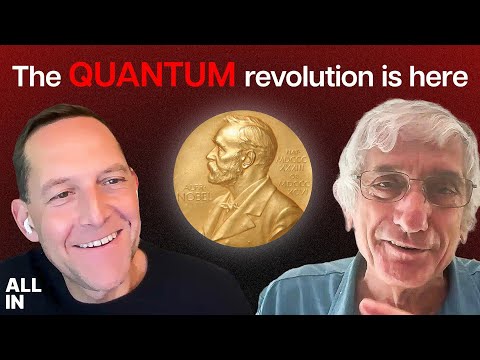
David Friedberg interviews John Martinis, the 2025 Nobel Prize winner in Physics, about his groundbreaking work demonstrating quantum mechanical behavior at macroscopic scales. Martinis explains his journey from growing up in San Pedro, California with a father who built things in the garage, to UC Berkeley where he studied under John Clark and became interested in quantum mechanics in electrical devices. His 1985 graduate work proved that macroscopic objects (electrical circuits with billions of electrons) could exhibit quantum mechanical behavior like tunneling and discrete energy levels - a question first posed by Anthony Leggett.
The interview covers the fundamentals of quantum mechanics, explaining how particles at small scales behave like probability waves rather than deterministic objects, and how quantum tunneling allows particles to pass through barriers. Martinis describes attending a conference where Richard Feynman gave a talk about using quantum mechanics for computation, which inspired his life’s work in quantum computing. He went on to work at NIST, then UCSB, and eventually Google where his team achieved quantum supremacy with 53 qubits in 2019.
Martinis discusses the current state of quantum computing (50-100 qubits, but need roughly 1 million for general-purpose use), the 8-10 year timeline for practical quantum computers, and his concerns about China’s rapid progress in the field. He has now started his own company working with Applied Materials and other partners to develop next-generation fabrication techniques that could provide a significant leap forward. The interview concludes with his reaction to winning the Nobel Prize - his wife let him sleep in after the 3am call, waking him at 5:30am to prepare for reporters arriving at 6am.
Highlights
”My dad didn’t have a high school education, but very smart person”
Clip command
yt-dlp --download-sections "*1:06-2:05" "https://www.youtube.com/watch?v=GWOPRdN8INU" --force-keyframes-at-cuts --merge-output-format mp4 -o "GWOPRdN8INU-1m06s.mp4"“My dad actually didn’t have a high school education, but very smart person. He was always building things in the garage, various projects. So, I grew up kind of knowing how to build things, which also kind of tells you how things work, kind of empirical view, tactical view of how physics works.” — John Martinis, 1:06
”If you make the wall thin enough, the ball will tunnel through”
Clip command
yt-dlp --download-sections "*4:38-5:40" "https://www.youtube.com/watch?v=GWOPRdN8INU" --force-keyframes-at-cuts --merge-output-format mp4 -o "GWOPRdN8INU-4m38s.mp4"“If you think about throwing a ball against the wall, it’s going to bounce off. But if you make the wall thin enough and the ball light enough, it’ll then every once in a while tunnel through because of the laws of quantum mechanics.” — John Martinis, 4:38
”I was just a lowly graduate student at Feynman’s talk”
Clip command
yt-dlp --download-sections "*25:37-26:40" "https://www.youtube.com/watch?v=GWOPRdN8INU" --force-keyframes-at-cuts --merge-output-format mp4 -o "GWOPRdN8INU-25m37s.mp4"“Afterwards he was absolutely mobbed by people asking him questions… I was a graduate student so I was kind of at the outside ring… I was just a lowly graduate student so I could hear a little bit but what I learned from this, it was a great question and something that would be kind of worth doing for your life work because it’s so deep and so interesting.” — John Martinis, 25:37
”China published something indicating they were on par”
Clip command
yt-dlp --download-sections "*40:56-42:00" "https://www.youtube.com/watch?v=GWOPRdN8INU" --force-keyframes-at-cuts --merge-output-format mp4 -o "GWOPRdN8INU-40m56s.mp4"“The thing that scares me a little bit is, you know, last December the Google group published the latest results, which is really much nicer. They made some real improvement, but then China soon afterward published something kind of indicating they were on par or near par.” — John Martinis, 40:56
”My wife didn’t wake me up because she knew the day was going to be hectic”
Clip command
yt-dlp --download-sections "*45:59-47:00" "https://www.youtube.com/watch?v=GWOPRdN8INU" --force-keyframes-at-cuts --merge-output-format mp4 -o "GWOPRdN8INU-45m59s.mp4"“We got the call at 3:00 and my wife answered the phone and found out what happened. But she didn’t wake me up right away because she knew the day was going to be hectic and I needed my sleep to not be grumpy. So, she woke me up at 5:30.” — John Martinis, 45:59
”We need approximately 1 million qubits for general-purpose quantum computing”
Clip command
yt-dlp --download-sections "*35:54-37:00" "https://www.youtube.com/watch?v=GWOPRdN8INU" --force-keyframes-at-cuts --merge-output-format mp4 -o "GWOPRdN8INU-35m54s.mp4"“Right now we’re about 50 or 100 qubits for the superconducting case… you’re talking about a million qubit quantum computers to be general purpose and solve really hard problems. A million something. A million is a good round number for it. Maybe a little bit more. And right now we’re at a hundred.” — John Martinis, 35:54
Key Points
- Nobel Prize Background (0:45) - John Martinis won the 2025 Nobel Prize in Physics for demonstrating quantum mechanical behavior in macroscopic electrical circuits
- Early Life and Education (1:06) - Grew up in San Pedro, California; father was a fireman who built things in the garage, teaching him hands-on skills
- UC Berkeley and John Clark (2:10) - Studied physics at UC Berkeley where advisor John Clark was researching quantum mechanics in electrical devices
- Anthony Leggett’s Question (3:19) - The Nobel Prize-winning physicist posed the question: do macroscopic objects behave quantum mechanically?
- Quantum Mechanics Explained (5:02) - At atomic scale, we must use probabilities to describe particle positions; electrons exist as fuzzy wave functions around nuclei
- Quantum Tunneling (9:28) - Particles can pass through barriers due to wave function behavior; seen in everyday memory circuits and magnetic memories
- Schrodinger’s Cat Paradox (12:14) - Leggett pointed out there was no experimental evidence that macroscopic objects could exist in quantum superposition states
- Electrical Circuits as Test Systems (14:36) - Circuits operating at microwave frequencies (5 billion attempts per second) make macroscopic quantum behavior observable
- Josephson Junction (15:22) - Two superconductors with an insulating barrier between them; Cooper pairs tunnel through together without loss
- Superconductor Physics (16:34) - Below critical temperature, electrons condense into Cooper pairs that move together as supercurrent without resistance
- 1985 Breakthrough (23:17) - Published work in Physical Review Letters demonstrating discrete energy levels in macroscopic circuits, proving quantum mechanics at scale
- Feynman’s Quantum Computing Talk (24:54) - Attended conference where Richard Feynman discussed using quantum mechanics for computation; crowd mobbed him with questions
- Peter Shor’s Algorithm (27:03) - In early 1990s, Shor developed factoring algorithm showing real-world applications for quantum computing
- Google Quantum Supremacy (30:03) - In 2019, achieved quantum supremacy with 53 qubits; demonstrated computation taking much longer on classical computers
- Qubit Architecture (30:56) - Metal wires connected by Josephson junction and capacitor, oscillating at 5 GHz to form qubits
- Current State of Field (33:07) - Thousands of researchers working on superconducting quantum computers; IBM selling quantum computers and computer time
- Timeline to Useful Quantum Computing (35:54) - Currently at 50-100 qubits; need approximately 1 million qubits for general-purpose use; 8-10 year timeline
- AI and Quantum Computing (39:17) - Potential to use quantum computers and AI together; AI could help with error correction decoding
- China Competition (40:56) - China duplicated Google’s quantum supremacy experiment; publishes results matching Western progress shortly after announcements
- New Company Strategy (42:45) - Working with Applied Materials on 300mm fabrication tools unavailable in China to achieve next fabrication leap
- Nobel Prize Reaction (44:06) - Wife received 3am call but let him sleep until 5:30am; reporters arrived at 6am for interview
Mentions
Companies
- Google (29:16) - Where Martinis built quantum computing lab and achieved quantum supremacy in 2019
- IBM (33:34) - Selling quantum computers and time on quantum computers
- Applied Materials (43:03) - Partner for next-generation 300mm fabrication processes
- Synopsis (43:52) - Partner providing design tools
- Hewlett Packard Enterprise (43:54) - Industrial partner in quantum computing consortium
Products & Technologies
- Josephson Junction (15:22) - Two superconductors with insulating barrier; fundamental component of superconducting qubits
- Cooper Pairs (17:37) - Paired electrons in superconductors that move together without energy loss
- BCS Condensate (17:40) - State where superconductor electrons are locked together
- Yttrium Barium Copper Oxide (15:42) - High-temperature superconductor material Friedberg used in science fair
- MRI Machines (19:03) - Use superconducting magnets in liquid helium that maintain magnetic field indefinitely
- Neutral Atoms (36:31) - Alternative quantum computing approach; newcomer that looks promising
People
- John Clark (2:14) - Martinis’s advisor at UC Berkeley who was researching quantum mechanics in electrical devices
- Anthony Leggett (3:22) - Nobel Prize winner (2003) for helium-3 physics who posed the macroscopic quantum mechanics question
- Richard Feynman (25:14) - Famous physicist who gave talk about quantum computing at UC Santa Barbara conference
- Peter Shor (27:03) - Developed factoring algorithm in early 1990s showing practical quantum computing applications
- Michel Devoret (25:48) - French collaborator from CEA who Martinis worked with as postdoc
- Daniel Esteve (28:01) - French physicist Martinis collaborated with
- Christian Urbina (28:04) - Colleague who worked with Martinis in France
- Dave Wineland (28:32) - Nobel Prize winner for atomic physics quantum computation; worked down hall from Martinis at NIST
- Stephen Hawking (8:55) - Figured out particle-antiparticle creation near black holes leading to evaporation
- Ben Mazin (47:50) - UC Santa Barbara researcher using superconducting detectors for exoplanet searches
Institutions
- UC Berkeley (2:02) - Where Martinis did undergraduate and graduate work
- Lawrence Berkeley Lab (3:03) - Where Friedberg worked as undergrad
- CEA France (27:52) - French atomic energy commission where Martinis did postdoc
- NIST (28:24) - National Institute of Standards and Technology where Martinis worked
- UCSB (29:43) - UC Santa Barbara where Martinis built 5 and 9 qubit quantum computers before joining Google
- Physical Review Letters (23:36) - Journal where 1985 breakthrough was published
- Scientific American (23:40) - Featured article about the macroscopic quantum mechanics discovery
Surprising Quotes
“My my dad, you know, actually didn’t have a high school education, but very smart person. He was always building things in the garage, various projects. So, I grew up kind of knowing how to build things, which also kind of tells you how things work.” — 1:27
“If you make the wall thin enough and the ball light enough, it’ll then every once in a while tunnel through because of the laws of quantum mechanics.” — 4:47
“I was a graduate student so I was kind of at the outside ring… I was just a lowly graduate student so I could hear a little bit but what I learned from this it was a great question and something that would be kind of worth doing for your life work because it’s so deep and so interesting.” — 26:08
“The thing that scares me a little bit is, you know, last December the Google group published the latest results, which is really much nicer. They made some real improvement, but then China soon afterward published something kind of indicating they were on par or near par.” — 41:47
“My wife answered the phone and found out what happened. But she didn’t wake me up right away because she knew the day was going to be hectic and I needed my sleep to not be grumpy.” — 46:32
Transcript
0:00 Welcome. Today I’m very excited for this all-in interview with this week’s Nobel laureate, winner of the Nobel Prize in physics in 2025, John Martinis. John, welcome to the all-in interview. Yeah, thanks for inviting me. I’m quite excited about this talk and love to explain to people about what this prize is all about.
0:27 All right, besties. I think that was another epic discussion. People love the interviews. I could hear him talk for hours. Absolutely. Oh, he crushed your questions in a minute. We are giving people ground truth data to underwrite your own opinion. What did you guys think? That was fun. That was great.
0:45 Well, the Nobel Prize is the most prestigious honor and particularly in physics that I think can be awarded. You’re in the record books. It’s going to be an incredible ceremony coming up for you. Maybe we could go back to the beginning in your history. I’d love to hear a little bit about, you know, where did you grow up and how did you get started with your interest in physics?
1:06 Well, so I grew up in San Pedro, California, and grew up there my whole time. My father was a fireman and my mom stayed at home, took care of us. Through the years I was always interested in science, technology. One of the things is my dad actually didn’t have a high school education, but very smart person. He was always building things in the garage, various projects. So, I grew up kind of knowing how to build things, which also kind of tells you how things work, kind of empirical view, tactical view of how physics works.
1:48 When I took physics in high school, I actually loved it because there was actually some math behind it and concepts and really made sense to me. I just really fell in love with the subject and then went to UC Berkeley and did pretty well there and enjoyed it a lot. And then in my senior year at UC Berkeley I had a class from John Clark who was my adviser and found out what he was doing. He was just starting to look at these quantum mechanics and electrical devices stuff and it sounded really interesting for me. I guess I could see maybe when something would take off. So I started to do the graduate school work with him.
2:36 You went to Berkeley for graduate school. I went to Berkeley for graduate school, which you’re not supposed to do. I was originally a physics and math undergrad at Cal. I changed my major later and actually got my degree in astrophysics. There was some upper division math class that really turned me off to math as a major. There was just so many proofs. It drove me nuts. And then physics was always exciting, but I liked working in the astro lab and I worked actually at Lawrence Berkeley Lab.
3:07 But then you stayed at Berkeley and went to grad school, right? Yeah, I stayed at Berkeley, went to grad school. We started this project a couple years into grad school. And what was interesting is this was a question that was actually posed by professor Anthony Leggett who won the Nobel Prize for helium 3 physics in I think 2003. Was that super fluid? Super fluid helium 3. Yeah that’s right.
3:34 So he showed like if you put helium 3 cold enough it kind of almost has this new sort of characteristic with the physics and how it moves and how it works. It has this super fluid behavior, but it has a very complicated behavior because of the more complicated nuclei of the helium 3. This had been discovered and people worked for a while to figure that out. And he helped develop the theory for that. So, he was quite well-known, very, very smart person.
4:05 Although he won the Nobel Prize for that, there’s not much helium 3 physics going on, but for the question that led to our experiment, there’s a huge field. And the question was, do macroscopic objects behave quantum mechanically? This is a macroscopic object might be a small ball. In our case, it’s an electrical circuit with billions of electrons in it, billions of atoms and is the collective motion of say the ball quantum mechanical.
4:38 If you think about throwing a ball against the wall, it’s going to bounce off. But if you make the wall thin enough and the ball light enough, it’ll then every once in a while tunnel through because of the laws of quantum mechanics. Hold on, let’s just pause on that for a second. I think that’s really worth spending a moment on.
5:02 So when we talk about quantum mechanics, when we talk about the relative position or energy or movement of a particle at the atomic scale as small as an atom or smaller than an atom, we have to use kind of probabilities to describe where things are going to be. That was what was really kind of the big understanding of quantum mechanics in the early 20th century, right? The probability of things being where they are and moving as they’re moving there. It’s not like deterministic like we can see with the ball that we throw around. When you get very very small things get very fuzzy and it’s very hard.
5:43 So you hit upon the key idea here maybe by accident but it’s very important. Quantum mechanics was developed for the theory of small things. Electrons, atoms, things that are the fundamental constituents of it, but very small. If you take an atom, it’s made from electron and a nucleus. Classically, they attract each other and they would just combine together and then atoms basically would have no size. Why do atoms have size? That was one of the strange things and it’s because this atom is kind of not a point particle. I used to say to my kids that the electrons were fuzzy.
6:34 Quantum mechanically it has some wave function and extended. You can think of the electrons being all around the nucleus at the same time. It’s just a very strange behavior but of small things and of course very important as how atoms work and how we describe nature. So quantum mechanics ultimately became a field that people say is very non-intuitive in terms of understanding where small particles are, the energy they have, where they’re moving to and basically we resolved to figuring out that we had to use these functions. It’s not just a single point, but it’s a distribution. It’s a whole bunch of places and there’s a probability of where the atom could be or where the electron could be. It’s also a probability of how fast it might be moving. All of these things become probability functions.
7:27 And you develop a mathematical theory for doing this that takes you until your third year in university to really know enough math to understand that. But basically that’s right, these are forming waves, waves of the electron. So you have kind of a wave and electron around the nucleus describing what the electrons are. And these are kind of like standing waves, it’s like hitting a string. If different length strings, different tension strings form different notes, these vibrations of the electrons around the atom can vibrate at different frequencies.
8:07 So rather than think about an electron moving around an atom in a prescribed path and I can know where it is at any point in time, the right way to think about an electron around an atom is it’s in a wave. There’s a wave that describes kind of where it is and what it’s doing. And you have the electron and you have the proton attracting it. So the whole wave theory combines all those two and gives you a description of how the atom works and quite accurate description too.
8:38 And so one of the other kind of features that arises from the fact that everything at a micro scale is described by wave functions is that there’s a small probability of something kind of extreme or extraordinary happening. Like one example is Stephen Hawking figured out that you could have a particle and antiparticle come out of nowhere in the middle of space and the antiparticle goes into the black hole. The particle shoots off. And that the probability of that happening is so low, but it happens enough that the antiparticle actually starts to delete part of a black hole. And that’s how black holes evaporate.
9:14 But can you tell us what quantum tunneling is? So this is another one of these sort of features of quantum mechanics that arises from the fact that these things are kind of waves and probability functions. Yeah. So if you have an electron just traveling through space hitting a wall let’s say there’s a little wave packet wave function to it. So it’s not a single particle. It has some extent to it. And what happens is that when that particle hits the wall, quantum mechanics says there is some small amount of this wave function or if you like the particle going through the wall and then to the other side.
10:00 Now most of the time it bounces off but every once in a while it goes through. And this is seen in everyday devices. This is not… if you build very small memory circuits you have to worry about electrons tunneling and charge leaking off your capacitor. They have magnetic memories that depend on these tunnel junctions. So this is a very well-known phenomenon and if you make this barrier, this insulator just 10, 20 atoms thick then that’s thin enough for it to go through.
10:37 To go through. So this is what’s so interesting. You can actually predict the number of electrons that might tunnel through one of these barriers, one of these insulating barriers as they’re called over to the other side which really is crazy to think about. It’s just like walking through walls, right? Yeah, that’s the idea. So, going back to the story you were sharing, you’re in grad school, right? And then Leggett proposes this idea. Maybe you can share a little bit more now that we’ve got I think a bit of the basics on what was discussed, which was zooming out a bit like rather than just think about all of this happening at a microscopic scale, is it possible for it to happen at a bigger scale?
11:17 Yeah. And again we’ve been talking about quantum mechanics is the physics nature at this microscopic atomic scale but the question was if you made a macroscopic object would it obey quantum mechanics also. And that was the basic question and it turns out that there’s a very natural system to look at, looking at an electrical system and seeing for quantum mechanics an electrical system where the currents and voltages of essentially electrical oscillator, does it behave like classical physics or does it behave with this quantum mechanical nature to it? And that was the question.
11:59 Now it turns out that when you think about quantum mechanics and thinking about well there’s the quantum behavior but then at some point you have to measure it which then turns it into a probability. There’s something called the Schrodinger’s cat paradox where in the paradox you have your radioactive decay and then you let it happen for let’s say half of the radioactive decay time and then you have a detector and then a bottle of cyanide which will kill a cat and then do you say after some amount of time is the cat in the dead or the live state.
12:47 Physicists, this is a good question. Einstein brought it up or Schrodinger brought it up. A lot of people discussed it. But Leggett pointed out that the reason this is a paradox is you can believe that a macroscopic object like a cat could be in a quantum superposition state. And in fact, there was no experimental evidence that this could happen. And that was his point. So he said people should be testing this and let’s see if it’s true and as a young graduate student who just learned about quantum mechanics and it’s like oh that’s a really great question that’s something that we should try to do and we should try to do an experiment on the suggested system to look for quantum mechanics. And the original proposal was looking for the tunneling. Well, it turned out to be more than that, but it looked for tunneling.
13:49 Let me just kind of describe another way is the macroscopic system could be my entire body. Could I walk through a wall? That’s right. And then the probability of all of my atoms being in the perfect moment, perfect position to be able to kind of cross through the wall is so low, it would never happen in this or many other universes. And that’s the problem is that most macroscopic objects when you try to think about the quantum mechanics that won’t happen.
14:21 Right. There’s a small probability one electron can cross over a barrier, but the probability that many cross over at once is lower and lower and lower and that makes it very difficult to see at scale. And what happens is if you look at an electrical circuit then the parameters become favorable for seeing this kind of macroscopic behavior. It’s hard to go into the whole physics of all that, but it’s basically because you can make a circuit that operates at microwave frequencies. So instead of you trying to go through the wall once a second, it tries to go through the wall five billion times a second. So then you have more chances to go through. And the other thing is the various parameters involved in quantum mechanics are favorable for seeing this kind of phenomena. You have to do the experiment right but it’s favorable for doing that.
15:22 So one of the parts of your experiment you created what’s called a Josephson junction. Is that correct? So this is two superconductors with a barrier between them. Right. I got really fascinated by superconductors when I was maybe 12 years old. I went and bought a superconducting disc, yttrium barium copper oxide. From the back of Popular Science and then I went to UCLA and I got a jug of liquid nitrogen and then I floated a magnet above the disc because of the Meissner effect and I had it at the science fair and I did very well with the science fair that year.
15:59 What year was that? Was that when it was discovered? Must have been ‘91. Okay. Yeah, that was close enough that that was good. Yeah, the hard part is getting the liquid nitrogen. Yeah, and I had a friend whose dad was like a doctor at UCLA or something like that, so he was able to get the liquid nitrogen for our demonstration. Right. Yeah, that was the hard part.
16:19 I’ve always been fascinated by the physics of superconductors and maybe you can just explain one of these important features of superconductors as it relates to kind of resistance and current flow and then we can talk about your experiment. So what happens is when a material goes superconducting all the electrons condense into one state. Now to just give you an analogy, it’s not a perfect analogy but a close analogy. If you have a normal metal, any metal we have at room temperature, it’s like a gas of electrons. It’s like gas in the air.
17:01 Sorry, I think we should just explain that. So you have a metal, all the electrons are kind of moving around. They’re perturbed. They’re all different energies, different states. That’s right. Different energies, different states. There’s some Fermi statistics. Not going to go into that, but it’s more or less looks like a gas. You think of a gas and then when you cool it below a certain temperature it then coalesces into let’s say a solid like atoms will and the electrons coalesce into the something called Cooper pair BCS condensate where all the electrons are kind of locked together and doing the same thing.
17:48 Now the nice thing about that, it’s not like they’re frozen in place but they have a free parameter that allows them, all the currents, all the electrons to flow in some direction which is the supercurrent in a superconductor, meaning a material that’s cool enough that it reaches its superconducting critical temperature. Right? So suddenly all the electrons can still move. They can still create a current, but they’re moving together like in my analogy like they’re in a solid instead of the gas.
18:20 And because they’re moving together, when you work through all the physics, they are not randomly scattering off things. They’re just moving together. And then you get a supercurrent where for example if you made a ring, a superconductor, that current would basically flow forever around the ring. This is what you saw with the floating magnet.
18:40 Right. That’s so interesting. I’ve always thought and there’s obviously been companies started around the idea of creating an infinite battery where you could store technically forever electricity because the electrons are just moving around. If it’s superconducting they can just spin forever around that circuit. And people actually do use big superconducting magnets to store energy. And when you get an MRI, you’re in a liquid helium machine with a superconducting magnet, they charge it up and that magnetic field is basically there forever, waiting for people to go inside it. It’s kind of strange to be in, you’re inside this super cold magnet. But they’ve designed it very well. Works well.
19:26 So this Josephson junction is two superconductors. They’re on either side of a barrier that you create, an insulating barrier. And then maybe just explain the experiment and what you guys measured. And this was all while you were in grad school, right? Yeah. And this Josephson junction, because the Cooper pairs have to tunnel through it, but they kind of tunnel through it together without any loss. This actually forms what’s called an electrical inductor in circuits. So an inductor is normally a coil of wire that stores energy in its magnetic field. Here this just stores energy of the electrons tunneling through. And so it’s something called kinetic inductance and it happens with this but that forms a nonlinear inductance.
20:18 And with a capacitor in the circuit that forms an inductor capacitance resonance circuit which is like in your old radios you have filters of LC resonance circuits to filter your signal and do anything. So this is a very common microwave and radio frequency element that you use all the time to make electrical circuits.
20:46 So I just want to simplify that. You have these two superconductors split by this barrier. There’s some tunneling, some of these electrons are actually going through the barrier to the other side and then you can effectively measure all of these different changes as you change the temperature. You guys were putting different voltage states into this circuit that you built. And what you saw and what you measured and what you demonstrated was that there were these very kind of discrete or specific changes that happened that basically demonstrated quantum mechanics at scale.
21:20 That’s right. So this inductor capacitor resonator which you just treat as a charge and a current going through but because it’s quantum mechanics there’s this wave function to it. So there’s some uncertainty in these and then given just the way that the simple electrical circuit works you can then demonstrate the quantum mechanics, one of the tunneling which is a little bit hard to describe here but you can see tunneling. But I think the little bit easier thing maybe easier is to look at the energy levels of this.
21:59 Let me kind of explain that. When people discovered atomic physics and started doing this, they excited a gas of some gas and the light coming out of that gas would be at certain colors of frequency. So if you go outside and you have the sodium lamps on, these are kind of the yellow lamps, you have kind of a single frequency coming out of that lamp. Or nowadays you look at LEDs, there are certain frequencies that come out of that. And this is a quantum mechanical effect, how the electrons travel around the atom. There’s only certain kind of frequencies that they oscillate at.
22:47 Classically, you would expect there to be all different frequencies that it spirals around or spirals into the nucleus. So, that’s what you expect. But we saw these discrete frequencies. And so, by measuring those discrete frequencies, you now had proof that there was quantum mechanics happening at a macro scale. That’s right.
23:11 And you published this work. And was there a lot of attention when you published this work? This was in 1985-86. Yeah. 85 or I actually forget but 85 or 86. And so was there much attention on this work at the time? Yeah. This was a big question and people wanted to understand that and we published it in Physical Review Letters and it got a lot of attention and I think we had a little article in Scientific American that I was very proud of that wrote about that and yeah it was kind of a big deal.
23:50 What did you go on to do at that point? Was it considered groundbreaking Nobel Prize-winning work and what was the story at that time when this came out? Yeah. So, it was an important piece of work and people noticed it, but we showed that quantum mechanics worked and quantum mechanics worked on the macro scale, which was nice, but one could still argue, well, what is it good for? What are you going to do? And in fact the secret of an important scientific breakthrough is does it lead to other experiments and other papers and other inventions and the like and that kind of took many decades to happen because it was so new and people had to do that. So I would say it was noteworthy at the time but not necessarily something for a Nobel Prize because it was just kind of weird and went off and what are you going to do with it?
24:54 But what happened at the time was very interesting and at the end of my thesis time there was a conference at UC Santa Barbara where I came here for the first time. And they were talking about this experiment but the very last day the last talk was by Richard Feynman, very well-known physicist. Of course, the greatest. Yeah right. I kind of idolized him and read his books and whatever. And he was talking about using quantum mechanics for computation which is building a quantum computer.
25:37 So he gave a talk that was really kind of amazing. I’m going to be honest as a student. I didn’t quite catch everything and my friend Michel Devoret said yeah maybe some of the things wasn’t quite figured out at the time but afterwards he was absolutely mobbed by people asking him questions because it’s so interesting to think about taking this basic law and actually doing computation with it.
26:08 And I was a graduate student so I was kind of at the outside ring, you have the professors in close and whatever and I was just a lowly graduate student so I could hear a little bit but what I learned from this, it was a great question and something that would be kind of worth doing for your life work because it’s so deep and so interesting and maybe practical and the like so that really motivated me.
26:39 Yeah so that big idea is to use quantum mechanics and these properties of quantum mechanics to do computing. Yeah, that’s right. And I would say soon after that other people in the field got a little bit more specific and showed how you would do it. And then it was in the early 1990s, maybe 5 years later, that Peter Shor came up with this factoring algorithm to solve a real world problem with it.
27:09 Yeah. And it took a while for people to figure out. It was very abstract and people quite weren’t sure what to do. But like I said I could see that in all the crowd around Feynman asking him questions that this was the most interesting fundamental question, how to combine quantum mechanics with doing computation. It’s really amazing. And so you started to do that with your life’s work pretty much. You go on to a very good career.
27:42 Yeah. So my career path was, of course quantum computing was getting developed and it took me a while to really get go all in on it. So what happened is Michel Devoret was from France from CEA France, went to Berkeley, went back. I went there as a postdoc and worked with them and they were young and unknown at the time and people like well you’re going to go to Europe and you’re not going to get connected to US science but I knew Michel and Daniel Esteve and Christian Urbina, the people I was working with, were absolutely brilliant and they’ve had a very illustrious career. So I went over there because I knew that was great. And we continued to do experiments on this.
28:29 And then after that I came back to the US and I worked for the National Institute of Standards and Technology. And it turns out just down the hall from Dave Wineland and his group who won a Nobel Prize for atomic physics for doing quantum computation. And I worked on some experiments on counting electrons and working for metrology and then did other experiments. And then in late the ’90s I just again went all in on building a quantum computer. There was funding available at that time. It had progressed enough theoretically that the US government started funding this to see if people can do it.
29:16 And so then a couple years after, in 2014 I think you ended up at Google’s quantum lab in Santa Barbara. Is that right? I was at UCSB for 10 years or so which was wonderful and built up the lab to go from very basic things to building a five and then 9 qubit quantum computer. And then during that time, Google got interested and I kind of decided that although academia was great, it would be hard to get the team together and keep them together for a long time to build this complicated machine and Google had the money.
29:51 So we went there and we started off fairly small, mostly from people coming from my UCSB group and then in 2019 we published this quantum supremacy experiment with 53 qubits where we made a lot of qubits and we made them really good and fast and whatever so that we could run some algorithm, a mathematical algorithm that produced some output that took much much longer on a classical computer to emulate and do that. It was not practical but it was a demonstration of the power of a quantum computer, that it worked.
30:38 Well, just maybe give your description of a qubit and maybe we can relate, how do we build these quantum computers from qubits to the Josephson junction and some of the early work you had done that you ended up winning the prize for. So very simply, we have a metal wire and a metal wire that gets put together on this Josephson junction which represents an inductor flowing through here. And then from this wire to this wire, we have a capacitor. And then we set that up to oscillate at about 5 GHz, cell phone frequencies, to form the qubit. Okay, this oscillating thing. And then there’s at low temperatures superconductors, all this magic we can get quantum mechanical behavior out of that.
31:32 And then you can measure that quantum mechanical behavior, create a representation and use that to run your computing. That’s right. What you can do is you put on microwave pulses to change the state of the quantum computer, change the way it oscillates and then we connect it to complicated readout circuitry to in the end figure out what state it’s in. And then you connect just an array of these and you just use capacitive coupling from one wire to the next one to couple them together and it’s more complicated than that but that gives you a good idea.
32:16 And then just to understand your work that you won this Nobel Prize for that demonstrated this quantum mechanical phenomena at scale. Is that part of the design of a qubit and the circuitry? Did that inform that design work or explain it rather? Yeah. It was the very basic simplest circuit. We were using analog simulators at the time, not even the… I took data with a computer but this is far back enough that it was very rudimentary. And then over the years we just got more sophisticated design by the whole field, many many people. And we were able to put things together in a way to actually build a computer now.
33:07 The reason why it’s interesting from the Nobel Prize thing is what it led to and what it led to right now is a thousand, maybe several thousand people around the world doing research to build this superconducting quantum computer and it’s just turned into enormous field, large number of papers, large number of people, people selling quantum computers. IBM is selling quantum computers, people are selling time in the quantum computers and the fact that it was a useful idea that led and brought into form all these different experiments, ideas and many many people contributed this.
33:51 I mean it’s very interesting and I think just this broad question or observation that sometimes inquisitive minds lead to research that leads to some set of discovery that are completely not apparent until 40 years later, the effect or the impact it may have had on building an industrial field like there’s now quantum computing everyone feels is on the brink of actually achieving what people have talked about in theory for decades but seems to be getting very close to doing it.
34:25 Yeah I can talk on that but I would say this field, many other ideas on how to build a quantum computer has been generated and it is very exciting field, quite large field and I would say that the science was very very deep too. To get these things to work you have to invent lots of different devices. You have to think about materials. You have to fabricate it, build complex control systems. Engineering and physics is to me quite beautiful.
34:56 And just to tell you a little bit about me, I grew up building things and as an experimentalist, I like to build instruments, build experiments to show this. And this was kind of the ideal project for me because from very early on it was like, well, let’s do this great physics, but let’s also build something. And by saying, well, what do we have to do to build a quantum computer? that kind of led me to know what physics we have to test and what are the kinds of things we have to build and that’s just the way my mind works. I’m much more practically oriented. So it was a perfect field for me to get in and that’s kind of what intuitively led me to want to do this in graduate school. And I think it’s just so fascinating the amount of engineering and technology you have to do to make this work.
35:54 Where are we in quantum computing evolution today? So what’s the state? At what point will we have call it generally accessible and generally useful quantum computers that can do all of the amazing things everyone’s kind of talked about for decades that one would be able to do with quantum computers? So right now we’re about 50 or 100 qubits for the superconducting case but they can be fully controlled and run real algorithms and do very complicated things.
36:26 They have a lot of other systems that can do that. I think the newcomer on the block which looks good is neutral atoms where they’ve made big neutral atom systems but they’re still working to get the gates controlled really well and the like. But what’s happened right now is we can run genuine algorithms on that and people have ideas they want to run but because these qubits are not perfect, it’s an analog control system and fundamentally these quantum bits have a little bit of error to it, little bit of noise to it, you can only run so complicated of a project and it’s good enough to write scientific papers and try things out. Every once in a while people say they’ve done something that’s hard to compute and well that’s fine, but they aren’t really big enough to be useful yet. They have to get bigger and they have to get better, less noise.
37:30 Do you have a point of view on the timelines? This is everyone’s speculation and there’s been more hype than reality. Yeah, there’s more hype than reality and it’s hard. I used to not want to speculate that but since I started a company then I can do that and what we want to do and it’s a timeline of many other groups is to do something in let’s say in the next 8-10 years, something like that. But the problem is people are predicting 10 years for a while now so we have to do that.
38:08 But I can tell you for what we’re doing is that we’ve identified what are kind of the technology bottlenecks of the current fabrication ways to make a quantum computer. We’ve written some papers on it and we’re working with people in the semiconductor industry to manufacture this in a much more cost effective quality way, the way you make these GPUs or something and we think when we get that to work we can scale up very rapidly so in a let’s say 10-year time scale something like that.
38:45 In a lot of technically difficult fields like fusion energy, perhaps even quantum computing, they are seeing profound acceleration in getting to their crazy big goals on these very big technical projects because of AI. Is AI starting to play a role in solving some of the engineering, material science, scaling, noise issues that we’ve seen historically in quantum computing? And do you think that there’s an acceleration underway in performance improvements because of AI?
39:17 There may be and there’s things we can maybe do modeling and the like. We also think what we can do is use the quantum computer and AI together to solve the problems better. So that’s what our theory team is proposing. I used to work with Google Quantum AI. That’s what they’re proposing. So there’s a general feeling of that. My particular view though is that in terms of this control, if you don’t build your system cleanly enough and that the control is clear enough, you’re not going to get the great performance out of it. So I’m a little bit old school here and working on building it that way.
40:05 There’s certainly some elements where you can use AI, in the decoding circuit for the error correction and the like. But the one thing to mention to you is that these qubits are naturally very noisy and you can maybe do sometimes 100 for bad qubits and maybe a thousand, maybe few thousand operations before they kind of lose their memory. You can think of it as like dynamic RAM where you have to refresh it. Well, you have to refresh it with error correction. And because of that, you’re talking about a million qubit quantum computers to be general purpose and solve really hard problems. A million something. A million is a good round number for it. Maybe a little bit more. And right now we’re at a hundred or a little bit more than that. So we have a ways to go.
40:56 What is your view on China and the progress that they’re making in this technology versus the US? This is the topic du jour in every field, industrial field, computing, science is where’s China at compared to the US, the comparisons and everyone’s worried about the progress in China versus the US and what that means. So I can talk about my own field but when I have read the papers that duplicated what we did at Google on the quantum supremacy experiment, they know what they’re doing. I mean they go through the theory, they talk about a lot of it is very similar to what we’re doing but they know what they’re doing and they’re getting great results.
41:47 And the thing that scares me a little bit is, last December the Google group published the latest results, which is really much nicer. They made some real improvement, but then China soon afterward published something kind of indicating they were on par or near par or something to it. And I’m worried that the Chinese government is saying, well, you can’t publish anything until it’s in the Western press and then you can, then it’s open and you can talk about it. That’s precisely what I’ve heard.
42:25 So I’m a little bit concerned about that. Now, what we’re doing with our company is we’re doing a new generation of fabrication of the devices. And I would consider in my research we had the simple fabrication with the original papers in ‘85 and then around 2000 we had more sophisticated fabrication and then for the quantum supremacy experiment we did something even more complicated, other groups too. But we want to do a similar jump in the fabrication and what’s interesting about this is we’re going to be using Applied Materials and the modern fabrication processes that they have which on 300mm tools you can’t get in China for example.
43:14 You can get it for CMOS and then we’re developing standard processes but new recipes and new ways to put it together. And we think by doing that we can do a huge leapfrog and then get there faster and get there in a way that will protect our lead. There’s other things we’re doing too. And we think there’s a way to really lead the field and we’re happy we have good industrial partners of Applied Materials, Synopsis design tools, Hewlett Packard Enterprise, some startups who do the theory work. So we have a good consortium and we want to use all that knowledge and expertise of engineering to make this happen.
44:06 Where were you when you got the news this week that you won the Nobel Prize and how surprised were you because this is a 40-year-old research effort. Had anyone giving you a call, rumor, gossip mill saying, “Hey, you’re on the list this year potentially being considered?” So let me give you a little bit of the inside story. We’ve known that this was an important experiment from the beginning. We’ve obtained some other prizes that are much less well-known and really appreciative of all that.
44:42 What happens is the Nobel system put together Nobel symposiums where they get together physicists in a certain field which is quantum information and this kind of thing and they have all the scientists give talks and they want to kind of check on the vitality of the field, how big is it? And then also maybe some of the leaders that maybe think about it, can they give a good talk? Would they be a good representative?
45:16 So Michel and John and I have been to these symposiums before and we kind of knew what was going on, that at least we were considered. But I’ll just tell you as a scientist, just to be invited to these and be considered is a fantastic honor. And having getting the prize is just so kind of unbelievable that you shouldn’t think that way. So I’ve known about it for a few years. And in fact, to be very honest, in the past when the dates have come around, it’s like, oh, is this going to happen? And then you wake up in the morning and it’s like, “Oh, it didn’t happen.” And you’re kind of down for a day. It didn’t happen this year.
45:59 And that’s a very bad attitude. I don’t like that at all. And you should not covet some insanely difficult prize that only goes to a few people. So, what happened this year is I kind of worked through this over several years and this year I just kind of forgot about it. So, I went to bed and then we got the call at 3:00 and my wife answered the phone and found out what happened. But she didn’t wake me up right away because she knew the day was going to be hectic and I needed my sleep to not be grumpy.
46:39 That was nice of her. Don’t want to be grumpy talking about it. So, she woke me up at 5:30 and as I looked at the computer, oh my god. And then we had some reporters coming over at 6 which interviewed me right when I had found out, half hour after I’d found out. And it’s great. It’s a great honor and it’s just been really fun. And then I’ve been getting a lot of emails from people I’ve worked with or students I’ve had in the past congratulating me and you exchange little stories and the like. And it’s kind of a very special time.
47:20 That’s great. Any science or technology fields that you’ve been following outside of your core discipline that you think are really exciting? I always like to hear what major thinkers… To be honest, I’m just so focused on doing this and especially when you start a company, you better be focused, right? So, I’m doing that. But one of the fields that I find, this is someone Ben Mazin at UC Santa Barbara is looking for exoplanets and they’re using superconducting detectors that are somewhat similar to what we’re doing.
48:04 In fact, in the 1990s or so, I helped establish that field with other people and did that for five, six, seven years to do that. But he’s doing it in a different way. And I really like how this instrumentation that we’ve been working on, their quantum devices are now able to do these astronomy detectors and look for these. And of course, there’s so much going on in astronomy these days with gravitational detectors and exoplanet searches and it’s just really fascinating to me. And again it’s very much technology-oriented where people are building good detectors. This is what I like. I like building instruments. So that’s particularly interesting.
48:54 Yeah, that’s great. Very exciting field and hopefully will develop quantum computers that will help us build materials and technology to help us get there one day. So that’s right. Many rungs on the ladder of human progress. Well, congratulations again on winning the Nobel Prize in physics this year. Very well deserved. It’s a fantastic moment. Enjoy it. Enjoy the ceremony and we’re excited for your continued work in the field of quantum computing. And thank you.
49:25 Yeah. And thank you. I really enjoyed the questions and the flow where you were asking questions to explain it at the right level for people. And I really appreciate that. This is a great podcast.