California Forever: The Startup Building America's Next Great City
California Forever: The Startup Building America’s Next Great City
Summary
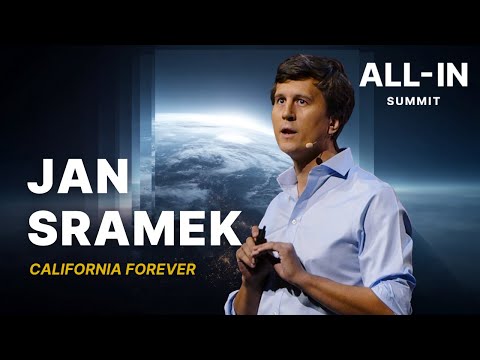
Jan Sramek, CEO of California Forever, presents his ambitious vision to build a new city in Solano County, California. Having raised over a billion dollars and acquired nearly 70,000 acres (over 100 square miles), the project aims to address California’s self-inflicted housing crisis and manufacturing decline. Sramek argues that despite California’s challenges, the state remains irreplaceable in America’s innovation ecosystem, and the solution is to build more rather than abandon it.
The project has three main components: the Solano Foundry (America’s largest advanced manufacturing park), a major shipyard to address national security concerns, and a new walkable city for up to 400,000 people. Sramek frames this as part of a broader movement toward American reindustrialization, emphasizing that competing with China requires “factories of the future” powered by robotics and AI rather than simply throwing labor at the problem. The Bay Area’s AI and robotics talent makes it the ideal location for this transformation.
The presentation positions California Forever as a physical manifestation of current American values: optimism, manufacturing resurgence, shipbuilding capability, affordable housing, and abundance. Sramek draws historical parallels to the transcontinental railroad, Hoover Dam, Kaiser shipyards, and the moon landing, suggesting that every era of American renewal has had its symbolic megaproject.
Highlights
”California is irreplaceable”
Clip command
yt-dlp --download-sections "*1:10-2:10" "https://www.youtube.com/watch?v=ElhxzUO7YQM" --force-keyframes-at-cuts --merge-output-format mp4 -o "ElhxzUO7YQM-1m10s.mp4"“Despite all of its flaws and challenges, California is irreplaceable. Whether you like it or not, there is nowhere else in America that can play the role that California plays in the United States right now.” — Jan Sramek, 1:10
”All of it was entirely self-inflicted”
Clip command
yt-dlp --download-sections "*2:03-3:05" "https://www.youtube.com/watch?v=ElhxzUO7YQM" --force-keyframes-at-cuts --merge-output-format mp4 -o "ElhxzUO7YQM-2m03s.mp4"“It was homelessness. It was people throwing rocks at Google buses. It was companies beginning to leave the state. And all of it was entirely self-inflicted. All of it. This was a self-goal. 100% of it.” — Jan Sramek, 2:03
”We cannot compete with China by throwing bodies at the problem”
Clip command
yt-dlp --download-sections "*5:06-6:10" "https://www.youtube.com/watch?v=ElhxzUO7YQM" --force-keyframes-at-cuts --merge-output-format mp4 -o "ElhxzUO7YQM-5m06s.mp4"“We cannot compete with China and onshore manufacturing by throwing bodies at the problem. We simply don’t have enough people in America to do that. The only way that we can compete is by building factories of the future where we use robotics and AI.” — Jan Sramek, 5:06
”One shipyard built more ships than the US has since WWII”
Clip command
yt-dlp --download-sections "*6:25-7:25" "https://www.youtube.com/watch?v=ElhxzUO7YQM" --force-keyframes-at-cuts --merge-output-format mp4 -o "ElhxzUO7YQM-6m25s.mp4"“Jong Jing Island shipyard in China built more ships last year than we have built collectively in the United States since the end of the Second World War. One shipyard.” — Jan Sramek, 6:25
”The enemy is that way”
Clip command
yt-dlp --download-sections "*7:45-8:40" "https://www.youtube.com/watch?v=ElhxzUO7YQM" --force-keyframes-at-cuts --merge-output-format mp4 -o "ElhxzUO7YQM-7m45s.mp4"“I hate to break it to you, but the enemy is that way. If you’re the Chinese Communist Party, the first thing that you’ll do in any kind of conflict in the Pacific is you will bomb or otherwise shut down the Panama Canal.” — Jan Sramek, 7:45
”A new shining city on a hill”
Clip command
yt-dlp --download-sections "*10:04-10:50" "https://www.youtube.com/watch?v=ElhxzUO7YQM" --force-keyframes-at-cuts --merge-output-format mp4 -o "ElhxzUO7YQM-10m04s.mp4"“California Forever is a physical manifestation of all of the most important things in America right now: this new optimism, manufacturing, shipbuilding, homes for everyone, speed and abundance. That’s why this matters for America because all of these places need a new shining city on a hill.” — Jan Sramek, 10:04
Key Points
- California’s irreplaceability (1:24) - Despite its flaws, no other state can play California’s role in American innovation
- Self-inflicted decline (2:12) - California’s problems (homelessness, companies leaving) are 100% due to failing to build enough housing, offices, factories, and infrastructure
- Historical building speed (3:07) - Golden Gate Bridge built in 4 years, Boeing 747 from idea to passenger in 3 years, nuclear submarine concept to water in 3 years
- Bipartisan building consensus (3:29) - Both left and right now recognize that “how do we build in America” is the defining question of the next 20 years
- Land acquisition scale (4:12) - Over a billion dollars raised, nearly 70,000 acres acquired - five times the size of Manhattan, 2.5x the size of San Francisco
- Solano Foundry (4:54) - Will be the largest advanced manufacturing park in America, collocating R&D and production
- Cannot compete with labor (5:15) - America cannot compete with China by “throwing bodies at the problem” - must use robotics and AI for productivity
- Manufacturing proximity problem (5:53) - Silicon Valley engineers currently have to make 3-day trips to Texas or Ohio to visit factory floors
- Chinese shipbuilding dominance (6:25) - Jong Jing Island shipyard built more ships last year than the US has built since WWII
- Chinese dual-use ships (6:39) - Every commercial ship in China is built to military standards for potential wartime conversion
- Shipyard scale comparison (7:13) - All major US shipyards plus China’s Death Star shipyard could fit in the 6.5 miles of waterfront California Forever owns
- Strategic vulnerability (7:51) - Most US shipyards are on the East Coast; in a Pacific conflict, China would bomb the Panama Canal, stranding the Navy
- Bay Area advantages (8:35) - Best natural harbor in the country plus all the AI talent needed to build ships of the future
- New city design (8:44) - Walkable city for 400,000 inspired by Charleston, West Village, and Marina - traditional architecture where 8-year-olds can walk to school
- Housing affordability gap (9:21) - Many Americans want to live in walkable traditional neighborhoods but can’t afford them or can’t find them at all
- Historical era symbols (9:46) - Gilded Age had transcontinental railroad, New Deal had Hoover Dam, WWII had Kaiser shipyards, Space Age had moon landing
Mentions
Companies
- California Forever (0:53) - The startup building the new city in Solano County
- Google (2:17) - Mentioned in context of people throwing rocks at Google buses
- Boeing (3:09) - Historical example of building speed - 747 from idea to passenger in 3 years
- Newport News (7:00) - The biggest shipyard in America
- Kaiser (9:54) - Historical shipyards from WWII era
Products & Technologies
- Solano Foundry (4:54) - Planned largest advanced manufacturing park in America
- Robotics and AI (5:27) - Key technologies for competing with China in manufacturing
- Nuclear submarine (3:17) - Historical example of fast US military development (1951-1954)
People
- Jan Sramek (0:53) - CEO of California Forever, born in Czech Republic in 1987
- Rosie the Riveter (9:57) - Historical symbol of WWII manufacturing
Places
- Solano County (0:11) - Location of the project, halfway between Silicon Valley and Sacramento
- Czech Republic (1:43) - Jan Sramek’s birthplace
- Jong Jing Island (6:25) - Chinese shipyard called the “Death Star of Chinese shipbuilding”
- Charleston (9:04) - Inspiration for the new city’s design
- West Village (9:06) - Inspiration for the new city’s design
- Panama Canal (7:59) - Strategic vulnerability in Pacific conflict scenario
Surprising Quotes
“It was homelessness. It was people throwing rocks at Google buses. It was companies beginning to leave the state. And all of it was entirely self-inflicted. All of it. This was a self-goal. 100% of it.” — 2:12
“Jong Jing Island shipyard in China built more ships last year than we have built collectively in the United States since the end of the Second World War. One shipyard.” — 6:25
“I hate to break it to you, but the enemy is that way. If you’re the Chinese Communist Party, the first thing that you’ll do in any kind of conflict in the Pacific is you will bomb or otherwise shut down the Panama Canal.” — 7:45
“We cannot compete with China and onshore manufacturing by throwing bodies at the problem. We simply don’t have enough people in America to do that.” — 5:11
“You cannot do a one-day trip to Texas or Ohio. It’s a 3-day trip. We should have places where Silicon Valley can build an hour outside of Menlo Park.” — 6:07
Transcript
0:02 The dream. Build a livable, affordable, eco-friendly community. California Forever owns more than 100 square miles of land here in Solano County, backed by Silicon Valley investors to build a new city.
0:16 We’re going back to what the Bay Area and Northern California used to do back in the 60s and 70s and 80s when it was the center for high-tech manufacturing in America.
0:24 This new city will be entirely self-funded and sustainable. The innovation engine that we have in Northern California is really special and the fact that we are throttling it by not building up housing is just crazy.
0:39 Ladies and gentlemen, please welcome Morning.
0:53 As you’ve just heard, I run California Forever, which is building the next great American city. And we are building it right here in California. And I know what all of you are already thinking, which is uh California. Really?
1:10 Well, uh where are we today? We are in California. The All-In Summit is in California. And I think that’s kind of the point because despite all of its flaws and challenges, California is irreplaceable.
1:26 Whether you like it or not, there is nowhere else in America that can play the role that California plays in the United States right now. And so we have to fight for fixing all of the things that are wrong with the state.
1:43 I was born in Eastern Europe in 1987 in the Czech Republic, which was two years before the wall came down. And growing up as a kid in post-Soviet Eastern Europe, California was the California dream. California was this.
2:03 And then after 26 years, I finally got here in 2013. And what I found was it was homelessness. It was people throwing rocks at Google buses. It was companies beginning to leave the state.
2:23 And all of it was entirely self-inflicted. All of it. This was a self-goal. 100% of it. Because we had failed to build enough of everything that you need to run an actual state. We failed to build enough housing. We failed to build enough office space. We failed to build enough factories. We failed to build enough freeways and trains and energy. All of it.
2:53 And I found that profoundly sad because to me, California and more broadly America, we were defined by building to the rest of the world. I mean, we were the place that could build better than anyone else in the world.
3:05 The Golden Gate Bridge was built in four years. The Boeing 747 went from an idea to carrying a fare-paying passenger in three years. The Navy got the idea to build a nuclear submarine in 1951. It was in the water in 1954.
3:27 And I thought it was really sad. Now here’s the good news. It took a while but in the last few years, both on the left and on the right, we have realized that this question of how do we build in America is going to be the defining question of the next 20 years.
3:45 And that brings me to this. Shortly after coming to California about a decade ago, I started working on what became California Forever. And we wanted to build a place where California would build at a scale that is worthy of this great state.
4:02 And we are doing that in a place called Solano County, which is about halfway between Silicon Valley and Sacramento. Very importantly, it’s also about half an hour east of Napa.
4:12 Over the decade, we’ve raised over a billion dollars and we’ve acquired nearly 70,000 acres to build. That’s over 100 square miles. This is what it looks like. It is this incredible canvas for California to build.
4:27 Again, it is five times the size of the island of Manhattan. The land we own is two and a half times the size of the city of San Francisco. It is where the Sacramento Bay meets the Sacramento River.
4:41 And what we’re going to build there are all of the things that California and America need right now. And we’re going to start by actually going back to what built Silicon Valley.
4:54 We’re going to start by building the Solano Foundry which will be the largest advanced manufacturing park in America, where Silicon Valley can once again collocate R&D and production.
5:06 There’s been a lot of talk about China here today and onshoring manufacturing. We cannot compete with China and onshore manufacturing by throwing bodies at the problem. We simply don’t have enough people in America to do that.
5:21 The only way that we can compete is by building factories of the future where we use robotics and AI to dramatically increase the productivity per worker. That also makes the job more fun. That also allows those companies to pay those people way better to work in those factories.
5:39 Who are the people who can build the factories of the future? Who are the people who do robotics and AI? Where do they live? They predominantly live in the Bay Area. And right now we are making it insanely hard for them to do their job.
5:53 By forcing them every time they need to go to the factory floor to get on a plane in Silicon Valley and fly to some other part of America and then adjust it and then spend 3 days coming back. You cannot do a one-day trip to Texas or Ohio. It’s a 3-day trip.
6:08 We should have places where Silicon Valley can build an hour outside of Menlo Park. And that’s what we’re building with the foundry.
6:15 The second major national security issue that we’re working on is shipbuilding. As you might have heard, we have quite a serious problem, Houston.
6:25 Just as one example, Jong Jing Island shipyard in China built more ships last year than we have built collectively in the United States since the end of the Second World War. One shipyard.
6:39 And by the way, every ship in China that is a commercial ship is built to military standards, so that if you need to in a conflict scenario, you can mount it with guns and systems and everything else that you need. We have a long way to go.
6:53 Here is the good news. Jong Jing Island, the Death Star of Chinese shipbuilding, is the area that you can see in red on this image. Newport News, which is the biggest shipyard we have in America, is shown in blue.
7:07 And then the next few shipyards are the next shipyards where we build submarines and other programs. The good news is that they all fit on the 6 and a half miles of waterfront that we own in Solano County on the deep water ship channel. All of them.
7:24 And that is less than 10% of the holding that we have overall in the area. So this shipyard has the scale to really move the needle for the country.
7:31 But it’s not just that. This is a map of all of the shipyards in the United States, public and private. And what you can see is that most of them are huddled around on the eastern seaboard and in the Gulf.
7:45 I hate to break it to you, but the enemy is that way. If you’re the Chinese Communist Party, the first thing that you’ll do in any kind of conflict in the Pacific is you will bomb or otherwise shut down the Panama Canal.
8:02 And if you’ve done that, there is no way to bring our ships back into the United States into the shipyards for repair. And there is no way to bring new ships out into the conflict without going around Argentina, which is tens of thousands of miles away.
8:17 So we desperately need new shipyards. We desperately need them on the West Coast. And the good news is that the best and the biggest site in America for shipbuilding, for new shipyards, happens to be located in the Bay Area.
8:32 Which is number one, the best natural harbor in the country. And number two, where all of the AI talent is that you need to build the ships of the future in the shipyard of the future.
8:44 Lastly, you can’t just build a shipyard and a manufacturing park. You need to build a whole city to support them. And to do that, we’re building a new walkable city for up to 400,000 people.
8:56 But unlike the shipyard and the foundry, which are about technologies of the future and of the 21st century, the city is inspired by old American neighborhoods, by places like Charleston and the West Village and Marina in San Francisco.
9:09 Where you have traditional, beautiful architecture. Your 8-year-olds can walk to school alone and you can have dinner with friends in a public square. It’s the kind of place that so many Americans and Californians want to live in, but right now they either can’t afford it or they even can’t find it at all.
9:27 And so in summary, there is this incredible energy whether it’s the re-industrialization movement, whether it is the abundance movement, people who say let’s it’s time to build, and all of them are calling on America to meet the moment.
9:42 And in the past eras whenever that happened, we had symbols that were built in those eras. The Gilded Age had the transcontinental railroad and the rebuilding of Chicago. The New Deal had the Hoover Dam. During the war, we built ships in Kaiser shipyards with Rosie the Riveter and the space age put a man on the moon.
10:04 And our proposition is that because of its scale and its location and ambition, California Forever is a physical manifestation of all of the most important things in America right now: this new optimism, manufacturing, shipbuilding, homes for everyone, speed and abundance.
10:22 And that’s why this matters for Solano County. That’s why this matters for California. That’s why this matters for America because all of these places need a new shining city on a hill and that’s what we are building. Thank you very much.