Bryan Johnson: I Just Took the Most Powerful Dose of DMT in the World... Here's What It Was Like
Bryan Johnson: I Just Took the Most Powerful Dose of DMT in the World… Here’s What It Was Like
Summary
Bryan Johnson joins David Friedberg and Jason Calacanis 48 hours after taking 5-MeO-DMT — what he calls the most powerful psychedelic on the planet, “somewhere between five and ten times more powerful than DMT” — to discuss the experience as a longevity intervention. Johnson describes being blasted into “infinite depth, infinite width, and dimensions” of raw consciousness, the dissolution of his ego and default mode network, and waking up the next day “laughing in a dream” — a characteristic of childhood. He frames psychedelics not as ritual or therapy for depression, but as a brand-new category of longevity medicine: a “psychological rejuvenation” that complements diet, sleep, and exercise by restoring the brain to a childlike, neuroplastic state.
The conversation drills into the underlying neuroscience: Johnson explains the brain like a globe of airports where psilocybin and 5-MeO scramble the routes, weakening the “New York to London” ruts of adult rumination and forcing new connections. He shares Kernel brain-interface data showing his default mode network “annihilated,” along with a first-in-human metabolic reset where psilocybin pushed his blood glucose from the 99.5th into the 99.9th percentile. Friedberg presses on the philosophical fallout — if a drug rewires your neurons in hours, are you still you? — while Chamath argues that in an AI-accelerated world, that very plasticity flips from liability to asset.
The episode closes with Johnson’s roadmap of next-generation interventions: mitochondrial transplantation (potentially using a sister’s child as a maternal-line donor), Foxo3 plasmid gene therapy, Yamanaka-factor reprogramming via New Limit, and “Bryan Johnson organoids” — lab-grown copies of his own heart, liver, and lungs being used to test molecules in a dish before they go in his body. Johnson and the besties argue that as GLP-1s, longevity drugs, and psychedelics make biological abundance routine, the metabolic malaise driving political extremism and personal unhappiness in America may finally start to lift.
Highlights
”The Most Powerful Psychedelic on the Planet”
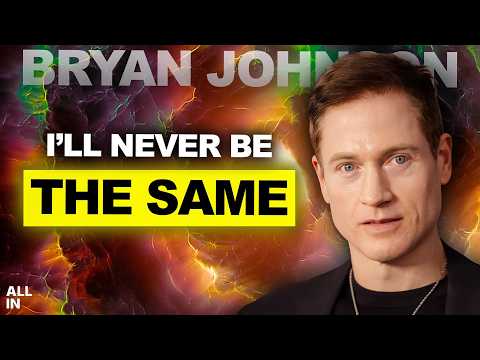
“I did five MEO DMT, which is the most powerful psychedelic on the planet, somewhere between five and 10 times more powerful than DMT. And so yeah, it’s been 48 hours. I’m still learning how to talk about it.” — Bryan Johnson, 0:07
Clip command
yt-dlp --download-sections "*0:07-1:00" "https://www.youtube.com/watch?v=Axpnkqd-Agk" --force-keyframes-at-cuts --merge-output-format mp4 -o "bryan-johnson-5meo-most-powerful.mp4"”You Have to Say Yes So Thoroughly”
“You have to in that moment, you have to say yes so thoroughly. You have to release all attachment, all preconditions, all want, all desire. You have to release self, ego, control. You just have to just relent entirely. And then when you do that, it opened up this unimaginable bliss and euphoria… this is without question the most dynamic experience I’ve ever experienced as a human.” — Bryan Johnson, 4:07
Clip command
yt-dlp --download-sections "*4:07-5:25" "https://www.youtube.com/watch?v=Axpnkqd-Agk" --force-keyframes-at-cuts --merge-output-format mp4 -o "bryan-johnson-say-yes-thoroughly.mp4"Restored to a Childlike State
“This morning I woke up catching myself laughing in a dream. I have not laughed in a dream — I don’t even know when I’ve ever laughed in a dream… I looked it up, and that is a characteristic of a child. And so you are restored to this childlike state.” — Bryan Johnson, 10:55
Clip command
yt-dlp --download-sections "*10:37-11:30" "https://www.youtube.com/watch?v=Axpnkqd-Agk" --force-keyframes-at-cuts --merge-output-format mp4 -o "bryan-johnson-childlike-state.mp4"Brain as a Globe of Airports
“Think of the brain like a globe with airports scattered about and you have certain traffic patterns like New York to London… when you do something like psilocybin it basically takes the airports, picks them up and then repositions them around the world. So it just all scrambles, so the traffic patterns aren’t the same.” — Bryan Johnson, 7:06
Clip command
yt-dlp --download-sections "*7:06-8:30" "https://www.youtube.com/watch?v=Axpnkqd-Agk" --force-keyframes-at-cuts --merge-output-format mp4 -o "bryan-johnson-brain-airports.mp4"”Am I the Same Person?”
“If I’m defined by my experiences, it roughly equates to my neurons are wired in a way that’s a consequence of my experiences. And if I go in and take a drug and in a few hours rewire all my neurons, am I the same person?” — Bryan Johnson, 21:12
Clip command
yt-dlp --download-sections "*21:02-22:30" "https://www.youtube.com/watch?v=Axpnkqd-Agk" --force-keyframes-at-cuts --merge-output-format mp4 -o "bryan-johnson-am-i-same-person.mp4"Bryan Johnson Organoids in a Petri Dish
“We took my IPSCs, we now have… a Bryan Johnson heart, liver, lungs. And now we’re gonna try molecules on me in dish… what if you give Bryan Johnson blank, you know, drug? What is — what happens? Is it good? Is it bad? What are the side effects?” — Bryan Johnson, 30:49
Clip command
yt-dlp --download-sections "*30:41-32:00" "https://www.youtube.com/watch?v=Axpnkqd-Agk" --force-keyframes-at-cuts --merge-output-format mp4 -o "bryan-johnson-organoids.mp4"Key Points
- 5-MeO-DMT as longevity protocol (0:59) — Psychedelics were never on the longevity radar until Johnson’s team found preclinical mouse evidence on psilocybin
- The 9 mg + 18 mg dosing (3:23) — 9 mg intramuscular plus 18 mg vaporized; “hits you within 10 seconds. You’re just out”
- Visual vs. felt experience (3:36) — Unlike DMT, 5-MeO is not visual; it lock you into raw existence with “the gates of hell” feeling unless you surrender
- Default mode network as ego engine (6:27) — DMN constructs self and ego; stiffens with age, narrows experience into ruts
- Psilocybin first-in-human metabolic reset (9:05) — Three 25 mg doses of psilocybin pushed Johnson’s blood glucose from 99.5th to 99.9th percentile and altered his microbiome
- Quantified with Kernel + MRI + EEG (13:57) — Structural MRI, functional MRI, Kernel optical brain interface, and real-time EEG to measure 5-MeO effects
- Psychedelic risks deserve all caution (16:07) — Friedberg flags persistent risk of psychosis and schizophrenic states; Johnson agrees safety structure is needed
- Founders abandoning companies (18:40) — Friedberg cites investors who put no-psychedelic clauses in deal docs after seeing CEOs walk away post-ayahuasca
- The identity question (21:12) — If a drug rewires you in hours, are you still the same person? Johnson calls it the most dramatic reconstruction of 60+ trillion cells possible
- Psychedelics as AI-era ally (22:24) — Chamath argues plasticity may flip from liability to asset when humans must change as fast as AI
- No limits on self-experimentation (23:46) — Johnson says yes to Neuralink, transgenic plasmids, and any frontier intervention; “I find it to be the most exciting context of life”
- Mitochondrial transplantation (26:35) — Friedberg pitches using a sister’s child’s young maternal-line mitochondria, multiplied in a bioreactor
- Bryan Johnson organoids (30:41) — IPSCs turned into in-dish replicas of his organs to test drugs and dosing before in-vivo administration
- Foxo3 plasmid gene therapy (29:37) — Mesenchymal stem cells with Foxo3 delivery showed >50% tissue rejuvenation in a Chinese study Johnson is replicating
- Yamanaka factor dosing problem (32:31) — Overdosing one cell can trigger cancer; Friedberg predicts cellular switches will eventually solve it
- GLP-1s as the first drop (33:23) — Johnson predicts history will see GLP-1s as the start, with Foxo3-style plasmid therapies as the second wave
- Metabolic malaise drives politics (34:31) — “84% of people have metabolic disorder. Over 40% obese… no wonder you have the proclivity towards these kinds of outcomes”
- 30–40 years of psychological rejuvenation (36:54) — Johnson estimates the 5-MeO experience returned him decades to a childlike state in a way nothing else can
Mentions
Companies
- Eight Sleep (0:29) — Episode sponsor; Pod cooling mattress cover
- Kernel (7:06) — Johnson’s brain-interface company used to measure default mode network changes
- Braintree/Venmo (13:05) — Johnson’s prior company, sold before he began Project Blueprint
- New Limit (32:11) — Yamanaka-factor reprogramming startup founded by Blake Byers and Brian Armstrong; Johnson is an investor
Products & Technologies
- 5-MeO-DMT (0:07) — Tryptamine psychedelic 5–10× stronger than DMT
- Psilocybin (1:09) — Three 25 mg “hero dose” experiments documented as longevity therapy
- Ketamine (13:25) — Earlier Kernel-quantified depression-therapy study, called “Little League” vs. 5-MeO
- Rapamycin / Metformin (1:09) — Standard longevity drugs Johnson has worked through
- Hyperbaric oxygen / Sauna (1:09) — Mid-tier interventions in his protocol
- Structural MRI / Functional MRI / EEG (13:57) — Imaging modalities used to quantify 5-MeO brain effects
- IPSCs (induced pluripotent stem cells) (30:43) — Source for Bryan Johnson organoids
- Yamanaka factors (32:02) — Reprogramming proteins; dosing is the gating risk
- Foxo3 plasmid / mesenchymal stem cells (29:37) — Gene-therapy approach showing >50% tissue rejuvenation
- GLP-1s (33:23) — Framed as the first wave of injectable life-changing biology
- Mitochondrial transplantation (26:52) — Phase-2 therapy Johnson is lining up
People
- Bryan Johnson (0:00) — Project Blueprint founder; Braintree/Venmo founder; subject of the interview
- Kate (12:00) — Johnson’s partner; first major emotional test post-trip
- Blake Byers / Brian Armstrong (32:16) — New Limit co-founders working on Yamanaka-factor reprogramming
- Chinese Foxo3 professor (30:14) — Author of the Foxo3 mesenchymal-stem-cell paper Johnson reached out to
Concepts
- Default Mode Network — The brain’s self/ego/rumination engine; quieter in children, ossified in adults
- Psychoflexibility — Friedberg’s term for willingness to change identity rapidly
- Hero dose — Clinical-grade dose of psilocybin (~25 mg)
- Project Blueprint — Johnson’s overarching longevity protocol
Surprising Quotes
“I’m stunned. Absolutely floored. Speechless. You basically experience raw consciousness and raw intelligence… multiply it by a thousand and then move out infinite depth, infinite width, and dimensions.” — Bryan Johnson, 2:26
“This was more efficacious than all of them in terms of the reset of me as a human. It just is incomparable.” — Bryan Johnson, 18:00
“One investor told me that he even put it in the deal docs that, you know, if we invest, you’re not going to do these psychedelics because they wanted to minimize the risk profile. It’s a thing.” — Bryan Johnson, 19:35
“Can humans change fast enough in the world where AI is the dominant engine of innovation? …you may want psychedelics as your ally to say as a human I’m struggling to move with the change.” — Chamath Palihapitiya, 22:24
“84% of people have metabolic disorder. Over 40% of people are obese. Like we’re just in really poor health. Nobody’s sleeping. Everyone’s on their phone. We have mental health issues. Like no wonder you have the proclivity towards these kinds of outcomes.” — Jason Calacanis, 34:31
“I’m gonna go to bed on time and do my wind-down routine.” — Bryan Johnson, 37:25
Transcript
Jason Calacanis: 0:00 Bryan Johnson, thanks for being here.
Bryan Johnson: 0:02 Yeah, it’s good to see you.
Jason Calacanis: 0:04 How are you feeling? Maybe just share with us what you did a few days ago and—
Bryan Johnson: 0:07 Yeah, I did a— I did five MEO DMT, which is the most powerful psychedelic on the planet, somewhere between five and 10 times more powerful than DMT. And so yeah, it’s— it’s been 48 hours. I’m still learning how to talk about it.
Jason Calacanis: 0:29 You know what many of the biggest tech CEOs and VCs have in common? They sleep on the Pod by Eight Sleep. It’s become tech’s favorite way to sleep, and for good reason. A cover that goes on any mattress, cools it down to 55 degrees, and uses AI to adjust your temperature all night, up to 34% more deep sleep. No wearable needed. Go to eightsleep.com/allin and use code ALLIN for up to $350 off your Pod purchase today. Before we get into your experience, why did you choose to do it?
Bryan Johnson: 0:59 Two things. One, mostly as a longevity experiment. So when we— when I started this project five years ago, the approach we had was go through all the scientific evidence ever published on health and longevity, try to find the interventions that have the best evidence and for effect size, and we just went down the list from top performing on down. So of course you start with exercise, nutrition, sleep, and you work your way down to things like hyperbaric oxygen therapy and a sauna, and then rapamycin, metformin. And so we never actually had on our radar psychedelics. They were always either an ancient medicine, being used in ritualistic practices, or being pointed at things like depression and anxiety and in certain trials. But it was never understood as a rejuvenation protocol, something that was for anti-aging. And so we found a preclinical evidence in mice on psilocybin. We thought that’s interesting. And so we did the world’s most studied, the most quantified experiment doing psilocybin, three doses at 25 milligrams of psilocybin—
Jason Calacanis: 2:00 Which are pretty high doses.
Bryan Johnson: 2:02 It’s yeah, it’s a clinical dose, very, very close to a hero dose, and we found that we think it’s a— a longevity therapy.
Jason Calacanis: 2:07 Let’s get to that data in a minute. But then you decided to try 5-MEO this weekend.
Bryan Johnson: 2:13 Yes.
Jason Calacanis: 2:15 Walk me through the experience, because you televised the whole thing. It was live-streamed. You looked amazingly calm going into it and going through the process. Walk us through your experience.
Bryan Johnson: 2:26 Yeah, I think those who have done 5-MEO would probably relate with me that it feels like an impossible task to explain what it’s like. So that caveat said, I’ll give it a go. I’m stunned. Absolutely floored. Speechless. You basically experience raw consciousness and raw intelligence. It’s this— so whatever, when I say these words, take these words that I communicate to you, take that idea— Yeah, multiply it by a thousand and then move out infinite depth, infinite width, and dimensions. And that gives you kind of like a rough map of like the size and space that you deal with. And it was incredibly hard because you get blasted into this space that is so foreign, you don’t even know what’s happening.
Jason Calacanis: 3:22 It happens very quickly.
Bryan Johnson: 3:23 Like you inhale it. I did nine milligrams of intramuscular and then 18 of vaporized, and it hits you within 10 seconds. You’re just out.
Jason Calacanis: 3:33 Visual changes? Everything?
Bryan Johnson: 3:36 Very little visual. Like you see on DMT, it’s a very visual, you’ll meet the elves or whatever else. This is not a visual experience. But you get in this world and you lock in to basically, you either panic because you feel like the gates of hell are going to open, that the stream of existence is just going to tear you to shred, it’s going to shard you.
Jason Calacanis: 4:05 Break your brain.
Bryan Johnson: 4:07 Yeah, you feel like it’s going to threaten your sanity. Like is it going to chop you up into little pieces? So in that moment you have to say, do I try to wrestle this and I need to just wait it out until it’s over, or you just relent and you say yes. And you have to in that moment, you have to say yes so thoroughly. You have to release all attachment, all preconditions, all want, all desire. You have to release self, ego, control. You just have to just relent entirely. And then when you do that, it opened up this unimaginable bliss and euphoria. And again, this is like a V1 of trying to explain this, but if I list out the most dynamic experiences I’ve had as a human, you know, certain accomplishments or getting married or having a child or overcoming a difficulty or, you know, state your list of things, this is without question the most dynamic experience I’ve ever experienced as a human.
Jason Calacanis: 5:22 Does the internal chatter, the internal monologue of the ego turn off?
Bryan Johnson: 5:26 It does. So you can’t hear yourself speaking. How do you rationalize what’s going on if you don’t have a dialogue going on?
Jason Calacanis: 5:35 It’s this visceral feeling. Like you’re hyper-aware of what’s happening. It’s not like you block out in the first, like, when you take a very high dose, you don’t really know what’s happening in the first few minutes, but then you kind of come to and you’re hyper-aware of everything. It’s not visual, but it’s this… you’re in the depths of existence. Like this… it’s just the…
Bryan Johnson: 6:00 the most majestic experience achievable by human, by intelligent life. I just can’t imagine anything more miraculous.
Jason Calacanis: 6:11 You’ve studied the biology, the biochemistry, what goes on in the brain as this molecule hits your neurons?
Bryan Johnson: 6:19 Yeah, so I mean like, it uh, I mean one, it completely dissolves your default mode network.
Jason Calacanis: 6:26 Describe what that is.
Bryan Johnson: 6:27 So like, um, it’s this is the engine that constructs self and ego. And so as you ruminate, you know, like you’re going through…
Jason Calacanis: 6:35 Thinking through your day, what’s next, how am I feeling, what should I be doing right now, constant conversation it’s like.
Bryan Johnson: 6:40 Yeah, it’s like do I feel bad about myself, do I feel, you know, like am I shy, am I like do I feel bad about whatever, like you’re doing this rumination stuff. Kids don’t have this rumination loop. Their default mode network is quiet and as you age you basically build up this default mode network into more stiffened patterns. And so as you age your experience of reality becomes increasingly narrow. You have these big ruts that form. And so you can just see people in their patterns, like how open a child is to say like very random things and as adults you’re just very shut in. Like when I did psilocybin one of the reasons why we did it is because it does have this effect where it dampens the default mode network. And we can pick this up with Kernel, the brain interface. You can see how the default mode network weakens. So basically like think of the brain like a globe with airports scattered about and you have certain traffic patterns like New York to London. You have a certain number of flights every day. That’s like a very strong connection. But New York to um, you know some small town in Arkansas has a very low traffic map. And so when you do something like psilocybin it basically takes the airports, picks them up and then repositions them around the world. So it just all scrambles so the traffic patterns aren’t the same. And then over time…
Jason Calacanis: 7:47 So the neurons don’t physically move, but the activity shifts around.
Bryan Johnson: 7:52 Exactly, the neurons are a little bit more random than they normally would be which
Jason Calacanis: 7:58 arguably drives neuroplasticity, causes those neurons to reach out for new connections and when new connections are made, new behaviors, new ways of thinking emerge coming out of these therapeutics. Is that a fair way to describe it?
Bryan Johnson: 8:12 Exactly right. Exactly right. So you look at my brain on psilocybin from Kernel, you see my patterns before, like the New York to London connection, you see my brain afterwards and it’s exactly what you said. New patterns are emergent, the old ones have quieted down so like a new map of connectivity and so we saw that happen and that does generate a lot of neuroplasticity.
Jason Calacanis: 8:28 And obviously this neuroplasticity rewiring these connections in the brain is what allows trauma victims or folks that have a certain wiring that they keep repeating in their brain which causes the trauma and the anxiety in their lives to get rewired and then that trauma and that anxiety feels like it dissolves or melts away, is that a fair
Bryan Johnson: 8:45 Exactly right.
Jason Calacanis: 8:47 Yeah. And so this has been documented in psilocybin, it’s kind of well understood. How did you connect that psilocybin data
David Friedberg: 9:00 …to an effort in longevity or was this just like a random idea, let’s try it out?
Bryan Johnson: 9:05 Yeah. Well, so we saw some mouse data that it had these effects. It also showed reduced inflammation. So we said like, this is interesting because most longevity therapies do some something with inflammation, right? Like inflammation is the killer. So if you can lower inflammation, very good sign. Uh, if you can do something that makes the brain more youthful and takes down those, those big ruts, that’s also useful. What we found with psilocybin though was that it had this, we found a first-in-human observation. It had this metabolic reset in the brain, where my blood glucose before this was in the top 99.5 percentile of all the population.
David Friedberg: 9:42 Okay.
Bryan Johnson: 9:43 After it went to the top 99.9 percentile. Like to move my blood glucose from that level is very, very hard, but it basically like, uh, not like metformin where you’re doing stuff with blood glucose, this just had a reset across the body, also changed my microbiome. Uh, so we saw full-on effects. So then we said, okay.
David Friedberg: 10:00 If that had that consequence, 5-MeO may have some similar characteristics. Since no one had done this in 5-MeO before.
Bryan Johnson: 10:07 Exactly. So there’s like, there’s some animal evidence. Um, but it’s the, the similar dynamics of like, can you take the brain and can you basically like smooth out the barnacles that accumulate. And 5-MeO-DMT compared to psilocybin, like just absolutely like blasted clean my default mode network. It felt like psilocybin dampens it, you know, like it softens it, but this thing just annihilated my default mode.
David Friedberg: 10:34 Turned it off completely. Yeah.
Bryan Johnson: 10:37 It just, it just doesn’t run the same way. But like, for an example, like, uh, this morning I woke up, uh, catching myself laughing in a dream. I have not laughed in a dream, I, I don’t even know when I’ve ever laughed in a dream. But that is a after I woke up I was like, that’s really weird. Like I don’t remember laughing. I looked it up and like, that is a characteristic of a child.
David Friedberg: 10:54 Right.
Bryan Johnson: 10:55 And so you are restored to this childlike state and I mean the past couple days I have felt childlike. You know, like yesterday morning I felt that, you know, that emergent excitement, the bubbling of like today’s so exciting, I’m going to do new things, I’m going to have new experiences, uh, that you’re just excited about all things. I haven’t felt that I don’t even know when, for so many years. So like it really was, um, profound on every layer. And I think I’m stumbling too, because I don’t even know how to talk about it yet.
David Friedberg: 11:27 During the day, you’re hanging out, you’re walking around, is your brain having the same normal chatter that it did before or do you think that there’s a persistent change in that default mode network?
Bryan Johnson: 11:41 Yeah, definitely a change. Like with I was with my partner Kate yesterday and we, um, I did something that made her upset. And so like in that situation, you know, like when, when couples are in that moment, you, you have like this negotiation: how do I sort this? And it all just became so clear to me. Like, when children have a fight, you have it out and then it’s just like, done. And you move on. But then adults take that and they like package it up and they want to weaponize it, be like, I got something on you. And then I’m like move it, I’m going to move the chess pieces and like try to leverage this and…
Jason Calacanis: 12:14 Or they store it up like a snake in one of those things that pops out all the snakes later. You know? So it all kicks it all out.
Bryan Johnson: 12:20 Exactly. And so like we had this and I just felt absolutely like no need to escalate or to defend or to like… it was just easy. Easy. And it was a breakthrough in our relationship, where I was able to communicate with her in a way and so it’s like laughing in my sleep, it’s how I deal with my partner when I walk around. I just feel so much… I feel so much more funny. You know like my ability to make quips that are just immediate. Uh, you know like, so yeah, I just feel renewed as a person in a way that I just really didn’t imagine.
Jason Calacanis: 12:56 Have you tried hallucinogenics before you started your longevity path a couple of years ago?
Bryan Johnson: 13:04 Yeah.
Jason Calacanis: 13:05 And did you do that recreationally or therapeutically?
Bryan Johnson: 13:09 It was mostly therapeutic in that I had sold my company Braintree/Venmo, I got a divorce, I left the Mormon Church and I was trying to remap like what is life? Who am I? What do I do? So it’s in that rebuilding stage where I just dabbled of like, you know I did Ketamine at Kernel. So one of our first studies at Kernel is we said Ketamine was a up and coming therapy for depression and we posed the question what happens when you do Ketamine? And so we did the world’s most intense measurement on Ketamine with Kernel, before during and after. And so that was interesting, like and I had some kind of you know transient effect, but that’s like a a like a Little League relative to 5-MeO.
Jason Calacanis: 13:47 And so as you’ve gone through this, maybe share a little bit of the MRI data that you’re gathering and the other data mapping neurological effects.
Bryan Johnson: 13:57 So far nothing. I have my subjective experience to share, but we we have a structural brain MRI, we have a functional brain MRI, we did Kernel which is like an optical interface and then I did real-time EEG capture.
Jason Calacanis: 14:12 And we should just talk about… I think it’s important. Structural, you can see the physical brain. Functional, you can see the activity in the brain. So neurons firing and neurons that are not firing, right?
Bryan Johnson: 14:27 Yeah.
Jason Calacanis: 14:28 And then electrical actions that are measured by a electrical device.
Bryan Johnson: 14:32 Exactly. So we basically like wanted because the brain is very… so we’ve had a lot of success rejuvenating my heart and my lungs and muscle and body fat, but rejuvenating the brain is very hard. And so we this is why this is so such a promising therapy. So we wanted to look at the brain through every modality possible. We wanted to look at blood flow, structural, molecular, you know the wave pattern form, so we it’s a it’s a very high fidelity quantification and so we’ll see what the data comes out. I’m very excited.
Jason Calacanis: 14:57 You did this on Psilocybin as well, right? You mapped the brain over time?
David Friedberg: 15:00 What did you learn there?
Bryan Johnson: 15:01 Dramatic restoration of youthful brain patterns.
Jason Calacanis: 15:05 Yeah, right.
David Friedberg: 15:06 Yeah. And what comes after 5-MeO? Like, I mean, how far do you take this?
Bryan Johnson: 15:13 Yeah, honestly, I am so encouraged by psychedelics. I, you know, again, in the community where I hang out, psychedelics have always been understood as, you know, it’s like a retreat, or it’s like a ritual you go to do various explorations. But never in the world of longevity, it’s never been understood as that thing. And now after seeing the data, man, I… And of course you have to be very careful when talking about psychedelics because they’re extremely powerful. It’s not like ‘go out and do them everybody’, right? It’s like, it needs to be done properly with a licensed professional, it needs to be done carefully, the person needs to be in the right state, like, it is not to be taken lightly. But I am more interested than ever in psychedelic compounds because they’re just uniquely powerful.
David Friedberg: 16:07 There’s some arguments to be made that psychedelics can induce permanent psychosis, cause functional changes and drive some people that might be predisposed into schizophrenic states.
Bryan Johnson: 16:20 That’s right.
David Friedberg: 16:21 How did you get over those risks because for a lot of people that would turn them off to trying psychedelics? And it’s not a non-zero percentage of people that suffer these consequences.
Bryan Johnson: 16:31 Yeah, I agree and also people who have really bad trips that leave them scarred. So it’s… it really is. And I think part of it is, what could be contributing to this is people who for example who have tried magic mushrooms, you know, it’s in a social situation, someone’s got a bag, you pull out some mushrooms, it’s like ‘yeah, like weigh’s blank’ and they pop it in, but they have no idea what kind of mushroom strain they’re eating, they don’t know what the dose of psilocybin is. So it’s like unquantified, unsupervised, wrong set and setting. And so for much of it I think you can… the risk persists, but I don’t think we’ve approached psychedelics with the appropriate rigor that we should to make it safe. And so it’s not to say that we can solve for the safety issue for all people, some people just may not be the appropriate candidate for it. But I think if we do create a safety structure around it, they could deliver the benefits people want without, you know, with less of the risk. But definitely I agree with you, like, it’s again, it deserves all the caution in the world.
David Friedberg: 17:30 Do you think it’s like neurogenic, neuroplasticity, trauma resolution? I mean, what is the way that this is going to be allowed to become, call it a medical therapeutic that can be more broadly trialed and then eventually figure out how to bring it to people without it being carrying all the risks and burdens that it does today?
Bryan Johnson: 17:46 Yeah. I mean, if I just subjectively compare my experience with 5-MeO to, you know, having a better diet and exercising every day and sleeping well and doing the sauna and doing hyperbaric oxygen therapy… This was more efficacious than all of them in terms of the reset of me as a human. It just is incomparable and I guess I’m really left pondering, amid like, for this molecule to have such a gigantic impact. Now, like, how long will it last? What’s the decay curve like? You know, will I find I become the former Bryan within 30 days, 60 days, do I have to repeat this again? I don’t know. But it really is, you know, when you sleep well, you feel great, when you exercise, great, but like nothing like what 5-MeO did in terms of like the reset of me as a human.
David Friedberg: 18:40 So let’s just talk about the consequences outside the physiological, which is life. There are lots of stories and friends that I have that and people that I know that have tried a heavy psychedelic, like an Ayahuasca or something. They’re the CEO of a company and then they quit their company and they go off to the jungle, leave their family, divorce their partner, make such dramatic life changes because their perspective has been shifted so much that they reevaluate what matters in life to such a degree that they give up a lot of the things that mattered before. In the wake of that, there are people that feel they’re a victim of that behavioral shift: the investors in the company, the employees, the family members, etc. Can you just talk a little bit about those broad risks? Because we’ve seen it and I don’t know if you’ve seen the same, but for friends that have kind of like said, ‘I have this new perspective, I’m giving up my life.’
Bryan Johnson: 19:35 I’ve seen the same thing and I, one investor told me that he even put it in the deal docs that, you know, if we invest, you’re not going to do these psychedelics because they wanted to minimize the risk profile. It’s a thing.
David Friedberg: 19:46 In your deal? In an investment in you?
Bryan Johnson: 19:48 No, I just spoke—because I’ve been doing this, people bring this up as a topic of conversation and so they say like, ‘I see you’re doing this for longevity, but you know, like I’ve seen so many examples where people put money in and then you lose the founder. Like they’re off and everyone’s high and dry.’ And so they were telling me that they put into deal docs that they can’t do this for the duration of the company. And so it is a thing and you know, I have nothing to say about it other than I know it happens. Also I would say that most people in the tech world that I’m familiar with, again, they’ve done this in retreat centers or in social environments. It’s not quantified, it’s not set and setting, it’s—so it’s a different thing. But I will say like, you know, I guess me as a person what I’m trying to focus on, I came back even more motivated to do what I’m doing now. I don’t have a desire to go off in the woods, you know, and like live that kind of life. It emboldened me to work on these things. But no question about it, you do have a dramatic shift in perspective and it’s very hard to communicate.
David Friedberg: 20:56 It begs a very important philosophical question.
Bryan Johnson: 21:00 Who am I?
Chamath Palihapitiya: 21:01 Yes.
Bryan Johnson: 21:02 If I’m defined by my experiences, it roughly equates to my neurons are wired in a way that’s a consequence of my experiences.
Chamath Palihapitiya: 21:11 Yes.
Bryan Johnson: 21:12 And if I go in and take a drug and in a few hours rewire all my neurons, am I the same person?
Chamath Palihapitiya: 21:21 Yeah.
David Friedberg: 21:22 What makes Brian, Brian? You can maybe recall some memories of Brian prior to taking the psychedelic, but Brian as a person has been rewired. Are you a different person now and what does that say about are we ever a persistent person? Right?
Chamath Palihapitiya: 21:38 Yeah. Yeah. Your question is spot on. Probably the most dramatic reconstruction of your 60 plus trillion cells that anything you can do in life. You know, I mean maybe like a near-death experience, you know, would maybe be close, but it’s a dramatic rewiring of you as a human.
David Friedberg: 21:57 Your values can change too.
Chamath Palihapitiya: 21:58 That’s right.
David Friedberg: 21:59 And you could judge the values pre and post, right? You could judge values ascribed to you by a religion or perhaps values ascribed to you by responsibility to family members, children, spouses, partners, what have you. You abandon them after you go through this change. So your values have changed. Is it right or wrong? I think is another important question that comes out of all this.
Chamath Palihapitiya: 22:24 I agree. And like you now, like you now think about that. That’s through the frame where the world changes at a certain speed. Now you take the world where it’s changing faster. So we now know that it’s hard to predict what’s going to happen two weeks from now or a month, right? Like things are changing very quickly. And so now you come up with this practical question: can humans change fast enough in the world where AI is the dominant engine of innovation? And so in that case, you may want psychedelics as your ally to say as a human I’m struggling to move with the change. And so there’s potentially a where it flips from a liability to an asset where now I do want that restructured changing even though you have some tail risk of like maybe my priorities will shift.
David Friedberg: 23:10 I think you have a profound what I would call psychoflexibility and I think most people don’t. They have either a disinterest in changing who they are overnight or they’re fearful of the ramifications or the experience and that they wouldn’t go through it. How far would you take it? Would you wire yourself up to a Neuralink or neural enhancement device that would give you the ability to have information on demand and maybe change your personality and capacity as a human through an implant? Would you consider doing something like that?
Bryan Johnson: 23:46 Yes.
David Friedberg: 23:47 You would. Would you consider a transgenic system where you basically take a plasmid which would then express a set of proteins in your body and change gene expression profiles and cells in your body and basically could rewire you as a different person?
Bryan Johnson: 23:54 Yes.
David Friedberg: 23:55 Yes. Is there a limit to what you would try?
Bryan Johnson: 23:56 No.
David Friedberg: 23:57 Interesting. Where do you think that comes from?
Bryan Johnson: 24:00 I think I find it to be the most exciting context of life. Integration of life, the ability to play on the frontier, novelty and expedition and challenge. That’s really my—
Jason Calacanis: 24:09 Did you always have it, or are you responding to childhood suppression of those opportunities?
Bryan Johnson: 24:14 It’s probably an overcompensation of trauma response, like most things are. And so, you know, as a child, I lived in a very structured religious environment where things were cemented. Like, here’s the story, here’s the plan, here’s what you do and what you don’t do. And so, yeah, maybe it’s probably just I’m now a flip in the opposite. And so, I mean, that’s like probably true that I really, I don’t trust my internal generation of reality. You know, I know I’m always making things up. I’ve got 188 cognitive biases like all humans do. So I’m just I’m generally suspicious of all things, all times, and I don’t take myself very seriously. So I just find the frontier playspace to be like, right now, I mean, you know, what you’re doing in building a company is like you just open up a toolkit and say like, what can I build and how do I modify? And so I agree with you, I do have a strong proclivity towards openness and play.
Jason Calacanis: 25:06 Do you find that you’ve been challenged in maintaining, I would call it, external responsibility as you explore and enhance yourself so much? Do you give up the responsibility to others around you who maybe are depending on you or in need of you?
Bryan Johnson: 25:21 Yeah, I have three kids. And so I do think about them a lot. And being a father is a really important thing to me and an important part of my identity. And so that has not changed. So I’ve never vacillated on that or changed my disposition towards that. For those around me, I guess fortunately, I have a social group that just says go and play. There’s really no one in my life that tries to claw me back. There’s no velcro. It’s just all encouraging. And so that, I guess I feel very fortunate that everyone around me and they’re willing to take the risks. I mean, this is, when I sat down for 5-MeO, I mean, my partner, Kate, like she’s got a ton of risk. Like what if it goes poorly? What if I change my perspective? What if something bad happens?
Jason Calacanis: 26:04 Well, one could make an argument that taking that degree of risk where something could have gone wrong, the people around you are enabling versus being supportive, right? I mean, that’s a consequence, but let’s shift topics to other modalities for longevity. What else is on the horizon? So you’ve had this profound set of experiences with psychedelics. You’ve documented in a very extraordinary and exquisite fashion all of the other things that you’ve been doing as interventions. Are there other things that are on the horizon that you’re either excited about or that you’re considering yourself?
Bryan Johnson: 26:35 Yeah, I mean, two of the ones that we’ve spoken about, cell therapy and gene therapy. Yeah, they’re all in the pipeline, as of they’re not ready yet. We’ve knocked out all the stuff you can do today.
Jason Calacanis: 26:42 Yeah.
Bryan Johnson: 26:44 Like we’ve gone through it all, done it all. The next-gen therapies are just not there yet. So we’re looking at mitochondria rejuvenation.
Jason Calacanis: 26:52 I think that’s incredible. I think mitochondrial augmentation…
David Friedberg: 27:00 transplantation therapy and there was a paper I saw where in order to get the mitochondria in the cell they coated the mitochondria in effectively a red blood cell envelope, which made it more transportable into cells and less attacked by the immune system, which is incredible and I’m a big, big, big believer in this this course of therapy I think this is going to be a whole therapeutic modality that no one has even recognized.
Bryan Johnson: 27:22 I agree. We have our first mitochondrial therapy lined up.
David Friedberg: 27:25 How are you going to do it? You’re like 99.9% you need someone who’s like 48.7% to try the mitochondrial… particularly, like, you know, I think they tried it in Parkinson’s patients, Alzheimer’s patients, that’s where you could really see profound shifts in certain metrics. For you it’s like 99.9 to what? Like…
Bryan Johnson: 27:44 Yeah. Yeah, I have the mitochondria of a 48-year-old, right? So like, what if I could…
David Friedberg: 27:47 Got siblings?
Bryan Johnson: 27:48 Yes.
David Friedberg: 27:51 You could go to your sibling’s child because the mitochondria is passed maternally because it’s in the egg cell. So it’s the mother’s mitochondria. So if you go down the mother’s line maternally, if you have a sister who has a kid, they’re going to have very young mitochondria. You can take a little blood sample and then grow their mitochondria extensively and use that as a biological match to you.
Bryan Johnson: 28:21 This is a perfect extension. I’ve had a blood boy as a son. So now I’m just going to go to the extended family and be like, guys, it’s a family project.
David Friedberg: 28:26 Yeah, family project. Yeah, exactly. Well that one’s super interesting and… sorry, are you going to do your own mitochondrial transplantation? You’re going to build a bioreactor? Or are you using… working with one of the third parties that already do…
Bryan Johnson: 28:34 A third company, yes. So I’ll give… we’ll do a blood draw in the next week or two. They’ll spin up, they’ll do it. Okay, yeah.
David Friedberg: 28:40 So you’re going to get your mitochondria, which have some… you know, the problem with mitochondria as you know is mitochondrial DNA degradation over time, right? It accelerates for certain people, but that way if you go back to a young person you have young mitochondria, but then you’re going to multiply yours out yes and probably select a little bit or for healthier ones? Exactly. Right. Okay. And then put them back in.
Bryan Johnson: 29:04 So, it’s very exploratory, you know, we don’t know… we’re one of the first. They’re in phase two now.
David Friedberg: 29:05 Do you sprint?
Bryan Johnson: 29:06 Yes, I do.
David Friedberg: 29:07 So you could probably score if you did it intramuscular, like mitochondrial therapy, you could sprint, see your score. That’s a good idea. Yeah, thank you. Yeah, that would be a great way to measure it from a… rather than just a basic biomarker perspective, it’d be really interesting to see.
Bryan Johnson: 29:18 Yeah, sprinting is one of the most underappreciated longevity therapies.
Jason Calacanis: 29:22 Yeah, I I don’t do it. I’ve got the the age of a 74-year-old roughly, probably. I am definitely not keeping track with you.
David Friedberg: 29:30 Would you consider or have you looked at any plasmids where you take a gene as DNA, put it in your body and then that gene makes a protein in your body that does something?
Bryan Johnson: 29:37 Yeah, like the one we were looking at in the Foxo3 expression. Yeah, exactly. So the mesenchymal stem cells, you package it up with the Foxo3 delivery, you know, that showed that over 50% of tissues getting that rejuvenation.
David Friedberg: 29:51 It’s unbelievable. Unbelievable. It’s like the best demonstration in the entire world. That’s perfect for tissue regeneration like as a… Particular applications at tissue regeneration using that sort of system seems like a no-brainer. Like yeah.
Bryan Johnson: 30:05 It’s safe, right? It’s like… so yeah, I reached out to that Chinese professor. I’m really interested in seeing if it replicated. I would love…
Jason Calacanis: 30:13 You reached out to the Chinese professor?
Bryan Johnson: 30:14 Yeah. It’s awesome. We sent that paper back in early… yeah, yeah.
Jason Calacanis: 30:17 That’s awesome. Did he respond?
Bryan Johnson: 30:20 Yeah.
Jason Calacanis: 30:21 Awesome.
David Friedberg: 30:21 Good.
Bryan Johnson: 30:22 Uh, so we… I’d love to do that. Uh, I’d love to actually build it ourselves. But that’s like a two-year project. So…
David Friedberg: 30:28 Hey, I can help.
Jason Calacanis: 30:30 Make it faster.
Bryan Johnson: 30:30 That’s true.
Jason Calacanis: 30:30 Yeah.
David Friedberg: 30:31 Actually true. Yeah. AI as a project manager for these sorts of programs is…
Bryan Johnson: 30:34 You know, that’s true. We spoke about this six months ago. Yeah, things are so different. So different now, six months later in terms of setting that up. Um, so that one’s cool. I think that’s a good option. But also I’m doing Bryan Johnson organoids. So… we took my IPSCs, we now have this…
David Friedberg: 30:43 Induced pluripotent stem cells.
Jason Calacanis: 30:46 Exactly. So you took your cells, turned them into stem cells. Yeah.
Bryan Johnson: 30:49 Yeah. So now we’re doing in dish. So now we have like a Bryan Johnson heart, liver, lungs. And now we’re gonna try molecules on me in…
David Friedberg: 30:59 Wait, wait, Bryan Johnson in dish. So you… let me just walk the audience through this. So you take cells off of your skin or something… blood, and then you put these Yamanaka factor proteins on those cells, causes those cells to become stem cells, which means they can then turn into any other cell. And then you put other proteins on them to turn them into a heart cell, or a eye cell, or what have you. And now you’ve got a store of these tissue-specific Bryan Johnson cells that you then use for…
Bryan Johnson: 31:21 …like you can say, okay, what if you give Bryan Johnson blank, you know, drug? What is… what happens? Is it good? Is it bad? What are the side effects? What are the complications?
David Friedberg: 31:31 In the petri dish, you put the drug in there. See what happens.
Bryan Johnson: 31:33 Exactly.
David Friedberg: 31:33 Okay.
Bryan Johnson: 31:34 Yeah. So you can simulate all these experiments. So now you… you get the advantage of time, of acceleration, of like what to take, what dose, uh, what combinatorial things to consider. And so we have the organoids stood up. We haven’t done our first test yet.
David Friedberg: 31:46 Yeah.
Bryan Johnson: 31:47 So that’s interesting because now I have to do this old-school methodology, like put it in my body, wait to see what happens. Is it good? Is it bad? But you know, how does it affect everything? And so…
David Friedberg: 31:54 Yeah, totally.
Bryan Johnson: 31:55 That’s a good one. But I mean, I don’t know, we’ll see. It’s cool in concept. Maybe TBD if it actually works, so we’ll see.
David Friedberg: 32:02 Have you tracked any of the alternative Yamanaka factors, the factor discovery work that’s going on? And do you think there’s anything worth testing at this stage?
Bryan Johnson: 32:11 Yeah. I’m an investor in New Limit. So I’ve talked to them about where they’re at and…
David Friedberg: 32:16 Blake and Bryan’s company.
Bryan Johnson: 32:17 Yeah. They’ve done… I mean, they’ve made remarkable progress. Yeah. They figured out how to computationally solve the discovery process. And so they… um, they’re much faster than they initially thought. And so that’s very encouraging.
David Friedberg: 32:31 You know, the big challenge with Yamanaka factors is always dosing. If you overdose a cell, a one cell, that cell can become a cancer cell and take off as a tumor. Yeah. So the sensitivity that you need to have to get the right number of the factors, which is a protein, into the cell needs to be perfectly tuned.
Bryan Johnson: 32:49 Yeah.
David Friedberg: 32:50 So I have a theory that this’ll end up being solved by cellular switches. That we’ll end up putting…
Bryan Johnson: 32:55 Hmm. Interesting.
David Friedberg: 32:56 …machinery into the cells that can turn on or off the protein synthesis.
Bryan Johnson: 33:00 At the right though thing based on the measurement of gene expression and the cell. Yeah, that’s my theory on where this will end up.
Jason Calacanis: 33:06 That makes a lot of sense.
Bryan Johnson: 33:07 Any other control mechanism will be inadequate.
Jason Calacanis: 33:09 That’s right. Feedback loop just… all you need is one error and you’re- you’re- you’re trouble.
Bryan Johnson: 33:13 But it is- it is the most profound I think technology that humanity’s dealing with today besides AI. We’re not quite there with fusion, which I would argue is probably a distant third, but it is very powerful with both of them.
Jason Calacanis: 33:23 I agree. But in the future like I think we’ll look back and we’ll see GLP-1s as the first big drop of like what? I can just inject myself and like it solves hunger.
David Friedberg: 33:38 Totally.
Jason Calacanis: 33:39 Yeah, and then the second will probably be something like new limit or one of these Fox- one of these plasmid-based Foxo3 therapies where it will show real life like dramatic changes.
David Friedberg: 33:52 Totally.
Jason Calacanis: 33:53 And then humanity will shift as like longevity being a vision of sci-fi, you know, rich people pursuit to like something that is truly change- I mean go back to like the conversation on- on the temptation towards socialism, right? Like if you can feel robust in your ability to pursue life and be healthy and vibrant and in control, I think these things could have dramatic changes to society not just at health, but like…
David Friedberg: 34:09 Well any form of abundance, whether it’s abundance in food, in energy, in housing, in mobility, in lifespan, the more abundance people get the happier they are.
Jason Calacanis: 34:21 Yes.
David Friedberg: 34:21 And the more you’re improving abundance in the world, the- the better we are going to live as a group of people together on planet Earth. Like the- the happier we will all be with each other.
Jason Calacanis: 34:26 Exactly. But I think like honestly like a lot of the the external conflict only comes from internal unhappiness. 100%. And so if you look at the general malaise of like American society, like no wonder things are shitty, right? You’ve got metabolic- 84% of people have metabolic disorder. Over 40% of people are obese. Like we’re just in really poor health. Nobody’s sleeping. Everyone’s on their phone. We have mental health issues. Like no wonder you have the proclivity towards these kinds of outcomes. Like so if you can get the health in check, it changes the psychological decision of you, your community, your country. Like you have much more of a can-do attitude. Like I can take on the world and I can do hard things. But when you’re not feeling well, like it’s just everything is just so much harder. Yeah, 100%.
David Friedberg: 35:12 And so in light of all of these new therapeutic modalities and these new opportunities that seem to be biologically proven and have these profound effects, why continue to tinker with psychedelics? Like are they as profound or are they a complement or like how do you think about fitting all of this portfolio of things that you’re looking at together?
Bryan Johnson: 35:26 I mean I guess the question is… um, I forget on the Foxo3 study, I don’t know if they saw brain rejuvenation.
David Friedberg: 35:30 They didn’t see that.
Bryan Johnson: 35:31 Yeah, I did not see that. And I don’t- I don’t remember. I mean it is a very complicated organ.
David Friedberg: 35:35 Yeah, exactly. It’s- it’s insane. Like you- you- you know you can grow muscle tissue back and you can grow skin tissue back and it’s kind of like, okay, I grew a little ex… like if you grow the- the neurons back maybe in the wrong way or like- we don’t know because it’s never been done before. So understanding the consequence of neuroregeneration is like…
Jason Calacanis: 35:57 Exactly.
David Friedberg: 35:58 So I wonder like if the role that it might play, like you know maybe…
Bryan Johnson: 36:00 Psilocybin and 5-MeO won’t be, you know, meaningful for basic functions of the body. But maybe it’s the outperformer in youthfulness of your disposition towards reality. Like one thing I’m apprehensive about is, you know, I’m 48. And so as you start climbing into your 50s and 60s, you do really narrow. Like your ambition goes from ‘I can do anything’ to start, you know, narrowing down further and further. And I worry about losing a youthful disposition of a can-do attitude of anything is possible. And maybe that’s the role of psychedelics, is you just get a wash of like the snap back of like ‘I can’ and ‘I can bounce’.
Chamath Palihapitiya: 36:41 Totally.
Bryan Johnson: 36:43 That’s definitely been the case for me. So I think they do probably play a really important role of, they’re probably a set of things that for certain people that will um…
Chamath Palihapitiya: 36:54 Basically like, I mean I felt like it was 30-40 years of psychological rejuvenation. Like you know to transport me back to a childlike state. That is insane. I don’t get that from the sauna or from eating well or from sleeping well, like I’m still… so just unique.
Bryan Johnson: 37:13 Right.
Chamath Palihapitiya: 37:14 Yeah, amazing.
Jason Calacanis: 37:17 Well listen, I’m gonna go drink alcohol and eat carbs and stay out late. I don’t know, what are you gonna do?
Bryan Johnson: 37:25 I’m gonna go to bed on time and do my wind-down routine.
Jason Calacanis: 37:29 Yeah, you do you. Well brother, you as well. Enjoy it.
Bryan Johnson: 37:33 I appreciate it. This has been great. Bryan Johnson. Thank you.
Jason Calacanis: 37:36 Yeah, thanks. That was awesome.
David Friedberg: 37:38 That was great.