Satya Nadella on AI's Business Revolution: What Happens to SaaS, OpenAI, and Microsoft?
Satya Nadella on AI’s Business Revolution: What Happens to SaaS, OpenAI, and Microsoft?
Summary
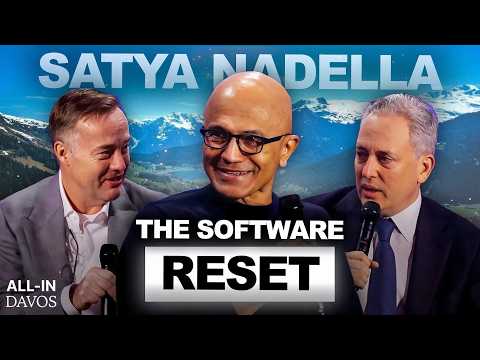
In this fireside chat from Davos, Microsoft CEO Satya Nadella joins Jason Calacanis and David Sacks to discuss the most profound shift in computing since the PC revolution. Nadella shares Microsoft’s philosophy of “macro delegate, micro steer” for managing AI agents, compares the evolution from chat to autonomous agents in coding as a preview for all knowledge work, and reveals that Microsoft is combining four traditional roles (product managers, designers, front-end engineers, and backend engineers) into full-stack builders at LinkedIn.
Nadella addresses head-on the concern that Microsoft doesn’t have its own foundation model like OpenAI, explaining that through their partnership Microsoft does have access to the IP while focusing on building “token factories” (Azure infrastructure) and the application server layer for the AI era. He predicts that firms will eventually want their own fine-tuned models embedding their tacit knowledge, suggesting “as many models as firms in the world.” The conversation tackles the extreme competition in AI, with Nadella embracing rivals as motivation to stay fit, while emphasizing that diffusion and ecosystem effects matter more than pure market share.
The discussion concludes with Nadella’s vision for enterprise AI adoption - both top-down through strategic CXO initiatives in customer service and supply chain, and bottom-up as AI-native employees bring tools into the workplace. He shares Microsoft’s own transformation, growing client-facing staff while shrinking back-office, and maintaining strong conviction in college recruiting despite AI’s impact on entry-level work.
Highlights
”Macro Delegate, Micro Steer” - The New Metaphor for AI
Clip command
yt-dlp --download-sections "*9:00-10:00" "https://www.youtube.com/watch?v=5nCbHsCG334" --force-keyframes-at-cuts --merge-output-format mp4 -o "5nCbHsCG334-9m00s.mp4"“Jobs had the bicycle for the mind. Bill had information at your fingertips. We need a new metaphor for AI. The one I like came from the CEO of Notion: manager of infinite minds. You macro delegate and micro steer. You give it instructions in parallel while it’s doing work.” — Satya Nadella, 9:00
”Microsoft Flat Headcount, Added $90B Revenue, Doubled Profits”
Clip command
yt-dlp --download-sections "*14:45-15:45" "https://www.youtube.com/watch?v=5nCbHsCG334" --force-keyframes-at-cuts --merge-output-format mp4 -o "5nCbHsCG334-14m45s.mp4"“Four years ago you had the same number of employees you have at Microsoft now, but you put a $90 billion onto the top line of the revenue in that time and you doubled your income. How did that happen? At some level this is the biggest structural change in knowledge work since PCs.” — Jason Calacanis, 14:45
”LinkedIn Collapsed Four Roles Into Full-Stack Builders”
Clip command
yt-dlp --download-sections "*16:00-17:00" "https://www.youtube.com/watch?v=5nCbHsCG334" --force-keyframes-at-cuts --merge-output-format mp4 -o "5nCbHsCG334-16m00s.mp4"“At LinkedIn we used to have product managers, designers, front-end engineers, and backend engineers. We took those first four roles and combined them - increased scope - and said let’s make them all full-stack builders. It’s a structural change that allows us to change both the work and the workflow.” — Satya Nadella, 16:00
”You Create Technology, But Benefits Come From Intense Use”
Clip command
yt-dlp --download-sections "*23:00-24:00" "https://www.youtube.com/watch?v=5nCbHsCG334" --force-keyframes-at-cuts --merge-output-format mp4 -o "5nCbHsCG334-23m00s.mp4"“I always go back to this study by Diego Comín out of Dartmouth about the Industrial Revolution. Countries that brought in the latest technology and did value-add on top of it got ahead. With general purpose technologies like AI, it needs to spread. Unless we see diffusion and intense use, we’re not going to have success.” — Satya Nadella, 23:00
”As Many Models As Firms in the World”
Clip command
yt-dlp --download-sections "*27:00-28:00" "https://www.youtube.com/watch?v=5nCbHsCG334" --force-keyframes-at-cuts --merge-output-format mp4 -o "5nCbHsCG334-27m00s.mp4"“When somebody asks me how many models should there be, I’ll say as many models as firms in the world. A firm should be able to take the tacit knowledge it has and embed it inside weights in a model that they control. That’s how this knowledge economy becomes an AI economy.” — Satya Nadella, 27:00
Key Points
- Immigration story (0:35) - Nadella shares how he had to give up his green card to get an H1-B so his wife could join him in the U.S.
- Evolution of AI form factors in coding (2:40) - From next-edit-suggest to chat to actions to full autonomous agents, both foreground and background
- Three modalities for knowledge workers (2:05) - Jason notes xAI’s “human emulator,” Anthropic’s Claude Code, and Microsoft’s Copilot as three different approaches
- Manager of infinite minds (9:00) - New metaphor for computing in AI age: macro delegate, micro steer
- Agent 365 identities (11:30) - Microsoft extending human identities and endpoint protection to AI agents
- Microsoft’s structural transformation (14:45) - Same headcount, $90B more revenue, doubled profits over four years
- LinkedIn role consolidation (16:00) - Combining PM, designer, frontend, backend into full-stack builders
- Competition keeps you fit (17:45) - Nadella joined Microsoft in 1992 when Novell was the existential threat; now facing intense AI competition
- Tech percentage of GDP will grow (18:20) - Not zero-sum; TAM is expanding dramatically
- Diffusion and ecosystem effects (23:00) - Market share matters, but ecosystem revenue and employment matter more
- SharePoint ecosystem 7x Microsoft revenue (24:15) - Sacks recalls consulting revenue on SharePoint was seven times Microsoft’s own software revenue
- Token factories (Azure) (26:10) - Microsoft’s biggest business is building AI infrastructure with heterogeneous fleet
- App server for AI era (26:35) - Foundry and orchestration layer for agents, evals, and RL gyms
- Multi-model orchestration (27:30) - Every company will use multiple models, orchestrated for different tasks
- Decision orchestrator in healthcare (27:50) - Assigning roles (investigator, analyst, expert) to models gets better results than single frontier model
- Database market analogy (28:15) - Like databases evolved from “everything is SQL” to rich proliferation, models will diversify
- Firms will want their own models (28:45) - Embedding tacit knowledge in custom weights
- Local models on Windows (29:20) - 5-silica models running on NPUs/GPUs; the workstation is back
- Top-down vs bottom-up adoption (30:15) - CXOs driving ROI projects in customer service/supply chain while employees build agents for their workflows
- College recruiting still important (31:15) - New grads will ramp up faster with AI mentors; experimenting with apprenticeship models
Mentions
Companies
- Microsoft (0:00) - Nadella’s company, third CEO in its history
- OpenAI (26:40) - Microsoft’s AI partner; Nadella confirms they have access to the IP
- xAI (2:05) - Elon’s company building “human emulator” employees
- Anthropic (2:15) - Claude Code mentioned as breakthrough in AI productivity
- Notion (9:05) - CEO coined “manager of infinite minds” metaphor
- LinkedIn (16:00) - Microsoft subsidiary restructuring roles into full-stack builders
- Yammer (24:00) - Sacks’ company acquired by Microsoft, part of SharePoint group
- SAP (25:15) - Nadella worked on SQL Server + R3 partnership in the ’90s
- Sun Microsystems (29:40) - Where Nadella started career on command line with $10K workstations
Products & Technologies
- GitHub Copilot (2:40) - Microsoft’s AI coding assistant
- Windows Copilot (1:41) - Desktop AI assistant that had lukewarm initial reception
- Agent 365 (11:30) - Microsoft’s system for giving identities to AI agents
- Azure (26:10) - Microsoft’s cloud computing platform, building “token factories”
- Foundry (26:35) - Microsoft’s app server layer for AI era
- SharePoint (24:15) - Microsoft collaboration platform with 7x ecosystem revenue multiplier
- SQL Server (25:15) - Microsoft database product Nadella worked on in ’90s
- Claude Code (2:15) - Anthropic’s AI agent that Jason has been testing extensively
- GPT-3.5 (3:20) - Model that preceded the coding breakthroughs with Codex
People
- Satya Nadella (0:00) - Third CEO of Microsoft, born in India
- Jason Calacanis (0:00) - Interviewer, testing Claude extensively
- David Sacks (0:15) - Co-interviewer, White House AI & crypto advisor
- Steve Jobs (8:50) - “Bicycle for the mind” metaphor
- Bill Gates (8:55) - “Information at your fingertips” vision
- Steve Ballmer (27:05) - Mentioned in context of missing mobile revolution
- Sam Altman (27:10) - OpenAI CEO, “savvy/controversial dealmaker”
- Peter Thiel (18:55) - “Avoid competition” philosophy referenced
- Elon Musk (2:05) - Building xAI’s “human emulator” approach
- Diego Comín (23:10) - Dartmouth economist who studied Industrial Revolution technology diffusion
Concepts
- Macro delegate, micro steer (9:00) - Nadella’s framework for working with AI agents
- Diffusion (23:00) - Key to AI success; spreading technology broadly for intense use
- Ecosystem effects (24:00) - Platform revenue multipliers more important than direct market share
- Eval-to-science-to-infrastructure loop (16:25) - New AI product development workflow
Surprising Quotes
“I started my career on a command line. Who knows, I may just end it in a command line.” — Satya Nadella, 29:30
“When people say ‘where is your foundation model?’ I mean, at the end of the day we do have the IP through OpenAI. But I think you’re bringing up a couple different things.” — Satya Nadella, 26:40
“It’s always helpful when you have a complete new set of competitors every decade because that keeps you fit. I joined Microsoft in ‘92 when Novell was the big existential competitor. Here we are in 2026.” — Satya Nadella, 17:45
“The reserve currency advantage, the strongest military, the most dynamic economy, the most advanced technology sector - finding that out is a different take on the Peter Thiel thing. You got to avoid competition by really understanding what customers want from you.” — Satya Nadella, 18:30
“The productivity curve of a college hire is going to be much steeper than ever before. It’s like having an unbelievable mentor who is getting you onboarded onto a codebase faster.” — Satya Nadella, 31:25
Transcript
0:02 All right, everybody. We’re thrilled to have the one, the only Satya Nadella here, the third CEO of Microsoft for a impromptu fireside chat with David Sacks, czar of AI and crypto. Satya, third CEO of Microsoft, born in India. What an incredible story. You came here right after college and you had a little round trip to pick up your wife in your book to bring her here. Tell everybody briefly how that occurred.
0:35 Well, you know, so that’s a great story of the labyrinth that is the immigration policies of the United States I think. My wife and I went to college together in India. I came here for grad school. We then got married. I got my green card. And she couldn’t come join because we got married. So the story goes basically I had to give up my green card. So the funny thing is I went to the American embassy in Delhi and I said where’s the line to give up my green card? And they said there is no such line. That would be a crazy thing to do in the ’90s. So it was a strange thing to give up your green card, get an H1 so that she could join, but it all worked out.
1:33 I wanted to ask you, having launched a co-pilot first with GitHub then having a co-pilot on the desktop - you made a very bold move for Microsoft to put that in the Windows product, which I use every day, on the desktop, but you did that before it really could recognize the file system and interact with applications. Got a little bit of a lukewarm reception, but now you’ve been doubling down, doubling down, and there seems to be, in my estimation, three modalities for knowledge workers. Elon’s building at xAI what they’re calling a human emulator, where they’re just building employees and just putting them into their chat rooms and email. Then you have Claude came out with Code this week. Incredibly powerful. People are kind of losing their minds over it. I’ve been playing with it for the last 40 hours. Truly impressive. What’s your vision for Microsoft and how knowledge workers will actually put this to use?
2:39 Yeah. So I think one of the most perhaps illustrative examples of trying to understand these various form factors is looking at coding, which is obviously a form of knowledge work, probably the best example of knowledge work. And if you think about the journey coding has been, it started with essentially the next edit suggest, right? That was the first time. In fact my own belief in this entire generation of tech really sort of got formulated where I started seeing - I think it was the Codex model back in the day, it was pre-GPT-3.5 - that’s when next edits started working with some real accuracy. Then we went to chat, then we went to actions, and now to full autonomous agents. And then the autonomous agents can be both foreground, background, in the cloud or local, right? So that’s all the form factors that exist today when you’re coding.
3:33 And interestingly, if you look at it, you use all of them, right? It’s not like there’s only one form factor. So for example, when I’m in a CLI, I can go to a foreground agent, background agent, and then just literally go edit in VS Code, right? They’re all happening in parallel. So that sort of shows how these form factors even compose. So then you bring that to knowledge work to your point. We started with chat. Chat with reasoning sort of goes beyond just request-response because you now have that chain of thought where you can see it work. Now there’s actions, right? Essentially either through computer use or through API, basically skills and agent calls. So you can do actions. So that’s kind of the state of the copilot today.
4:31 Now there is a way to think about the theory of the mind evolution, right? Because you need - if you remember, Jobs had the best line I would say for PCs or computers, was to say it’s a bicycle for the mind. Bill had a line which I liked as well, which was it’s information at your fingertips. We kind of need now a new concept metaphor for how we use computers in the AI age.
[Full transcript continues with the complete conversation through 32:00…]