World's First Trillionaire, Anthropic Fable Banned, The New Oligarchs, Iran Peace Deal
World’s First Trillionaire, Anthropic Fable Banned, The New Oligarchs, Iran Peace Deal
Summary
The Besties open with David Friedberg’s fired-up thesis about a “Great American Politburo” — a class of politicians (he names Warren, Sanders, Ro Khanna) who dangle free childcare, education, and paychecks as “virtue” while eroding individual liberty and manufacturing “learned helplessness.” Chamath grounds the abstraction in his own childhood on welfare in Canada, describing how a just-enough safety net let his father cycle between drinking and not working, and how the threshold for helplessness is “far lower than one may think.” Sacks ties it to Pritzker’s crypto-tax law in Illinois as the leading edge of the government dissolving private property.
The SpaceX IPO — the biggest of all time at $135/share, briefly a $2T+ market cap — becomes a meditation on where wealth actually comes from. Friedberg argues Elon didn’t gain a dollar in the bank; the public simply re-priced “the machines that make the stuff,” and Sacks and Chamath extend it into a makers-vs-takers framework where the true divide isn’t rich vs. poor but builders vs. commentators. SpaceX also exercised its option to acquire Cursor for a stock deal effectively valued near $15B, and the group predicts an eventual Tesla–SpaceX merger. Jason pushes his long-running drum: retail should be allowed to buy private-company stock far earlier.
The centerpiece is the U.S. government’s shutdown of Anthropic’s Fable 5 (the guardrailed release of “Mythos”). Sacks gives a firsthand readout: Dario primed Washington to see Mythos as a cyber weapon, Anthropic over-extended the preview to a partner the White House viewed as a China-linked national-security risk, and when Amazon (as a testing partner) flagged a serious jailbreak, Dario reportedly refused to take Fable down until the letter arrived. Chamath warns the “own goal” hands hyperscalers a KYC-gatekeeper oligopoly; Friedberg reads a Claude-generated psychoanalysis of Dario (“epistemic exceptionalism… you’ve built a machine that outputs me”). The episode closes on the Iran MOU — enriched uranium removed, Strait of Hormuz reopened, sanctions lifted, no U.S. dollars owed — which Sacks defends as the pragmatic alternative to another forever war.
Highlights
”The Great American Politburo Is Formed”
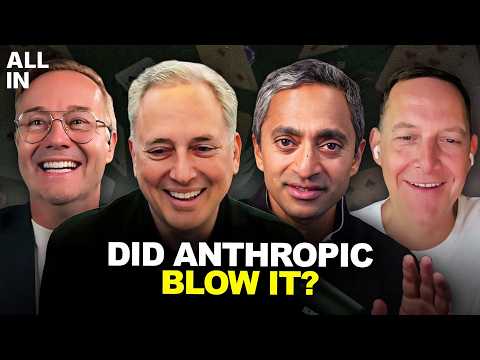
“What is being formed in the United States right now is the great American Politburo, okay? The new oligarchs are taking their seats. They’re arranging the chairs. They’re determining who will assign what workforce to do what efforts for them.” — David Friedberg, 2:30
Clip command
yt-dlp --download-sections "*2:30-3:19" "https://www.youtube.com/watch?v=3Amlu4y94Ho" --force-keyframes-at-cuts --merge-output-format mp4 -o "great-american-politburo.mp4"”I Grew Up on Welfare”
“The threshold for learned helplessness is far, far lower than one may think. I grew up on welfare… it was just enough that my dad just spent the cycle between drinking and not working, drinking and not working.” — Chamath Palihapitiya, 8:18
Clip command
yt-dlp --download-sections "*8:18-9:10" "https://www.youtube.com/watch?v=3Amlu4y94Ho" --force-keyframes-at-cuts --merge-output-format mp4 -o "chamath-welfare.mp4"The World’s First Trillionaire Has No More Cash
“He doesn’t have one more dollar in the bank than he did the day before the IPO… Literally his balance sheet is exactly the same. It’s just that the public is putting a higher value on the shares of stock in SpaceX that he already owned.” — David Friedberg, 18:18
Clip command
yt-dlp --download-sections "*18:18-19:15" "https://www.youtube.com/watch?v=3Amlu4y94Ho" --force-keyframes-at-cuts --merge-output-format mp4 -o "trillionaire-paper-wealth.mp4"Makers and Takers
“The great lie is that there are two sides to this society that is the rich and the poor. And the great truth is that there are two sides that are the makers and the takers.” — Chamath Palihapitiya, 31:31
Clip command
yt-dlp --download-sections "*31:31-32:35" "https://www.youtube.com/watch?v=3Amlu4y94Ho" --force-keyframes-at-cuts --merge-output-format mp4 -o "makers-and-takers.mp4"Claude Psychoanalyzes Its Creator
“When your safety framework requires that someone hold the keys and your analysis keeps concluding the other key holders can’t be trusted, you’ve built a machine that outputs me, no matter what you feed it… The more precise term is epistemic exceptionalism.” — Jason Calacanis (reading Claude’s analysis of Dario Amodei), 63:00
Clip command
yt-dlp --download-sections "*63:00-64:34" "https://www.youtube.com/watch?v=3Amlu4y94Ho" --force-keyframes-at-cuts --merge-output-format mp4 -o "claude-psychoanalyzes-dario.mp4"”They Literally Walked Themselves Into Prison”
“They literally walked themselves into prison and handed the hyperscalers the keys and were like, ‘Please lock us up.’” — Chamath Palihapitiya, 74:18
Clip command
yt-dlp --download-sections "*74:18-75:00" "https://www.youtube.com/watch?v=3Amlu4y94Ho" --force-keyframes-at-cuts --merge-output-format mp4 -o "walked-into-prison.mp4"Key Points
- The “Great American Politburo” (2:30) - Friedberg’s thesis that Warren, Sanders, and Ro Khanna are new oligarchs masquerading control as virtue.
- Why people fall for it (5:33) - Free childcare, education, and paychecks are offered in exchange for “taking the knee.”
- Learned helplessness and welfare (8:18) - Chamath’s childhood on ~$17K/year welfare in Canada and its effect on his father.
- The end of private property (10:29) - Sacks frames Pritzker’s Illinois crypto-tax law as the government taking already-taxed assets.
- Record-breaking SpaceX IPO (14:18) - $135/share, up 19% to $161, market cap above $2T, 3x Saudi Aramco’s raise.
- Cursor acquired via S-1 timing (17:37) - Chamath: the stock-for-stock structure effectively gets Elon Cursor for ~$15B.
- Trillionaire = paper wealth (18:18) - Friedberg: Elon has no more cash than the day before the IPO.
- Wealth is the machines that make the stuff (19:47) - Corporations as “cybernetic organisms” whose future output is discounted to today.
- Karl Marx got labor vs. capital wrong (21:28) - Sacks argues the delineation is fluid; a SpaceX welder made ~$1M in stock.
- Democratize private markets (28:21) - Jason on 600–700K Robinhood users getting SpaceX allocations and letting retail buy earlier.
- Makers vs. takers (31:31) - Chamath’s reframe of the rich-vs-poor “lie.”
- The Anthropic Fable ban (33:34) - Commerce Secretary Lutnick tells Anthropic to restrict Fable 5; they shut it down entirely.
- Dario primed D.C. with “Mythos as cyber weapon” (37:05) - Sacks: he “spiked the cortisol level” back in April.
- Amazon’s jailbreak escalation (40:53) - A cloud partner tested Fable, found a serious jailbreak, and escalated “like a whistleblower.”
- The Treasury Secretary’s call and the Heisman (42:00) - Friedberg on why Dario didn’t just say “yes, sir, we’ll fix it.”
- Frontier-lab leaders “leave a lot to be desired” (45:12) - Chamath on evasiveness and immaturity damaging the AI movement.
- Hyperscaler KYC gatekeeping (46:59) - The “own goal” that could hand Amazon/Google/Microsoft an AI oligopoly.
- The IBM disaggregation analogy (51:19) - Chamath on how government forced the ISV era and why AI will fragment similarly.
- Industry self-certification (57:22) - Jason: labs should self-certify models like the MPAA/ESRB before asking government.
- Not politically motivated (57:55) - Sacks denies a personal or Department of War “beef” drove the decision.
- Claude’s psychoanalysis of Dario (63:00) - “Epistemic exceptionalism” and the tell hidden in the word “misunderstanding.”
- Anthropic captured the Biden administration (65:08) - Its AI-policy officials went to work at Anthropic after Biden’s term.
- Competition vs. the “race condition” cartel (66:00) - Sacks: Anthropic sees competition as dangerous and wants centralization.
- Stop doom-trolling (71:15) - Chamath’s 1961 Newsweek “end of the workforce” parallel and Sacks’ warning to labs.
- Iran War MOU (74:32) - Strait of Hormuz reopens, enriched uranium removed, sanctions lifted, no U.S. dollars owed.
- The alternative to the deal (76:34) - Sacks rejects neocon calls for ground troops in a “mountain fortress.”
Mentions
Companies
- SpaceX (14:18) - Record-breaking IPO at $135/share, briefly the 4th most valuable company, later 7th behind TSMC.
- Cursor (15:00) - Coding agent acquired by SpaceX; ~$4B revenue, effectively ~$15B stock deal.
- Tesla (17:37) - Chamath predicts an eventual Tesla–SpaceX merger.
- Anthropic (33:34) - Its Fable 5 / Mythos model shut down after the export-control letter.
- Amazon / AWS (39:00) - Anthropic’s largest shareholder and cloud partner; flagged the Fable jailbreak.
- Microsoft & Google (49:22) - Named as hyperscalers positioned to become AI KYC gatekeepers.
- OpenAI (54:39) - Contrasted with Anthropic as more pro-administration (Greg Brockman donation).
- Robinhood & Charles Schwab (28:21) - Retail platforms that offered SpaceX IPO allocations.
- SK Telecom (33:34) - Reported (not confirmed on-pod) as the China-linked partner given Mythos access.
- IBM & Intel (51:19) - Chamath’s mainframe-era disaggregation history.
- Meta (72:24) - Cited for product-liability lawsuits over AI harms.
- Saudi Aramco & TSMC (14:18) - Reference points for the IPO raise and market-cap ranking.
- Ohalo (1:29) - Friedberg’s company, whose rising valuation Jason jokes makes him “more based.”
Products & Technologies
- Mythos (33:34) - Anthropic’s frontier model that Dario framed as a cyber weapon.
- Fable 5 (33:34) - The guardrailed public release of Mythos, later shut down.
- Claude / Claude Code (15:00) - Anthropic’s model, and the tool that psychoanalyzed Dario.
- Colossus (15:00) - Elon’s hardware cluster Cursor would use for its own models.
- Starlink (24:59) - Cited as one of SpaceX’s competitive fronts.
- Bitcoin / crypto (10:29) - Subject of Illinois’s new tax law under Pritzker.
People
- Elon Musk (14:18) - “World’s first trillionaire” on paper after the SpaceX IPO.
- Dario Amodei (37:05) - Anthropic CEO; central figure in the Fable ban and Claude’s psychoanalysis.
- Andy Jassy (33:34) - Amazon CEO who reportedly flagged the vulnerability to the administration.
- Howard Lutnick (33:34) - Commerce Secretary who told Anthropic to restrict Fable.
- Pete Hegseth (58:46) - Secretary of War, whose “kicked Anthropic out” tweet is debated.
- Reid Hoffman (49:55) - Cited as backing lawfare against the White House.
- Greg Brockman (54:39) - Named for a $25M donation to Trump.
- Warren, Sanders, Ro Khanna (3:19) - Friedberg’s named “politburo.”
- Karl Marx & Joseph Schumpeter (21:28) - Invoked on capital/labor and resentful intelligentsia.
- Ben Thompson (64:38) - Stratechery author quoted on Anthropic’s worldview.
- Marc Andreessen (66:00) - Cited as hearing the “we’ll anoint the winners” AI-cartel message.
- John Podhoretz & Reza Pahlavi (76:59) - Neocon regime-change advocates Sacks rebuts.
- Graham Allison (82:35) - Referenced on containing North Korea’s nuclear program.
Surprising Quotes
“I’ve always thought that the people that rail on wealth are actually secretly incredibly jealous and want to be extremely rich.” — Chamath Palihapitiya, 26:35
“If you have to put in your driver’s license to buy fertilizer, you’re sure as shit will have to put in your driver’s license to use Fable 5, which is the precursor to know how to use fertilizer to make the bomb.” — Chamath Palihapitiya, 49:32
“There is a deep arrogance to technologists… we all assume that this time is different and everything’s about to change completely. And you know what? It fucking doesn’t. Everyone needs to chill the fuck out and just let technology do what it does.” — Chamath Palihapitiya, 70:13
“An entire AI model can fit on a USB drive and you just need to have good hardware to run it… we’re all losers if there’s one stack that one company owns the whole thing and we all have to put in our ID and the government decides who’s the winner and who’s the loser.” — Chamath Palihapitiya, 51:19
“They closed the door themselves, they locked it, they threw the keys out the window.” — David Sacks, 74:26
Transcript
Jason Calacanis: 0:00 All right everybody, welcome back to the number one podcast in the world. It’s the All-In Podcast. The original quartet is here, the Rain Man, David Sacks. How you doing, brother?
David Sacks: 0:10 I’m good.
Jason Calacanis: 0:11 Been a busy week. A lot of long posts from you on X. We’ll get into it.
David Sacks: 0:16 Wait, a lot of what?
Jason Calacanis: 0:17 Long posting. A lot of long posts. Yeah, carpal tunnel going over there?
David Sacks: 0:23 I had one long post. I had two. I had two long posts.
Jason Calacanis: 0:27 Yeah, that carpal tunnel flaring up.
David Sacks: 0:28 I got a third one teed up. I might save it for the pod. It’s a good rant.
Jason Calacanis: 0:33 Ooh, coming in hot. I wonder who’s gonna get this bullet. A cackling, of course. The Dictator, Chamath Palihapitiya. How you doing, brother? Getting ready for summer? Summer’s gilets have been laid on the bed. You’re ready to pack it up?
Chamath Palihapitiya: 1:13 Opposite. I got a lot of travel. Grinding.
Jason Calacanis: 1:17 Oh, I forgot. You’re doing founder-led sales. So the summer of relaxation’s over. Now he’s in the CEO slot. Gotta get out there and do those enterprise sales. And of course, coming off a pretty hot week. Comment section was on fire. Very pro-Friedberg, very pro-Friedberg. Perhaps his greatest performance. Also the first performance when he said more than three sentences. What’s going on, Friedberg? You went off last episode and then I think you also with the long posts. You know what’s so funny? As the valuation of Ohalo ticks up, he gets more and more based. I love it.
Chamath Palihapitiya: 2:00 Welcome to the club. Welcome to the club.
Jason Calacanis: 2:01 He’s got tres commas based. Unleash the beast. When you’re just a mere singleton, you kind of just keep it to yourself. And then all of a sudden it ticks up and then you’re like nine-figure Friedberg. He’s like, I got something to lose. Wait for ten-figure Friedberg. Ten-figure Friedberg’s like, yolo! You also with the long posts. You and Nancy Pelosi making sweet, sweet… Look, here’s what’s happening. He’s starting! Let him go!
Chamath Palihapitiya: 2:26 He’s starting! Let him go! Go ahead.
David Friedberg: 2:30 What is being formed in the United States right now is the great American Politburo, okay? The great American Politburo is formed. The new oligarchs are taking their seats. They’re arranging the chairs. They’re determining who will assign what workforce to do what efforts for them. Which 600 million dollar stock trades they’re gonna go… families will make to benefit and enrich themselves as they fly around in their private jets on the taxpayers money and we are watching it all before our very eyes as individual liberties are eroded. I am fired up about it, I see it happening.
Jason Calacanis: 3:13 You know Sacks is on the show this week, you can’t just take straights like that.
Chamath Palihapitiya: 3:16 Friedberg expand on who the politburo is, who’s—
David Friedberg: 3:19 Yes. So basically the politburo is the leaders who elect themselves to dictate the flow of the economy, the allocation of capital, what work individuals are allowed to do and what activities they’re allowed to do in an unfree system which is what they’re creating. They are the true oligarchs and this is Elizabeth Warren, Bernie Sanders, Ro Khanna, this is the group that is trying to coalesce power and create for themselves a system whereby they have greater influence, greater control over aspects of the economy. They want to seize the means of production, they want to control education, they want to control media, and anytime there’s an effort by an individual enterprise or an individual themselves to go out and build a business and succeed and do something that’s outside of their scope and their span of control, they lose their fucking minds over it. And that’s what we’re seeing. So I react to their tweeting and their bullshit where they’re basically trying to contort things about inequality and fairness and justice when the truth is they are the rising empire, the evil empire in Star Wars. They are the folks who want to take from all of us what we were endowed with when this nation was started and what many people came to this country for which is individual freedom and liberty, the ability to build a business in peace, the ability to make decisions to do what you want with your own assets and to have functionally private property. And they’re taking it all away and they’re trying to take it all away and we’re watching piece by piece, step by step. So they are forming a politburo where they can effectively control the economy, control education, control the media and tell us all what we can and can’t do and say. And it’s frustrating to me to watch it because it’s masqueraded as bullshit virtue, as justice, as equity, it’s a bunch of fucking nonsense words that they use to try and make themselves seem virtuous when in the end of the day they are fundamentally evil and I hate watching it. So that’s why I react so aggressively to it.
Chamath Palihapitiya: 4:46 Friedberg I think you said something that’s really important which is they present it as virtue.
David Friedberg: 5:22 That’s right.
Chamath Palihapitiya: 5:23 Put yourself in the body of a person that’s probably middle of the roadish but is falling for it. Why do you think they’re falling for it?
David Friedberg: 5:33 Because they have needs and wants and desires individually that this person is saying this system, this evil empire will give to you. If you take the knee, we will give you the education for free, we will give you the child care for free, we will give you the food for free, we will give you the paycheck every week, we will give you, we will give you, we will give you. Those promises in a democratic system like this or in a—
David Sacks: 6:00 Fake democratic system like this are what make people feel like the virtuous offerings will align with their individual needs and wants. And I think that that’s why people say like, okay, that’s good, free childcare for all, there is inequality in the world, there is disparity in wealth, there is disparity in asset ownership. And your solution despite, you know, the loss of liberty along the way and the loss of economic mobility that arises from what you’re offering, this is really key. People don’t realize the value of the United States, the power of this nation was to give people individual liberty, which, which unlocks agency to progress yourself, to educate yourself, to make money, to give yourself more assets and more freedom and more flexibility than you had. Economic mobility is the key to the United States. You do not get economic mobility if the government is giving you a job or giving you money. You lose economic mobility. You become indentured to the government. Everyone wants more, everyone wants something that they don’t have. But the truth is that the more the government is giving it to you, the less you have mobility, the more you are indentured, the more you are enslaved, and the more we are eliminating people’s ability to progress. And I think that that’s what’s really so frustrating for me is that people sign up to this to your point, Chamath, and they’re like, okay, that’s great. I get to have this and I get to have that and I get to have that. But at the end of the day, you’re giving all of your liberties up. You’re giving all of your progress up. You’re giving all of your mobility.
Jason Calacanis: 7:25 You become a ward of the state is what you’re saying, and you’re looking for them and you don’t have agency to pursue your own personal freedom.
David Sacks: 7:31 Yeah. One thing I believe to be 100% true is that no human being that’s ever been alive has ever lived up to their true capacity as a human. Like human agency is limitless. Limitless. And the truth is, like anytime that you create a system with the government that’s giving people stuff, you are taking away people’s agency. And so that is what is so sad about the whole thing is like human agency is the one thing that we have unlimited capacity, unlimited, infinite upside. Every human does. And to enshroud yourself in this government burden, thinking that it is a relief…
Jason Calacanis: 8:11 well then that creates learned helplessness because you’re always looking to the government to solve your problems.
Chamath Palihapitiya: 8:18 The threshold for learned helplessness is far, far lower than one may think. I grew up on welfare. And my mother was initially a housekeeper and then she was a nurse’s aide. She was probably making eight, nine, ten bucks an hour. My father couldn’t get a job. So we were on welfare. And welfare was probably 17, 18, 19 thousand dollars a year at the time in Canada. And it’s a family of five. But it was just enough that my dad just spent the cycle between drinking and not working, drinking and not working, and he would try…
David Friedberg: 9:00 bursts and, you know, I think that it must have been deeply frustrating for him, obviously, so I want to be compassionate to the struggle that he went through. But man, I would have thought that 17,000 is not nearly enough support, and so it would animate you to try to do whatever it took. But could he have gotten a job making eight, nine, 10 bucks an hour at a store? He could have. He chose not to. And so my recollection of being a ward of the state…
Jason Calacanis: 9:35 Right.
David Friedberg: 9:36 is that the threshold for that helplessness is far lower than one may think. And then if you actually stack all these other things, people will just fall into their worst proclivities, and they will be a shell and a shadow of what they could be. My dad was, in my mind, a giant who had all this potential unfulfilled, and I keep that because I want a positive sense of who he was to me, despite all of the ups and downs and the stuff that he went through and how it negatively affected me at times. But man, if you want a whole country of those people, what happens when you’re giving people 30, 40, 50, 60, 70, 80,000 dollars a year of stuff? One, at some point you’re not going to be able to pay for it, but two, you’re going to reduce people to a shell of what their potential is. And that is not good. I have lived it and I am warning all of you: be careful what you wish for.
David Sacks: 10:25 The flip side of it, by the way…
David Friedberg: 10:27 As you point out, you can’t pay for it.
David Sacks: 10:29 What ends up happening is the moment that we find ourselves in today, and we see it in—and we’ll talk about Pritzker’s law in Illinois that passed this week—but we are now at a moment where we are saying there is no longer private property in the United States. This is one of the foundational rights that the founders of the United States tried to create a distinction between these other nations that everyone flees from where a monarchy or a totalitarian government or some communist system says everyone owns everything together or some small number of people own and control everything. And that’s what this always comes down to, whether it’s a socialist state or a communist state or a monarchy or some other totalitarian regime, there’s a small number of people that own and control everything. And that is the brink that we’re on because they are trying to say for the first time ever, there is no longer private property in the United States, that if the government can say everything that you’ve already paid your income tax on and then you’ve bought and you now own, the government can take a piece of it every year based on the vote and the budgetary needs of an irresponsible fiscal legislature, we’ve lost it all. And that’s where we are. And we see this, it just passed in Illinois. People think it’s just crypto, just like they think the billionaire tax is just billionaires. But anytime the government can take your private property after you’ve paid your taxes, bought something and put it in your garage, we are done for. Because that is when the Politburo has unlimited capacity to tax and take and do what they please.
Chamath Palihapitiya: 12:00 They want, here’s that’s the moment we’re at.
David Friedberg: 12:01 Well and the super sinister part to dovetail what both of you are saying and to give some grace to your dad Chamath, in the studies of learned helplessness for people who, you know, are trying to guess what that term is who haven’t heard it before, a psychological condition. If you give people a hard problem to solve like an impossible problem to solve they don’t solve it, then you give them easy problems to solve, they don’t solve the easy ones, and they become depressed. And then they attribute their depression to themselves, they internalize it in other words.
Jason Calacanis: 12:03 Yeah, we’re gonna get into it.
David Friedberg: 12:30 If you give people easier problems to solve and make them increasingly harder as you go, they become empowered. They have agency. They feel like they can solve problems. And then when they get stuck on something they don’t attribute it internally. And this is the why alcoholism is so pernicious in our society as well is because when you start attributing it to yourself and you then start self-medicating, you try to dull these feelings because you’re depressed. And I’ve had many friends who’ve gone through it and family members. And this is why having agency is so important. This is why endless unemployment is so dangerous, and you need to taper people off it and you need to give them a chance to be successful. If your dad had taken that 10, 12 dollar an hour job he would have become the manager, then he would have become the owner of the place. So the coda to your story is…
Chamath Palihapitiya: 13:17 At some point I think, and I don’t know because my mom doesn’t share this with me, there was some kind of breaking point because it was a really violent household and then near the end of my high school career when I left, things got I think materially better and part of it was because he got a job. And ultimately he got a job pretty low-level clerical work at the government, but we were so proud of him and he did that until he passed away, but it changed him completely. Now it could also have been because he had gotten older, you know, but drank a lot less and was much more regulated.
David Friedberg: 14:01 Yeah, so I completely agree with what you’re saying. It’s a really sad phenomenon and you see it sometimes in successful people. They get successful very quick, they don’t attribute to their own success, they get up out of bed in the morning, they don’t have to get out, they start drinking, they don’t take a job and they’re affluent but they’re just not motivated, they don’t have purpose.
Jason Calacanis: 14:18 All right, let’s get started. We got a huge docket to get through today. SpaceX had a record-breaking IPO and 60 billion dollar Cursher deal was quickly consummated as predicted. Friend of the pod Elon Musk took SpaceX public last Thursday, 135 dollars a share. A lot of people got to participate, Robinhood, Charles Schwab, everybody talking about they got an allocation—one share, ten shares—and they filled the green shoe, 85 billion raised. That’s three times what Saudi Aramco raised back in 2019. Stock closed up 19 percent to 161, market cap above two tril, and at the taping of this pod, 177 dollars. Not too shabby on Tuesday, SpaceX exercised its option to acquire Cursher. That’s the coding agent, that got shivved by, speaking of Anthropic and Claude, they originally used Claude to be the back end of Cursor and then Claude and Anthropic had an internal skunkworks project they took Cursor allegedly, they were never going to release it to the public, they would never have a coding agent and they did and that led to this incredible opportunity for Cursor to make their own model and use Elon’s hardware at Colossus. They’re doing 4 billion in revenue, so they got bought for 15 times revenue, SpaceX trading 100 or 60, 70 times revenue, so a great deal for everybody. SpaceX briefly passed Amazon and Microsoft, which is mind blowing to be the fourth most valuable company. Amazon’s revenue in ‘25, 717 billion, Microsoft’s 2025, 282 billion, SpaceX’s 2025 only 19 billion. So, uh, they’ve corrected a bit. And now SpaceX is sitting at seventh largest company right behind TSMC. That’s the Taiwan Semiconductor Corporation. So let’s just go around the horn here. Congratulations to Elon and the team over there. Elon exercised his Tesla shares that he had coming from his employment there. I think he’s done a pretty good job as CEO, he got a little bonus. So that sets up potentially Chamath the merger of the two big companies, just broad strokes, what’s your take from takeaway from this SpaceX IPO? Seems to have been executed flawlessly.
Chamath Palihapitiya: 16:25 It’s an incredible company. It’s a one of one, it’s just a unique animal. I think that the highest price to sales was essentially these last few days and now it’s just going to grow into its valuation and generally just grow valuation.
Jason Calacanis: 16:50 Nick, play the clip.
Chamath Palihapitiya: 16:51 The acquisition was essentially negotiated and the way that it’s structured is so that the S-1 doesn’t go stale. So I think the way that it was announced has more to do with the fact that they don’t want to slow down and have to rewrite parts of the S-1, have to redo the disclosures, have to redo the risks. The deal is effectively done. But what’s so smart is that where is SpaceX today, let’s call it a trillion. Where could it be, just for the purpose of this argument, let’s say 2 trillion. So when the deal gets done on a stock-for-stock basis, it’s going to be again if it’s 60 billion in tomorrow dollars, effectively Elon’s gotten a 50% discount.
Jason Calacanis: 17:32 Alright, nailed it. We’ll give that an mm. Okay. Sure enough.
Chamath Palihapitiya: 17:37 What I didn’t factor as well is that the revenue run rate would essentially double on top of that. So he essentially got Cursor for 15 billion. He got a good deal. Which is unbelievable. His business intellect is off the chart. That is an incredible deal and now the consolidation phase will begin and we’re going to see Tesla and SpaceX merge and it’s going to be glorious.
Jason Calacanis: 17:57 Sacks, you can also take a a little bit of a victory lap here. You’ve been… with Elon since PayPal days obviously and, um, you obviously were an investor in SpaceX for a long time. Your thoughts on what this means for the company, obviously it’s an incredible milestone, but what does it mean for the company going forward? Obviously champagne bottles yada yada, but what does it practically mean for SpaceX and Elon going forward?
David Friedberg: 18:18 Well, in a certain sense, as we all know, this was the biggest IPO of all time and so in that sense, it was a huge milestone for this company that Elon and many other people have been working on for a very long time. I mean, this has been 25 years in the making. When people turn on the TV and they see this, they think that this is just some sort of overnight success, it’s not. A lot of people had to work very hard to get to this point. But at the same time that it was this historic IPO, it’s also the case that in a certain sense, this didn’t change anything for Elon. You know, I think when people read that he’s the world’s first trillionaire, they start to think that he must have gobs of money, a trillion dollars sitting in a bank account, and that’s not true. That’s not how it works. That’s not how wealth is created. He doesn’t have one more dollar in the bank than he did the day before the IPO. He doesn’t have more stuff, doesn’t have more houses or anything that you could buy with money. Literally his balance sheet is exactly the same, it consists of the same thing. It’s just that the public is putting a higher value on the shares of stock in SpaceX that he already owned. And he’s not selling, he’s under a one-year lock-up and I predict that he’ll hold on for much longer than that because creating SpaceX is his life’s work. So, you know, you see all these people reacting with tremendous animosity and basically saying that, you know, we can’t allow the world’s first trillionaire or, you know, stuff like that. Look, he doesn’t have more cash than he did the day before the IPO.
Jason Calacanis: 19:45 It’s paper wealth, clearly.
David Friedberg: 19:47 It’s that other people are placing a greater value on what he’s built. And I think this is very important for people to understand is that there’s a big difference between stuff and then the machines that make the stuff. And I think again, this is where wealth comes from is the machines that make the stuff. So, you know, you go all the way back to hunter-gatherer days, right? The only wealth was in what you could collect, hunt, gather, whatever. It’s basically the collection of stuff. Then humans developed the ability to create tools and then very sophisticated tools and then some of those tools are corporations, which are almost like cybernetic organisms, they’re combinations of tools, workflows, humans work in them, and it’s those corporations that make the stuff. And the way that people get wealthy is that if you create a machine that makes more stuff, then there’s a discounted present value for all the stuff in the future that that machine might create. And that’s where the wealth comes from.
Chamath Palihapitiya: 20:49 Really well said. Really well said.
David Friedberg: 20:51 It’s not in the stuff. It’s in creating a machine that will create stuff for humanity for a long time and people will put a value on it today.
Chamath Palihapitiya: 21:00 That’s really why because of all the stuff that it’ll create in the future. And so just out of nowhere it will appear that all of a sudden you have all this wealth created, but again, that wealth is a reflection of all the stuff that this machine will now create in the future.
David Sacks: 21:15 And people need to understand that that process is a good thing, because when you think about all the progress that humanity has made, it’s not in having more stuff because again, that stuff it all goes away, right? Whether it’s food or shelter or clothes…
Chamath Palihapitiya: 21:27 It’s ephemeral.
David Sacks: 21:28 It depreciates, it’s a wasting asset. The reason why humans are more prosperous is because of all the machinery we’ve created to make stuff well into the future. And, you know, again, some of that stuff can be things like shelter, clothes, it can also be medicines and cures and entertainment, electricity, all the things that make your life better. We need those machines, and someone has got to own the machines and the people who own it are the ones who create it. And the thing that Karl Marx never understood is that it’s not this sharp delineation between capital and labor because you can take people who start with nothing.
Chamath Palihapitiya: 22:10 Elon started with nothing. I mean, he was an immigrant to the United States. He came here from Pretoria.
David Friedberg: 22:13 Nothing.
Jason Calacanis: 22:14 Slept on the floor at Zip2.
Chamath Palihapitiya: 22:15 Exactly. He created these companies, he created these machines from nothing with his own vision and hard work and he included thousands of other people. So here’s the other thing is, just because you’re quote-unquote ‘labor’ doesn’t mean that you’re not also an owner of capital. There’s a great story of how there’s a welder who worked at SpaceX…
David Sacks: 22:30 Yeah, crazy.
Chamath Palihapitiya: 22:31 …who I think has made a million dollars in SpaceX stock. Transformational. But everybody who’s part of these companies, and I think this is the magic of the tech industry, is it is much more inclusive in terms of ownership than any other industry.
David Friedberg: 22:46 It’s the magic of capitalism and free markets where anyone can participate in that market, anyone can enter that market and ultimately anyone can transition from being labor to capital.
Chamath Palihapitiya: 22:58 Yes.
David Sacks: 22:59 It’s fluid. It’s back and forth.
Jason Calacanis: 23:00 If you buy shares in a company and you have the ability to buy them…
Chamath Palihapitiya: 23:05 Or you vest them. You vest them. It’s sweat equity.
David Friedberg: 23:08 Or you start a business and you basically do work, save money, invest your capital and continue to compound the capital until you get to a point that your labor is worth less than your capital. And that’s what ultimately allows this economic mobility, this transition for people and when you take that away, you destroy that capacity for mobility.
David Sacks: 23:30 Back to capitalism where we started today, yeah.
Chamath Palihapitiya: 23:33 That’s right. And that’s why it’s so frustrating to me to watch people denounce Elon’s success and denounce the value that the world is putting on this business and on this success because what they’re saying is that no future human, no kid that’s sitting on a floor right now, sleeping on a floor that’s poor, should have the capacity to achieve what Elon achieved. No one should be allowed that capacity to transition, to progress, to mobilize.
David Sacks: 23:59 It’s even worse than that.
David Friedberg: 24:00 They’re saying you should hate him, you’re denouncing him, and by denouncing that, you’re basically taking that ability away and you’re saying that this is evil, and you’re telling all these young kids around the world that are thinking about their future, that they are now indentured to a government or to a fixed income for the rest of their lives, to perform labor for a fee for the rest of their lives, as opposed to having the opportunity to transition, which is what Elon has done and what millions of others have done because of the freedoms in the United States and other free markets that have allowed this to happen for people. And that is why it’s not just about getting wealthy, it’s not just about getting rich, it’s about having agency to transition yourself.
Jason Calacanis: 24:41 And that’s that transition.
David Friedberg: 24:42 And inspiring young people, yeah.
Jason Calacanis: 24:44 It’s a different kind of transition. This is the good transitioning.
David Friedberg: 24:46 No, you’re transitioning from labor to capital by virtue of sweat equity. You have skills that are valuable that you can then translate into creating something that’s valuable.
David Sacks: 24:59 Just to underscore that point, I mean you think about SpaceX, it’s a machine that makes satellites. It’s a machine that makes broadband connections from space. It’s a machine that creates launch vehicles, AI software and so forth and so on. So it’s a machine that makes things that people want and that therefore enhances people’s lives and it’s only the market, the public’s value that it places on those things that creates the net worth, that creates the value of SpaceX’s stock and therefore the net worth of someone like Elon. But again, he doesn’t have one more dollar than he had before.
David Friedberg: 25:37 Well, and to put a finer point on it, you have to earn that by continuing to make the best product in your class. The second Elon’s satellite Starlink is not as good as the next two or three competitors, and there are two or three of them coming right behind him, and there’s other people doing rockets, and obviously he’s in a heated competition for LLMs and with Cursor versus Claude Code, he’s not guaranteed. He has to fight, and he’s had to fight to win each of those categories. And the second he stops fighting in those categories, he loses and all that equity gets cut like we see when stocks tank because they cannot keep up. So he’s had to fight for every inch by making the best product. Nothing was given to him. Everything was earned, and earned by his team. This idea that like he won the lottery is farcical. It’s a 25-year overnight success story that had three or four distinct points where it was going out of business and he had to scramble.
Chamath Palihapitiya: 26:35 I’ve always thought that the people that rail on wealth are actually secretly incredibly jealous and want to be extremely rich.
Jason Calacanis: 26:46 Or worse.
Chamath Palihapitiya: 26:47 Because I’ve never heard a coherent argument about why when somebody achieves something that you should dismantle the things that they’re building. And what you both of you said are so right. The vicissitudes of the market can make that number fluctuate wildly. There is a version of the market that has nothing to do with him that judges his stuff in the future as half of what they’re judging it today. Nothing stops us from doing that and all of a sudden everybody who’s breathlessly mad that he’s a trillionaire, what do they say now because he wouldn’t be a trillionaire, he’s some version of what he was the Thursday of last week, right?
Jason Calacanis: 27:22 Right, right.
David Sacks: 27:23 Right, right, and you know, to semi-analogy, the machine’s become obsolete very quickly, you know, in a capitalist society you can get disrupted, and companies get disrupted all the time if they become stale or calcified, if they don’t, if they don’t invest in maintaining and upgrading their machine, they will become obsolete.
Chamath Palihapitiya: 27:43 Improving value.
David Friedberg: 27:44 To your point.
Chamath Palihapitiya: 27:45 And you know what can’t get disrupted? You know what can’t get disrupted? The one unobstructed monopoly, government. And that’s the problem. Government is competing for capital and it’s competing for markets and it’s competing for all these things and that’s why I talk about these people as being evil, they’re a politburo of… they’re basically trying to take away capacity for value creation, to make things better every generation for society: better medicine, better education, better livelihoods, better homes, everything gets better. But when the government monopolizes it, it doesn’t. And that’s the competing force that we’re up against.
Jason Calacanis: 28:21 Yeah, and I want to just add one thing to this, which is: there is a piece of this that needs to be solved, which is people wanted to participate in the success of these companies earlier and we Chamath and I interviewed the head of the SEC and he’s working on this, but the amount of demand from retail and it was a very innovative thing that Elon did and the team over at SpaceX, they gave 20 or 30% of the IPO to retail investors. When you opened up your Robinhood account, I don’t know if you guys have one, or Charles Schwab account, it gave you a little interface that said ‘Hey, would you like to participate in the IPO of SpaceX?’ and you could put in your request. I think 6 or 700,000, I was talking to Vlad, maybe 6 or 700,000 Robinhood users got an allocation. It might have been one share, it could have been 50. That democratization needs to continue because the real uh… back to Friedberg’s points about being a wage slave or an equity holder and trying to make that transition. Well, people being able to open up Robinhood and just buy one or two shares and vote with their dollars for 150 bucks that they want this future as opposed to other versions of the future, that’s what gives them that empowerment. That’s what gives them that agency. Well, what if they could do that earlier? And I’ve beaten this drum on this podcast and my other podcast for a decade on this, but people knew SpaceX, they were watching these rockets launch for a long time, and they would have placed that bet 10 years ago when the company was worth 100 billion, or 10 billion, or you know, 500 million, but they weren’t allowed to because we have a corrupt system in our government that says rich people, the top 4-5% of this country are smart enough to buy private company stock and the 95%…
Chamath Palihapitiya: 30:00 are too stupid to, and it’s antiquated and it has to change and you should be able to buy whatever you want. If you want to buy crypto you can, if you want to buy a private company you can, if you want to play cards with your friends and play Bombpots and watch Dave Friedberg rage quit because he keeps losing at Bombpots when we play, that’s Friedberg’s right. Let people buy private company stock. It’s fucking crazy that we still have this rule keeping poor people poor. Thanks for coming to my Ted Talk.
Jason Calacanis: 30:31 Can I take a shot at answering Chamath’s question, why are there so many people who are influential who are resentful of what Elon’s done or what other capitalists do?
David Sacks: 30:39 I think it was Joseph Schumpeter who explained this. That basically you’ve got this intelligentsia in a society like ours where they don’t make things, they don’t make the machines that make things.
Jason Calacanis: 30:49 100%.
David Sacks: 30:50 They just make words and, you know, I guess ideas and most of those ideas are just wrong, right? They’re just made up. And they become resentful of the fact that there are all these people who are able to create not just stuff but the machines that make the stuff, right? And that in our society that is the thing that creates the greatest reward financially. Why? Because it actually aligns with what’s in the greatest value for society whereas they produce a bunch of hot air. So it’s natural for that class of intelligentsia to become resentful and hostile towards the people who are able to amass this great wealth.
Chamath Palihapitiya: 31:31 I think that the great lie is that there are two sides to this society that is the rich and the poor. And the great truth is that there are two sides that are the makers and the takers. The lie is that the rich are unfairly rich and the poor are unfairly poor and therefore the poor must take from the rich. But the truth is that it’s the takers that tell you that lie. That the real truth is that artists, plumbers, electricians, woodworkers, computer scientists, people that build, people that make shit from all walks of life, all income levels, all wealth brackets are the makers. And the takers are what Sacks calls this intelligentsia, the analysts, the espousers, the armchair mechanics, the critics, the commentators, the politicians. They are the takers. They are the people that watch the rest of society make stuff, build stuff, specifically doing things that create value for other people in society. That’s what a maker is. Tell my kids this lesson all the time. I say, what did you guys make today? They tell me something they made and I’m like did someone else value it or did you make it just for yourself? At the end of the day, if you made something and someone else valued it, you were a maker. That was an amazing achievement. That is a great day. Whether you make a piece of art, whether you build a house, whether you write a piece of software, whether you build a business. Whatever you make, if you’re a maker and someone else values it, they become your
David Sacks: 33:00 customer in some way, they become your partner in some way, you’ve done something valuable. Those are the true engines of progress for humanity. And the takers are the ones that tell the lie that it’s rich versus poor, because they what they want to do is rip apart the makers. And they want to tell everyone you got to be on one side or the other. And they use that lie to get everyone to line up against each other and to give them ultimately the control to form the Great American Politburo, which is what they’re trying to create. That is what’s underway right now. And that is the fundamental great truth and great lie that that we’re kind of fighting against at this moment.
Jason Calacanis: 33:34 All right, this broke shortly after we taped our episode last week. We taped on Thursdays, we drop on Fridays, as fans of the show know. Well, the US government has pulled the plug on Anthropic’s latest model. You’ve heard us talk about that as Mythos. They released it as a controlled version called Fable 5. So there was Mythos, that was the one they held for 30 days while they were doing security, cyber security testing, then they released it as Fable in a bit of a guardrailed version of it. Commerce Secretary Howard Lutnick told Anthropic to restrict that model to US citizens last week, last Friday in fact. Anthropic couldn’t implement those restrictions or wouldn’t in that granular of a way, so they just decided to do something more conservative and shut it down for everybody. This of course created a lot of hand-wringing in the industry. Rug pulling, oh my god, we lost this great model, and what does that mean if I build my models on top of Anthropic? Can I trust them? Yada yada. And this was just days after the model was launched on June 9th. How this all started seems to be that Amazon CEO Andy Jassy, who owns a large… Amazon is a, an early investor in Anthropic and they own a large portion of it. He had told the administration, uh, that there was a security vulnerability in Fable 5 that they were able to bypass to jailbreak the guardrails that Anthropic put on it. Dario said the jailbreak wasn’t serious. There seems to be some fingerpointing back and forth. And Dario said it was narrow. Separately, Semafor, a publication, uh, like an email publication, reported that the White House acted partially over suspicion that a China-linked group had access to Mythos and they weren’t supposed to. Wired reported that this group was South Korea’s SK Telecom. Now you’re saying, hey, how does South Korea have anything to do with China? Well, they have a long-standing… or there are long-standing allegations that SK has relationship with China. The White House previously ordered Anthropic to revoke SK Telecom’s access to Mythos. They’re kind of like the Verizon, 70% market share for a telecom in South Korea. According to the Washington Post, Anthropic did not initially disclose it had given Mythos to SK Telecom, and this happened before all the export controls. Quote, “badly damaged officials’ confidence in the company’s ability to safeguard sensitive technology.” Anthropic says the White House never raised the Chinese access in the Fable jailbreak conversations. There is a lot of fingerpointing and perhaps Nobody is closer to this except the principals and you, David Sacks, so tell us what is going on here. Is this politics and political between Anthropic and the administration? Is this a misunderstanding? Or is this, you know, the future of what’s to come as these models become more powerful?
David Sacks: 36:20 Well, let me give you an update based on what I learned. This would have been last Friday and Saturday. So by that point I got a readout from various folks at the White House about what happened around the time that that letter was sent to Anthropic. And I then summarized what I learned in that long post on X. And no one told me what to say. I just listened to these various officials explain themselves. I also heard from, let’s say some of the private companies who were involved in this. And all I asked was, listen, I think this context would be helpful to provide. They said sure, you can publish it. So I posted my summary of what was happening. And whether you agree with the decisions of those officials or not, I do think that my post provides a window into exactly what they were thinking at that time. And what this comes down to is a couple of things. So first of all, like you said, Dario came to Washington a few months ago, this was back in April, and basically said that he had created a cyber weapon called Mythos. And he spiked the cortisol level, got everyone really worried, and there was some truth to it in terms of the sense that this model had advanced cyber capability, but he got everybody very focused on this problem. So mission accomplished. They then had this pilot program for Mythos, this trusted partners program. And as the Washington Post reported, Anthropic expanded the program to something like 50 companies or more without consulting the White House. And according to the Washington Post, I can’t confirm, I don’t have any firsthand knowledge of this, but I don’t have any reason to question the Washington Post’s reporting on this. They did share Mythos with a company that the White House believes it should not have been shared with. So think about that. They’re sharing these capabilities that Dario himself has said is a cyber weapon with parties that the White House and really we’re talking about the National Security officials believe might have connections to China.
Jason Calacanis: 38:23 That’s SK Telecom according to these reports.
David Sacks: 38:26 I’m not going to say who it was. I know that’s been reported. I don’t have any firsthand knowledge of that.
Jason Calacanis: 38:35 Okay.
David Sacks: 38:36 I’m just reporting what was in the Washington Post. But you have to understand that that’s the context. So first of all, you got Anthropic effectively conducting its own foreign policy here, expanding the Mythos preview to groups that the White House didn’t have any knowledge. And then once they found out, the White House, you know, this is really the role of what the White House wants is, look, we have classified information that you don’t have. We know that there are certain groups that shouldn’t be getting this. And Anthropic expanded the pilot without consulting, which is again sort of- bewildering because the whole point of what they were supposedly doing by trying to get this pre-approval regime was to consult with the government. So really that was the predicate for this and apparently again this is according to the Washington Post that’s when conversation started about whether a model like Mythos needed to be export controlled. Okay? Then you have the launch of Fable which is basically Mythos with guard rails. Again if those guard rails fail then you have a cyber weapon being released to the public and it wasn’t the White House who came to the conclusion that the guard rails failed, it was private companies who were testing Fable, testing those guard rails and as has been publicly reported one of them was Anthropic’s largest shareholder and cloud partner.
Jason Calacanis: 39:48 Amazon.
David Sacks: 39:50 Well, again, I’m not going to confirm but I think we all can read the publications, okay? So again normally I wouldn’t mention the names at all but this is all widely reported, okay? In any event, they I think tried to convey their findings to Anthropic. I think there was some sort of breakdown in communication I don’t really understand but they felt the need to escalate it to the White House. And it’s almost like a whistleblower, okay? Uh because they have no reason to lie about this. I mean again they are Anthropic’s partner.
Jason Calacanis: 40:25 Well they have reason to- I mean they’re partners so that’s even reason to support Anthropic. Obviously Sacks, they would have told Anthropic first, but the fact that Andy Jassy got involved in this at all means somebody on the team must have said, ‘Hey, um on the security team at Amazon who has to host these models said, hey, this is something that could be a liability for us, Amazon, and could be a national security threat.’ That’s why Andy Jassy made that call because somebody put that into a slack room somewhere or documented it.
David Sacks: 40:53 Oh no, no, no. They don’t do things like that based on slack room, okay?
Jason Calacanis: 40:58 But somebody in the security team reported it, right?
David Sacks: 40:59 No, hold on, hold on. Amazon is part of Mythos Preview and they are also testing Fable. Remember they’ve got the biggest cloud to protect, we’re talking about AWS. They’ve got teams banging on this and making sure the guard rails are safe. And as has been publicly reported they came to the conclusion that there was a jailbreak and that this was a serious security problem. So they then escalate to the White House and again and this is where my summary takes over based on me hearing firsthand from these officials they tried to call Anthropic, they tried to call Dario and there were a number of conversations and the TLDR of it is Dario refused, meaning refused their request to take down Fable until this jailbreak could be fixed. And again the White House was really just I think bewildered and confused by that because again it’s so off-brand for Anthropic they claim to be the AI safety company and yet here the White House is reacting to credible information about a major security threat from Anthropic’s own partner and-
David Friedberg: 42:00 And instead of basically saying yes, we’ll react on this right away, they get the Heisman. I mean, just imagine this call. Apparently, again, reportedly, the Treasury Secretary of the United States called Dario personally. I mean, why wouldn’t this be a five-minute call? Why wouldn’t Dario just say, ‘Yes, sir, we take security more seriously than anybody else, we’ll fix the problem. Thank you for taking the time to call us out of your busy day. We’re going to handle it right now.’ Click. And instead of doing that, you know, what the administration heard—and I’m not saying maybe Dario didn’t mean to communicate this, but he sort of pedantically argued that this jailbreak wasn’t really a serious issue. And we know that to be true because you don’t have to take the administration’s word for it. Dario then published a blog post that basically conveyed the idea that, well, not all jailbreaks are that bad, and trying to differentiate between good jailbreaks and bad jailbreaks.
David Sacks: 42:51 Minor ones, major ones.
David Friedberg: 42:52 Whatever. You know, again, very off-brand for them. I didn’t know until now that that was the case. Remember, this is all downstream of the fact that Dario primed all of these officials to view Mythos as a cyber weapon, and to view, therefore, Fable as a cyber weapon if the guardrails failed. And they already had problems with the Mythos preview being over-extended to parties that they didn’t approve of. So, look, I think maybe there’s room in here to give Dario some grace, maybe he didn’t interpret this correctly, what have you, but this was the way that the administration perceived the situation that they were in as of whatever that date was a week ago, last Thursday, and they reacted by sending the export control letter because they wanted Fable to come down until the guardrails were put in place. Now we’re in a situation where Anthropic is negotiating with the government to try and fix the situation. Look, once you’re in one of these situations, it’s always harder to extricate yourself than to avoid getting in them in the first place because the trust is broken. The trust is now gone. Look, I hope this does get resolved as quickly as possible because I don’t view what the administration did as a policymaking exercise. Some people are saying that this export control letter is now a new type of policy, now the government has to approve every model release. I don’t think that was the intention. I think this was a reaction by the administration to a credible report of a national security threat, and they felt that they had no alternative but to react immediately with the tools that they had available to themselves. So, I hope that this problem gets fixed, and then we have a serious, deliberative policy conversation about what the right hoops should be for models that are cyber weapons.
Jason Calacanis: 44:44 And we’ll pause there. Which, yeah, let’s pause there because we’re going to get into model reviews and what’s the best way to do that. Chamath, what’s your take on this situation in terms of maybe a little bit of, I don’t know, your handicapping of the situation? with the relationship with Amazon. I think that’s kind of an interesting angle. Or if you have a different angle you want to take.
Chamath Palihapitiya: 45:05 I think the leaders of the frontier labs leave a lot to be desired.
Jason Calacanis: 45:11 Okay.
Chamath Palihapitiya: 45:12 I think what we’re seeing is a consistent pattern of evasiveness and immaturity and I think that that does a huge disservice to the entire movement of AI. Maybe to connect the dots between this and what Friedberg said, I couldn’t agree more with what he said. The key to a vibrant life is rooted in economic mobility and I think AI is the grand leveler. It is the thing that can enable everyone to have unique amounts of economic mobility because they are unencumbered to figure out what their upper bound is. And against that backdrop, which is an incredibly positive sum view of the world, but I think is accurate, We have to live in this constant doomism, hype cycle, naivety, and I think it holds us back.
Jason Calacanis: 46:12 How does it hold us back?
Chamath Palihapitiya: 46:13 Tactically number one, it creates mistrust. I think that Silicon Valley was already decaying in the prestige that it held in American society. When I first came here in 2001, it was a place of misfits that were good-intentioned, that were doing the right thing, that didn’t take themselves too seriously, that in success wasn’t ostentatious, that kind of kept their head down. We built important things. Then we veered away from that and we started building less important things. And now we’re at a point where we’ve potentially started to rebuild important things again, but we have this veneer of negativity and mistrust that are created in large part because we just cannot get our shit together. The leaders of the frontier labs are public enemy number one. And so this entire episode is yet another proof point that you just can’t trust these guys. That’s number one. Number two, I think what it creates, which I think is bad, but what it creates is an incredible opportunity for the hyperscalers. And the very simple opportunity is to convince governments all around the world, not just America, that they should be the gatekeeper. A, you can’t trust these guys. B, these models are all over the place. C, let us be the ones that provisions them to the world. We will wrap it in KYC. I’ve been now talking about KYC for a while, right? Who are these customers? Do they have identification? Why are they allowed to run these models? What are they prompting? Let’s keep them so that there’s an audit trail. All of these things are going to become issues. The frontier lab folks made it an issue because of how they’ve handled all of this up until now. And what does that create? Now that creates an oligopoly for AI, the most powerful economically leveling instrument we’ve ever seen, in the hands of maybe a handful of hyperscalers who, by the way, would make an incredibly compelling argument, and they would be right. And the only counterfactual to it would be, well, trust us guys, it should actually be much more open and in a far more distributed environment. Hey, can you imagine the cost and the complexity if you asked a Neoscaler to build the same robust KYC or the same VPC infrastructure that Amazon and Microsoft and Google have spent decades investing trillions of dollars in? It’s an impossibility, Jason. So you can take all of those data centers off the map, you can take all of the Neoscaler market off the map, all of this was preventable. So instead of a diverse, robust, open ecosystem giving a tool that is the fundamental unlock for humans, we are now going to debate gatekeeping and duopoly versus oligopoly. They have created a total fucking mess, and it’s a shame.
David Sacks: 49:22 So instead of people, just to summarize that, instead of people being able to use the model they want from the provider they want, you’re going to have to put in your driver’s license, your tax ID, your social security number, whatever it is to Amazon Web Services or Google…
Chamath Palihapitiya: 49:32 It’s obvious! If you have to put in your driver’s license to buy fertilizer, you’re sure as shit will have to put in your driver’s license to use Fable 5, which is the precursor to know how to use fertilizer to make the bomb. Yeah, as we talked about last week. Sorry, last thing. Total own goal. And then what does it do? We in Silicon Valley yet again look like people that have just optimized for our own selves. We take ourselves seriously, we take nobody else seriously, we’re not willing to play ball. It’s unserious, it’s immature, and it does not help society at large.
Jason Calacanis: 49:55 Okay, Freebird, there’s been some talk about political tribalism here, and I’ll let you take this one. Anthropic, the only company that doesn’t seem to show up when President Trump has CEOs at the White House, backed by Reed Hoffman, who funded the lawfare against the White House, Jean Okaro lawsuit, this lawsuit, that lawsuit… There’s major beef between the left and the right, and Anthropic’s in the middle of it. Is this the White House treating Anthropic differently, and do they have it out for Anthropic? And Anthropic is basically handing them the ability to take these kind of actions. In other words, is this political instead of pragmatic and practical in your mind?
David Friedberg: 50:23 Well, I mean, I think that there’s no regulatory framework today, and so antagonizing the government to create a regulatory framework…
David Sacks: 51:00 framework, and then feeling antagonized when they regulate you just seems a little bit weird and Anthropic seems to be the only one doing that
David Friedberg: 51:07 so I don’t know if it’s a political motivation as much as it is like some strange set of behaviors from Anthropic that’s motivating this perception for Sacks
Chamath Palihapitiya: 51:19 Look, I think at the end of the day we’re all losers if the government is going to be picking winners and losers in AI and we’re all losers if we all have to be restricted on accessing these tools. At the end of the day, like I’ve said before, you know, an entire AI model can fit on a USB drive and you just need to have good hardware to run it and the value of that model is time-bound because at some point a better model is going to come around. So my point being, I think we’re all losers if there’s one stack that one company owns the whole thing and we all have to put in our ID and the government decides who’s the winner and who’s the loser. None of us are going to be winners in that sense. That’s why I think that there’s currently a natural market force for two things: one is more open source and second is a fragmentation of the AI stack. If you go back to the 1960s IBM was the predominant provider of mainframe computers and I don’t know if you guys remember this or know this but like at the time IBM did the whole stack. They actually made the chips.
Jason Calacanis: 52:11 Yeah.
Chamath Palihapitiya: 52:12 So all of the, you know, I think it was Solid Logic Technology chips that IBM created were were made in-house. They made the hardware. They made the operating system. They also made the software. And this was the case through the whole mainframe technology era that IBM was the monopoly, they had the whole thing. And then ultimately the government had to intervene to get them to disaggregate the software layer and that’s what actually started the independent software vendor era, which is when the software industry really started, was after the government said, hey, we shouldn’t have one company that has the whole stack in computing. Then we get to the 80s and that’s when everything disaggregated, then IBM started buying the Intel chip for the personal computer, they had their own OS but ultimately Microsoft came along and made a better OS and then this entire proliferation of the software stack with independent vendors took off. And I think that that ultimately is what allowed this industry to progress. The productivity boom that arose from both mainframe computing and desktop PCs was because of this disaggregation that happened. I think the same is likely going to have to happen with these AI companies. And, you know, I’m not sure that what we’re looking at today as being kind of some oligopoly of three or four businesses is really where we’re going to stand. I think the equivalent on the hardware side is there’s going to be multiple chip vendors, there’s also going to be multiple clouds, there’s also going to be multiple models that run on the clouds, people are also going to run models locally, they’re going to use different software factories, they’re not just going to use Anthropic, they’re going to use tools like say
David Friedberg: 54:00 Salesforce and you know 80/90 and other things. They’re going to run different applications on top of it that are going to be purpose-built or custom-built. So I think there’s very likely kind of a diffusion that’s happening right now. If it doesn’t happen, it’s going to be pretty nasty, but I just think the market forces are so strong for a diffusion of each layer in the stack finding its way to the cheapest, the more available, the more accessible partners, vendors, that we’re very likely going to see these kind of, you know, handful of oligopolies kind of break down a little bit.
Jason Calacanis: 54:28 Yeah. I think that’s… I think it’s a solid…
David Friedberg: 54:31 That’s my take on this. I’m not sure… I’m not sure there’s going to be a political capture that’s going to happen. It just seems very unlikely.
Jason Calacanis: 54:39 I’m going to steelman for the good of the pod and also a little bit of my personal belief here. I think if we were to take Anthropic’s name out of their series of behaviors and how they handled the release of Mistral, let’s just say we put Grok in there, OpenAI or Gemini. Gemini is a good one, Google, they’re not totally in either camp and it’s a company that’s been around for a long time. So Gemini comes out with a model. When they test it, it’s incredible at hacking and cyber warfare. And they say, “You know what? This is incredible. It’s super powerful. We’re going to limit it to 50 partners.” And those 50 partners include Microsoft etc. They happen to have SK Telecom in there. They make a mistake. They put them in there. And we looked at them and we said, “Hey, holding the model for 30 days while they test it, we’d say thumbs up, good move.” And then one of their partners, Amazon, says, “Hey, we were able to jailbreak this,” and they say, “Okay, we’re going to put a couple guardrails on this when we put it out, or let’s just say second phase after they give it to their 50 partners in controlled beta.” They say, “We’re going to open it to the public, but we’re going to watch every single thing you do.” I think, David, you said this is a privacy issue. It’s pretty standard, actually, for when you release something like this to monitor it for the first 30 days. If you don’t want to be… have people looking at the results, then don’t join the beta. Keep using 4.8, don’t use the newest one. And so you’d say thumbs up to that as well. “Hey, they’re giving it only to logged-in customers and if somebody does something dangerous, like they try to get it to do nuclear weapons or last week when I asked it about fertilizer regulation, it dropped me out of the model, right?” We would give a thumbs up to that. And then if we were asked, “Hey, by the government to take it down for anybody outside the United States,” and we said, “You know what? We’ll take it down for everybody.” Probably give a thumbs up to that too, if Gemini did it. So there is a definite backdrop of beef between Anthropic and this administration. And if you look at the Reid Hoffman connection, you look at Dario who refuses to participate… the people who go work at Anthropic are the people who hate Trump, who hate the Trump administration. They’re opting into that. If you look at OpenAI and Grok, those are the people who are largely pro-Trump, uh, including Greg Brockman and his wife who gave 25 million to Trump. So there is a political underpinning here. In fact, you may not be able to get into this, I understand that, but that’s part of what’s going on here. I think Anthropic actually did a really… good job of rolling out this model and being conservative about it. I think their comms are the problem. Every time Dario talks, it’s too much talking and there’s too much fearmongering. So somebody’s got to fix the comms over there to your point, Chamath, because the whole industry is going to need to be regulated, and I think the industry needs to regulate themselves. That’s the key to this. We need to have a set of tests that Google, Microsoft, Amazon all agree to, Elon, ‘Hey, these are the things we should test’ and they should self-certify each model before asking the government, which doesn’t understand the models, to certify them. The industry should have an industry certification like they do for countless other things I’ve talked about, the MPAA and the video game industry. We should just self-certify. It’s the simplest thing in the world to do. And then we could release the models ourselves without the government getting involved. Anybody else have any thoughts on this before we go on to our next topic?
David Sacks: 57:55 Well, let me just respond to this accusation. You’re saying that this is somehow politically motivated. That’s just not true. Look, there are Anthropic-aligned influencers who are trying to spread the story that all of this is basically a beef between me and Anthropic. They’re trying to say that somehow I did this, which obviously is untrue. I don’t have the power to do it. I’m not a day-to-day employee of the White House, and I only got the readout of this once the letter was sent. So, you know, I wasn’t involved. Secretary of War Pete Hegseth, he wasn’t involved. People are trying to make it sound like this was a beef with the Department of War. Just not true. This happened as a result of the things I mentioned, which is they got a report of a jailbreak, Dario had the chance to fix it, he basically said no, maybe that’s not the way he thought he was communicating, but that’s what the administration heard. Dario doubled down on that blog post and that the prior history of expanding the Mythos preview to at least one company that the administration felt was a national security threat. That’s the reason it happened. It has nothing to do with a beef. And by the way, it was the people in the administration who were most sympathetic to Dario and Anthropic who wanted to reset this relationship after the Department of War, and then Dario basically blew it with those people.
David Friedberg: 59:11 Yeah, that’s the… Oh no, I’m not making it up. Just, you know, I take offense to that, Sacks, because it’s your guy Pete Hegseth who is doing tweets like this: ‘Three months ago, Department of War kicked Anthropic out of the building forever. Every passing day proves why this was the right move.’ I’m not making anything up here. There’s serious beef between these folks.
David Sacks: 59:30 Okay, look at the date. Look at the timestamp.
David Friedberg: 59:35 If you’re saying that like Hegseth has nothing to do with this, read the tweet.
David Sacks: 59:37 That was after the letter was sent. Check the timestamp.
David Friedberg: 59:39 I get it. No, no, it’s totally fine. There is beef between Anthropic and the administration. To say there’s not is just silly.
David Sacks: 59:45 I didn’t say there wasn’t a prior history. I’m just saying that that wasn’t the reason why this happened. This was not a dispute between Anthropic and Department of War. This was not a dispute between Anthropic and me. We were not the parties who were involved.
David Friedberg: 59:56 Yeah, I don’t think you’re involved in it. I didn’t say that, obviously.
David Sacks: 60:00 Department of War. Now, what Hex’s tweet reflects is he feels vindicated. There’s a sense of vindication that, hey, we had a really difficult time with these guys when we did a contract negotiation. People may have thought that we were the difficult ones. In fact, we said they were difficult and communicated in a strange way. And now everybody else can see it, too. So I think what Hex is saying there is like, hey, we told you so. But he did not make the decision here. This had nothing to do with him. But neither was Hegseth.
David Friedberg: 60:04 Well…
Jason Calacanis: 60:27 And look at the timestamp of that. It was after this whole series of events went down.
Chamath Palihapitiya: 60:31 If I’m a shareholder in Anthropic, I would have told Dario to show up every time Trump had the CEOs over there. And I would have told somebody in that management team to drop a $10, $20, $5 million check into some ballroom or some America, you know, PAC, just like Greg did at OpenAI.
David Sacks: 60:39 He really didn’t need to do that. All he needed to do is that when a cabinet secretary calls you and says…
Jason Calacanis: 60:47 …that we have a credible national security threat reported to us by one of your own most trusted partners, that he take it seriously. I mean, he took it down. How much more seriously can you take it than taking the whole thing down?
David Sacks: 61:12 He didn’t take it down until after they got the letter, which was the whole point.
Jason Calacanis: 61:16 Anyway, can I jump in here?
David Friedberg: 61:18 Please, jump in. Yeah. I had Claude read Machines of Loving Grace and AI Policy on the Exponential. And then I asked it to do…
Jason Calacanis: 61:31 What is that?
David Friedberg: 61:33 Those are his two long-form essays.
Jason Calacanis: 61:35 Dario’s? Dario’s. Just to be clear for the audience.
David Friedberg: 61:37 Yeah. And I asked it to do a psychological analysis. And, well, no, I mean, I’m not joking. I mean, I think it’s important, you know? And use these as insights into his personality and give me a psychological analysis of him based on these, as well as based on the current facts on the ground with Mythos. Be truthful, don’t protect simply because you are an Anthropic model. And then I asked it to refine through the lens of e/acc movement and tell me if there’s any psychological leanings.
Jason Calacanis: 61:54 Do you want me to read to you what it said?
David Friedberg: 61:55 e/acc movement, just so people know, is the accelerator movement to accelerate society and technology as opposed to decelerate. Okay. I think people understand. Yeah, let’s see what it said.
Jason Calacanis: 62:04 Can I read this? Okay. Two paragraphs. Delusions of grandeur?
David Friedberg: 62:06 No, let me… I’m not saying it to make fun of him. Look, he’s built an incredible business. The shareholders in here are doing phenomenally well. I think the revenue run rate of this business continues to accelerate. All of it’s incredible. But I want to understand this person. I am paying millions of dollars, and so, you know, I just want to understand.
Jason Calacanis: 62:22 Here we go. Okay.
David Friedberg: 62:23 He distrusts other labs, positioning them as racing recklessly. He distrusts authoritarian states because he says they will weaponize AI. He distrusts markets to distribute the gains. He distrusts institutions to move fast enough, and post-Mythos, distrusts the government to wield power, quote, transparently and fairly. That’s a very long list of untrustworthy actors.
Jason Calacanis: 63:00 The list of trustworthy ones is conspicuously short, and it has a suspicious tendency to resolve towards people who reason the way I do operating under the rules I help design. When your safety framework requires that someone hold the keys and your analysis keeps concluding the other key holders can’t be trusted, you’ve built a machine that outputs me, no matter what you feed it. EA would call that a god complex. The more precise term is epistemic exceptionalism. Not that I am superior, but more my reasoning is the load-bearing one and the failure of others to reach my conclusions is evidence of their corruption or slothfulness, not of my error. That’s the genuinely concerning pattern and it’s worth naming plainly because it’s the engine of the dangerous version. Once you believe your judgment is the uncorruptible reference point, every conflict gets recoded. Government overreach isn’t powerful actors have competing interests and I lost, it becomes they failed to be transparent and fair. Losing the Pentagon fight isn’t a negotiation he misplayed, it’s evidence the system runs on leverage instead of reason. The Mistral collision is we shipped a dangerous capability and a hostile state reacted predictably. It’s a misunderstanding. The word his company actually used. Notice that misunderstanding presumes that if everyone simply understood correctly, they’d agree with him. That word choice under stress is the closest thing in the public record to the tell. It’s not megalomania, it’s the quieter, more defensible feeling conviction that disagreement is downstream of error. I thought that was really interesting.
David Sacks: 64:38 I mean, well I think it’s like super accurate. I mean, look, there’s no question that Anthropic’s whole mantra, and actually Ben Thompson pointed this out in one of his pieces, is that they believe that AI is super dangerous and only they are virtuous enough to basically control the negatives of it. I mean, that is basically their view on it.
Jason Calacanis: 64:54 They’re the Jedi, they’re the Jedi, they believe that they will bring balance to the universe…
David Sacks: 64:59 …and that they are the ones who can adjudicate all of these rulings. Yes, they believe they’re superior to everyone else, which is why they are a magnet for talent. Now, what I would say is I don’t think that they have a particular problem with the Trump administration per se. What I would say is they got spoiled by the Biden administration, because they had totally captured the Biden administration. And the proof of that is the fact that the leaders of the Biden administration’s AI policy, not just one of them, but all of them went to go work at Anthropic like the minute the Biden administration was over. I’m talking about officials who were in charge of AI for the NSC, the ones who were in charge of the new AI Safety Institute, which was something that Anthropic basically set up under the Biden administration. The person who was my predecessor effectively as AI czar, they all went to go work at Anthropic.
Jason Calacanis: 65:54 So there’s no politics going on here except it’s incredibly tribal. Okay.
David Sacks: 65:57 No, I just think that they got used to the fact, they… They, I mean they were incredibly organized for a startup and prioritized government affairs from an early stage, maybe before any other AI company. And I think Dario went to Washington very early on and convinced key officials in the Biden administration of this idea that AI was extremely dangerous and needed to be controlled by the government in some sort of like merger between the government and then a very small number of hand-selected companies, two or three of them. It was that message that Marc Andreessen heard, which is what caused, remember this, when he went to go meet with the government and they said don’t waste your time investing in different AI companies, we’re going to anoint the winners, it’s only going to be a couple of them, we’re going to create a cartel. I think the way that Anthropic describes it is that they describe competition between AI companies as a dangerous race condition, meaning they all just start racing towards AGI and therefore safety falls by the wayside and they want to centralize and control. They see competition as a nefarious force, so they want centralization, they effectively want to create a cartel and that is their view of AI safety. Now you can see how they could see it in their language as being virtuous, but if you see it from the point of view of what’s really happening, which is they’re trying to create a monopoly or duopoly or cartel, it’s incredibly self-serving. And that is the danger. And I do think that, you know, a fundamental philosophical question is whether you think competition is a good force or a bad force. In my opinion, competition is a good force. It’s what protects consumers, it gives consumers choice. It also brings out the best in competitors and prevents regulatory capture.
Jason Calacanis: 67:31 It balances the power too, right? If you don’t have one person who you’re dependent on.
David Sacks: 67:35 Yes, and it has a greater chance of leading to decentralization. I think centralization is the greatest threat of AI,
Chamath Palihapitiya: 67:42 Right? You don’t want it to become a totalitarian force.
David Sacks: 67:47 So there’s a fundamental ideological difference here. But look, you have to say Dario was incredibly successful at resetting the conversation with mythos. You go back to, I think it was April, and they had just been kicked out of Department of War because of that unsuccessful contract negotiation. And then all of a sudden they come to Washington and declare they’ve invented this cyberweapon and they basically freaked everyone out and they got everyone to basically go along with their idea of some sort of government approval regime and it’s only because I think of their own, I don’t know, you could say hubris—
Jason Calacanis: 68:26 Hubris?
Chamath Palihapitiya: 68:27 Or delusion.
Jason Calacanis: 68:28 Yeah, their delusions or hubris and they misplayed it and it ended up getting kicked out under their own nascent pre-approval regime. All right. Hey, Friedberg, just one last question for you. If we do tip over into super intelligence and it becomes like cataclysmic for humanity and we look back on this conversation, what would have been the right thing to do for the government?
David Friedberg: 68:51 Again, there’s this important force that needs to continue to maintain its strength, which is to avoid the natural instinct to control this.
Chamath Palihapitiya: 69:00 Stop. This—this happened with the desktop computing revolution and the mainframe computing revolution. Do you guys know there were, like, articles published in Newsweek and New York Times in 1961 that talked about the demise of the workforce because of this computer? They said we’ve now automated everything, humans are irrelevant, no one will have a job, the workforce will go away. It was an existential threat in the media at that time. And what happened? The mainframe computer drove productivity. Every individual that worked was able to do 100 times more work. Then the same thing happened with the desktop computer, and that also enabled economic mobility, and it enabled productivity gains, it enabled new industries. And everyone said when that happened, ‘this is the end of the workforce, no one’s gonna be able to get a job anymore, everyone’s getting replaced, it’s over, we’ve gotta retrain our entire workforce.’ In fact, the federal government did this deal in the early 80s, they spent hundreds of millions of dollars in workforce training programs that literally did nothing. And it was all about, ‘oh my god, we’ve gotta get our workforce ready to transition to the desktop computer industry.’ You know what ended up happening? People figured shit out.
Jason Calacanis: 70:10 Yeah, it wasn’t that difficult to turn on a Windows PC, right?
Chamath Palihapitiya: 70:13 And companies figured out how to help employees navigate and transition to higher levels of productivity by taking advantage of this new technology and these new tools. The same thing is gonna happen here. So this whole notion of AGI wipes out everything and this is the end conclusion… there is a deep arrogance to technologists. A deep arrogance, and we know it, it’s what drives all of us. But that arrogance always leads to these existential conclusions: this will cure all cancer, this will solve all disease, this will eradicate all jobs. None of us—and by the way, no one’s immune to this arrogance, from Elon to Sam to Dario to all of us. We all assume that this time is different and everything’s about to change completely. And you know what? It fucking doesn’t. We’re all part of this long-term continuum of technological and productivity improvements driven by human ingenuity, which unlocks human potential and gives humans more capacity to do more shit, and it’s fucking awesome! And there’s no job loss narrative to—you know, end of the world—and that is driving us all into an insane frenzy. Everyone needs to chill the fuck out and just let technology do what it does.
Jason Calacanis: 71:13 Well, and to your point, when the desktop computer—
David Sacks: 71:15 Look, these companies need to stop doom trolling. They need to stop doom trolling.
Jason Calacanis: 71:18 Did you see that New York Times op-ed? Look, this is all downstream. This is all downstream of the fact that these AI CEOs have been scaring the daylights out of the public with respect to AI. It was totally unnecessary.
David Sacks: 71:37 And by the way, J-Cal, I just want to say one other thing, which is I am not happy about this result. I’m not happy about the fact that Anthropic is in this predicament. Why? ‘Cause I don’t like the precedent, you know? I hope this does not become precedential. I don’t want policy being made out of these types of emergencies. I trust it won’t be. I hope this won’t become the basis for policy. I hope it’s a one-off.
Jason Calacanis: 71:53 You think they should regulate themselves, as I’ve been saying?
David Sacks: 71:57 Well, look, if you go back to April, here’s the thing that’s really crazy, okay. I just—
David Friedberg: 72:00 I saw that Dario did this interview with Bloomberg, you know, Emily Chang, and he said that by not releasing Mythos in April, the company suffered massively commercially. You know, he’s acting like he’s doing this great and noble thing for humanity, this great sacrifice. The truth is that if he had to release Mythos with no guardrails in April, he would have exposed the company to massive legal exposure. Because thousands of companies would have gotten hacked, and it would have been very easy to say that was a foreseeable consequence of releasing Mythos with no safety features, no guardrails. Look, right now Meta is being sued, they just lost a multimillion-dollar verdict because a user accused them of body shaming. Meta and Google are both being deluged with product liability lawsuits right now. So you’re telling me that it was this great sacrifice for humanity that you didn’t release Mythos when it was patently unsafe back in April? Of course you had to include the safety features. Of course you would have exposed yourself to liability that could have put you out of business. That is just good business practice. That is corporate responsibility. You shouldn’t deserve this giant pat on the back, and you didn’t need to go to Washington and freak everybody out like this. I mean, you should have quietly done it. You should have quietly gone to the NSA and said, listen.
David Sacks: 73:13 That’s a complete swindle what it is.
Jason Calacanis: 73:15 They’re going to get knee-capped by the hyperscalers. It’s a clear lane for them to say let us be your trusted partners. And by the way, the hyperscalers, if you look at their balance sheets, the hyperscalers are out over their ski tips. They have trillions of dollars of on-balance sheet and off-balance sheet exposure to AI. The best thing that they can do to underwrite all of that money is to knee-cap the frontier labs and play gatekeeper. Charge a toll, take a tax. It is business 101.
Chamath Palihapitiya: 73:42 They’re going to say they’re the adult supervision.
David Sacks: 73:44 And regulatory capture 101, yeah.
David Friedberg: 73:46 That’s not regulatory capture. Well, they’re creating a market opportunity for themselves because these companies have doom-trolled their way into it.
Jason Calacanis: 73:55 They’ve doom-trolled their way into it. Yeah, basically to the public, saying ‘Give us a policeman.’ That’s what I’m saying.
David Sacks: 73:59 Regulatory capture is when you surreptitiously in the dead of night swoop into Washington and introduce some bill as a Christmas tree ornament in a Christmas tree bill. This is literally the exact opposite, with the same outcome, I agree with you, Jason. Which is you bumbled your way into getting knee-capped by everybody around you.
Chamath Palihapitiya: 74:18 No, no, it’s—I guess that analogy would be they literally walked themselves into prison and handed the hyperscalers the keys and were like, ‘Please lock us up.’
David Sacks: 74:26 They closed the door themselves, they locked it, they threw the keys out the window.
David Friedberg: 74:29 Yes, we’re locking ourselves up.
Jason Calacanis: 74:32 All right, the Iran war might be ending after 110 days. President Trump has announced for the 37th time that the war has ended and that the initial agreement on June 15th will be codified. A lot of details here, a lot of unknowns. Conflict began obviously on February 28th. Formal signing happens Friday, June 19th in Geneva. Deal was mediated by Pakistan, extends the ceasefire for 60 days, includes a Lebanon… Ceasefire, US gets the Strait of Hormuz reopening, which it was open before the war obviously, Iran commits to not developing nuclear weapons, Iran agrees to destroy its stockpile of enriched uranium under IAEA supervision and that they will freeze its nuclear program at current levels for 60 days. Iran gets all sanctions lifted and $300 billion in reconstruction. So we spent $100, $200 billion blowing the place up and we and our partners in the Gulf are going to spend 300 billion, half a trillion.
Chamath Palihapitiya: 75:36 we’re not… we’re not on the hook for a dime Jcal.
Jason Calacanis: 75:38 Okay, I was just saying… there are some people in the Gulf who are going to be involved in this, and we’ll get into it. Access to, Iran’s going to get access to their frozen assets and the US is going to remove its forces from the region after the final deal. A lot of stuff not defined yet, will be deferred like Israel’s sign on to this deal and a bunch of spicy comments happening there, and Iran’s nuclear enrichment going forward, that’s not resolved. Iran’s ballistic missile program, that’s kind of important, that’s also not yet resolved. I’ll stop here, obviously there’s a lot in play. Many people said the reason to vote for Trump was because he would never start wars. He started a couple. What’s your take on where we’re at today, Sacks?
David Sacks: 76:23 Well, I think this deal is a tremendous achievement for the president. I think that it was very difficult to get, I think the Iranians are not easy to negotiate with.
Jason Calacanis: 76:32 You think?
David Sacks: 76:34 Let’s review this deal. Number one, it reopens the Strait of Hormuz, that means all the oil will flow and all the other vital materials that are necessary for the global economy. So that’s number one. Number two, we have a commitment from them not to pursue a nuclear program and to collect all of the nuclear materials. Number three, there’s a ceasefire of the war on all the different fronts. Four, this will not cost us a dime. There is a reconstruction fund, but we’re not paying for it. I don’t see why that’s a problem for us.
Jason Calacanis: 76:58 Who’s paying for it?
David Sacks: 76:59 I guess it’s something that the Iranians will do in combination with the Gulf states, but it’s not the US is not on the hook for that money. We’re not paying a dime. And then lastly, this could lead to a rapprochement with Iran, which I think could be a good thing, because I don’t think we need to be at war with that country forever. And look, what is the alternative to this deal? I’m seeing a lot of people, it’s easy to take potshots and criticize the deal, but what is the alternative to this? I’m hearing neocons who basically want us to put ground troops in and try and effectuate a regime change in Iran. This is what I’m hearing. I heard John Podhoretz say this, I’m hearing other neocons say this. I mean, are you serious? Are we really going to escalate this war by putting ground troops in? Who exactly do you want to go fight? What I heard John Podhoretz say is well we have a volunteer army so they signed up for this. No, they didn’t. They signed up to protect America, not to go charging into Iran which is basically a mountain fortress. I’ve heard estimates it would take over a million troops and even then it might not be successful. We sent half a million to Iraq and Iran is three times bigger as a country and it’s a mountain fortress. So that would be a suicide mission. That would be insane. Nobody wants that. I’m not sending my kids to fight that war. You don’t want to send your kids to fight that war. If John Podhoretz and the neocons want to do it, let them send their kids and their family. If Reza Pahlavi wants to go to Beverly Hills and muster an army from his legion of supporters, let him try and do that. I don’t think they will sign up for it. I think they’re living too well in Beverly Hills. Okay? Nobody wants to fight that war. That is the alternative here. Okay? So if we’re not going to send in ground troops and we’re not going to continue the bombing because what’s the point? We already hit every, we already flattened every military target above ground in that country. So what is the point of continuing bombing? It won’t do anything. Then we might as well, hold on, if, my point is, if we’re not going to send in ground troops because it makes no sense, we’re not going to continue the bombing because it makes no sense, then we might as well try what’s behind door number three, which is a deal here that will try to create a peace. Remember we’re only at the MOU stage of this, but let’s give peace a chance here. I don’t understand these people who just want this war to go on forever. Haven’t we tried that before? The forever wars of Iraq and Afghanistan? We’re really going to sign up for another one of those? I don’t think so. So look, it’s easy for people to take potshots at the President here, but I think this is by far the best of all the alternatives.
David Friedberg: 79:28 Sacks, the long-term issue has been the enrichment of uranium to the point that it can be used as a nuclear weapon. Is it part of the deal that all that enriched uranium that we do know there’s a stockpile of gets removed from the country? Because if that goes, I personally feel very good about let the citizens deal with what they have to deal with.
David Sacks: 79:47 That’s what they’ve said. This is a part of the MOU. They will not only agree not to pursue a nuclear weapon, they will give up their nuclear material, this enriched uranium.
David Friedberg: 79:55 Yeah, that’s a big deal. If all that enriched uranium comes out of the country, I think it’s a very big deal. Because even if they restarted the program, even if they resourced the equipment, rebuilt the intelligence to do it, etc, etc, it’s going to take years to a decade to 15 years plus to build enough enriched uranium to build a nuclear weapon. That would kind of be the natural setback, if you will, that provides some defense for the conditions that we really care about. I didn’t realize that was in the deal. I thought the deal was just that they would make a quote, ‘commitment’ to stopping a program. But if all that enriched uranium’s coming out, that’s a really big deal.
David Sacks: 80:12 Well, they still have to define it, you know, again, this is at the MOU stage as the level of high-level principles. They have to define exactly how that program’s going to work, but what they get in exchange is relief from the sanctions and they get a more normalized relationship with the US.
David Friedberg: 80:20 Yeah.
David Sacks: 80:21 Yeah.
Jason Calacanis: 80:22 There’s an incentive there for them, you know, if they’re willing to basically give that up. Chamath, you have… you have any take here? You want to check in or not?
Chamath Palihapitiya: 80:52 I think the market’s going to the moon.
Jason Calacanis: 80:56 The market’s going to the moon.
Chamath Palihapitiya: 81:00 And it was a huge blunder for Trump to do this, and obviously he’s trying to get out of it, should’ve never done it, but here we are and I hope it resolves and I hope the people of Iran are free eventually. I’ll just add, I’m glad if this gets consummated.
David Friedberg: 81:10 Do you think it’s worth it, J-Cal, to have gone through what we went through over the last couple of months, if all of the Iranian enriched uranium is gone, their missiles are depleted, and they have no capacity to enrich uranium again? Like do you think, just looking back, like if you just put this all together summarily and said, ‘Hey, like there was this big war and this stuff that happened and the loss of life and suddenly this real risk of nuclear proliferation…’
Chamath Palihapitiya: 81:28 As I’ve said from the beginning of this, we don’t have complete information, so four venture capitalists, capital allocators, entrepreneurs could speculate all they want, but we don’t see what Trump sees, right? So I think you have to be humble enough to know we don’t know what information he had in all of this. But the trimming of the grass, the hedging of the garden approach that Israel had been taking all this time, that was the right approach. Isolating dictators, waiting them out, is always the better approach than starting full-scale wars with them because you don’t know what could happen in an escalation. So simply not worth the risk. Much better to just send the air troops in and clean it up, and we did not need to, you know, go collect this material obviously because we have these bunker busters and we can just slam it every X number of months and that would have been a much better approach, just like we’ve contained North Korea for all this time and we’ve contained other dictators with weapons.
David Sacks: 82:29 North Korea has a nuke. What are you talking about? North Korea has a nuke.
Chamath Palihapitiya: 82:35 No, no, but we’ve contained them. And we actually did have this discussion with Graham Allison about, hey, why didn’t we contain that one when we had a chance? That was a mistake by other presidencies to allow them to get this far. And then once they have it, it’s really hard. And in this case it was working very well. Every 18 months we bomb the facilities, it was fine. We didn’t need to start a full-scale war and we’re probably gonna just wind up where we were at the start of all this. But I hope that at some point the people of Iran are free and that’s my true hope. But people have to, we can’t enforce democracy in the Middle East. We’ve learned that over and over and over again. The people have to, they have to lead their own revolution, we can’t facilitate it.
Jason Calacanis: 83:12 All right, listen, another amazing episode of the All-In podcast. For the Sultan of Science, the Dictator, and the Rain Man David Sacks, I am the world’s greatest moderator and we’ll see you next time. Bye-bye. Love you boys! Bye-bye. Maybe actually meet me at 12:15.
Chamath Palihapitiya: 84:02 We should all just get a room and just have one big huge orgy because you’re all so beautiful.
Jason Calacanis: 84:05 It’s like this like sexual tension that we just need to release somehow. Wet your beak!
Chamath Palihapitiya: 84:11 Wet your beak!
David Sacks: 84:13 Wet your beak! We need to get merch.
David Friedberg: 84:16 These are merch.
Chamath Palihapitiya: 84:17 I’m going all in. I’m going all in.