Father Brendan McGuire: Bringing AI to Church | The Aboard Podcast 2026-07-21
Father Brendan McGuire: Bringing AI to Church
Summary
Father Brendan McGuire, pastor of St. Simon Parish in Los Altos — “right smack in the middle of Silicon Valley” — joins Paul Ford and Rich Ziade to explain how the Catholic Church became an unlikely broker in AI ethics. McGuire is a former electronic engineer with a master’s in computer science who worked in cybersecurity before being ordained in 2000. He never really left the tech world: his old friends from the industry rose into CEO roles, and starting around 2010-2015 their conversations with him turned from success stories to “existential fear” about what was coming over the hill. That listening turned formal in 2019, when McGuire and a Rome-based bishop co-founded the Institute of Technology, Ethics and Culture at Santa Clara University — years before ChatGPT existed and years before anyone in the industry was returning his calls.
The story’s hinge is Chris Olah, an Anthropic co-founder and self-described atheist, who cold-called McGuire in the fall of 2025 asking to talk to “somebody from the Vatican.” That meeting led to McGuire and fellow commentator Bishop Paul Tighe being given an early, unpublished copy of Anthropic’s 64-page “Constitution of Claude” — McGuire wrote a 35-page commentary on it and urged Anthropic to publish rather than keep it internal, arguing that transparency leads to accountability, accountability to shared responsibility, and shared responsibility to trustworthy AI. Anthropic published it and credited McGuire, Green, and Tighe as contributors, which is how a Catholic priest ended up publicly tied to a frontier AI lab’s governing document — and later at the table when Pope Leo XIV became the first pope in history to personally deliver his own encyclical, on AI.
The conversation ranges into the theology and the stakes: the Pope’s use of the Tower of Babel (inward-looking, ungrounded technical power) versus Nehemiah’s rebuilding of the wall of Jerusalem (everyone — philosophers, journalists, politicians — building their section) as competing models for how society engages AI; the “vicious circle” of compute, capital, and competitive pressure that makes self-restraint nearly impossible for any single lab; and McGuire’s argument, borrowed from Martin Luther King’s “fierce urgency of now,” that society has a six-to-nine-month window to tilt these systems toward the common good before the economic pressure to monetize hardens them in place. He closes with a practical charge to listeners: model consumption is a moral choice, and the industry “needs us to use their systems” — so vote with your feet.
Highlights
”We’re kind of like, when are the adults going to show up?”
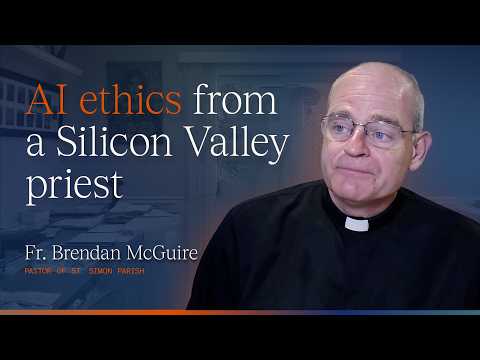
“In that meeting fundamentally, Chris Olah, who’s one of the co-founders of Anthropic, basically said, you know, we’re trying to do the right thing. We broke off from OpenAI to do the right thing… And we need help. And we’ve been trying to do it, but we can’t get anyone else to partner with us. And so we’re kind of like, when are the adults going to show up? We’ve been trying to hold the line.” — Father Brendan McGuire, 16:25
Clip command
yt-dlp --download-sections "*16:25-17:35" "https://www.youtube.com/watch?v=lX6UXyCCN1g" --force-keyframes-at-cuts --merge-output-format mp4 -o "when-are-the-adults-going-to-show-up.mp4"”Oh god no, he’s an atheist, an avowed atheist.”
“Oh god no, he’s an atheist, an avowed atheist. Okay, that’s, okay, so an atheist from Anthropic has said look we’re trying to figure it out, and we have to work with… we could convene through the Catholics, let’s call the local guy who also understands some of what we’re doing.” — Father Brendan McGuire, 18:47
Clip command
yt-dlp --download-sections "*18:47-19:21" "https://www.youtube.com/watch?v=lX6UXyCCN1g" --force-keyframes-at-cuts --merge-output-format mp4 -o "an-avowed-atheist.mp4"”The seven founders took a pledge that they would give away 80 percent of their wealth.”
“What most people don’t understand is that Anthropic is set up as a public benefit corporation… The seven founders… took a pledge that they would give away 80 percent of their wealth. Now, I don’t hear the other guys ever saying that number, and I don’t hear about a public benefit. So there is a distinct difference.” — Father Brendan McGuire, 25:39
Clip command
yt-dlp --download-sections "*25:39-26:43" "https://www.youtube.com/watch?v=lX6UXyCCN1g" --force-keyframes-at-cuts --merge-output-format mp4 -o "eighty-percent-pledge.mp4"”Is it a Word doc? Is it Google Docs? … Is it a PDF?”
“I’m going to ask a ridiculous question, but I won’t be able to sleep if I don’t ask it. Is it a Word doc? Is it Google Docs? How—how do you get an embargoed copy? Is it a PDF?” / “It’s a PDF because you won’t believe it—it’s a PDF, yeah.” — Paul Ford and Father Brendan McGuire, 30:43
Clip command
yt-dlp --download-sections "*30:43-31:05" "https://www.youtube.com/watch?v=lX6UXyCCN1g" --force-keyframes-at-cuts --merge-output-format mp4 -o "is-it-a-pdf.mp4"”The mortar is still wet.”
“I believe that like if you think we’re building a wall then the mortar is still wet. We can still tilt these machines to good but they need to be tilted now because in six or nine months the mortar will be hardened and we will not be able to tilt them anymore.” — Father Brendan McGuire, 37:25
Clip command
yt-dlp --download-sections "*37:25-38:57" "https://www.youtube.com/watch?v=lX6UXyCCN1g" --force-keyframes-at-cuts --merge-output-format mp4 -o "the-mortar-is-still-wet.mp4"”These guys need us to use their systems.”
“If you vote for a system by using it, you are telling them you’re okay with that. If you don’t use a system, then you are saying they aren’t okay with that. And guess what? These guys need us to use their systems.” — Father Brendan McGuire, 41:16
Clip command
yt-dlp --download-sections "*41:16-42:20" "https://www.youtube.com/watch?v=lX6UXyCCN1g" --force-keyframes-at-cuts --merge-output-format mp4 -o "vote-with-your-feet.mp4"Key Points
- St. Simon Parish, Los Altos (1:17) - McGuire’s parish sits “right smack in the middle of Silicon Valley,” with parishioners from OpenAI, Anthropic, Google, Meta, and Microsoft, plus investors from Los Altos Hills.
- From engineer to priest (2:12) - Youngest of 12 children from Dublin; earned an electronic engineering degree and a master’s in computer science/cybersecurity before immigrating to California and eventually being ordained in 2000.
- PCMCIA irony (3:08) - Before the priesthood, McGuire helped unify ~750 organizations worldwide around a single hardware standard at PCMCIA — a preview of the “convening” role he’d later play for AI labs.
- CEOs quietly stepping down out of fear (5:32) - Around 2018-19, McGuire’s tech-executive friends began leaving leadership roles, citing not business risk but “existential fear” of technology they didn’t understand.
- The Institute of Technology, Ethics and Culture (2019) (7:25) - McGuire and a Rome-based bishop formalized a decade of informal listening sessions into a standing institute at Santa Clara University.
- Four inflection points, now compounded (11:57) - The internet, mobile, cloud computing, and social media were each allowed to develop “hands off”; AI is all four combined, affecting every industry at once.
- “Ethics in the Age of Disruptive Technology” (14:42) - McGuire’s institute published ethical standards before ChatGPT even existed, but got polite dismissal from industry: “very nice job, Father.”
- Chris Olah cold-calls looking for “somebody from the Vatican” (15:43) - In fall 2025, the Anthropic co-founder reached out through a mutual friend, kicking off the relationship that led to the Constitution of Claude collaboration.
- Convening power is the church’s actual asset (17:47) - McGuire concedes the church has no technical or even universal ethical expertise; what it has is the ability to get people to show up when a cardinal — or the Pope — calls.
- Early access to the Constitution of Claude (19:21) - McGuire, Brian Green (Santa Clara ethicist), and Bishop Paul Tighe were given an unpublished 64-page draft; McGuire wrote a 35-page commentary and urged Anthropic to publish it.
- Transparency → accountability → trust (21:19) - McGuire’s core argument for why Anthropic should publish the Constitution rather than keep it internal — “you cannot shortcut that circuit.”
- Two 14-hour days with the rest of the industry (22:29) - In January, McGuire and Bishop Tighe met with OpenAI, Gemini, and other AI labs and nonprofits; the universal finding was goodwill mixed with fear of a “race to the top or race to the bottom.”
- The vicious circle of compute and capital (24:03) - Bigger models require more money; more money buys bigger, more accurate models; the loop is nearly impossible to exit once started.
- Anthropic’s public benefit corporation structure (25:39) - Seven founders pledged to give away 80% of their wealth — a commitment McGuire says he doesn’t hear from other labs.
- Why Pope Leo took the name Leo (28:42) - Leo XIII wrote Rerum Novarum on the Industrial Revolution; Leo XIV told cardinals the next day he chose the name because “we’re in the middle of a new revolution called artificial intelligence.”
- Tower of Babel vs. the wall of Jerusalem (32:36) - The encyclical’s two biblical metaphors: inward-looking technical power that ignores everything outside itself, versus Nehemiah’s model where every family builds its own section of the wall.
- Paul pushes back on the wall metaphor (33:42) - Ford notes Nehemiah’s wall was literally built to keep interlopers out, and asks whether the Pope is also calling for defensiveness, not just collaboration; McGuire agrees the protective reading is correct.
- What are we protecting? Human dignity and the common good (34:30) - McGuire frames the central question as “what does it mean for humans to flourish?” — distinct from what makes the technology flourish.
- Six to nine months before the mortar hardens (37:25) - Borrowing MLK’s “fierce urgency of now,” McGuire argues the window to tilt AI systems toward good is closing as capital investment locks in current trajectories.
- Model costs: $500M-$1B to $3-5B per model (39:03) - The scale of capital now required is itself a countdown clock, because that money will eventually demand a return.
- Microsoft “throws in the towel” (40:10) - McGuire cites reports that Microsoft has stopped developing its own frontier models and is now leaning on partners, leaving the field down to two or three real contenders.
- The parishioner who quit on Monday (41:16) - A young engineer told McGuire he realized he’d “been building the Tower of Babel” and, with his wife, decided to quit and start a company building a “wall of Jerusalem” instead.
- The airline safety-record analogy (41:16) - McGuire’s closing pitch for consumer responsibility: if you keep flying the airline with the bad safety record, the fault for its survival is partly yours.
Mentions
Companies & Organizations
- Anthropic (16:31) - Co-founder Chris Olah initiates the relationship with McGuire; later profiled as a public benefit corporation whose founders pledged 80% of their wealth.
- OpenAI (25:29) - The company Anthropic’s founders left; also met with directly by McGuire’s delegation in January.
- Google / DeepMind / Alphabet (25:39) - Described as a “multi-nation state,” making Gemini’s safety posture harder to pin down than Anthropic’s.
- Microsoft (40:10) - Reported by McGuire to have stopped developing its own frontier models in favor of partnerships.
- Meta (1:17) - Named among the major tech employers in McGuire’s parish.
- PCMCIA (Personal Computer Memory Card International Association) (3:08) - McGuire’s pre-priesthood employer, where he helped unify ~750 organizations around a single hardware standard.
- Institute of Technology, Ethics and Culture (Santa Clara University) (7:25) - Formal body McGuire co-founded in 2019 to continue a decade of listening sessions with tech leaders.
- Aboard (0:02) - The hosts’ podcast and AI transformation company, named at the top of the show and again via aboard.com in the outro.
Products & Technologies
- Constitution of Claude (19:21) - Anthropic’s 64-page governing document; McGuire, Green, and Tighe reviewed an early draft and are credited as contributors in the published version.
- ChatGPT (14:42) - Reference point for timing: McGuire’s institute published ethics standards before ChatGPT’s model existed.
- Magnifica Humanitas (the encyclical) (28:42) - Pope Leo XIV’s encyclical on AI, delivered personally by the Pope for the first time in Church history.
- Rerum Novarum (28:42) - Leo XIII’s 1891 encyclical on the Industrial Revolution, the namesake precedent Leo XIV invoked.
People
- Father Brendan McGuire (0:39) - Guest; pastor of St. Simon Parish, Los Altos; former electronic engineer and cybersecurity professional.
- Chris Olah (15:43) - Anthropic co-founder and self-described atheist who initiated contact with McGuire in fall 2025.
- Bishop Paul Tighe (19:21) - Rome-based bishop, fellow Dublin native and co-commentator on the Constitution of Claude with McGuire.
- Brian Green (19:21) - Ethicist at Santa Clara University who joined McGuire’s early meetings with Anthropic.
- Cardinal Reinhard Marx (6:16) - German cardinal on the Pope’s cabinet who made an official visitation to Silicon Valley that helped launch McGuire’s listening sessions.
- Pope Leo XIV (28:42) - Chose his papal name in reference to Leo XIII’s Rerum Novarum; personally delivered the AI encyclical.
- Pope Francis (29:41) - McGuire notes Leo XIV had been in dialogue with Francis before the encyclical, so it wasn’t a surprise from within the Church.
- Martin Luther King Jr. / Vince Harding (36:27) - McGuire invokes King’s “fierce urgency of now” speech (written by Harding) at Riverside Church as the model for why silence now would be a betrayal.
Surprising Quotes
“It’s very nice, but who the hell is he?” — Father Brendan McGuire, 15:23
“What? A Catholic priest, a Catholic bishop, were involved in the constitution? What in God’s name is going on?” — Father Brendan McGuire, 21:19
“The road to hell is paved with good intentions. I know that. But you can’t get anywhere without goodwill.” — Rich Ziade, 27:13
“Only a handful of technologists who are making the decisions — that’s the real scandal.” — Father Brendan McGuire, 37:25
“Silence was a betrayal. My thing to everyone is silence is a betrayal. You cannot afford to be silent in any part.” — Father Brendan McGuire, 41:16
Transcript
Paul Ford: 0:00 Hi, I’m Paul Ford.
Rich Ziade: 0:01 And I’m Rich Ziade.
Paul Ford: 0:02 And this is the Aboard podcast. It’s a podcast about how AI is changing the world of software and culture and Rich, did you notice that there was a big Papal encyclical that came out Richard?
Rich Ziade: 0:11 I did. Yes I did.
Paul Ford: 0:12 Is that pop popped up in your RSS feed?
Rich Ziade: 0:14 It popped up in many places actually.
Paul Ford: 0:17 That’s right. And so we have someone who can really really talk us through what’s going on, where that came from, and and the role that a large religious institution, namely the Catholic Church, is seeking in in sort of guiding the world through this very confusing and very strange time. And that person is Father Brendan McGuire. Father, thank you for coming on to the show.
Father Brendan McGuire: 0:39 Pleasure to be here. Thank you Paul, Rich. Look forward to having this conversation.
Paul Ford: 0:45 Alright, let’s play our theme song and then let’s come back and talk about encyclicals. So Father, at the risk of being a little redundant, could you tell us who you are and talk a little about your relationship with AI and with the world of technology?
Father Brendan McGuire: 1:17 Yes. So my name is Father Brendan McGuire and I’m pastor at a parish called St. Simon Parish in Los Altos, which for those of you who don’t know is right smack in the middle of Silicon Valley. So our parish is we got engineers from all the major companies, OpenAI, Anthropic, Google, Meta, Microsoft, you name it are here. But we’ve also got the users. We also have the investors. The investors are just up the street. They mostly live in Los Altos Hills. And so they’re here and we regularly have conversations and so it’s in that context that I’ve been very involved. But my journey started actually quite a long time ago. I’m originally from Ireland, from Dublin, Ireland and…
Paul Ford: 2:00 That’s not a California accent. That’s not what I’m hearing yet.
Father Brendan McGuire: 2:03 No, that’s not a California accent. No. Although I don’t hear the accent. I just want you to know. I think you all talk with accents, not me.
Paul Ford: 2:09 Fair enough.
Rich Ziade: 2:11 I do.
Father Brendan McGuire: 2:12 Yeah. So youngest of 12 children. I grew up in a very Catholic family. Loved the church. Went to daily Mass. And so I’ve always had a proclivity for church. So my vocation didn’t kind of pop out of nowhere. It was sort of in there as a young man. But I didn’t really want to become a priest to be told is I wanted to be an engineer. And I wanted to be rich and famous, have a wife and children and everybody’s dream. I want to go to California. So I I went to college. I did my engineering degree in actually electronic circuit design. So electronic engineering degree. And then I did my Masters in computer science with software programming that led me into the cyber security side. And so when I came to California, I immigrated here and there was no jobs to be had in believe it or not in cyber security. It wasn’t a very big industry back then. And so I joined a company called PCM CIA, Personal Computer Memory Card International Association.
Paul Ford: 3:07 Hmm.
Father Brendan McGuire: 3:08 And so we started out as a very small organization, about 20, 30 organizations and ended up with about 750 organizations worldwide. And so my role was to bring all these companies together into a single standard. So you could sort of see a certain irony of the Lord’s providence in bringing me back into all that world. But here’s what’s interesting. So when I left the industry, I loved working in the business world, like that wasn’t the reason why I left. I just felt I needed to serve the Lord in a different way, and that’s what I felt. But I stayed in contact with all my friends. So as I got ordained in the year 2000, I stayed in contact and all my friends then rose up into the corporate ladders of their companies. And as they were getting closer and closer to top and then most of them ended up in the top, they used to share increasingly the stories that sometimes were fantastic stories, fabulous stories, sometimes miserable stories, you know, the way you just, you talk. But it all changed somewhere around 2010, maybe 2012 to 2015. It really, the tenor of the conversation and the concern of the conversation changed. And they were saying, ‘What’s coming over the hill, Brendan, you wouldn’t believe. It’s unbelievable what’s coming over the hill. This is scary, scary technology. And you’ve got to help us because we don’t know how to use it. In fact, even the people who are designing this stuff don’t know how to use it.’
Paul Ford: 4:35 Now is this specifically—so this would be sort of pre-LLMs, like sort of machine learn—like what—what was coming over the hill?
Father Brendan McGuire: 4:42 So it was all around artificial intelligence, although they weren’t calling it that. If you remember back in 2015, that wasn’t a popular word back then. In fact, if you said that, you probably didn’t get any investment. But there were some large companies who were developing towards it at that time. Google was one of the biggest investors back then and Microsoft. They were—they were sort of a race even back then. And people were saying what the potentiality of this technology is huge and it’s going to change how we do everything. Now, it didn’t really—they weren’t being very clear about exactly what it meant. But I could tell you, like their lives changed. Like they quit their jobs as CEOs rather than take this on.
Rich Ziade: 5:30 Hmm.
Father Brendan McGuire: 5:32 And they joined boards. So they were frightened enough to move out of companies, leadership in companies. They said, ‘I just—I don’t want to take it on. I’m done. I’ve made my money. I’ve had a great career. Don’t need it anymore. Just too much liability.’ And their fear was for—actually wasn’t just a business fear, it was an existential fear, fear for humanity that there was something that we were designing we didn’t know how it would work. And then that became increasingly more ‘18, ‘19, and then it became very clear that something was definitely at—on the horizon. And so at that point, I was doing these business—then I tried to formalize to get these same guys together, most of them were guys, a couple— When they were mostly guys, get them together and they were really—I could get these one-on-one conversations. They’d tell me all this stuff. But put them in a group, wouldn’t share.
Rich Ziade: 6:09 Because of corporate sort of secrecy just being built in, or…
Father Brendan McGuire: 6:13 Right, yeah.
Rich Ziade: 6:15 Okay.
Father Brendan McGuire: 6:16 Corporate liability. Corporate liability. They didn’t know—they didn’t have enough trust with these other CEOs. I knew them. I was a common core between them. They didn’t necessarily all know each other. But you know, so at the same time, I had interests from—I was a vicar general at the diocese here, that’s kind of number two or three in charge with the bishop. And we had people coming in, Cardinal Marx from Germany who was on the Pope’s cabinet at that time. And he came as an official visitation to the Valley and we set up meetings with all sorts of different people. It was really a true—it was kind of the beginning of the synodal style of church, which was listening. We went and we just listened. We went to—went to these corporate corporations and sat and said ‘what’s on the horizon? What do you think is interesting? What should we be—what should we be paying attention to?’
Rich Ziade: 7:24 Mhm.
Father Brendan McGuire: 7:25 And we learned a lot. So much so that it convinced me that we needed to continue to do this. So then I started to set up more meetings in these group meetings and that was like ‘16, ‘17 and then… with limited success, truth be told, but I still had lots of meetings. Not every month, but certainly every quarter. And then in ‘19 it became much more intense. Because at the same time, I partnered with a bishop from Rome who’s another Dublin, Irish priest who was head of communications and then moved to communications and to education and culture. And he come over and we hosted some meetings there. So I continued my meetings parallel and he continued more meetings there to call them Minerva dialogues over there with people who would come to visit the Pope. And then we joined forces in a—in an institute of technology, ethics and culture at Santa Clara University. We formalized our agreement in 19—2019. And so we’ve been continuing that every month ever since. So while everybody says ‘well this comes out of the blue,’ we’ve been—we’ve been listening for over 10 years. So this hasn’t come out of the blue for us. You see, so we knew it was coming.
Paul Ford: 8:17 This makes sense to me. Also, um, there was a doctrinal note published a couple years ago too, right? I mean, I think there’s been a sort of steady cadence of engagement with the church.
Father Brendan McGuire: 8:29 Correct.
Paul Ford: 8:30 Going back to your role and your relationship with your parishioners, I’m curious because you have in your flock a number of people from these very large and ostensibly very secular companies. Very large, non-faith based, they might have elements of sort of faith or cultural responsibility baked into them, but definitely not Catholic. Anthropic, OpenAI, Google. And so engineers, product managers, developers are coming to you and they’re—they’re in the faith with you and they’re trying… to triangulate how to work within this large system. It’s a good source for them. They may love the work. And I’m just curious how you minister to them because it seems like there’s a lot of paradox and confusion. And some of the people you described just said, “I’m done. I’m out of here. I don’t I don’t want to do this anymore.” But I’m sure others did not. And so as a as a priest, what what do you tell them?
Father Brendan McGuire: 9:23 Well, look, one of the things, one of the great gifts that we have as as priests, we get to be with people in the most vulnerable moments, typically in the sacrament of what we call the sacrament of anointing of the sick. And what we learn in those moments is the greatest gift that you can give with somebody is simply presence. You can’t change the reality, you can’t stop them from dying, you can’t stop their illness, but what we can be is present to them in their suffering and you can accompany them, walk with them. Why I bring that up is that’s that’s what I do as a as a pastor. I walk with people. I accompany them. I can’t solve their problems. I can’t take away their suffering. But what I can do is listen to them and I can accompany them on that journey. And so that’s what I largely do, no matter who they are. I will listen to them. Now, maybe it’s maybe a little bit more interesting because I’ve got a technology background. I can ask maybe deeper questions to get to the understanding and then I get so many different samples from different people. I I can be more engaged with them. But fundamentally the stance is accompaniment and walk with them.
Paul Ford: 10:30 The last 10, 12 years, maybe even 20 years, let’s go ahead and do 20 years have been there’ve been various sort of peaks of tech insanity, for lack of a better word, or excitement. I mean, there’s there’s the crypto wave, there’s, you know, we’ve talked on this podcast about how you can transact and gamble online now. There’s all kinds of things that have come up. And but obviously with AI, I think a whole new level of sort of anxiety and urgency, maybe is the word, at this point? I I it’s hard to tell what’s urgent when everything feels loud all the time with with with this stuff. Who is initiating? Who is leaning forward and saying, “We yo, slow down. We have to talk about this.” Is it the church? Is it business leaders? Is it is it just a groundswell of sentiment? Like what is causing everyone to step forward and say we this is different and we have to address it?
Rich Ziade: 11:41 I mean, I think let me let me just frame that and then to to simplify it a little bit, which is why is there an encyclical and before that a doctrinal note around AI, but not around mobile technology or around blockchain technologies? Social media, which is, yeah, has its own harm and what not.
Father Brendan McGuire: 11:57 Well, I think it’s a great question. I would name… I name four major inflection points. Now I think there’s more of each, but I think the four major inflection points technology of Silicon Valley has been—impacted the world globally has been of course the beginning of the internet in the 90s, right? That was a huge big one explosion and we said, ‘No, we can’t—we can’t regulate it. It needs to go unfettered. It needs to have a technocratic determinist—let it determine itself.’ And we did. Largely regulators were hands off and they didn’t do anything. Then we come along and we have the mobile media. It comes and it explodes and the same approach to that—we got hands off again. And then comes in there the cloud computing and again the same thing. We can’t—we just—there’s no need for anything here. No alarm bells here. Let’s just continue this opportunity. And then came along mobile—the whole social media and the exact same approach and Section 230 gets applied to these companies and all of a sudden they have a protection racket that goes on that they can’t—they can’t be held accountable for anything.
Paul Ford: 12:59 Mhm.
Father Brendan McGuire: 13:00 And every time everyone said each time that, look, we can—we can do this. And and I think we’ve got probably the most data on—on the social media and how that has disas—has been a disastrous play, especially for our young people. Now, there’s been lots of benefit, I get, but our young people are paying a price for that at what I call the addiction market. And now you see it popping up in other areas such as the Polymarket or the online gambling market and there’s all sorts of other—but it’s come. And so I think with—with this new tech—what makes this new one so much different and the inflection point massive is because I believe that it’s probably all of those put together into one size-wise. And why? Because it has the ability to affect all the industries at the same time, right? Now, it won’t happen exactly the same, but it has the potential. It has the potential to do great good and it has the potential to do great harm. And this is the one time that while we could have said before we could let the technocratic determinism take over, that would be a drastic mistake this time because it can go so wrong so fast, because it’s so powerful, because it has so much power behind it and—and intelligence in discrete ways. So we can’t afford to play the game of let’s see. And the reason why we have leaned in as a church is because nobody else has showed up.
Rich Ziade: 14:37 Mhm.
Father Brendan McGuire: 14:38 Just to be clear, like if there was other people at the table we wouldn’t have to show up.
Paul Ford: 14:41 Mhm.
Father Brendan McGuire: 14:42 Like had we produced a document at the ITEC called Ethics in the Age of Disruptive Technology—we didn’t even call it AI—that came out before ChatGPT’s model. So we had that in place and we were gaining—we were trying to get out to people and CEOs and get attention and get adoption of this—these sort of ethical standards. But we were given very limited success. Everybody was giving me and everything. Oh, very nice job, thank you Father, that’s great, lovely, on it goes. Very, not mean to be patronizing, not deliberately patronizing, but in some ways…
Rich Ziade: 15:08 Everyone is very, they’re very polite when a priest shows up. You know, it’s…
Paul Ford: 15:11 Thank you, thank you, you’ve done this…
Father Brendan McGuire: 15:14 But they also have, to be honest with you Paul, they also have a question, which is what the hell is he doing here? Like, why are you? I mean just to be clear, they’re going…
Rich Ziade: 15:22 This is none of his business.
Father Brendan McGuire: 15:23 It makes no sense to them. It’s very nice, but who the hell is he?
Paul Ford: 15:26 It’s sort of what I’m getting at though, which is, I feel like it’s been unusual to see tech leaders show initiative and say, we need to help.
Father Brendan McGuire: 15:31 Right. So that’s an important point. But I will tell you, there’s not many, just be careful to overgeneralize here.
Rich Ziade: 15:36 Yeah, yeah.
Paul Ford: 15:38 I want to get to the crazy eyes in a second.
Father Brendan McGuire: 15:43 I’m gonna say, the path was going along, we were trying, I was, I mean, I run a busy parish, I’ve got a school of 560 students, so I’ve got other things to do. I try and, I would go out and meet with people at lunches or dinners, coffees, whatever I could take. And I would get some traction, but then nothing would happen. I was getting very disappointed, very distraught, very disenchanted by the industry’s lack of willingness to apply ethics. And then Chris Olah, this was now only fall of last year. We’re not talking about long ago. We’re talking about six months ago, or eight, nine months ago. Chris Olah called me up through a mutual friend and said, I want to meet somebody from the Vatican. I’d like to talk to somebody from the Vatican. And I said, well, I’m not really connected to the Vatican per se, I mean, I don’t like, don’t have the Holy Father’s phone number…
Paul Ford: 16:25 Come on, Brendan. On LinkedIn, it’s not a lot of degrees of separation. I mean, you’re a proxy.
Father Brendan McGuire: 16:31 No, no, but people think that we’re all connected. It’s all that simple. In some ways it is, in some ways it isn’t. But… Anyway, I said, well, look, I do, I have a bishop coming in from Rome next week. We could set up a meeting if you’d like to do that. So that’s what we, we sat down and it was in October of last year. And in that meeting fundamentally, Chris Olah, who’s one of the co-founders of Anthropic, basically said, you know, we’re trying to do the right thing. We broke off from OpenAI to do the right thing. We feel that there needs to be guardrails on this technology. We believe that this potential for this technology is wonderful and brilliant, but it needs guardrails. And we need help. And we’ve been trying to do it, but we can’t get anyone else to partner with us. And so we’re kind of like, when are the adults going to show up? We’ve been trying to hold the line.
Rich Ziade: 17:35 What’s wild Father is they came to you. Here you were at PCMCIA many years ago. They came to you as an ethical standards body, and they said, how do we get people around the table to build a good standard?
Father Brendan McGuire: 17:47 I would be saying the same thing, wondering, I don’t know. But I’ve always maintained, and this is where we had immediate complete agreement, what we don’t have in the church is expertise in technology. We don’t even have expertise in… necessarily an ethics because we have lots of ethical opinions, but it’s not universal in the sense we have to get other people around the table. You have to get ethics goes beyond a religion. It has to be for the common good of humanity. And we don’t, you know, so what then what are we doing at the table? And so the one thing that we can bring is convening power. And and I felt we always had that. So when a cardinal calls, people take the call. It’s because there’s only one of a hundred in the world.
Paul Ford: 18:22 Mhm.
Father Brendan McGuire: 18:23 when the Holy Father calls people to Rome, they show up or when technology people go to Rome, they want to meet the Holy Father. So there is something mystical about that institution that somehow it matters to people beyond the religion of Catholicism.
Paul Ford: 18:27 Mhm.
Father Brendan McGuire: 18:28 So we felt that that’s what Chris Olah was trying to tap into was the convening power. Could we help him? And so we had this long wonderful conversation which blew my mind. And at that moment, I knew I had I had to help.
Paul Ford: 18:33 Mhm.
Father Brendan McGuire: 18:34 I mean, I’m glad you said it blew your mind. That’s a hell of a, is he coming to you as a Catholic or just as a concerned person?
Rich Ziade: 18:46 Mhm.
Father Brendan McGuire: 18:47 Oh god no, he’s an atheist, an avowed atheist. Okay, that’s, okay, so an atheist from Anthropic has said look we’re trying to figure it out, and we have to work with, okay, so and sort of sussed out, like, okay, we could convene through the Catholics, let’s call the local guy who also understands some of what we’re doing.
Rich Ziade: 18:55 It’s good to say, that’s a hell of a move, is he coming to you as a Catholic or just as a concerned person?
Father Brendan McGuire: 19:02 Oh god no, he’s an atheist, an avowed atheist.
Rich Ziade: 19:05 Okay, that’s, okay, so an atheist from Anthropic has said look we’re trying to figure it out, and we have to work with, okay, so and sort of sussed out, like, okay, we could convene through the Catholics, let’s call the local guy who also understands some of what we’re doing.
Father Brendan McGuire: 19:21 Right, and his vision at that time was very much in sync with Bishop Paul Tighe and my vision, which was that this wasn’t a Catholic issue, this was a world issue, and that the role the Catholics had was one of the oldest institutions around the world and people tend to listen to the Holy Father and and there’s sort of a wisdom, not necessarily always everybody agrees with it, but that people will tend to pause and listen. And so so we, I met him the next day, that was a, you know, a couple hour meeting, next day I called him up and said I want to continue this conversation, you know Bishop Paul went back to Rome, and we deepened a friendship and we went up Brian Green who was also at that meeting who’s the ethicist at Santa Clara University, Brian and I went up for a three quarter day meeting up in Anthropic in early December and before that, they gave us an early copy of the Constitution of Claude, which is the the guiding document that they had never published to the world and they asked our opinion on it. It’s a 64 page document, if you’ve ever interest you should really read it, it’s on their website.
Rich Ziade: 20:49 No I’ve I’ve read it, we should put, we’ll put a link in the show notes for everybody.
Father Brendan McGuire: 20:52 No, it’s, it’s an unbelievable document in so many ways. But when I got a copy of it, I thought to myself, wow, this is just extraordinary. I was impressed by the humility of it, the courage of putting this out, and the willingness to, you know, the courage to be willingness to be made vulnerable by by not having all the answers to something, but they’re willing to kind of engage the world in it. It’s not—it’s not the end. This is what they need to continue to work on, but they need input from everyone. They can’t be just relying on the engineers and the philosophers at Anthropic. They need other people to contribute to it. So they asked us to contribute to it. So we did. I made—so there’s a 64-page document, I made a 35-page commentary.
Paul Ford: 21:16 No, I’m I’m a terrible cynic, and I, that is a very well intentioned document.
Rich Ziade: 21:18 Mm-hmm.
Father Brendan McGuire: 21:19 So in that commentary, I basically said what I just said to you guys earlier: I promise to accompany you on this journey. I don’t know what else I can do. I don’t have answers on the technical problems. I probably don’t even have answers on the philosophical or theological problems. But what I can do, and I do know, is I know souls. And you’re going to have a lot of interaction with a lot of souls, and that matters to me. And so I will walk with you to get that part right. It is a well intentioned document, but it’s not, it’s, you have to understand it’s the beginning. And so that’s what I did. And so they asked the question—I remember it—they said, ‘Do you think we should publish this to the world versus keeping it?’ I said, ‘Absolutely you need to publish this to the world.’ And the reason why I said that is because transparency will lead to accountability, accountability will lead to shared responsibility, and shared responsibility will lead to trustworthy AI. You cannot shortcut that circuit. And so the first step is transparency. And so they did, and they published it. And in that publishing of it, they credited—they put my name, Brian Green’s name, and Bishop Paul’s name as commentators, contributors. And so we went from being in the background, hidden, which is what I generally like, to being exploded onto the front stage and everyone goes, ‘What? A Catholic priest, a Catholic bishop, were involved in the constitution? What in God’s name is going on?’
Rich Ziade: 22:21 I mean, they are—they’re one of the big players, but there are other big players. Was there any attempt to get others to—to sign on?
Father Brendan McGuire: 22:29 So there is. So the next month, early January, we—Bishop Paul came back and we had him back and we had a full-day visit with Anthropic, and then we had another full-day visit with other AI companies. So we met with OpenAI, we met with a—people from Gemini, we met with other non-profits. And so it was two crazy days, I mean, two 14-hour days, but we had a ton of meetings.
Rich Ziade: 22:46 And the reception?
Father Brendan McGuire: 22:48 And the reception was—and I think here’s the interesting part, it’s a great question, Rich, because the reception was universally across all the boards that they all were trying to do the right thing, and they were all terribly nervous that this could go wrong. And they did not know how to self-correct because they were in a race to the top or race to the bottom.
Paul Ford: 23:02 I mean, there’s a tension there, right? I mean, it is hotly competitive, but at the same—so how do you do the right thing?
Father Brendan McGuire: 23:11 Correct.
Paul Ford: 23:11 There’s also—
Father Brendan McGuire: 23:12 Correct. But there’s also, in order to move the technology forward, which is their mission and it’s what they believe in for various reasons, the amount of capital necessary requires an unbelievable—like they just—once that foot gets onto the gas, it’s very hard to slow it down.
Rich Ziade: 24:00 Very hard to take it off. Right?
Paul Ford: 24:02 Correct.
Rich Ziade: 24:02 So I think they’re triangulating that.
Father Brendan McGuire: 24:03 So they have this curve that this is a mathematical curve that they they have shown the data that the larger the models become and the the more compute power they have, the more accurate and the faster they become. Right? And and so you’ve seen this now and it’s played out. And as a result then, the more money you get, the bigger your model can become, the bigger your model you become, the more accurate you become, the more effective you become, then the more money you can get, then the bigger you can get, and the and it just there’s this vicious circle, some will call it a virtuous circle, but it’s a vicious circle.
Paul Ford: 24:41 Well and there’s a motivating belief in many of the labs that by getting to superintelligence first, superintelligence in quotes, but that they will be able to make the world more safe if the if it’s under ethical principles that they define, they’ll be able to create an intelligence that can be managed and that will lower the risk to the rest of humanity.
Father Brendan McGuire: 24:53 I would respectfully say Paul, some are saying that.
Paul Ford: 25:00 Mm, okay.
Father Brendan McGuire: 25:01 The others are saying that whoever gets to the line first wins the prize.
Paul Ford: 25:07 Mm-hmm, mm-hmm.
Father Brendan McGuire: 25:08 Right? So it’s not all so ethical. You know, so unfortunately, I wish they all were saying that.
Rich Ziade: 25:12 But I’ve, you know, outside looking in Father, I mean, it looks like, I mean, I don’t think this is even a leap to say that Anthropic, it’s really become part of their story, that they’re sort of driven by a, a sort of ethical compass so to speak, whereas you don’t hear a lot about it from the others. Maybe there’s an essay out here or there, but Anthropic, and I think two-part question really, one…
Paul Ford: 25:29 Remember they spun off from OpenAI because even though OpenAI was a non-for-profit nominally focused on the same things that they believe in, so…
Rich Ziade: 25:34 Because they didn’t like the direction, yeah.
Father Brendan McGuire: 25:39 So bear in mind let me just maybe double-click on that one sec, Rich, just to give a little illustration to that. So what most people don’t understand that Anthropic is set up as a public benefit corporation. So it’s a- it’s a for-profit, but it’s set up for profit for the public benefit. The seven founders, I think it’s seven or five, I don’t ever remember which- I think it’s- I think it’s seven. Seven founders took a pledge that they would give away 80 percent of their wealth. Now, there’s not a- I don’t hear the other guys ever saying that number one. And I don’t hear about a public benefit. So there is a distinct difference and I do think that they- they do try to walk that walk. Now that isn’t to say, I will tell you like I’m in contact with people from OpenAI, from Gemini, and there’s people of goodwill inside those organizations who are trying to do the right thing and to steer that ship right. They just don’t have the same infrastructure, in the case of OpenAI, they just don’t have the same backing for safety that Anthropic does. And in the case of Gemini is part of Google DeepMind which is part of Google which is part of Alphabet, which just a massive organization.
Rich Ziade: 27:09 Yeah, it’s a nation-state. Yeah, yeah.
Father Brendan McGuire: 27:11 And it’s – it’s just it’s a multi-nation state. So it’s – it’s just it’s so hard to get.
Rich Ziade: 27:13 But they are genuinely trying to do the right thing. Now, I’m not naive. The road to hell is paved with good intentions. I know that. But you can’t get anywhere without goodwill. So you have to get – you have to start somewhere. So our – our choice was to partner with Anthropic and to take them at their word and we are deepening that relationship.
Father Brendan McGuire: 27:41 You – you saw with the Holy Father invited Chris Olah to the table at the announcement and the release of the document. Two things extraordinary about that was number one, is that the Holy Father, there never before has a Pope ever given publicly his own encyclical. So it’s the first time in the history of the church.
Rich Ziade: 28:12 So we never had the Pope give his voice to his own encyclical. Usually it’s one of his cardinals who gives a talk on it. Second of all, we’ve never invited an industrialist of whom we’re speaking out against to come to the table and like bear in mind that Chris was there and we were speaking out challenging the AI industry and he was there accepting that challenge and – and then begging for, go deeper with it. Like it’s extraordinary talk if you haven’t listened to that talk of Chris at the – at the Holy Father’s table, it was extraordinary to listen to.
Paul Ford: 28:36 That’s wild. Take a step back for us, how does an encyclical come to be?
Father Brendan McGuire: 28:42 So what’s interesting about this particular encyclical is I suppose I know most about this as opposed to other ones, is that Pope Leo when he became Pope, he took the name Leo and he explained the day after why he took it. He took it Leo the 14th because Leo the 13th was the Pope who – who first brought out an encyclical on social doctrine, what we call social doctrine, Catholic social doctrine, which means that it’s the church in the world and that we need to make commentary on what’s going on in the world. It’s kind of a, think of it as applied theology. You apply the theology into the social realities of the world. And at that particular time, that was right in the middle of the Industrial Revolution. And he came out with a document, encyclical, called Rerum Novarum. And so Pope Leo when he got – when he got elected, he took the name Leo and then the next day he told the cardinals, the reason I took Leo is because we’re in the middle of a new revolution called artificial intelligence.
Rich Ziade: 29:40 Hmm.
Father Brendan McGuire: 29:41 So that was like, so that was definitely a movement of the Holy Spirit. Like there’s no question, like I don’t know how that came about, but that’s a movement of the Holy Spirit that he was that aware back a year ago how important this would be. Now, bear in mind he had been talking to Pope Francis, so it’s not like it came out of the blue. He knew what was going on, he knew again he would have known about these dialogues that we had inside the church. people know about it. And so this all came not as a surprise to us, but maybe as a surprise to people who were maybe not as well versed. So he takes it—and so we knew he was going to write something. And—and so therefore he telegraphed that he was writing it, and that’s exactly what happened. Now, how he writes it, it’s always a mystery how these things get written. But he obviously talks to experts and informs his opinion and writes it together. I mean, I got an embargoed copy of it because I was asked to be on the front stage with them in handling the press and helping because I was so connected to Anthropic here locally, they asked me to basically be a verse to it and talk about it and be willing to engage with it. And so I did. And so I—
Paul Ford: 30:43 I’m going to ask a ridiculous question, but I won’t be able to sleep if I don’t ask it. Is it a Word doc? Is it Google Docs? How—how do you get an embargoed copy? Is it a PDF?
Father Brendan McGuire: 30:54 It’s a PDF because you won’t believe it—it’s a PDF, yeah.
Paul Ford: 30:58 Oh, okay. So not—they’re not looking for too much—
Father Brendan McGuire: 30:59 I’m not going to be—they’re not asking me for my opinion, mark it up. You’re not going to mark it up. ‘Here’s some questions and comments for you.’ No, no. They—yeah.
Rich Ziade: 31:05 So let’s tilt this to a more optimis—I’m going to be a little optimistic for a moment here. Anthropic’s winning. They took this bet, they made a statement about being a company that’s actually concerned and aware of the implications of this technology. And if you let’s put all that aside and just look at the—the pure market score and capitalist score of what’s going on, they’re—they’re sprinting right now. And they are—and—and my optimistic read on that—I’d love to hear yours—is that that’s because the masses, humanity, it—it resonated with them.
Father Brendan McGuire: 31:46 I—I think so. I absolutely agree. I—I think that people do—like, I mean, I will tell you, I think people do care. I think they do care if something is more ethical and less ethical. Now, not that everyone cares, but I think the vast majority of people want a more ethical system. They don’t want the whole world to be ruined. And—and they like our world, right? They—and they like what technology can bring them. They don’t want it to be intentionally bad. If it’s going to—they want it to be intentionally good. And so I think they are getting rewarded for their stance. And I think that’s a good thing.
Rich Ziade: 32:22 And this is the only way, I think, the other companies will bend their moral compass.
Father Brendan McGuire: 32:28 They will not do it because Father Brendan McGuire shows up to talk to them and say, ‘Hey, we think you need to do this and do that.’ They’re going to—they haven’t done it so far.
Rich Ziade: 32:35 It’s a win.
Father Brendan McGuire: 32:36 Yeah. So the market conditions, I think this is where, you know, the Pope in the document has this beautiful meta—two biblical metaphors he uses. He uses the building of the Tower of Babel and—and the build rebuilding of the wall of Jerusalem by Nehemiah. And in the building of—of the wall of the Babel is that it’s—it’s built inwardly looking, and it’s all focused inward, no reference to God, no reference—
Rich Ziade: 33:00 And it’s just sort of unique that everything gets changed by this one reality that they kind of unify around the tower about.
Father Brendan McGuire: 33:07 The alternative is, is Nehemiah gathers the people of Jerusalem and families and says what should we do with the wall. They, they go through a discernment process and then they decide that everyone, every family needs to build their section of the wall. And so they go about reconstructing the wall, but everybody has a role. And that’s the theme he pulls up, that everyone has a role to play here. The technology people who are building this are not the only ones who should be called to build it. Every philosopher, every theologian, every journalist, every sociologist, and every politician needs to be engaged in and do their part of the wall.
Paul Ford: 33:42 But Father, when I, when I read it, an asterisk sort of popped into my head. Because the story of Nehemiah, well, the, the Babel narrative in this context made sense, but Nehemiah’s interesting because it’s about building the wall. It’s about defending Jerusalem, and it’s about taking care and, and sort of finding safety away from and, and to protect yourself from interlopers. And interlopers are coming. They’re trying to keep you from building that wall in that narrative. And I wonder if you could contextualize that a little bit for me, because it sort of threw me because essentially I read it as, as the office of the Pope saying, ‘Hey, we all gotta get together and protect ourselves from, from what is coming,’ as much as I read it as a story of collaboration and industriousness.
Father Brendan McGuire: 34:30 Right. And it, it depends. What was he asking us to protect? What, what was he asking us to protect? And that’s the very central question. And the, and the answer to that is human dignity and the common good. And that we have to start asking ourselves, ‘What does it mean for humans to flourish?’ Because if we just go to technology flourishing, that does not necessarily mean human beings. We need to ask the question before we engage with this. And that is the protection. We’re protecting against from that which seems to be good, but that under the disguise of good, but in fact, it may not be. And so the intention was to pause and ask, ‘What does it mean to flourish?’
Paul Ford: 35:13 So my reading that there, we need to defend ourselves a little bit is not incorrect? Like there is a sense of, like, we need to figure out a way to protect ourselves against many of these influences.
Father Brendan McGuire: 35:27 Correct. No, no, it is. Absolutely. No, it is. Very much so.
Paul Ford: 35:32 Okay. I’m not a, I’m very much not a theologian, so…
Rich Ziade: 35:35 I, I want to ask, we could talk for a long time because this is so far-reaching, but I, I want to touch on government. It feels like we’re in an era of deep mistrust of government. Frankly, government as an entity that can head off the potential dangers of technology has always been late, late to the game. It’s always kind of cleaning up and scrambling. And even then, sometimes it doesn’t clean up. I, I don’t know a lot about, I think Australia passed some pretty strong laws on… social media but the rest of the world is still way behind. I mean talk about who should be at the table obviously our political leaders and government being aware of this stuff and putting aside the politician dynamic and putting on a sort of civic leader dynamic feels really important here. Your thoughts there have they been in the in the are they in the conversation or what what’s how’s that
Paul Ford: 36:27 So I think they need to be and but I think that they are conflicted for obvious political reasons and so I you know the US Congress is not exactly a functional location right now that might be the most understated comment I’ve made for the whole day but I think to expect them to be able to push through some contentious issue like AI where a lot of people are going to stand to make a lot of money or not money on it is it would be very naive of us when they can’t even pass a housing bill that would help the entirety of of America right? So I mean so I think we just have to be realistic but they need to show up. Don’t get me wrong they do need to show up but in the interim we cannot wait and I’ll tell you why there is a there’s a famous talk that Martin Luther King gave written by his close friend Vince Harding at the Riverside Church
Father Brendan McGuire: 37:25 incidentally we’re called Riverside here I thought it would be important. It was to talk about his widening of the lens of who he was going to continue to fight for. It was not just going to be blacks he was widening the lens to he fought against the Vietnam war and he started to speak out on other issues and a lot of people inside his own group did not agree with this they said stay focused stay in your lane don’t go outside the lane but he got up and he gave this powerful talk and he talked about the fierce urgency of this present moment and that how silence would be a betrayal and so he felt that him being silent on this matter would be a betrayal. I think that we as a church have to see this as and we as a society need to see that silence will be a betrayal in this moment that these technologists and remember when we talk about this technology you’re only talking about a handful of technologists who are making the decisions that’s the real scandal only a handful of people are making the decisions where this goes that when it affects the entirety of humanity is too dangerous and that’s why it is the fierce urgency of this moment and I believe that like if you think we’re building a wall then the mortar is still wet we can still tilt these machines to good but they need to be tilted now because in six or nine months the mortar will be hardened and we will not be able to tilt them anymore.
Rich Ziade: 38:57 You say six to nine months realistically Basically or rhetorically, or do you feel like it’s that time?
Father Brendan McGuire: 39:03 Oh, I mean I mean nine months is the outside. And I’ll tell you why. The sheer number, just this is sheer numbers. Think of the numbers. At first when they were building these these models, it was it was costing somewhere between $500 million to a billion for a single model. Is now known that the models are costing between three and five billion dollars to roll out. Right? That’s a lot of money, guys. There’s a lot of money being poured out into these systems. Eventually that money that’s going out will want to return. The economics, capitalism always wants a return on investment.
Rich Ziade: 39:41 Sure.
Father Brendan McGuire: 39:42 And they’re going to want that that someone’s going to keep calling for that. And they’re going to say, ‘Eh, it’s good enough. We don’t need it.’ And it’s not good enough. We need to have it better, we need to have it smarter, yes, but we need to have it more accurate, and we need to have it tilted to good. And then we can harden it. Then we don’t need to then you go develop all the operators can come up with all their different implemented you do discrete imple… Then we’re good. That’s why this urgency moment is so important this now next next nine months.
Rich Ziade: 40:07 Immense pressure.
Father Brendan McGuire: 40:08 Immense pressure.
Rich Ziade: 40:09 Zero to one.
Father Brendan McGuire: 40:10 And remember there’s a row… there’s so much money being spent in this, look, for all intents and purposes, Microsoft in the last two weeks has announced it’s thrown in the towel with regards to co-it’s now developing with the other ones. They’re no longer doing their own.
Rich Ziade: 40:23 Sure.
Father Brendan McGuire: 40:24 So I mean so others are falling out of the race because they can’t afford to keep going.
Rich Ziade: 40:27 Yeah.
Father Brendan McGuire: 40:28 So it’s so the question is it comes down to two or three that are left.
Paul Ford: 40:31 Closing question. This is great by the way, really fascinating conversation. It’s something we think about but we don’t bother to like really have a deep discussion about. Are you optimistic? Am I allowed to ask that question?
Rich Ziade: 40:44 Well, actually hold on. So, don’t don’t answer that. Don’t answer that.
Paul Ford: 40:47 Just play the closing theme song after I ask the question.
Rich Ziade: 40:49 No, no. I actually I have a different question that I think would maybe be a little more helpful than than your own opinion Father. A young parishioner comes to you and they say, ‘I don’t know if there’s reason for optimism. I don’t know if there’s value in my work anymore. And I don’t know how I’m going to find myself in a world in which robots talk to me all day long.’ What advice would you give them? How would you center them?
Father Brendan McGuire: 41:16 Well, let me give you an example, it’s even more powerful. I had when we came back from Rome after the Encyclical was released. I had coffee outside everyone was on buzz of course and so we had these coffee morning coffee and donuts and we sat outside and we’re having coffee with people. And a roundtable conversation with tons of people. Two groups of people came to me and one of the young men who’s been working at a company I’ll just remain nameless right now says, ‘Father, I I’ve been reading the document. And I’m really blown away by the Holy Father’s challenge to humanity. And I realized in upon reflection that I’ve been building the Tower of Babel.’
Rich Ziade: 41:52 Hmm.
Father Brendan McGuire: 41:53 ‘And I can’t do it anymore. I’ve decided with my wife that we’re going to quit on Monday and we’re going to start our own company and we’re going to build a… we’re going to build a…’ a wall of Jerusalem. So I think I—I can’t see what people listen to them and say, ‘You need to make a decision that you can make.’ Not everyone has the ability to be able to make that decision because they’ve got financial pressures that does not free them. He and his wife were proud to make that decision because they had been thinking about setting up a company and they will do it. Um, other people are not going to be in that position. But what they can do is raise the question internally with their company and raise their voice. They can give voice to their concerns and if their concerns are never heard, they can never be addressed. But if they’re—if they are addressed, then we have success. If they are not addressed, then you have—then you have a different issue. Because now you have—you have heard—you have said what you needed to say, and they’re not being addressed. Do you want work with a company that wants that—that has that culture? That becomes a question. Because at—at this point, everyone has a role to play. Because if all the engineers continue to develop without any sort of—any sort of question about what value—is this helping society? Then we have a different problem. You’re—I go back to—uh, you know, the example that is often used is when Nazism raised itself up. There were plenty of men of good will and women of good will that said nothing. Silence was a betrayal. My thing to everyone is silence is a betrayal. You cannot afford to be silent in any part. So if you’re using a product and you say, ‘Well, it doesn’t matter, I’m just a user.’ No, you choose the product that has the safest one. Let me give you the perfect example. This is the example I use when you give me the example, Paul, and this is what I tend to tell them by story. I said if you were to go into an airline and you had several airlines to choose from to fly between two cities. But this airline had—had—had a really bad safety record. Like as in safety record as in, you know, doors flying off, seats falling apart, captains falling asleep at the cockpit. And you still bought those tickets for that airline. Who’s fault that that airline is still in existence is? Because if you had another choice and you chose another one whose safety record was higher, then that airline would not have customers and they would go out of business. And then they would stop flying or they would change their safety. I think people need to ask—they have a role to play. Their feet plays a role. If you vote for a system by using it, you are telling them you’re okay with that. If you don’t use a system, then you are saying they aren’t okay with that. And guess what? These guys need us to use their systems.
Paul Ford: 44:42 All right, I don’t know if we could find a better closing than that. I think that everyone should go and evaluate a little more, think a little more. We—we advocate for this quite a bit, like, people should be conscious users of the systems that they engage with. And—
Rich Ziade: 45:00 Correct.
Paul Ford: 45:00 Father Brendan McGuire. Where, if someone wanted to reach out to you, if somebody wanted to talk to you, what would they do?
Father Brendan McGuire: 45:05 They’d come to church.
Paul Ford: 45:06 There you go. I don’t… you’re very findable. You can’t do any better than that. We’ll put the link to your website in the show notes. That was excellent. Thank you so much for coming on the Aboard podcast. This was an illuminating conversation and we’re very grateful.
Father Brendan McGuire: 45:21 All right, thanks guys, appreciate it. Thank you for your good work.
Paul Ford: 45:24 It’s great to meet you. Thank you. Thank you, Father. Father, we can let you go and then Rich and I will do a quick outro, but this was really useful and good and we appreciate it.
Father Brendan McGuire: 45:33 Okay. All right, God bless, take care.
Paul Ford: 45:34 Blessings. Thank you.
Rich Ziade: 45:35 Have a good day.
Paul Ford: 45:35 Well, Rich, I don’t… I don’t really want to add much. I think if people want to get in touch with us, they know how, but that is a good message to walk around with.
Rich Ziade: 45:45 Paul, Paul, I make funny images with OpenAI all the time.
Paul Ford: 45:52 Well, we’ll talk about that after the podcast, Richard.
Rich Ziade: 45:54 Okay.
Paul Ford: 45:57 That was actually great. It’s… no, I needed that. I think people are actually, through the masses, voting as he likes to call it. I’d like to see more of it, but yeah. I’m going to tell you this and then let’s go. It’s good to see somebody with faith in humanity talking about AI.
Rich Ziade: 46:17 Yeah, yeah, yeah, yeah, yeah. It’s needed.
Paul Ford: 46:22 We need it.
Rich Ziade: 46:23 It was great.
Paul Ford: 46:25 Check us out at aboard.com. We love to demystify this stuff, help you navigate all this crazy change that’s happening. We’re doing it for a lot of great companies and reach out if you have podcast topic ideas or have questions or anything. hello@aboard.com. All right, thank you everyone. We’ll talk to you soon. Have a great week. Bye. Aboard.