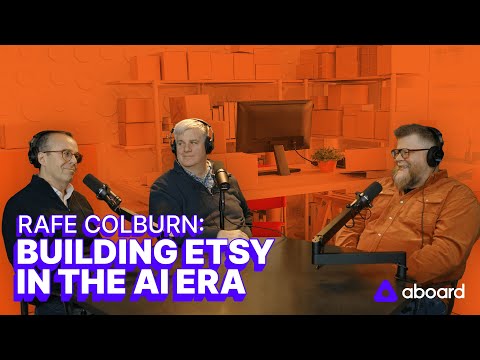
Rafe Colburn: Building Etsy in the AI Era
Rafe Colburn: Building Etsy in the AI Era
Summary
Paul Ford and Rich Ziade welcome Rafe Colburn, the Chief Product and Technology Officer (CPTO) of Etsy, to discuss how one of the internet’s biggest spaces for human creativity is adapting in the AI era. Rafe manages over a thousand people across engineering, product management, and design, and has been at Etsy since 2012 when he started as an individual contributor engineer. He describes Etsy’s distinctive engineering culture — rooted in the Flickr tradition of massive observability, simple stacks, continuous deployment, and feature flags — that still deploys code to production dozens of times a day.
On AI adoption within Etsy, Rafe takes a notably pragmatic approach. Rather than issuing top-down mandates, he has given engineers access to tools and let early adopters lead the way through an internal “agentic coding” Slack channel with hundreds of participants. His policy is simple: you are responsible for the code you check in, whether AI wrote it or not. He pushes back on the narrative that companies fail because they do not produce enough code, arguing that it is almost always strategy and prioritization that hold companies back, not engineering velocity.
The episode also covers Etsy’s partnership with OpenAI to display products directly in ChatGPT shopping results. Rafe explains that rather than being scraped, Etsy pushes a product feed to OpenAI — similar to how they work with Google Shopping — and has a checkout integration so users can buy without leaving ChatGPT. For Etsy, whose sellers often have imperfect metadata, LLMs are transformative because “to an LLM, everything is metadata” — allowing AI to synthesize context from images, text, and descriptions to match products with buyer intent.
Highlights
”Very Few Companies Fail Because They Don’t Write Enough Code”
Clip command
yt-dlp --download-sections "*12:25-13:20" "https://www.youtube.com/watch?v=YOhcr71TydA" --force-keyframes-at-cuts --merge-output-format mp4 -o "YOhcr71TydA-12m25s.mp4"“Very few companies don’t succeed because they cannot get enough code into production. It’s almost always strategy, prioritization, and some of these other things. So that whole productivity discourse is maybe a little bit misplaced.” — Rafe Colburn, 12:25
”If No One Told Executives About AI, Engineers Would Think It’s the Greatest Thing”
Clip command
yt-dlp --download-sections "*12:46-13:40" "https://www.youtube.com/watch?v=YOhcr71TydA" --force-keyframes-at-cuts --merge-output-format mp4 -o "YOhcr71TydA-12m46s.mp4"“If no one told anything in the executive suite about AI, engineers would think this is the greatest thing that ever happened to them in their entire career. They discovered it themselves. It is so useful for so many things.” — Rafe Colburn, 12:46
”It’s Your Code”
Clip command
yt-dlp --download-sections "*14:41-15:30" "https://www.youtube.com/watch?v=YOhcr71TydA" --force-keyframes-at-cuts --merge-output-format mp4 -o "YOhcr71TydA-14m41s.mp4"“The policy at the bottom is like you’re responsible for the things you check in to GitHub. You’re responsible for the emails you send to people. If you use AI to make it and it’s better, great. But ultimately, it’s your code.” — Rafe Colburn, 14:41
”To an LLM, Everything Is Metadata”
Clip command
yt-dlp --download-sections "*28:10-29:00" "https://www.youtube.com/watch?v=YOhcr71TydA" --force-keyframes-at-cuts --merge-output-format mp4 -o "YOhcr71TydA-28m10s.mp4"“We don’t have the metadata that like an Amazon has. We have like millions of small sellers. They just describe their items. But to an LLM, everything is metadata. Everything is an API. The taxonomy stuff can actually be solved now, whereas asking humans to do it is…” — Rafe Colburn, 28:10
”Lean In — You’ll Have a Massive Competitive Advantage”
Clip command
yt-dlp --download-sections "*34:40-35:40" "https://www.youtube.com/watch?v=YOhcr71TydA" --force-keyframes-at-cuts --merge-output-format mp4 -o "YOhcr71TydA-34m40s.mp4"“If you can figure out how to really be an expert and harness AI to do your job, you will have a massive competitive advantage over your peers. But if you think you can just type stuff into a box and make your job go away, you just kind of miss the point.” — Rafe Colburn, 34:40
Key Points
- Rafe’s Role at Etsy (1:05) - CPTO managing over 1,000 people across engineering, product management, and design
- Etsy Career Journey (2:11) - Started as IC engineer in 2012, ran Depop in London, returned as CTO then CPTO in May
- Still PHP (3:58) - A “shockingly large amount” of Etsy is still a giant PHP app, with mobile, Python, and Scala for ML
- Flickr Engineering DNA (4:27) - Etsy’s culture is a mutation of the Flickr engineering culture: massive observability, simple stack, continuous deployment, feature flags
- More Agile Than Agile (5:38) - If you have an idea at Etsy, you can get it into production today; no need to wait for a sprint
- Culture Trumps Process (7:15) - Top-to-bottom commitment to developer tooling has never been sacrificed, enabling velocity at scale
- Management as Craft (8:40) - Rafe describes the “peak Rands and Repose era” when engineering management became taken seriously
- Two-Layer AI Anxiety (11:07) - Bottom-up fear of job loss and top-down fear of being left behind create chaotic dynamics
- Productivity Discourse Misplaced (12:25) - Companies rarely fail from insufficient code production; the bottleneck is strategy and prioritization
- AI Like Open Source (12:46) - AI adoption resembles open source: a ground-up movement that engineers love but management imposes from above
- No Formal AI Policy (13:34) - Instead of mandates, Rafe provides tools and lets early adopters lead via an agentic coding Slack channel
- You Own Your Code (14:41) - The simple policy: you are responsible for what you check in, regardless of how it was produced
- Stack Overflow Problem (15:16) - Not reading code is a human problem, not an AI problem; people copied from Stack Overflow without understanding it
- Clueless Companies Getting Worked by Vendors (18:57) - One of the oldest traditions in the industry, now repeating with AI vendors
- OpenAI Product Feed (22:50) - Etsy pushes product data to OpenAI via a feed (not scraped), similar to Google Shopping integration
- ChatGPT Checkout Integration (24:00) - Users can buy Etsy products inside ChatGPT; Etsy was the first company with this integration
- LLMs Solve Etsy’s Metadata Problem (28:10) - With millions of small sellers providing imperfect descriptions, LLMs can synthesize all context into useful metadata
- AI-Generated Products on Demand (30:30) - The future of typing a description and having a custom product generated and shipped is “utterly feasible and not far away”
- Human Creativity as Differentiator (33:00) - Etsy’s big bet: human creativity remains important; just because people can make things with AI doesn’t mean they will make good things
- Advice to Young Engineers (34:40) - Lean in hard; understand AI deeply rather than just using it superficially
Mentions
Companies
- Etsy (0:06) - E-commerce platform for handmade and creative goods; headquartered in DUMBO, Brooklyn
- Depop (2:21) - Clothing resale site owned by Etsy; Rafe was CPTO in London
- Flickr (5:57) - Photo sharing website whose engineering culture was the ancestor of Etsy’s culture
- Slack (6:07) - Half of Flickr’s leadership went on to found Slack
- OpenAI (2:57) - Etsy’s partnership to display products in ChatGPT shopping results
- Amazon (28:10) - Referenced as having superior product metadata compared to Etsy
- Google (23:20) - Etsy has a huge streaming integration with Google for shopping data
- Cursor (12:08) - AI-powered IDE mentioned as part of real change in code generation
- Replit (13:08) - AI coding platform; valued at billions for essentially fancy text editor configuration
- Aboard (36:42) - Hosts’ company; stands up enterprise-grade software quickly
Products & Technologies
- ChatGPT Shopping (3:14) - OpenAI’s shopping feature that surfaces Etsy products
- PHP (3:58) - Still the backbone of Etsy’s website and entire back end
- Feature Flags (4:47) - Core to Etsy’s engineering culture from the beginning
- Claude Code (17:45) - Paul mentions getting $1,000 in free credits from Anthropic
- Jibbitz (31:50) - The charms that go in Crocs holes; discussed as future on-demand product example
- Google Shopping (23:20) - Existing product syndication system that Etsy’s OpenAI integration builds on
People
- Rafe Colburn (0:06) - CPTO of Etsy; guest on the episode
- Paul Ford (0:00) - Host, President of Aboard
- Rich Ziade (0:02) - Host, CEO of Aboard
Surprising Quotes
“A shockingly large amount of Etsy is still PHP.” — Rafe Colburn, 3:58
“I’ve been around long enough to see people copy and paste things from Stack Overflow that they had no idea whatsoever. Not reading the code is a human problem, not an AI problem.” — Rafe Colburn, 15:16
“Every AI startup that’s worth a lot is essentially the same as configuring your text editor but just at like a $6 billion scale.” — Paul Ford, 13:15
“Clueless companies getting worked by vendors is one of the oldest traditions in our industry.” — Rafe Colburn, 18:57
“The day of asking for a Jibbitz on Etsy that doesn’t exist, that isn’t in your product catalog, and it just gets generated in response feels utterly feasible and not far away.” — Paul Ford, 32:10
Transcript
0:00 Hi, I’m Paul Ford. And I’m Rich Ziade. And this is the Aboard podcast. And today we’re joined by Rafe Colburn. Who is — well, we’ll get into who he is in a minute, but he understands a lot about how AI and software are coming together. Let’s play the theme song and get into it.
0:38 Rafe. Hello. How you doing? I’m doing great. You’re coming to us from — when I take the Brooklyn Bridge, there’s one company that dominates it. That’s right. You’re going over to DUMBO and there’s Etsy. Overpass. That would be DUMBOO, which doesn’t make any sense.
1:05 So you are the CPTO of Etsy. I’m the chief product and technology officer. Originally started there in engineering but I’m managing the product managers and designers as well now. Your team is over a thousand people. You put them into VP buckets. That’s how you keep it organized.
2:11 I started at Etsy as an IC engineer in 2012 and then I took three or four years in London. I was actually CPTO of Depop, which Etsy owns, clothing resale site, kids like it. And then I came back as CTO and eventually CPTO just like in May, so relatively recently.
2:30 We want to talk about two things. One is AI — how you see your role with a thousand engineers evolving because there’s a lot of robots that say they can write code now. And then two is you guys just made a deal with OpenAI where all of your stuff shows up in ChatGPT shopping searches. It seems like you solved the generative engine optimization problem the smart way by just making a big old deal with the LLM itself.
3:58 Is it all still in PHP? A shockingly large amount. Yes. We have mobile apps in the right languages and the search stack and ML stack use Python and Scala, but the actual website and the entire back end are basically still a giant PHP app.
4:27 The Etsy engineering culture is in some ways a mutation of the Flickr engineering culture. The core tenets were massive observability, really simple stack, continuous deployment back before everybody did it, and branching in code with feature flags. I went to work at Etsy because this was just revolutionary at the time and no one was doing it that way.
5:38 I always used to say we’re more agile than agile because if I have an idea I can get it into production today so I don’t need to wait for a sprint. We were very early into really using A/B testing to test lots of things at our scale. That kind of data-driven high velocity continuous deployment on top of a very operationally simple stack was the hallmark of the culture.
6:37 How do you keep that going? There’s just been this real top-to-bottom commitment to maintaining all the infrastructure and developer tooling that allows us to go fast. Because that’s never been sacrificed, we are still able to do it at even a much larger scale. We’re still deploying code to production dozens of times a day. Culture trumps process.
7:21 Back in the day Etsy was famous for: if you start there as an engineer on day one you’re shipping some code. Is that still going on? Sadly, no. But I’d like to get back to it. It’s totally doable. It’s just a habit we got out of.
7:44 Talk about your career. You start as an IC, now you manage a thousand people. What steps along the way did you have to really go learn something new? I was actually really lucky. I moved into management just a few weeks after I started at Etsy and all the managers were kind of learning to be managers. We had a guy who really believed in management as a real practice that you try to get good at. This was probably peak Rands and Repose era where everybody just woke up and realized engineering management is a real job.
10:05 It’s a big org. It’s not just engineers now. It’s product people, it’s designers. There’s a lot of anxiety out there around what these AI tools mean. Not just for orgs but individuals.
11:07 It’s kind of a crazy time because you have people bottom up who are afraid about their job changing, maybe losing their job. Most engineers are not early adopters. They’re mainstream adopters. And the adoption curve is going really fast which is scary. Then there’s this completely other anxiety at the executive level — people are desperately afraid of being left behind and the hype is crazy.
12:25 Very few companies don’t succeed because they cannot get enough code into production. It’s almost always strategy, prioritization. So that whole productivity discourse is maybe a little bit misplaced. The other thing is like the rise of open source was a ground-up conspiracy. Management didn’t want it. If no one told anything in the executive suite about AI, engineers would think this is the greatest thing that ever happened to them.
13:34 Have you set a policy for how things are supposed to go? No. What I have tried to do is give people access to the tools they need and then rely on the early adopters to lead the way. We have an agentic coding Slack channel with hundreds of people in it sharing what they’re doing. I want to step back and let the innovation happen rather than trying to be directive. I just don’t think I’ll get it right.
14:41 The policy at the bottom is like you’re responsible for the things you check in to GitHub. You’re responsible for the emails you send to people. If you use AI to make it and it’s better, great. But ultimately, it’s your code. I’ve been around long enough to see people copy and paste things from Stack Overflow that they had no idea whatsoever. Not reading the code is a human problem, not an AI problem.
16:30 Let me be a naive executive. Rafe, a thousand engineers — should be like 600. Or maybe 10 with all this magical technology. That sort of casual sentiment is taking hold at companies. How do you make the case? Having a long history in the industry really helps. Could we make more use of more software? Absolutely. If AI makes it feasible for us to build more of our own stuff, we would probably do more of it. When I started my career, we paid so many people to write HTML by hand. The industry did not go away.
18:30 Does Etsy consider itself a technology company? Yeah, unquestionably so. My number one push for any executive is if you’re talking about AI all the time and you’re not using it, then what are you doing? It’s a power tool. If you can figure out how to really be an expert and harness AI to do your job, you will have a massive competitive advantage. But if you think you can just type stuff into a box and make your job go away, you just kind of miss the point.
20:00 Productivity not showing up yet. They’re spending all this money because we’re in the panic part of the hype cycle. Clueless companies getting worked by vendors is one of the oldest traditions in our industry.
22:00 ChatGPT rolled out shopping. When you type things into ChatGPT and say help me buy something, it’ll throw up products with prices and links. It’s a strong argument for generative engine optimization. Etsy was one of a few large companies that ended up providing all of their stuff to this new world.
22:50 Under the hood it’s in many ways like search ads. We provide them with a feed. Rather than just being scraped, we actually have a product feed that we send to them. It’s push, almost like you would use with Google Shopping. We also have a checkout integration so people can buy things on Etsy by way of OpenAI. We were the first company to do that.
25:00 There are open schemas for how to describe products all over the internet, which Google pushes. Etsy has a huge streaming integration with Google. Updated pricing, inventory, descriptions — it’s like an internal search indexing pipeline. Product syndication.
28:10 The hard part for Etsy over a long period of time has been we don’t have the metadata that Amazon has. We have millions of small sellers. They just describe their items. But to an LLM, everything is metadata. Everything is an API. Catalog search and taxonomy stuff can actually be solved now, whereas asking humans to do it is… And it can take all that context — images, text — and write you the sentence you really care about.
30:30 I type in blue Crocs with cool yellow streaks on them. It shows me an image it generated. It puts a price on it. I pick one and when I purchase it, it generates the product and sends it to me. 100% feasible. I think soon. The days of asking for a Jibbitz on Etsy that doesn’t exist and it just gets generated in response feels utterly feasible and not far away.
33:00 The big bet on Etsy is human creativity is going to remain important. We’re all in on human creativity and human connection. Most people are not good at making and designing things. Even if I said I don’t have amazing furniture, I could learn all the carpentry skills and still wouldn’t have amazing furniture because I’m not a designer. Just because people can doesn’t mean it’ll be good or other people will want it.
34:40 Advice to young engineers, product managers, designers: really lean in. When I started my career, it was just hard to have the tools to build real things. Now we have this amazing ability. Being able to build whole products and see how they work is really cool. If you’re new to this industry, lean into it and show how you can outperform people who’ve been doing it for longer.
36:10 Taking the time to understand it — you don’t have to. It’s such a consumer experience that you could just use it and spew out code. But understanding it is how you get your angle. If you use it and you don’t understand it, you might outperform someone who doesn’t use it at all. But are you going to outperform someone who really understands it?
36:42 Thank you, Rafe. If you don’t have a thousand person incredibly well-run engineering culture, but still have technology to build, check out Aboard. We stand up enterprise-grade software really quickly. Like and subscribe. Five stars. Jibbitz.