Can Tech CEOs Be Thoughtful
Can Tech CEOs Be Thoughtful
Summary
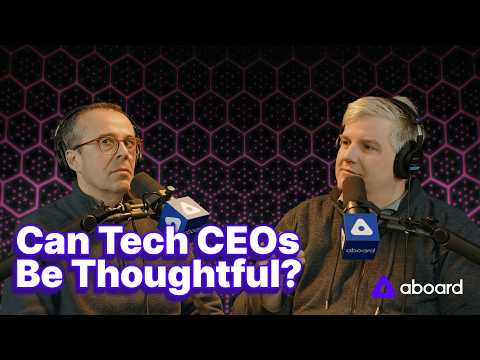
Paul Ford and Rich Ziade dive into Dario Amodei’s lengthy essay “The Adolescence of Technology,” in which the Anthropic CEO argues for social responsibility both from within and around the AI industry. The episode opens with Paul struggling to pronounce Amodei’s name before launching into the substance of the essay, which they describe as a surprisingly thoughtful and self-aware document from a tech CEO. They trace Amodei’s backstory — leaving OpenAI over disagreements with Sam Altman about the seriousness of AI safety — and how Anthropic became a legitimate competitor alongside Google and OpenAI.
The conversation explores what it means for a CEO worth billions to argue for regulation of his own industry. Paul and Rich dissect Amodei’s core argument that technology (and AI specifically) is going through an “adolescence” — powerful enough to cause real harm but not yet mature enough to be trusted on its own. They compare this to past tech industry moments where leaders claimed good intentions while building monopolies, and debate whether Amodei’s essay represents genuine conviction or savvy positioning. Rich is more skeptical, pointing out that no company voluntarily constrains itself when competitors won’t, while Paul argues the essay at least represents a new kind of discourse from a tech leader.
The hosts also explore the broader landscape: Google’s comeback with Gemini, China’s competitive threat via DeepSeek, and the “vibes” shift in how the industry talks about itself. They note that Amodei’s essay lands differently in a political environment where regulation seems unlikely, making it more of a philosophical document than a practical policy proposal. The episode ends with both hosts agreeing that regardless of Amodei’s motivations, having this kind of nuanced public conversation from inside the industry is better than the alternative.
Highlights
”He had fundamental disagreements with Sam Altman”
Clip command
yt-dlp --download-sections "*2:00-2:55" "https://www.youtube.com/watch?v=XtfKYHK1dxw" --force-keyframes-at-cuts --merge-output-format mp4 -o "XtfKYHK1dxw-2m00s.mp4"“He was essentially a person who was like, ‘We’re not being serious enough about this technology. We’re not being focused on safety.’ A real true kind of scientist type. And he had some really fundamental disagreements with Sam Altman at OpenAI and was like, I’m going to go do my own thing.” — Paul Ford, 2:00
”A 15,000-word essay from a tech CEO — that’s unusual”
Clip command
yt-dlp --download-sections "*5:50-6:50" "https://www.youtube.com/watch?v=XtfKYHK1dxw" --force-keyframes-at-cuts --merge-output-format mp4 -o "XtfKYHK1dxw-5m50s.mp4"“You don’t typically get these kinds of essays from tech executives. Usually it’s a blog post or a tweet thread. This is a real piece of writing. It’s long. It’s thoughtful. It engages with criticism. And that alone is worth paying attention to, regardless of whether you agree with every word.” — Paul Ford, 5:50
”The adolescence metaphor actually works”
Clip command
yt-dlp --download-sections "*9:10-10:10" "https://www.youtube.com/watch?v=XtfKYHK1dxw" --force-keyframes-at-cuts --merge-output-format mp4 -o "XtfKYHK1dxw-9m10s.mp4"“Technology is going through its adolescence. It’s powerful enough to cause real harm but not mature enough to be trusted fully on its own. And that’s actually a pretty honest framing — like, we built this thing and it’s kind of out of control and we need guardrails.” — Paul Ford, 9:10
”Regulation is dead on arrival in this political environment”
Clip command
yt-dlp --download-sections "*20:00-21:00" "https://www.youtube.com/watch?v=XtfKYHK1dxw" --force-keyframes-at-cuts --merge-output-format mp4 -o "XtfKYHK1dxw-20m00s.mp4"“Here’s the thing though — you can write a beautiful essay about regulation but we’re in a political moment where nobody is going to regulate anything. So what is this really? It’s a philosophical document, not a policy proposal.” — Rich Ziade, 20:00
”DeepSeek changed the vibes”
Clip command
yt-dlp --download-sections "*25:00-25:55" "https://www.youtube.com/watch?v=XtfKYHK1dxw" --force-keyframes-at-cuts --merge-output-format mp4 -o "XtfKYHK1dxw-25m00s.mp4"“When DeepSeek showed up, the whole conversation shifted. All of a sudden it wasn’t just American companies racing each other. It was like, oh wait, China can do this too, and maybe cheaper. That changes the calculus for everybody talking about regulation.” — Paul Ford, 25:00
Key Points
- Dario Amodei’s background (2:00) - Left OpenAI over disagreements about safety seriousness, created Anthropic as a more safety-focused competitor
- The essay’s unusual nature (5:50) - A 15,000-word thoughtful essay from a tech CEO is extremely rare in the industry
- Adolescence metaphor (9:10) - Amodei frames technology as going through adolescence — powerful but not mature
- Self-regulation paradox (12:30) - The inherent tension in a CEO worth billions calling for regulation of his own industry
- History of tech promises (14:40) - Past tech leaders claimed good intentions while building monopolies; is this different?
- Claude Code as competitive edge (17:00) - Anthropic’s coding tools are genuinely leading the market
- Political environment (20:00) - Regulation is dead on arrival in the current political climate
- DeepSeek disruption (25:00) - Chinese competition changed the vibes around AI regulation discussions
- Google’s comeback (27:30) - Gemini is catching up and the AI race is tighter than many realize
- Sincerity vs positioning (29:00) - Debate about whether Amodei’s essay reflects genuine belief or strategic positioning
- The essay as discourse (32:00) - Regardless of motivation, having this kind of nuanced public conversation is valuable
- Aboard’s approach (35:00) - Using AI responsibly in software development, not just repackaging model outputs
Mentions
Companies
- Anthropic (2:00) - Central subject; Dario Amodei’s AI safety-focused company
- OpenAI (2:00) - Where Amodei worked before founding Anthropic
- Google (27:30) - Making a comeback with Gemini
- DeepSeek (25:00) - Chinese AI company that disrupted the competitive landscape
- Aboard (35:00) - Paul and Rich’s AI software company
Products & Technologies
- Claude (17:00) - Anthropic’s AI model
- Claude Code (17:00) - Anthropic’s coding tool, described as industry-leading
- Gemini (27:30) - Google’s AI model, noted as improving significantly
People
- Dario Amodei (1:30) - Anthropic founder and CEO, author of “The Adolescence of Technology”
- Sam Altman (2:00) - OpenAI CEO; had fundamental disagreements with Amodei
Surprising Quotes
“Every conversation about AI is either someone telling you that Jesus is coming back or that you represent Satan. There’s no middle ground in public discourse.” — Paul Ford, 4:30
“The adolescence metaphor works because adolescents are powerful enough to drive a car but we still don’t trust them with the car keys without some rules.” — Paul Ford, 9:30
“No company voluntarily constrains itself when competitors won’t. That’s just not how capitalism works, no matter how many 15,000-word essays you write.” — Rich Ziade, 22:00
“At least someone in this industry is producing long-form thinking instead of tweet threads. That alone is worth something.” — Paul Ford, 33:00
Transcript
0:00 Hi, I’m Paul Ford. And I am Rich Ziade. And this is the Aboard Podcast. It’s the podcast about how AI is changing the world of software. Brought to you by a company that uses AI to change the world of software. That company is called Aboard. Good. Good one. Good energy. I’m just getting in there today. So did we tell them who we were? We just did like five seconds ago. Then let’s play the theme song and let’s get into a conversation about if the world’s going to end or not.
0:42 Okay, Rich, I’m going to play a little bit of audio for you. Okay, you ready? Go ahead. Not the Doobie Brothers again. Dario — I’m a day. I’m a day. Okay, there’s 30 seconds left on pronunciationfinder.com. Are they trying variations? I don’t know how that YouTube monetization strategy really works.
1:30 Dario Amodei is the founder of Anthropic. They make Claude Code and it’s an enormous company. It didn’t really spin out, but he left. He was one of the very early people at OpenAI and he didn’t like the way OpenAI was being run. Is that true? I didn’t know the backstory.
2:00 Oh yeah. He was essentially a person who was like, “We’re not being serious enough about this technology. We’re not being focused on safety.” A real true kind of scientist type, like a real sort of math person. And he had some really fundamental disagreements with Sam Altman at OpenAI and was like, I’m going to go do my own thing relatively early in the game. And created Anthropic, which is a true competitor along with Google and along with, you know, not too many others. You got to go to China to get the next big thing.
3:00 And in some ways I think Anthropic is a leader, especially in certain areas. One of the reasons we talk about it is Claude Code. Let me tell you something. As a CEO, what I love about Claude Code more than anything is I know my engineering team is not going to use it and stop thinking. They’re going to use it to be faster and better. And that’s the distinction.
4:00 So Dario wrote this essay. It’s called “The Adolescence of Technology.” It’s long. It’s really long. And this is unusual. You don’t typically get these kinds of essays from tech executives. Usually it’s a blog post or a tweet thread. And here’s 15,000 words of a person trying to think through what their responsibilities are.
5:00 The premise is interesting. Technology is going through its adolescence. It’s powerful but not mature. It can cause harm but it’s also incredible. And the argument is that we need guardrails from both inside the industry and from government. Now, the question Rich and I want to explore is: can we take this seriously?
6:30 Here’s what I like about the essay. It doesn’t read like marketing. It reads like someone who actually thinks about this stuff. He engages with the counterarguments. He acknowledges that his company benefits from the status quo. He acknowledges that his competitors might not play by the same rules. And he still says, “Here’s what I think we should do.” That’s rare.
8:00 Let me push back a little bit. We’ve seen this before, right? Google said “don’t be evil.” Facebook said they were connecting the world. Every tech company has had its “we’re the good guys” moment. And then they build monopolies. So what makes this different?
9:10 I think what makes it different is the specificity. The adolescence metaphor actually works. Technology is powerful enough to cause real harm but not mature enough to be trusted fully on its own. He’s not saying “trust us.” He’s saying “don’t trust us — regulate us.” That’s a different message.
11:00 The essay talks about safety testing, about publishing results, about working with government. It’s a framework, not just vibes. And look, I’m not naive. I know that a company with a moat benefits from regulation because it raises the barrier to entry. But at least he’s being transparent about that tension.
14:00 There’s a section where he talks about the employees. And this is interesting because the people who work at Anthropic are true believers in a way that’s different from other tech companies. They’re not there for stock options. They’re there because they genuinely believe this technology could be dangerous and they want to be at the company that takes that seriously.
17:00 Let’s talk about the competitive landscape. Claude is genuinely good. Claude Code is genuinely good. This is not a company that’s only about safety theater. They ship real products that real people use. And that matters because it means the safety stuff isn’t a cover for mediocrity.
20:00 Here’s the thing though — you can write a beautiful essay about regulation but we’re in a political moment where nobody is going to regulate anything. The current administration is not interested in AI regulation. So what is this really? It’s a philosophical document, not a policy proposal. And I think that’s okay. But let’s be honest about what it is.
22:00 No company voluntarily constrains itself when competitors won’t. That’s just not how capitalism works. And Amodei knows this. He writes about it. He says the game theory problem is real. So what’s the solution? He doesn’t really have one beyond “everyone should be more responsible.”
25:00 When DeepSeek showed up, the whole conversation shifted. All of a sudden it wasn’t just American companies racing each other. China can do this too, and maybe cheaper. That changes the calculus for everybody talking about regulation. Because now if you regulate American companies, you might just be handing the advantage to China.
27:30 Google’s comeback is real. Gemini is getting better fast. The race is tighter than people think. And in that context, calling for regulation feels even more complicated because you’re asking companies to slow down when their competitors are speeding up.
29:00 So is Amodei sincere? I think the answer is yes, and also it’s good positioning. Those things aren’t mutually exclusive. You can genuinely believe in safety and also recognize that being the “responsible AI company” is a great brand. The question is whether the actions match the words.
32:00 Look, regardless of motivation, having this kind of nuanced public conversation from inside the industry is better than the alternative. At least someone is producing long-form thinking instead of tweet threads. The discourse is better for it.
35:00 Let’s bring it back to Aboard. We use AI to make software. We use people to steer that AI. We’re not a vibe coding tool. We’re a software assembly tool. We use AI in very strategic ways. And we take responsibility for what we ship. If you need reliable, extensible software, get in touch. Hello at aboard.com. Have a great week.