Breaking: Software Work Still Difficult | The Aboard Podcast 2026-04-28
Breaking: Software Work Still Difficult
Summary
Paul Ford walks Rich Ziade through the “Aboard AI Rundown,” a personalized newsletter system he’s spent months building and refining to keep himself informed on the AI industry — and, in a generalized form, on any client’s industry. Ford wanted a tool that would let him talk to journalists and clients without cramming, and thought it would be a five-minute AI project: tell Claude or ChatGPT what he cares about and let it write a newsletter. It wasn’t. The naive version broke constantly and produced shallow, forgettable output. Getting to something actually good required treating the problem like real product management — pulling in roughly 300-400 RSS feeds plus a daily Gemini search, parsing full article text, and building a small local vector-embedding database (384 dimensions, “shades of RDF” as Rich puts it) to cluster and deduplicate news before any model ever sees it.
The newsletter itself layers several AI systems for different jobs: a Gemini-generated header image, a “By the Numbers” section pulling out statistics, Haiku for cheap summarization, Sonnet for denser synthesis, and Opus for two more ambitious sections — “Strategy Prompts,” where the model role-plays a business strategist interrogating Aboard’s own positioning against the day’s news, and “Product Improv Theater,” where it invents and then actually prototypes a fictional product (like “ContextMesh,” a shared organizational-context API) based on the day’s headlines. Ford is explicit that none of this was cheap or fast: running the raw API calls would cost roughly three dollars a day, and building it took months of part-time nights-and-weekends work by someone with three decades of editorial and technical background — work he says would have cost “a couple hundred thousand dollars with a team” in the pre-AI era.
The conversation turns into a broader argument about AI and craft: Rich’s thesis that these tools “punish laziness” — generic prompts produce generic, forgettable output, while genuine quality still requires real product thinking, refinement, and what Ford calls “editorial thinking.” Ford offers his own definition of talent: not being good at something, but being “annoyed” enough by imperfection to keep returning to a problem until it meets your own standard. The two agree that AI has genuinely de-risked building software — the “last mile” problem of turning a prototype into something real is much smaller now — but that the gap between a five-minute demo and a product someone will actually rely on hasn’t closed, and won’t.
Highlights
”It wasn’t that easy.”
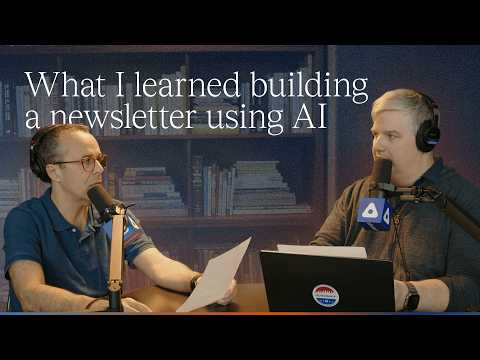
“This is what they tell you. They tell you, ‘Hey, you want—you want your own little personalized newsletter? You say Claude, make me a little newsletter,’ and Claude and—or, you know, or ChatGPT and it’ll be like, ‘Of course, master!’ You know, and then it’ll go do whatever you want. But that’s not how you get to quality, and quality is different with this stuff.” — Paul Ford, 2:36
Clip command
yt-dlp --download-sections "*2:36-3:11" "https://www.youtube.com/watch?v=Ue52vggn9dw" --force-keyframes-at-cuts --merge-output-format mp4 -o "it-wasnt-that-easy.mp4"”Every time it fires off a newsletter to you, it’s costing three dollars.”
“So today, this is worth pointing out, every time it fires off a newsletter to you, it’s costing three dollars.” / “It would if I was using the straight-up API, but I have some little hacks in there.” / “Zero because it’s… I’m… I have the Claude Max plan. I run it command line.” — Rich Ziade and Paul Ford, 18:58
Clip command
yt-dlp --download-sections "*18:58-19:21" "https://www.youtube.com/watch?v=Ue52vggn9dw" --force-keyframes-at-cuts --merge-output-format mp4 -o "three-bucks-a-day.mp4"”You’re coming up to the model buffet.”
“So you’re kind of… you’re sort of… you’re coming up to the model buffet to see what is faster, cheaper, easier, and effective.” / “That’s right. And it’s… people don’t think that way. They just type in the box.” — Rich Ziade and Paul Ford, 19:39
Clip command
yt-dlp --download-sections "*19:39-20:05" "https://www.youtube.com/watch?v=Ue52vggn9dw" --force-keyframes-at-cuts --merge-output-format mp4 -o "the-model-buffet.mp4"”Product improv theater.”
“It takes all the news of the day, and it says, ‘Given what we know about Aboard’s—’ business model and maybe a little bit of what we just learned in that strategy session… Can you go ahead and improvise and make up a product that might help this company? … So in this case it created ContextMesh, a one live context layer that makes every AI tool in your stack actually know what’s going on.” — Paul Ford, 23:57
Clip command
yt-dlp --download-sections "*23:52-24:52" "https://www.youtube.com/watch?v=Ue52vggn9dw" --force-keyframes-at-cuts --merge-output-format mp4 -o "product-improv-theater.mp4"”These tools punish laziness.”
“Yeah. I… here’s my read on it. That yes, these tools are going to be very capable and they are going to infer a lot, but for in my experience today and I don’t think that’ll change in four years is that these tools punish laziness.” / “Yeah, they do.” / “No, it’s… it’s worse. They reward it, but it’s actually a punishment.” — Rich Ziade and Paul Ford, 33:42
Clip command
yt-dlp --download-sections "*33:42-34:30" "https://www.youtube.com/watch?v=Ue52vggn9dw" --force-keyframes-at-cuts --merge-output-format mp4 -o "punish-laziness.mp4"”Talent is being annoyed at something.”
“No. Talent is being annoyed at something. And you are annoyed with it enough that you will go back to it and you will do it again and again until it is at a level of quality that gives you comfort and control.” — Paul Ford, 34:42
Clip command
yt-dlp --download-sections "*34:40-35:34" "https://www.youtube.com/watch?v=Ue52vggn9dw" --force-keyframes-at-cuts --merge-output-format mp4 -o "talent-is-being-annoyed.mp4"Key Points
- The Aboard AI Rundown (3:13) - Ford’s daily, auto-generated newsletter tracking AI industry news, built because his job requires him to “be very informed” without spending a weekend catching up.
- Naive prompting broke constantly (5:05) - Early “hey AI, write me a newsletter” attempts were exciting for a couple of days, then useless — AI isn’t naturally good at knowing what news matters or how to organize it.
- Refining since October (5:25) - Ford has been iterating on the system for months, not typing a one-off prompt.
- Would have cost “a couple hundred thousand dollars” (7:25) - Ford estimates what a team would have charged to build the same editorial product pre-AI.
- Evidence it works: unprepared podcast appearances (8:16) - Ford says he no longer prepares before going on shows to discuss AI because the newsletter keeps him current.
- 300+ RSS feeds plus a daily Gemini search (13:18) - The ingestion pipeline: existing feeds Ford already read, AI-discovered additional feeds, and a daily Gemini search pass for news the feeds miss.
- AI “handcrafted” the spidering (14:26) - Ford directed the AI to build article-parsing scrapers (akin to Readability or Beautiful Soup) with “100% tactical guidance” from him.
- A local embeddings/vector database (17:18) - Ford installed a lightweight, 384-dimension embedding system on his own server to cluster and pre-organize incoming text before it reaches an LLM, cutting query time from minutes to seconds.
- The model buffet: Haiku, Sonnet, Opus, Gemini (19:09) - Different models handle different jobs — cheap summarization on Haiku, denser synthesis on Sonnet, strategic reasoning on Opus — chosen for cost, speed, and fit rather than defaulting to one model.
- “By the Numbers” (12:33) - A Harper’s Index-style section pulling striking statistics out of the day’s news, including a jab from OpenAI’s revenue chief that Anthropic’s claimed $30B run rate is inflated.
- “Strategy Prompts” (21:47) - Opus role-plays a business strategist, using a small financial model of Aboard to ask pointed questions like how the company competes now that ChatGPT Enterprise bundles everything in-house.
- “Product Improv Theater” (23:52) - Opus invents a fictional product idea from the day’s news (e.g. “ContextMesh,” a shared organizational-context API) and then actually prototypes and screenshots it.
- Generation time cut from ~30 minutes to ~5 (27:54) - Ford optimized the pipeline heavily because token costs and inefficiency bothered him.
- Discovery via database introspection (28:25) - Asking Claude to suggest optimizations using the pgvector extension surfaced a real bug: the system had stopped segmenting news by industry, muddying results.
- “It’s still really hard to build software” (30:38) - Ford’s blunt takeaway: you can get a lot done in a week with AI, but you still have to tweak every subsystem for months to get it right.
- Light-skill users can now pull off things beyond their abilities (31:23) - Ford’s example: he’s now programming FPGA chips, something that was never in his skill set, thanks to LLM-assisted environments like Claude Code.
- Three audiences to satisfy (32:16) - Ford builds first for himself, then the company, then clients — and says getting a client to genuinely want the product (not just receive it) still took months of work.
- These tools punish laziness (33:42) - Rich’s core thesis: generic prompting produces generic, low-value output; real quality still requires real product thinking.
- Talent is being annoyed (34:30) - Ford’s definition: talent isn’t being good at something, it’s being bothered enough by imperfection to redo the work until it meets your standard.
- Fully de-risking software with AI (36:42) - Rich argues that the old “last mile” problem — needing to hand-code the final stretch — is genuinely gone; the tools are secure, safe, and production-ready.
Mentions
Companies
- Aboard (0:59) - The hosts’ AI transformation company; the newsletter’s generalized form is being productized for clients.
- Anthropic (12:33) - Subject of a “By the Numbers” item: OpenAI’s revenue chief disputes Anthropic’s claimed $30B annual run rate.
- OpenAI (12:33) - Its revenue chief is quoted disputing Anthropic’s numbers; ChatGPT Enterprise’s all-in-one stack becomes a “Strategy Prompts” discussion point.
- Google (6:45) - Maker of Gemini, used for the newsletter’s header images and daily news search.
- Harper’s Magazine (12:33) - Ford’s former employer; the “By the Numbers” section is modeled on the Harper’s Index.
- Grab (26:09) - Southeast Asian super-app cited in a “find a big cheese” newsletter section; CEO Anthony Tan is recasting it as an AI-native platform.
Products & Technologies
- Claude / Claude Max / Claude Code (19:11) - Runs the newsletter pipeline at effectively zero marginal cost via Ford’s Claude Max plan and command-line access.
- Claude Haiku / Sonnet / Opus (19:21) - Different Claude models handle summarization, synthesis, and strategic reasoning respectively.
- Gemini / Gemma 2 (6:45) - Used for header images and news search; Gemma 2 (a small, on-device LLM) is discussed as a news item about local AI and data privacy.
- pgvector (29:03) - Postgres vector extension Ford uses for the embeddings-based news clustering.
- Embeddings (384-dimension) (17:18) - The lightweight local vector system Ford built to organize and deduplicate incoming news before LLM processing.
- RSS (13:18) - Feed format underlying the ~300-400 sources the system ingests.
- Readability / Beautiful Soup (14:12) - Reference parsing libraries invoked while discussing how the AI-built spiders extract article text.
- ContextMesh (24:11) - A fictional product the newsletter’s “Product Improv Theater” invented and prototyped: a shared organizational-context API exposing Slack, Teams, Calendar, Jira, CRM, and Docs via MCP endpoints.
- Nano Banana Pro (0:21) - Image-generation tool Ford uses to open the episode with an AI-generated boardroom scene.
People
- Paul Ford (0:00) - Co-host; builder and narrator of the newsletter system.
- Rich Ziade (0:02) - Co-host; presses Ford on the technical and business details.
- Anthony Tan (26:09) - Co-founder and CEO of Grab, cited as the “big cheese” recasting the company as an AI-native platform.
- Gabe (23:24) - Off-camera colleague who supplies the “ideal customer profile” answer for the ICP joke.
Surprising Quotes
“I’m using different languages, I’m using databases the old way, I’m using a web platform that I built and vibe coded.” — Paul Ford, 6:52
“It’s very easy, this stuff is a black box, and it’s very easy for it to just create a big mess, and then it’ll kind of clean it up because it knows it’s supposed to deliver a newsletter.” — Paul Ford, 28:51
“Anyone can slap together a fake TikTok in an hour in four years from now, but nobody will ever care.” — Paul Ford, 34:58
“I do believe that it is very, very possible now to fully de-risk building with these tools.” — Rich Ziade, 36:42
“It’s not a newsletter that I would go out and sort of I wouldn’t pay to subscribe to it from someone else, but for me it’s very, very useful.” — Rich Ziade, 37:06
Transcript
Paul Ford: 0:00 Hi, I’m Paul Ford.
Rich Ziade: 0:02 And I’m Rich Ziade.
Paul Ford: 0:03 And this is the Aboard podcast, the podcast about how AI is changing the world of software and software is everywhere and you can’t stop it and it’s a lot and we’re all dealing with it together. Blah, blah, blah. Hey, Rich, what do you think of that?
Rich Ziade: 0:15 This looks like AI nonsense.
Paul Ford: 0:18 It is AI nonsense.
Rich Ziade: 0:19 Is that Nano Banana 2?
Paul Ford: 0:21 It is. It’s Nano Banana Pro and it’s a pangolin and a quokka talking about…
Rich Ziade: 0:27 God.
Paul Ford: 0:27 Yeah, they’re in a boardroom.
Rich Ziade: 0:28 What do you do? You’re the president of the company, dude.
Paul Ford: 0:31 The reality is this is an incredibly powerful business tool and I would really like to show it to you.
Rich Ziade: 0:36 What?
Paul Ford: 0:37 Yeah.
Rich Ziade: 0:37 All right, let’s do it.
Paul Ford: 0:38 Okay. All right, Rich, what’s Aboard?
Rich Ziade: 0:59 Aboard is an AI transformation company. We use great people, great tools, a great process to get you production-grade software faster than anyone. We’re really, really good at it. Whether it’s an agent you’re spinning up or software you’re standing up for your company. We’ve got a lot of years behind us and we know how to do it well.
Paul Ford: 1:21 And we have great clients and and look…
Rich Ziade: 1:23 We’re your partner. Like, that’s what’s—that’s what’s emerging is—is we partner with you and we work with you kind of every day.
Paul Ford: 1:32 Plot twist: people matter. Yeah, it’s—if you’ve ever read Rich writing in the newsletter, that’s—that’s—that’s the—we should just give you your own blog called People Matter.
Rich Ziade: 1:41 Oh, yeah, because you don’t write enough times on the newsletter, Paul Ford?
Paul Ford: 1:44 That wasn’t really where I was going with that.
Rich Ziade: 1:46 Oh, you want to put me on my own newsletter?
Paul Ford: 1:48 I just think People Matter would probably prefer…
Rich Ziade: 1:50 I’m tired of being John Oates in this relationship.
Paul Ford: 1:53 I think you’d be more the Garfunkel.
Rich Ziade: 1:55 Oh.
Paul Ford: 1:55 Yeah, I know. Okay, look. I made something. And I want to use this as an opportunity to talk about the nature of product in the age of AI and all that stuff, but I also want to sort of talk—I want to show you what I built.
Rich Ziade: 2:07 How’d you make it? Let’s talk about that for a minute.
Paul Ford: 2:10 Okay, so look at what it is. Every day, a series of bots comes together, reads a lot of news and sends me one or more newsletters about my interests. Every day. Every day, at late at night, about 3:00 a.m.
Rich Ziade: 2:27 You told it what your interests are and you unleashed bots on the internet.
Paul Ford: 2:31 I did, but I got to tell you, it wasn’t that easy.
Rich Ziade: 2:35 Hmm, okay.
Paul Ford: 2:36 It wasn’t. This is what they tell you. They tell you, ‘Hey, you want—you want your own little personalized newsletter? You say Claude, make me a little newsletter,’ and Claude and—or, you know, or ChatGPT and it’ll be like, ‘Of course, master!’ You know, and then it’ll go do whatever you want. But that’s not how you get to quality, and quality is different with this stuff. Now I’m going to—I’m going to actually walk through what the newsletter does for me and why I created it and if you’re— The kind of person who’s like, oh no, they’re trying to replace writers. Relax, that’s not what this is. It’s very much a digital product, it’s very much an AI-generated product and it doesn’t pretend to be otherwise.
Rich Ziade: 3:11 It’s gathering stuff that writers put out in the world.
Paul Ford: 3:13 So, so what this is—we’ll talk about how I made it in a minute—but let me tell you what’s in it. So I go, it’s called the Aboard AI Rundown, right?
Rich Ziade: 3:19 Okay.
Paul Ford: 3:20 Because what is my job? My job is to share news about AI on LinkedIn. I have other responsibilities like selling services and delivering them.
Rich Ziade: 3:29 Yep.
Paul Ford: 3:30 But one of the things I really need to do is be very informed. I get called on to write and talk, and you can’t get caught up in a weekend. You have to just let your brain bake.
Rich Ziade: 3:39 Mm-hm.
Paul Ford: 3:40 And so I created a system that would kind of know about all the things that we care about at work,
Rich Ziade: 3:46 Which for us happens to be AI.
Paul Ford: 3:48 Happens to be AI…
Rich Ziade: 3:51 The industry, the players, the news that’s happening.
Paul Ford: 3:54 And focused on the things we do, which is sort of transformation and delivery and kind of—
Rich Ziade: 3:58 Consulting.
Paul Ford: 3:59 Consulting and sort of, you know, it’s very interesting to me—and this’ll be, I don’t expect anyone else to be thrilled by this—but I like to know like what Accenture is going to do about AI today.
Rich Ziade: 4:10 Right.
Paul Ford: 4:11 Right? Like I want to know that because it just helps me understand the world I’m in. And we all do. I have another newsletter just like this. I won’t talk about it too much because it gets too confusing, but I also am trying to understand the world of one of our clients that’s a big insurance company.
Rich Ziade: 4:25 Okay.
Paul Ford: 4:26 And it sends me an insurance newsletter.
Rich Ziade: 4:27 Cool.
Paul Ford: 4:28 And I’m starting to share that with the client.
Rich Ziade: 4:30 And so it’s what basically any subject at all you can feed to this thing. All right, so this is worth saying. You didn’t one-off this.
Paul Ford: 4:35 I started that way but now it’s generalized.
Rich Ziade: 4:37 And so you can—you fill out a form of some kind?
Paul Ford: 4:40 Yeah, basically.
Rich Ziade: 4:41 You tell it what industry you’re interested in and what topics you care about and it puts it together?
Paul Ford: 4:46 So that’s a good question.
Rich Ziade: 4:47 Thanks.
Paul Ford: 4:48 Yes. It’s a system. It has subscribers and I go in and I have a set of prompts and it absorbs feeds of news.
Rich Ziade: 4:58 Mm-hm.
Paul Ford: 4:59 And then it synthesizes the feeds and then it uses actually a pretty—now see I started with like, hey AI, just write me one of these.
Rich Ziade: 5:04 Okay.
Paul Ford: 5:05 It broke all the time.
Rich Ziade: 5:07 Because—
Paul Ford: 5:07 Because you’re—it’s, you know, it really like AI isn’t necessarily good at knowing what news to get or how to organize it or what a subject would be or what a category—
Rich Ziade: 5:16 Quality is not in the conversation a lot these days.
Paul Ford: 5:19 No, that’s right. So it’s just sort of like it was exciting at first but it wasn’t really useful after a couple of days.
Rich Ziade: 5:24 So you kept refining it.
Paul Ford: 5:25 I kept refining it and I’ll tell you I’ve been refining it since probably about October.
Rich Ziade: 5:29 Wow. Okay, so—
Paul Ford: 5:30 This isn’t I typed some stuff in a box. No, look, I’m going to be a little arrogant for a minute and just forgive me. I’m a very, very good and very senior editorial thinker. I used to be an editor at magazines and I used to build content management platforms as someone who—and—and like I’m known for that. Like that is a—people call me in New York City I’m—
Rich Ziade: 5:50 I don’t think you’re dropping a bombshell here.
Paul Ford: 5:52 I’m—I’m not. I’m not. But I’m just saying like, and so what I have been doing over the last couple months is as a product person who focuses a lot on editorial—
Rich Ziade: 5:59 You’re, yeah. You’re an editorial product manager.
Paul Ford: 6:00 simulate humans, but try to make it a useful tool that I can use every morning to okay and I don’t just copy and paste into LinkedIn, I need it to guide me to articles that have interesting data in them that I can then go read and share relevant quotations and use that to drive our our social and so on, but also to get me ready and get me prepped for for kind of what’s out in the world. Shaping this. Not trying— Mhm. So look, let me just describe it to you for a minute and then I’ll tell you how it’s actually gonna be easier to talk through the sections and how each one’s a little different.
Rich Ziade: 6:28 Let me recap before you dive in.
Paul Ford: 6:30 Okay.
Rich Ziade: 6:31 Every morning, I wake up and there’s a message there. And it is a nicely formatted newsletter essentially. And it’s pretty long, it’s got a lot of detail, starts with a picture.
Paul Ford: 6:44 Okay.
Rich Ziade: 6:45 The picture is generated by Gemini which is Google’s AI. Okay so you’re using different AI services.
Paul Ford: 6:50 I’m using different languages, I’m using databases the old way, I’m using a web platform that I built and vibe coded.
Rich Ziade: 6:58 Okay, so it’s worth saying out loud, you’re going to get into how you got here.
Paul Ford: 7:02 Absolutely.
Rich Ziade: 7:03 But you did not spin up a few AI agents and they email you every morning.
Paul Ford: 7:07 I did that. It just wasn’t that good.
Rich Ziade: 7:10 That’s important.
Paul Ford: 7:11 I couldn’t make it good. Okay? And then what happened is when I started to actually get enough data into it, it couldn’t handle all the data. So I needed to go in and program and product manage and actually build this as a product. Yes. Now the way you do that is sometimes you actually log into a system and say some words. That’s different. I didn’t write a lot of lines of code, but absolutely I have read through the code, I’ve looked at this system, I’ve thought about it as I walked around and rode my bike, like all the things you do when you’re building a product and a platform, I’ve done on this in a slightly new way over many months. And I’m going to be frank, when I was talking about myself as an editorial advisor, there’s no way I would have done this for less than a couple of hundred thousand dollars with a team in the past. Like this is not a light work. Yes. And I gotta be frank, not many people could pull this off. It’s just it’s a skill I have.
Rich Ziade: 7:58 Not just that. You are the president of a company.
Paul Ford: 8:00 Yes.
Rich Ziade: 8:01 So this wasn’t like you’re going head down for five months. That’s not what’s happened.
Paul Ford: 8:05 No, I’m doing this on the train, I’m doing this on the weekends. But what’s critical is every day it sent me another one and I’d be like ‘ah I don’t like that’.
Rich Ziade: 8:13 Okay, do you feel good about how it, what it sends you today?
Paul Ford: 8:16 It’s not just that. I get evidence that it’s good. And here’s the evidence: I go on podcasts and I don’t have to prepare. I go on, like people call me, they’re like ‘Paul, come talk about this thing’. And I don’t have to prepare because I know the industry really, really well now. Whatever industry you want. When I go talk to other AI people, they do not have information I do not have… they have information that I don’t have, but not much.
Rich Ziade: 8:37 Got it. Um, when we come back, we’re going to talk about your journey and how you got here.
Paul Ford: 8:42 Wonderful.
Rich Ziade: 8:43 Hey Paul.
Paul Ford: 8:44 Hey Rich.
Rich Ziade: 8:45 Do you need a really great mattress?
Paul Ford: 8:47 Always.
Rich Ziade: 8:49 That’s not why we’re here.
Paul Ford: 8:50 Oh, good.
Rich Ziade: 8:51 We’re here to talk about our company, Aboard, and what we actually do for once. And in fact, I think it is time for us to grow up and read a piece of paper.
Paul Ford: 8:59 Please. Alright, let’s write a manifest. No, a manifesto. We need a paper that tells people what we really do and why.
Rich Ziade: 9:02 Okay.
Paul Ford: 9:03 I’m gonna start. You ready?
Rich Ziade: 9:04 Go.
Paul Ford: 9:05 AI is everywhere right now. And for most companies, it’s creating more confusion than clarity. There is immense opportunity and value out there, and most organizations don’t know how to get to it. And that is true. You wrote that, but that is true.
Rich Ziade: 9:18 It really is true. Where do you start? What matters to a company or an organization? And how do you turn any of it into something real?
Paul Ford: 9:27 Look, you and I and the team here at Abord have been on the ground with some of the world’s largest companies helping them navigate complex transformations about AI and about other stuff. And we deliver real systems. We deliver real software that works great. It is not decks and memos, it is things that you can do to drive revenue and grow your organization every day.
Rich Ziade: 9:45 Abord is how we do that today. We keep AI in check and don’t rush to it. We actually want to learn about your company and organization, and then slowly, methodically, we deliver real solutions built with AI, sometimes empowered by AI, whether it’s an agent or an app that makes your company perform better and do better. And it’s always delivered faster and cheaper because the tools are incredible today.
Paul Ford: 10:13 It’s like rapid, rapid management consulting, except unlike management consulting, there’s no hype. There’s no endless planning. Just real outcomes in production.
Rich Ziade: 10:23 If you’re ready to take advantage of all this change, reach out. We love to give advice, even if it- if we don’t work together.
Paul Ford: 10:31 Even if- even if you don’t want it.
Rich Ziade: 10:33 That’s true. Yeah. Visit abord.com or email us at hello@abord.com.
Paul Ford: 10:37 That’s it. Alright. And get that mattress.
Rich Ziade: 10:40 Paul.
Paul Ford: 10:40 Yes.
Rich Ziade: 10:41 You’re excited. You’re animated. Apparently not enough people are emailing you and you needed a friend. A very informed friend.
Paul Ford: 10:47 There’s a little truth in that. No, look, here’s the thing. You know how- you use this technology and everything. So the first thing it does, okay, it gives me a picture. Okay, get- get the day started because it was just hard to be met by a wall of text. And I like to see what Gemini can pull off.
Rich Ziade: 11:01 Sure. No, but are you in- genuinely interested in the content that it’s putting in front of you?
Paul Ford: 11:05 In the picture? I’m interested in what AI can do, right? So I have it kind of collage together some of the ideas in the newsletter.
Rich Ziade: 11:11 Have you learned- on occasion, have you learned something you would have never otherwise learned?
Paul Ford: 11:16 From the images, no. But from the newsletter, absolutely.
Rich Ziade: 11:18 Okay, so when you say images, there’s a header image, there’s a few images in the- in the newsletter.
Paul Ford: 11:22 Absolutely.
Rich Ziade: 11:23 Okay. How did you get here? You- it wasn’t going well in October and November. You were banging away at it and now you’re really happy with what you have.
Paul Ford: 11:32 I did a few things. So the first- first of all, I learned how to really refine data using these tools. And it’s not as obvious as people think. So what you might think you do and what you can do is you can say, hey, look at this webpage, right? Can you summarize that for me? And you can make- can you, you know, and then could you make it into a poem? Can you do something silly with it? And I tried that. I tried to do like, okay, keep me interested. But I didn’t want that. I get tired- it gets really, really tiring when it tries to be a person.
Rich Ziade: 12:00 Yeah, it also the open-ended asks like that don’t go well.
Paul Ford: 12:03 They don’t go well, so what the first section after the picture. So the picture is just like just kind of because I’m waking up looking at this. But the first section is called By The Numbers. And what I said is, okay, go find news that has statistics and large sort of numbers in it, information, data. And then create a section for me called By The Numbers that breaks out three or four or five really interesting, important numbers, percentages, whatever that will help me…
Rich Ziade: 12:30 This is a thing, by the numbers.
Paul Ford: 12:33 Right, I mean I used to work at Harper’s Magazine, we had the Harper’s Index which was just literally kind of a ironic statistics. And so the first number is 30 billion, Anthropic’s claimed 30 billion annual run rate is inflated, according to OpenAI’s revenue chief. So there’s a little conflict, okay, that came from…
Rich Ziade: 13:00 OpenAI’s revenue chief commented on…?
Paul Ford: 13:03 Said Anthropic is full of it. So that’s good, that’s immediately like I know. Okay, 25%, which is the number of organizations realizing significant value from AI despite 75% of C-suite leaders ranking it among their priorities per a Pearson and AWS study.
Rich Ziade: 13:09 Okay, so this is useful and catchy, like it’s nice to snack on, right, as you get this information. But it wasn’t easy to get here.
Paul Ford: 13:18 So I’m going to give you, I’m going to go real nerdy for a minute, okay, you ready? So I have a set of 300 feeds that get pulled in and they’re pulled in periodically over the day.
Rich Ziade: 13:31 How’d you compile that list?
Paul Ford: 13:33 Some of them I was already reading in my kind of feed environment, right? But then I had AI go find some feeds, I have it do a Gemini search every morning so it can pull in news that the feeds don’t find. Gemini is able to search yesterday’s news because it’s Google. It’s able to so it’s stuff that you don’t see normally in your in your feeds, okay.
Rich Ziade: 13:53 Sort of putting this all together.
Paul Ford: 13:56 Putting in stuff, so maybe a couple hundred articles are coming in every day, okay. So then I go and I get the text of the articles.
Rich Ziade: 14:05 Did you have to handcraft the spidering?
Paul Ford: 14:09 Yes, I mean I had to have AI handcraft the spiders.
Rich Ziade: 14:12 Okay, so you told AI to use like a parser like Readability, which is excellent.
Paul Ford: 14:16 It’s beautiful, whoever created that was a genius.
Rich Ziade: 14:18 Yeah, or Beautiful Soup or one of those like I’m trying to get a sense of how much tactical guidance you had to give it.
Paul Ford: 14:26 100% tactical guidance.
Rich Ziade: 14:30 Okay, so I’m going to compliment you again now. We’re similar in this way. I think I’m more of a sort of big picture platform thinker than you are, but you are technical you’re a technical hobbyist that is deeply knowledgeable about the tools out there.
Paul Ford: 14:45 Look, I’m often in a position where I have to describe the change that the tools are bringing. Ethically I don’t feel comfortable unless I know them top to bottom and I enjoy it.
Rich Ziade: 14:57 That’s the thing, right? It’s a one-two hit. I think you’ve created these newsletters because you were
Paul Ford: 15:00 We were touching industries when we would land clients that were alien to you and you wanted to learn about them.
Rich Ziade: 15:06 I got to tell you, I know a lot about how to be what a managing general agent insurance firm does now.
Paul Ford: 15:10 I have to say, I wish I had your level of insecurity
Rich Ziade: 15:12 Yeah.
Paul Ford: 15:13 about knowledge of other domains. Like, I’m not saying that as a snide remark. I actually think it fuels a lot of your thinking. I think your technical know-how is also fueled by that. I want to wrap this point up as general advice and then we’ll come back to your journey here for a second. These tools are actually picking up a lot of tools when you ask it to do something.
Rich Ziade: 15:33 That’s right.
Paul Ford: 15:34 They’re doing that all the time. And lifting the hood and actually being a little curious about all the stuff they’re picking up, which are frankly sitting there in GitHub or they’re libraries that are widely used, is really good because you don’t have to code. We’re not saying go code. What you’re really finding out is, wow, these happen to be the toolbox that the whole world has been using for the last 30 years.
Rich Ziade: 15:54 It throws open the treasure box.
Paul Ford: 15:56 Yes. I had a similar experience when I made that—we talked about in the previous podcast—I couldn’t get past the bug in the little family feud game I was making with Claude. And finally I was like, okay, I know about this library, just use this library.
Rich Ziade: 16:13 That’s right.
Paul Ford: 16:13 And it fixed it.
Rich Ziade: 16:14 Sometimes if you know… that’s right. If you know the platforms and the approaches, you will be so much more successful. But it will also teach you the platforms and approaches.
Paul Ford: 16:21 This is the teaching… we’ve said in the past there’s a teaching challenge that comes with all this change.
Rich Ziade: 16:22 That’s right.
Paul Ford: 16:23 It brings down your anxiety, but also it’s just what’s going to be asked of the world. So I’m going to keep describing the platform. So first of all, it gives me those stats—
Rich Ziade: 16:42 All right, so here, let me go back to where we were.
Paul Ford: 16:44 I will, I will. It also gives me a couple glossary terms like change management, transparency—
Rich Ziade: 16:48 You’re jumping. You’re jumping ahead again.
Paul Ford: 16:51 Okay, fine. It pulls all—I got 400 sources being parsed in a database with full text.
Rich Ziade: 16:58 Okay.
Paul Ford: 16:59 Now that’s just a glob of stuff.
Rich Ziade: 17:00 It is, but it’s organized by time and you can search through it.
Paul Ford: 17:02 Oh!
Rich Ziade: 17:03 So there is a data model here.
Paul Ford: 17:05 Yeah, of course.
Rich Ziade: 17:05 Time-based.
Paul Ford: 17:06 Of course.
Rich Ziade: 17:06 Are you latching on metadata to all these?
Paul Ford: 17:08 I’m using RSS, I’m using the time it’s ingested, all that. I had to figure all that out. It has to have a good clear timestamp because otherwise how can you make a newsletter? It’s got news in it.
Rich Ziade: 17:18 Yeah.
Paul Ford: 17:18 Okay? So I do that. And so now I have chronology, but I don’t have subjects. Now the first thing that you might think is like, ‘All right, put it all in a big blob, send it over to Claude and it’ll give you back a newsletter.’ Yeah, but that—it just doesn’t work. It’s too much, or it’s just too—it just kind of broke all the time in different ways because we all know that, like, it doesn’t really work. You’ve got to have like batches. You’ve got to constrain things. So instead what I did is I installed a little LLM-ish technology on my server. It’s called—it’s embeddings. Embeddings are a way of breaking up text and sort of doing the same kind of weird vector stuff that LLMs do, but teeny tiny. 384 dimensions instead of like billions and zillions and trillions. Okay. So just like this little tiny…
Rich Ziade: 18:01 Shades of RDF.
Paul Ford: 18:02 Yeah, little tiny… it’s topics. It’s just what it means is when you say…
Rich Ziade: 18:07 Bits of data.
Paul Ford: 18:08 When you say OpenAI, it knows you mean big AI company. Right? That’s all. And you didn’t have to go OpenAI or Anthropic or…
Rich Ziade: 18:16 So you’re creating a little vector, baby vector database.
Paul Ford: 18:19 So that’s sitting there on the server, and when all the text comes in, it gets vectorized, which means that I can say, I can start to sort of pre-cluster. The reason to do that is that those queries take two to three seconds versus like five minutes.
Rich Ziade: 18:33 Right.
Paul Ford: 18:33 So I can… it’s cheaper. I can assemble and organize and I can also deduplicate and get rid of a lot of information, because ultimately this thing is going to cost about three bucks a day to send if I’m using straight API calls. It’s a little cheaper because I got it wired into my Claude account. I just run a command line and it does it once a day. But like, it adds up. Like, if I kept it running and I hadn’t done this, it’s like ten, fifteen bucks a day. It’s not worth it. Like, it is, but it starts to get silly.
Rich Ziade: 18:58 So today, this is worth pointing out, every time it fires off a newsletter to you, it’s costing three dollars.
Paul Ford: 19:05 It would if I was using the straight-up API, but I have some little hacks in there.
Rich Ziade: 19:09 Okay. And what is it costing you now?
Paul Ford: 19:11 Zero because it’s… I’m… I have the Claude Max plan. I run it command line at the… like… this wouldn’t…
Rich Ziade: 19:18 But you’re using much less tokens.
Paul Ford: 19:21 Oh, absolutely. Because then what I do is I pass it to Haiku, which is their baby model. And I pass it to… and there was a point where I was passing it to one of the really like Gemini models to kind of do some fact-checking, Flash or whatever. Turns out I didn’t need it, but like, so then Haiku, then Sonnet does some summarization, and then there are some sections that are really dense…
Rich Ziade: 19:39 So you’re kind of… you’re sort of… you’re coming up to the model buffet to see what is faster, cheaper, easier, and effective.
Paul Ford: 19:50 That’s right. And it’s… people don’t think that way. They just type in the box, but instead, if you treat these as different surfaces that do different things and really get to know them… The other thing is every time I wanted to generate it to test, it would take twenty, thirty minutes. And so I wanted to get that down, and now it takes about five.
Rich Ziade: 20:02 Okay.
Paul Ford: 20:03 So, so this is programming, dude. Like, there’s no difference.
Rich Ziade: 20:05 This is the thing worth pointing out, right, which is this is a product of about thirty years of technical domain knowledge. Like, I think people may have thought when we started this podcast that it was going to be a, ‘Wow, he’s got a bag of tricks and I can do them too,’ but everything you just threw out is going to sound alien to a lot of people. It’s worth saying that out loud.
Paul Ford: 20:26 No. And you know what’s funny? And this is what’s tricky. It’s a product. Like, if a client comes to us, I can’t give this away because it costs too much. I cannot for free give you nine… a thousand dollars of token time for your particular company and your particular industry. However, I can forward you this email for free.
Rich Ziade: 20:46 A couple more questions about how does it assemble it? Is there some place where a draft lives and then it pushes it into the email?
Paul Ford: 20:54 Yeah, so it has a… there’s a scaffolding that’s kind of an outline, a set of prompts and rules, and there’s some scripts that run that as it goes… assembles each section as its own thing.
Rich Ziade: 21:02 Did you do any actual coding?
Paul Ford: 21:04 Yeah, I did. I mean, what I didn’t do is a lot— I didn’t write a lot of code. I mean, yes, I’ve had editors open and looked at it, but that all gets blown away with the next section, right? Or the next session. So, but what have I— I absolutely have like read through the code and made it narrate each sort of step and document the data that was going through, and I know that there is a JSON data blob that gets generated by the database output that then gets fed to— to Haiku. So yeah, no, no, like all of that—
Rich Ziade: 21:33 Got it.
Paul Ford: 21:34 If you asked me to reproduce this system from here using all my coding skills, I could. I would just sit down and write the code and I would know what to do.
Rich Ziade: 21:42 Got it.
Paul Ford: 21:43 There is two other kinds of sections that I want to talk through.
Rich Ziade: 21:46 Okay.
Paul Ford: 21:47 One is called strategy prompts, and what it does is it looks at our business, it looks at the news, and it actually has a little model of our business— like a little financial model that I programmed, little guy. Think Excel spreadsheet. Yeah. And it says, ‘Hey, you’re running an AI transformation shop, you work with customers and clients and you do these sort of things. Here’s what the news is saying. Let me be a strategist for a minute and ask you some leading questions.’ So in this case, it’s like, ‘Wait a minute, we got ChatGPT Enterprise has hit. Okay, ChatGPT Enterprise is Codex and— and their sort of enterprise offering and all their stuff is like one big stack, right? So it’s no longer split up, everybody can kind of have it in your org.’
Rich Ziade: 22:21 Yeah.
Paul Ford: 22:22 And so the question it’s asking is like, ‘Hey, wait a minute, you guys are trying to deliver this stuff, but you know, it’s coming out of the box over there with OpenAI. How are you going to compete?’ It’s a good question. And it’s actually a question I think we tend to avoid, and I’m kind of glad to have a robot be a— we’ve been very moat-centric these days.
Rich Ziade: 22:46 Yes.
Paul Ford: 22:47 And so, you know, it talks about things like context engineering, TDD, but it gives me actions. It’s like, ‘Draft a board’s point of view on AI-ready development practices. Build a one-page checklist clients can self-assess against.’ Am I going to do that? No. I’m just not. Like, it doesn’t— that’s not where we are as a company right now, but the framing is actually good for just jarring my head a little bit and making me go like, ‘Wait a minute, what are people thinking here? Like what is going on?’ And then it asks like a big old question at the end. It likes to— it likes to get dramatic. ‘Is aboard’s value in the build or the process? The answer changes pricing and ICP, which is Insane Clown Posse.’ So I don’t know why— I don’t know. Is ICP a thing? Do you know ICP?
Rich Ziade: 23:24 I don’t know what that means. I know Insane Clown Posse.
Paul Ford: 23:29 You can write in. Hold on. Wait. What? Go ahead.
Rich Ziade: 23:32 Ideal customer profile.
Paul Ford: 23:34 Ideal customer profile, baby! There it was. Thank you, Gabe. Thank you.
Rich Ziade: 23:38 Okay.
Paul Ford: 23:40 Okay. I’m going to tell you— so that is it— that’s Opus. Opus goes runs the strategy and actually tries to be a consultant for a minute. And then I have Opus do one more thing. I got to tell you about it. I got to tell you about it. Okay.
Rich Ziade: 23:51 Go for it.
Paul Ford: 23:52 It’s called product improv theater.
Rich Ziade: 23:54 Oh Jesus, Paul. No more computer for you.
Paul Ford: 23:57 It takes all the news of the day, and it says, ‘Given what we know about Aboard’s—’ business model and maybe a little bit of what we just learned in that strategy session. Notice how the pieces fit together.
Rich Ziade: 24:05 Yeah.
Paul Ford: 24:06 Okay. Can you go ahead and improvise and make up a product that might help this company?
Rich Ziade: 24:10 Okay.
Paul Ford: 24:11 So in this case it created ContextMesh, a one live context layer that makes every AI tool in your stack actually know what’s going on. It’s a shared organizational context API that ingests live signals from Slack, Teams, Calendar, Jira, CRM and Docs, and exposes them as a queryable knowledge layer via MCP endpoints that any AI tool can call. And then, Richard. Then…
Rich Ziade: 24:30 Mmm.
Paul Ford: 24:31 it builds it. It makes the… it prototypes it for me.
Rich Ziade: 24:34 Oh god.
Paul Ford: 24:35 No one’s ever thought of this before. It’s absolutely random. It comes out of the news and it builds me every day another prototype piece of software, another web application…
Rich Ziade: 24:43 This is upsetting.
Paul Ford: 24:45 that and then it sends me a screenshot of it. And I get to look at it and I’m just in paradise because it’s the silliest and also most useful thing.
Rich Ziade: 24:52 Okay. Not great stuff.
Paul Ford: 24:55 No, no, no. It’s not, like, it’s not you… Pentagon hasn’t come in here and done the branding guide.
Rich Ziade: 24:59 No, no, but you… Pentagram, you mean.
Paul Ford: 25:02 Well, yeah, no, those are different.
Rich Ziade: 25:03 The Pentagon doesn’t do branding, as far as I know.
Paul Ford: 25:05 No, they actually do when they’re setting up new countries after they’ve, like, killed some… no, you really do.
Rich Ziade: 25:10 Fair enough. Go ahead. I mean, this is just you playing. There’s no useful utility in this.
Paul Ford: 25:17 That is absolutely not true. Some of these ideas are good and I’ve shown them to people and they’re like, ‘They’re pretty good.’ And then it goes… then it tells you who the buyer is: CIOs and heads of AI. Tells you why it’s a good idea and it gives you, like, a nice list. It gives you a TAM. It gives you ARR. And then it plays devil’s advocate and tells you why this is a bad idea. And then it gives you… then it does some competitive research.
Rich Ziade: 25:40 No more. Go to the Brooklyn Botanical Garden.
Paul Ford: 25:43 No, I’ve been there. I’ve been there many times. One of my first dates with my wife was there. But regardless, it was very hot and a man took off his shirt and he was so covered with hair that I will never forget it. The hairiest man I’ve ever seen. Brooklyn Botanical Garden 2000 and something. Then it gives me news that’s related and it gives me competitors to that product. This is a very good serendipitous way to just venture out a little…
Rich Ziade: 26:08 Venture out a little bit.
Paul Ford: 26:09 yeah, just… never saw it before, never going to see it again. Am I going to take this to a client? Kind of probably once a year I’m going to go, ‘Check this out, this is kind of wacky, you want to talk about it?’ And then it gets… then I’m just… I’ll go through the rest in like 30 seconds. It does a thing called find a big cheese. In this case, it’s Anthony Tan, the co-founder and CEO of Grab, which is… is a Southeast Asian super app that he is recreating as an AI-native platform.
Rich Ziade: 26:32 Okay. Like a WeChat.
Paul Ford: 26:33 That’s right. And so it gives you that. And then it actually just breaks down some news and it contextualizes the news. So, Google releases Gemma 2, which is an LLM that kind of can run on your phone. And it says… it gives me a summary and then it says, ‘No more choosing between capability and data privacy. If you’re building for regulated industries or enterprises with strict data residency rules, local agents eliminate API dependencies entirely.’ Not bad. Like, okay, good. And so on we go, on we go, and it gives me lots of news It reads some PDFs and then it goes—it goes to YouTube, goes to podcasts.
Rich Ziade: 27:02 Okay, so this is a very big newsletter every day.
Paul Ford: 27:05 Yeah, because—well, but it’s a lot smaller than the news. It’s really manageable. And it’s kind of fun, it’s mine, it’s got—it’s got the product improv theater, like it—it just is like, what can robots get up to? And then it sort of—it always, I have it suggest something to write about, I will never take its advice, it’s terrible, but it always usually gives me like one or two ideas.
Rich Ziade: 27:29 Like what lights a fuse?
Paul Ford: 27:30 Something that sucks is so much better than nothing. Yeah. And then it tries to pick a really good article and then I have it make a cartoon.
Rich Ziade: 27:37 Oh God.
Paul Ford: 27:38 I know. And the cartoons are always really weird, and they never make any sense, and they usually have little animals in them, and I think it’s the dumbest thing and every time I see it, it’s so absolutely vacuous and devoid of meaning that I crack up.
Rich Ziade: 27:52 I mean, it’s a little smile on your face.
Paul Ford: 27:54 Yeah, it’s just really good. So, multiple layers get brought together, they get reviewed in multiple steps. Used to take more than 30 minutes, used to take almost an hour, got it to 30 minutes, and now I got it to about five.
Rich Ziade: 28:06 Five to generate the news? So you spend a good amount of time optimizing this thing.
Paul Ford: 28:10 I had to, because it was—it was getting expensive, and it was eating up a lot of tokens, and I don’t like—I don’t like inefficiency in general.
Rich Ziade: 28:19 Okay, so let’s talk about that for a minute, and then I have a closing question.
Paul Ford: 28:21 Okay.
Rich Ziade: 28:21 Did you say, ‘Claude, this is taking five minutes, make it take 30 seconds, go optimize and find shortcuts?’
Paul Ford: 28:25 It was funny, as it—it did. It did. But it—it doesn’t do the best. So then you go, ‘Hey, hold on a minute, we can do vectors in the database. Can you think of some ways that we could optimize?’ And it’s like, ‘Yeah, yeah.’ And then it actually would go do all this stuff for me, and it would often—it’s discovery, right? It’s essentially, it’s writing a query for me. At one point, it found that we had stopped segmenting news by industry. And so everything was getting kind of muddy, and it was kind of covering it up. It’s very easy, this stuff is a black box, and it’s very easy for it to just create a big mess, and then it’ll kind of clean it up because it knows it’s supposed to deliver a newsletter. But it was gathering way too much news and like, not—so you really got to go in there and you got to like, you got to get it tightened up. And then you kind of have to go, you have to know. Now what’s different is you can say, ‘Hey, I’ve got the PG vector extension installed in my database. Can you tell me a few things I might do with this that would help me organize the news feeds for the newsletter?’ And it will go away and it will sort of, you know, stochastically come up with a list of 10.
Rich Ziade: 29:22 Yeah.
Paul Ford: 29:23 And then you’ll go like, ‘All right, let’s try that.’ And then the cost of trying is very, very low.
Rich Ziade: 29:26 I have two closing questions.
Paul Ford: 29:28 Okay, go for it.
Rich Ziade: 29:29 The first is, you learned a lot doing this.
Paul Ford: 29:32 A ton.
Rich Ziade: 29:33 Do you think the next time you do a project like this, it’ll take half the time?
Paul Ford: 29:37 Oh, no. It’ll take—it takes five minutes.
Rich Ziade: 29:39 No.
Paul Ford: 29:39 Yeah. No, because what—it’s a product now. It doesn’t look—
Rich Ziade: 29:39 No. You’re not going to go from five months to five minutes.
Paul Ford: 29:44 No, you really do because what—it’s a product now. It doesn’t look—
Rich Ziade: 29:44 No, no. Forget— Look at this product. You’re going to make another product to like manage your kid’s, you know, college application.
Paul Ford: 30:04 Oh, okay. So the first thing — but just to — just to close that point out. If I want to make a newsletter about the interests of a company, I can give it the URL for the company, it will go read the company’s website, go through this process, and it will construct a newsletter for them that they can receive every day. And we’re going to do that for our clients, right?
Rich Ziade: 30:23 Fair enough. Fair enough.
Paul Ford: 30:24 Okay. So that we can all be… oh, the other thing I forgot to say, you can reply to this and it will do research based on — on the news that’s in the database. So it doesn’t go off and LLM it up, it —
Rich Ziade: 30:35 That’s very cool.
Paul Ford: 30:36 Yeah, you’ve seen it. It’s pretty cool.
Rich Ziade: 30:37 I’ve seen it. It’s pretty cool.
Paul Ford: 30:38 Okay, but wait, wait, wait, the answer ultimately is like, no, it’s still really hard to build software. You can get a lot done in a week, but then you’ve got to tweak every subsystem for months.
Rich Ziade: 30:46 Yeah. But, which leads me to my second question, which is, you don’t think you’re technical. You don’t call yourself an engineer. You call yourself a quote-unquote ‘journalist’. Whatever. But you’re highly technical.
Paul Ford: 30:59 Well, I am a developer. I won’t — I was…
Rich Ziade: 31:01 You are a developer. I mean, this is — we nerded out probably more than any other podcast to ever on this podcast today. Do you think that in six months, 12 months, 24 months, four years from now, that someone without your technical know-how will be able to do this?
Paul Ford: 31:23 Yeah, here’s what I — okay, I’ve given this a lot of thought. It depends on the kind of human. A human who leans in — here’s what’s different. Getting to execution of something with a computer in an LLM-assisted environment, like Claude Code or whatever, I’m seeing people who have pretty light technical skills pull off things that are way beyond their abilities.
Rich Ziade: 31:47 Today?
Paul Ford: 31:48 Yes. Now, the funny thing is that this newsletter aggregation was never beyond my abilities. I’ve always been good at that kind of thing. But I’m doing stuff like programming FPGA chips, which always was outside of my abilities.
Rich Ziade: 32:00 Wow. Hardware.
Paul Ford: 32:01 Everybody can take a step up. You gotta know the step you want to take. And frankly, that goes —
Rich Ziade: 32:06 But do you? In four years?
Paul Ford: 32:08 Yeah, you do. Because you gotta —
Rich Ziade: 32:09 Why? Why can’t I just say ‘I really like this, reprogram my remote control. I want to use it to manage — to control my air conditioner’?
Paul Ford: 32:16 Yes, you will be able to say that, but it won’t mean anything because absolutely anybody can do it. You’re asking kind of two questions. Will the LLMs allow you to do all sorts of programming things even if you aren’t a programmer and don’t care and it can be really casual and kind of lazy? The answer is yes. Will the LLMs allow you to build really great products that integrate with lots of different systems that let people have really great experiences? Sometimes. But that takes work. But ultimately, what I’m finding is that — you know what I’m looking for here? I’m building a product. And it has to have novelty and it has to meet my standards. And I have a goal in mind. The first person to make happy was me. I’m very patient. Then the next group is the people in the company. Because they have to do things because we’re the president and CEO and I’m sorry about that.
Rich Ziade: 32:59 Yeah.
Paul Ford: 33:00 Yeah. But the next level is our clients who we have to do the things that they tell us to do…
Rich Ziade: 33:06 …and make them happy.
Paul Ford: 33:07 And they have to be really kind of excited and motivated. We’re not quite there with this yet, but I got to tell you I showed it to a client a week ago and they were like, ‘Yeah, yeah, please send me that.’ Now they might get bored with it in a week and I would really welcome that, right? But what I’m saying is like…
Rich Ziade: 33:20 What would… let me tell you what you’re…
Paul Ford: 33:22 But wait, wait, months to get to that phase. Now I could also have hacked it together in a week and shown it to them if they really wanted this specific product. But to make a truly good product that they would lean in on and be like, ‘Hey, actually I am curious about that’ as opposed to them asking me for it and I build it quickly, that’s still a lot of work.
Rich Ziade: 33:42 Yeah. I… here’s my read on it. That yes, these tools are going to be very capable and they are going to infer a lot, but for in my experience today and I don’t think that’ll change in four years is that these tools punish laziness.
Paul Ford: 33:56 Yeah, they do.
Rich Ziade: 33:57 What they essentially do…
Paul Ford: 33:58 No, it’s… it’s worse. They reward it, but it’s actually a punishment.
Rich Ziade: 34:02 It’s actually a punishment. And the truth is, high-quality output is hard. That isn’t changing. Now, will these things have more taste and be more thoughtful? Probably. But the truth is, what you had conceived in your head that wasn’t real yet for a long time, it… it needed to be… you needed to hold its hand to get there. That is a reality of good product thinking and good design thinking and it isn’t going to change.
Paul Ford: 34:30 I’m… I’m going to leave you with a thing I deeply believe. I’ve talked about this a lot. I’ve shared it with you, but I’m going to ask it to you as a question. What is talent?
Rich Ziade: 34:40 Being good at something.
Paul Ford: 34:42 No. Talent is being annoyed at something. And you are annoyed with it enough that you will go back to it and you will do it again and again until it is at a level of quality that gives you comfort and control.
Rich Ziade: 34:57 Yeah.
Paul Ford: 34:58 If you watch a professional pianist, their standard is so unbelievably high and that little… little finger goes over and they are like, ‘That is the end of my year. I am so frustrated.’ People are talented because they need to work something out, okay? And humans connect to that because we want to see someone do that work so we can understand the world. We don’t… Anyone can slap together a fake TikTok in an hour in four years from now, but nobody will ever care. Yeah. So even though it looks really scary right now, just know that everything that looks scary is going to be a matter of enormous indifference in the future and new talents will be emerging about how to get that newsletter to be really good, not a person, and interesting and creatively fresh somehow. In a reflective mirror way… I don’t want it to be… I… you know what? And I’ll… and I’ll leave you with this. At one point, the little strategy section, I tried to make it have the voice of an arrogant CEO who would only talk about wine and his annoying stoner children and his five daughters.
Rich Ziade: 35:50 That’s fun.
Paul Ford: 35:52 It was fun. It was exactly fun once. I laughed out loud and the second time the joke was so dead that I was ashamed and embarrassed that I had put it forward. This thing should produce…
Rich Ziade: 36:00 Stats and weird images and call it a day.
Paul Ford: 36:02 I get it.
Rich Ziade: 36:03 And so that’s where we are. So look, this is a product in this new world, but underneath it is a software platform like I have built for 25 years and it took months, but now it can scale and I can deliver it to any client. The only real major difference between how we used to build things, because I actually if I, is that I was able to do it in my spare time from my phone.
Paul Ford: 36:28 It’s crazy.
Rich Ziade: 36:29 That’s the real difference here.
Paul Ford: 36:32 You’re not hunched over a laptop.
Rich Ziade: 36:34 And I had to learn an enormous amount of stuff, I had to get really caught up on my PG vector extensions, all that stuff. So like…
Paul Ford: 36:41 It’s a lot of learning in there.
Rich Ziade: 36:42 That is correct. And so I just like, I thought it would be good to show people a thing. Like, we are building nonstop here and we’re probably not talking about it enough. But I’m going to say something else that I think is really important. I do believe that it is very, very possible now to fully de-risk building with these tools.
Paul Ford: 36:58 100%.
Rich Ziade: 36:59 There was a long period of time where everybody was like, well, the last mile’s just too long and you’ve got to get back in there, you’ve got to type the code.
Paul Ford: 37:03 No, we built tools that make that happen without risk.
Rich Ziade: 37:06 And they are secure and they are safe and they work like software used to work. And I think like, we have to get past that part of the conversation where they’re like, it’s not real until blah, blah, blah. It’s real. This is a real tool that I use and it is very useful for me in doing my work. It’s not a newsletter that I would go out and sort of I wouldn’t pay to subscribe to it from someone else, but for me it’s very, very useful and it’s very easy to adapt that to any organization.
Paul Ford: 37:21 Sure.
Rich Ziade: 37:23 So, that’s, there we are.
Paul Ford: 37:25 Very cool. Yeah, you’re having fun and I’m a little jealous. I’m going to subscribe you to the Property and Casualty newsletter. Ooh. Yeah, insurance, baby.
Rich Ziade: 37:33 Good stuff in my inbox.
Paul Ford: 37:35 It does.
Rich Ziade: 37:35 It tends to draw a lot of tornadoes when it does the image.
Paul Ford: 37:37 Yeah. We take a different approach to leveraging AI for your company. We study, understand, get a full context and then bring these amazing tools and amazing people to deliver solutions for you. We are Aboard. Check us out at aboard.com or reach out. We love to talk, we love to give advice in this crazy, crazy time. Hello at aboard.com.
Rich Ziade: 38:09 And if you’re really nice, I’ll make you a newsletter.
Paul Ford: 38:11 Ooh. Have a great week.
Rich Ziade: 38:13 Bye.