Andrew Leland: Hacking Disability with AI
Andrew Leland: Hacking Disability with AI
Summary
Paul Ford and Rich Ziade are joined by Andrew Leland — Wesleyan visiting professor, essayist, and author of the Pulitzer Prize finalist The Country of the Blind — to talk about how AI is reshaping the practical, day-to-day experience of disability. Leland has Retinitis Pigmentosa, a slowly degenerative retinal disease that has been quietly closing in on his vision for years, and his journey through assistive technology has taken him from QuarkXPress at The Believer magazine through Apple’s VoiceOver, into Windows screen readers like JAWS and the open-source NVDA, and ultimately into the terminal: Markdown, Pandoc, and Emacs with Emacspeak.
The conversation digs into why mainstream products like macOS so often feel like a “side entrance” for disabled users — features layered on top of a fundamentally visual paradigm — and why a malleable, text-based environment like Emacs gives blind power-users a kind of control that no commercial app can match. From there, Leland describes what he calls “the blind vibe-coding revolution”: blind developers using Claude Code and similar tools to build NVDA add-ons, custom Wikipedia scrapers, accessibility mods for inaccessible games, and personalized fixes that no mainstream product roadmap will ever prioritize. Multimodal AI gets its own breathless treatment — Meta Ray-Bans reading airport gate numbers, ChatGPT narrating Alison Bechdel graphic novels, the patience of a chatbot for someone learning a non-visual workflow — which Leland says “landed like an asteroid in the blind community.”
The episode closes on a tension Leland straddles personally: he lives in two worlds simultaneously — the literary, sentence-loving world that wants to “kill AI with fire,” and the blind community, where these tools are an obvious, life-changing utility. Paul and Rich riff toward a “post-product” future where a developer could pair with a newly-blind person for a day or two and ship them five or six bespoke tools, but Leland gently insists that baseline accessibility (WCAG, screen-reader compatibility, alt text) doesn’t go away just because Claude can write a Python script — you still need to be able to get to the prompt in the first place.
Highlights
”The blind vibe coding revolution is upon us”
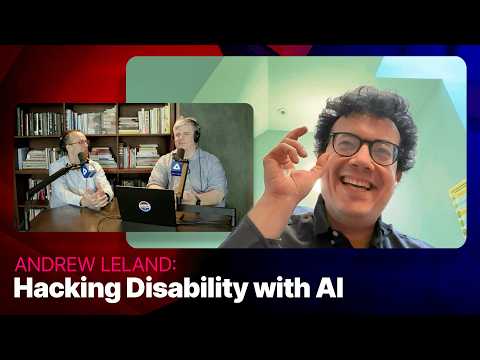
“I don’t know the Emacs Lisp, right? I never really — I mean I know enough to just like barely like open the front door, but with Claude Code, I could say, ‘Hey, this package is broken, fix it,’ and it does it. Or, you know, blind people — the blind vibe coding revolution is upon us for sure.” — Andrew Leland, 30:00
Clip command
yt-dlp --download-sections "*30:00-30:55" "https://www.youtube.com/watch?v=OZiah3QUa-g" --force-keyframes-at-cuts --merge-output-format mp4 -o "OZiah3QUa-g-30m00s.mp4"”Multimodal stuff landed like an asteroid in the blind community”
“I first saw it through the blind communities I’m a part of, and a lot more people who have a lot less vision than I do. And the way I saw it was in the multimodal stuff, which did land like an asteroid in the blind community… Five years ago you’re like asking your wife to do it, right? Or you’re like, you gotta hire somebody, or you’re outsourcing it.” — Andrew Leland, 27:41
Clip command
yt-dlp --download-sections "*27:41-28:40" "https://www.youtube.com/watch?v=OZiah3QUa-g" --force-keyframes-at-cuts --merge-output-format mp4 -o "OZiah3QUa-g-27m41s.mp4"”It’s always going to be a second-class experience”
“A wonderful person named Chancey Fleet, who works for the Andrew Heiskell Talking Book Library at NYPL — she’s like one of the great blind technology thinkers of our time — it’s always going to be a second-class experience on some level if you’re working with mainstream tools. There’s always fundamentally a feeling of, ‘I am going through the side entrance here.’” — Andrew Leland, 16:26
Clip command
yt-dlp --download-sections "*16:26-17:25" "https://www.youtube.com/watch?v=OZiah3QUa-g" --force-keyframes-at-cuts --merge-output-format mp4 -o "OZiah3QUa-g-16m26s.mp4"”He had Claude Code Cold Stone Creamery the Wikipedia”
“This guy just had an LLM write him an add-on for his screen reader that basically scrapes Wikipedia and Cold Stone Creamery’s it up into the his particular confection that he wants and then he uploads it to the NVDA add-on store and now lots of other blind people are using it.” — Andrew Leland, 30:53
Clip command
yt-dlp --download-sections "*30:53-31:55" "https://www.youtube.com/watch?v=OZiah3QUa-g" --force-keyframes-at-cuts --merge-output-format mp4 -o "OZiah3QUa-g-30m53s.mp4"”I turn on screen curtain when my wife walks by”
“My wife is an English professor and there’s a thing called screen curtain with a lot of assistive tech where you can basically make your screen go black but you can still hear it. I will turn on screen curtain if I’m using Claude and she walks by because I’ll get in trouble. She really hates — she’s one of those ‘kill it with fire’ people.” — Andrew Leland, 33:59
Clip command
yt-dlp --download-sections "*33:59-34:55" "https://www.youtube.com/watch?v=OZiah3QUa-g" --force-keyframes-at-cuts --merge-output-format mp4 -o "OZiah3QUa-g-33m59s.mp4"”We’re heading toward a post-product world”
“I think generally speaking we talk about it on this podcast, we’re heading towards a post-product world with this stuff because the ability to sort of assess a situation and then build something that’s utterly custom and tailored and has a customer of one…” — Paul Ford, 42:43
Clip command
yt-dlp --download-sections "*42:43-43:40" "https://www.youtube.com/watch?v=OZiah3QUa-g" --force-keyframes-at-cuts --merge-output-format mp4 -o "OZiah3QUa-g-42m43s.mp4"Key Points
- Andrew Leland’s introduction (1:18) — Wesleyan visiting professor, former managing editor of The Believer, author of The Country of the Blind: A Memoir at the End of Sight
- Dave Eggers and the QuarkXPress manual (3:32) — Leland dropped out of college to manage The Believer, learning desktop publishing software end-to-end on a flight
- Retinitis Pigmentosa explained (8:06) — Slowly degenerative disease causing tunnel vision; Leland has a few degrees of useful central vision and uses a white cane
- Doctors don’t recommend tools (12:03) — “The doctors are like, I am going to cure your blindness, and then if they can’t, they’re like, dang. Here’s a support group.”
- Why screen readers feel like the side entrance (15:00) — Screen readers pull from an “accessibility tree” of buttons, lists, and headings, but the underlying paradigm is built for visual users
- The DOS-to-GUI regression (18:41) — Blind users were thriving on the command line; the GUI was a “nightmare” because everything became fundamentally visual
- Patrick Smith’s rabbit hole (19:49) — A blind hacker steered Leland from Word into Markdown, then Pandoc, then Linux and finally Emacs with org-mode
- TV Raman and Emacspeak (22:55) — Legendary blind developer (formerly Adobe, now Google) built Emacspeak, a screen reader purpose-made for Emacs
- Joy Bubbles documentary (19:49) — New documentary about an OG blind phone phreak who could whistle the 2600 hertz tone to unlock the phone system
- Multimodal AI as game-changer (27:41) — Real-time image description, Meta Ray-Bans reading airport gate numbers, ChatGPT narrating graphic novels page by page
- Patience as a UX feature (28:18) — Chatbots’ willingness to “let’s try it again” matters disproportionately for blind users learning non-visually
- NVDA versus JAWS (30:53) — Open-source NVDA is taking market share from the proprietary, expensive JAWS screen reader, with a thriving Python add-on ecosystem
- AI-built Wikipedia scraper (30:53) — A blind developer used an LLM to write a personalized NVDA add-on that reformats Wikipedia, then shipped it to the add-on store
- Two communities, opposite reactions (33:00) — The literary world wants to kill AI with fire; the blind community sees it as foundational to independence
- Apple’s accessibility reputation (24:13) — iPhone is “the number one tool for a blind person, bar none,” but very few blind users love the MacBook
- Diversity within disability (40:58) — An 80-year-old who lost vision is radically different from a “blind hacker who’s been Unixing it up since childhood”
- Post-product world / customer of one (42:43) — Paul argues software is moving toward bespoke, single-user solutions assembled on demand
- A pairing service for newly-blind users (45:00) — Rich proposes a future where a developer hangs out with a newly-disabled person for a couple of days and builds five or six custom tools
- WCAG still matters (45:54) — Leland insists baseline accessibility standards aren’t made irrelevant by AI — you still need to reach the Claude prompt
Mentions
Companies & Organizations
- The Believer (magazine) (3:32) — Magazine where Leland was managing editor; founded by Dave Eggers
- Wesleyan University (1:28) — Connecticut liberal arts university where Leland is a visiting professor
- Apple (16:21) — Strong accessibility reputation but accessibility still feels like a “side door”
- Microsoft (16:00) — Most blind users live on Windows because of more robust screen readers
- Adobe (22:55) — Where TV Raman previously worked; also home to InDesign
- Google (22:55) — TV Raman’s current employer; one of the better-doing companies on accessibility
- Meta (28:58) — Maker of Ray-Ban smart glasses popular with blind users; Facebook’s accessibility regressions a known frustration
- NYPL Andrew Heiskell Talking Book Library (16:26) — Where Chancey Fleet works
- American Council of the Blind (34:00) — Advocacy organization that emails about regressions and fixes
- Amazon (34:00) — Used as a guilt-tinged dependency by people who can’t drive
- Aboard (47:30) — Paul and Rich’s own software company
Products & Technologies
- QuarkXPress (3:32) — Desktop publishing software Leland learned to manage The Believer
- Adobe InDesign (3:32) — Successor to Quark for magazine layout
- Markdown (19:49) — Plain-text format Leland adopted for accessibility
- Pandoc (19:49) — Command-line document converter recommended by Patrick Smith
- Linux (20:55) — Where Leland eventually landed for accessibility-friendly customization
- Emacs / Emacs Lisp / org-mode (21:04) — Highly customizable text editor that works extremely well for low-vision users
- Emacspeak (22:55) — Screen reader for Emacs created by TV Raman
- VoiceOver (24:29) — Apple’s built-in screen reader on macOS and iOS
- JAWS (30:22) — Venerable proprietary Windows screen reader, expensive
- NVDA (30:22) — Free, open-source Windows screen reader with Python add-on ecosystem
- Claude Code (30:00) — Anthropic’s coding agent enabling “blind vibe coding”
- Meta Ray-Bans (28:58) — Smart glasses used by blind people to navigate airports independently
- Apple Dwell Control (35:50) — Apple accessibility feature for users with mobility disabilities
- WCAG (45:54) — Web Content Accessibility Guidelines, baseline accessibility standards
- Mastodon (19:45) — Where blind hackers tend to congregate online
- Riverside (9:27) — Podcast recording platform used by Aboard
People
- Andrew Leland (1:18) — Author, professor, guest of the episode
- Dave Eggers (4:23) — Founder of The Believer and McSweeney’s; gave Leland his start
- Patrick Smith (19:49) — Blind hacker with an English PhD who steered Leland to Emacs, Markdown, and Linux
- Chancey Fleet (16:26) — NYPL Andrew Heiskell Talking Book Library; “one of the great blind technology thinkers of our time”
- TV Raman (22:55) — Blind developer (Adobe, now Google), creator of Emacspeak
- Alison Bechdel (29:32) — Cartoonist whose graphic novels Chancey Fleet reads via multimodal AI
- George Saunders (2:22) — Author Rich admires; running joke about capitalists who like literary fiction
- Joy Bubbles (19:49) — Subject of new documentary; OG blind phone phreak who could whistle the 2600 Hz tone
- Jose Saramago (37:35) — Author of Blindness; referenced for fictional mass-blinding event
Surprising Quotes
“It’s not just like, oh you know what? You need a screen reader, here’s the good one, go for it… I mean, it could be if I wanted to make my life simpler, but if you care about this stuff, it’s not.” — Andrew Leland, 13:00
“You can magnify the whole screen, but it’s sometimes nicer to have all of the UI elements large, right? And that would always inevitably break things… Until I found Emacs where just everything is like Lego blocks that fit perfectly.” — Andrew Leland, 22:00
“I just got like a really excited email this morning from the American Council of the Blind that was like, ‘Great news!’ and I was like, ‘Oh, is this like some legislative thing?’ and it was like, ‘The Facebook — if you update your Facebook app, the back button works again! Fuck yeah! We did it, guys!’” — Andrew Leland, 34:00
“Blind people really like this kind of asphalt and when you fill in the potholes with the other kind it’s not good… I was like ‘What are you talking about, man? Like that’s just a you thing.’ But now the whole community council is like ‘Okay, well the blind community really likes this style of asphalt.’” — Andrew Leland, 41:24
“There does have to be a baseline — like WCAG is not made irrelevant by AI, right? There are still basic accessibility features without which I can’t even get to the Claude prompt.” — Andrew Leland, 45:54
Transcript
Paul Ford: 0:00 Richard. It’s become your signature.
Rich Ziade: 0:03 Paul. How are you?
Paul Ford: 0:05 I get very Brooklyn when I’m around you. How are you today?
Rich Ziade: 0:07 I’m doing well. How are you doing?
Paul Ford: 0:09 I’m doing fine. It’s a busy day. Lots going on.
Rich Ziade: 0:10 Busy day, lot going on.
Paul Ford: 0:11 Good stuff. We are the Aboard podcast. I’m Paul Ford, you’re Rich Ziade, and we have a software company that builds software using which technology?
Rich Ziade: 0:20 AI.
Paul Ford: 0:21 Artificial Intelligence, which, you know, gives people the willies.
Rich Ziade: 0:25 Yeah. And we deliver AI into clients.
Paul Ford: 0:30 That’s right. We are a transformative AI play.
Rich Ziade: 0:33 Absolutely.
Paul Ford: 0:34 And so today we have a rare treat. We have a guest who is a professor, a thinker, a writer…
Rich Ziade: 0:42 Whoa.
Paul Ford: 0:43 …an essayist, a literary person, and why in God’s name would such a person be on this nerd capitalist podcast?
Rich Ziade: 0:52 Let’s find out.
Paul Ford: 0:53 Let’s find out. We’re going to talk to Andrew Leland in a second. We’re going to play our wonderful theme song and off we go.
Rich Ziade: 0:58 Let’s do it.
Paul Ford: 1:17 Andrew!
Andrew Leland: 1:18 Hello.
Paul Ford: 1:19 Welcome. Welcome to the Aboard podcast. We’re so glad to have you.
Andrew Leland: 1:21 Hi Paul. Hi Rich.
Paul Ford: 1:22 For people who don’t know you, I’m going to introduce you for like 20 seconds and then you’re going to correct me, okay?
Andrew Leland: 1:27 Yep.
Paul Ford: 1:28 So, you are a professor, a visiting professor at Wesleyan University. For people that don’t know that’s like one of those little liberal universities kind of somewhere in New England. Which state is it in?
Andrew Leland: 1:41 Connecticut.
Paul Ford: 1:42 Yeah, we knew… I knew that. I just… you know, I was testing you.
Andrew Leland: 1:45 Yeah.
Paul Ford: 1:46 And you’re also an author and an essayist. I actually interacted with you many years ago when you were editing the Believer and you have a very long range of work around a whole lot of stuff. But in the last few years, because you have a degenerative eye condition, you have been writing about blindness and what it means to go blind. And your book, The Country of the Blind, is really, really good. Like, and I say that not in my normal podcast “oh my gosh, I’m really excited you’re here”, but boy it’s got good sentences. You would like it. Rich hasn’t read it yet. You would really like it.
Rich Ziade: 2:22 Yeah.
Paul Ford: 2:22 Rich is funny for a capitalist because he also like, he’ll come in on a Tuesday and be like “George Saunders is amazing”.
Rich Ziade: 2:30 Oh Lord.
Paul Ford: 2:32 It’s real though. No, no, you’re in a safe space.
Rich Ziade: 2:33 You can do both of those things. I can make money and like George Saunders.
Paul Ford: 2:38 You’re… that’s… no one has ever said that before. Ever.
Rich Ziade: 2:41 That’s possibly true. It’s groundbreaking.
Andrew Leland: 2:43 That’s how George Saunders survives is that, you know, people who make money read him.
Rich Ziade: 2:47 Exactly. Exactly.
Paul Ford: 2:49 And so we had a conversation earlier, Andrew, and I’m going to stop talking and hopefully you will start talking. There’s an angle for you on this podcast that I don’t think people might expect, which is why you are a very thoughtful and… So as an essayist, a family man, a person who is narrating an experience of a disability. You were kind of a huge nerd already, but this situation has turned you into an unbelievable nerd and a very thoughtful product person, building tools for yourself. Just kind of talk a little bit about that and help the audience frame it.
Andrew Leland: 3:32 Yeah, I got my start at the Believer magazine where I was interacting with you, as you said, and I was managing editor for many years, which meant — I dropped out of college to take the job and Dave Eggers, who started that magazine, told me, “Just buy a manual for QuarkXPress and read it on the plane as you fly from Northeast Ohio to San Francisco.” And I did that because basically the reason that the Believer could exist is the overhead was so low, there was only one full-time employee and I was dropping out of college to be that guy. And it was all done in QuarkXPress, you know, later transitioned to Adobe InDesign, but that was just such a formative experience for me reading a software manual end to end on an airplane. “This is going to be my life. Okay, let me learn the keyboard shortcuts that will dictate my professional career.”
Rich Ziade: 4:23 I wanted to just pause for one second and remind everyone that you just said that Dave Eggers started your technology career.
Andrew Leland: 4:34 Yeah. He’s an interesting guy. He would write — I don’t know if he still does this, I hope he doesn’t — but he would write novels in QuarkXPress, which is not a normal thing. The usual workflow is you write in a word processor and then export it several iterations later. But he was a designer as much as he is a writer and that ethos was a big part of my education as an editor and as a writer.
Paul Ford: 5:00 I mean, he came out of, what was the magazine? I think it was called Might. So he was this sort of very San Francisco, almost like zine transitioning to magazine, very Gen X thing. And the Believer kind of came after McSweeney’s. So that’s really interesting. Because everything with him was low budget and kind of low-fi, right? So he’s like, “Andrew, you want this job, you better learn the software.”
Andrew Leland: 5:26 Yes. And you can’t learn software on an airplane without a laptop, which I did not own at the time because I was a college student and it was 2003.
Rich Ziade: 5:34 Those thick books, right? They were heavy and they were a good time.
Andrew Leland: 5:43 It was like reading a travel guide to a country you haven’t visited yet. I was like, “Oh, okay, I guess that hostel sounds good, but I’m not really going to know until I get there.” Anyway, I got there and it was a technically nerdy job. I really had to dive into the guts of Quark and then InDesign at the same time that I was writing copy and editing pieces. I start my answer to your question with that because in some ways, it was this lesson that there is no real divide for me between that wonky keyboard shortcut memorization and understanding how a piece of software structures your art and your thinking and your craft all the way up until now. And blindness changed that, but it wasn’t as big of a change as you might think.
Rich Ziade: 6:39 No, I mean, I think you know where my brain is going, and I don’t want to do this on this podcast, but QuarkXPress had tags and structured data, and so did InDesign. When you dig into these tools, a lot of them were very structured and organized, and a lot of that thinking was some of the earliest thinking that got translated onto the web around navigation and structure. People could hear this and hear “Oh, well, he was putting together a magazine with desktop publishing,” but the reality is a lot of that workflow stuff is very much like programming. Putting together a magazine is almost a software process in a lot of ways.
Andrew Leland: 7:24 I loved watching the little Fetch dog run as I uploaded gigantic PDF files to the printer in Canada.
Rich Ziade: 7:31 Yeah, that’s right. This is all I want to talk about.
Andrew Leland: 7:34 Yeah, that nothing made me feel more like a coder, or not that I was anything remotely like a coder, but that was the most adjacent I got. Whatever, HTML and so on. But all to say, yes, I was making a digital artifact even though it ended up as a print product.
Paul Ford: 7:40 Okay, so on you go in your editorial career and have a lot of success, you’re writing, you’re doing all kinds of stuff. Blindness happens and you find yourself… Okay, go ahead.
Andrew Leland: 8:00 Well, I mean, no, the only thing that I have to interrupt you about there is that “blindness happens” is complicated. The disease I’ve got — Paul, why are you trying to simplify my life?
Paul Ford: 8:03 Finally! No, no, honestly, I welcome this. Let’s get into it.
Andrew Leland: 8:06 RP, the name of the degenerative retinal disease that I’ve got, Retinitis Pigmentosa, it goes different speeds for different people, but I have this sort of pretty much normal version, I think, that is the most common, and it’s just unbelievably slow. And I think this is important to point out only because it informs my perspective as the kind of product user, product expert? I forget what you called me.
Rich Ziade: 8:50 No, you’re product developer. You’re product strategist. Product adjacent… take it and run with it.
Andrew Leland: 8:56 Product adjacent. Take it and run with it, yeah.
Paul Ford: 9:00 The money is good. You want it. Keep going.
Andrew Leland: 9:03 When I was working at The Believer, I had night blindness, I stopped driving at night, but I still drove during the day. It’s basically slowly encroaching tunnel vision. So these days I have a couple of degrees of useful central vision, but I still use them a lot, all the time. I can see stuff, particularly when I can control the visual elements.
Paul Ford: 9:27 Now, you’re looking at us right now on Riverside, which is the podcast platform — so what do you see?
Andrew Leland: 9:33 Basically I see very little at a time, but what I do see I can see fine. So like if I’m looking at you — I can zoom way in and actually see your face pretty well to point at you in a lineup if you committed a crime, I think I’d be able to ID you.
Rich Ziade: 9:51 I’m glad that’s the use case.
Andrew Leland: 9:54 Yeah, I mean I’m expecting that to happen at some point. I use a white cane though because if I’m later today when I’m going to be navigating Grand Central, the idea of like imagine strapping a toilet paper tube to your head and trying to navigate Grand Central, where you could only see like a pair of shoes at a time. It’s not going to work.
Paul Ford: 10:14 So nothing on the periphery, just like this. And then reading? Mostly audio or do you — like what do you do?
Andrew Leland: 10:19 Yeah, so like I can spot check text, especially if it’s large and especially if it’s a light color on a dark background, but that is not super sustainable. So if I’m going to read anything more than a couple of words, I’ve got audio going or I’m zooming way in, controlling the visuals. And that’s been a very, very slow process. In the reporting I did for my book, I talked to plenty of people who were in a car accident and lost their sight instantly. And people who were born blind. I’m in this other weird category where I’m just very, very, very slowly going blind. And as a writer and as a product guy, which I’m not, but I like that you think of me as that —
Rich Ziade: 11:24 Andrew, most people live with the condition, obviously research the tools, maybe their doctors will say “Hey, you should use this tool.” As a product person, who the idea of product creation is changing over time, do you feel like, “Hey, I can go make something” or “I can have an opinion about the tools that affect my life, I don’t have to just wait for some product to come out”? Talk us through how you think about this.
Paul Ford: 12:00 Empowering or is it empowering and frustrating?
Andrew Leland: 12:03 Well, first of all, the doctors do not tell you what tools to use. The doctors are like, I am going to cure your blindness, and then if they can’t, they’re like, “Dang. Here’s a support group that you should go to.”
Paul Ford: 12:14 Okay. That’s interesting.
Rich Ziade: 12:14 Call this number.
Andrew Leland: 12:16 Yeah, exactly. Then you call the number, and you might get a very benevolent sighted lady or guy who’s like, “Oh yes, here is the solution. You’re going to want to buy a gigantic closed-circuit television that will take up your entire bedroom, and that will be what you use to painstakingly read books.”
Rich Ziade: 12:39 Whoa.
Andrew Leland: 12:41 And what I realized as I kind of entered this world is that it’s a little bit like asking somebody where you should go to college. There are a lot of options, some of them will be terrible options or not right for you. And to this day — and this is sort of to answer Paul’s question about why losing vision made me into a nerd, because the deeper I went, the more complex and interesting, but also totally unsatisfactory it became in terms of what the tools are. It’s not just like, “Oh you know what? You need a screen reader, here’s the good one, go for it.” It could be if I wanted to make my life simpler, but if you care about this stuff, it’s not.
Paul Ford: 13:21 Do you — let’s be brutally honest here, is it just a lot of bad software out there? A lot of bad tools?
Andrew Leland: 13:31 Well, yeah, that is such a good question. One thing that I’ve been wrestling with is that as this process started — I mean the process really is like, okay, I need to use a screen reader. I need to have my computer talk to me. And I resisted it for a long time because I have vision, but the thing that I experience that so many people losing vision experience is the longer you cling to the visual, especially if you have a degenerative condition, it’s just diminishing returns. I’ve met people who are like one highway-sign-sized letter at a time, trying to read anything. That is just a recipe for frustration and failure. And the successful blind people — a lot of my reporting and writing was ostensibly to write a book, but also I was just like, how did the people I want to emulate myself after, how are the successful blind people doing it? And you got to do the screen reader, basically.
Paul Ford: 14:22 So leaning into a screen reader was your way to kind of own the condition? “Okay, here we go, I’m going to get good at this.”
Andrew Leland: 14:32 Yeah. The thing I was going to say was that there was a moment where it was scary and hard and frustrating, but I kind of got into it in the same way that I think anybody who is sort of technically minded or interested in software was like, “Oh, okay, I’m cracking open the computer in a way that I haven’t previously.” Because the thing that a screen reader does, which I did not understand and I still don’t totally understand — it’s not just what it sounds like. It’s not, “Oh, I’m going to here’s a bunch of text on the screen, and it’s going to read it.” There’s a thing called — you know this, and your listeners know this better than I do — an accessibility tree, that is sort of pulling from the guts of whatever the system is, like whether it’s a web page or an API. I don’t even know what these words mean. What’s it called? The toolkit? The webkit? It’s got “kit” in the suffix.
Paul Ford: 15:26 I mean, there’s many kits in your life —
Andrew Leland: 15:28 It’s pulling from the kit, Paul!
Rich Ziade: 15:30 Yes, from the kit.
Andrew Leland: 15:31 In other words, it’s generated, so it’s like, “Okay, here’s all the buttons, here’s all the lists, here’s all the headings.”
Paul Ford: 15:39 It’s trying to make sense of the order of things. It’s not just rambling out all the stuff and leaving it to you to decipher it. So there is a hierarchy, so to speak.
Andrew Leland: 15:48 Yes. Partially because I had vision — I have vision — when things didn’t work right, I wasn’t completely screwed in the way that many blind people are when something’s inaccessible. Because I was writing a book, it kind of became an interesting project. “Okay, I’ve been a Mac user my whole life, but most blind people are on Windows, and therefore the screen readers on Windows are way more robust than what Apple offers for the desktop.”
Rich Ziade: 16:21 Oh, this is one of the worst things that this condition could do to you.
Paul Ford: 16:24 Is you’d have to go back to Windows XP.
Andrew Leland: 16:26 Which sucked, but also I was learning, and I had this honeymoon period where I was like, “This is leveling me up as a person who’s engaged in technology and thinks about it.” And then the kind of rude awakening that I think is a cycle I’ve been in where I’ll get jazzed about something and then be like, “Ah, this is always…” A wonderful person named Chancey Fleet, who works for the Andrew Heiskell Talking Book Library at NYPL, she’s one of the great blind technology thinkers of our time — it’s always going to be a second-class experience on some level if you’re working with mainstream tools. Even the Apples of the world that are doing these great commercials that show a university full of disabled people using their products — the products are great. There’s always fundamentally a feeling of, “I am going through the side entrance here.”
Paul Ford: 17:16 How come? Explain that. There’s so much time and energy and money that’s been spent on building these tools. Why aren’t they great?
Andrew Leland: 17:24 I don’t know, I was reading something from a blind hacker guy last night, and he was talking about the problem of keyboard input on a touchscreen. There’s something just sort of fundamentally — the metaphor is fundamentally visual. The way the touchscreen keypad keyboard is built is you look at it, you type, then you get visual feedback that you’re typing the right letters. So there are ways to make that accessible, and there’s been some ingenious ones, but his argument is, like, there’s just fundamentally a mismatch. If you were going to design a text input to be non-visual, you wouldn’t build it like that. So there’s always a sense that there’s like carpet laying over the nice wood floor that you want.
Rich Ziade: 18:10 Yeah, yeah.
Paul Ford: 18:15 You’re negotiating with these experiences that are assuming full capabilities in the user and it’s always caked on. It’s never from ground up because they are software add-ons oftentimes on top of the world that’s been created.
Andrew Leland: 18:30 Yeah. I don’t want to get too nerdy with history, but if you think about the history of computing —
Paul Ford: 18:38 Oh no, this is a safe space. You should do that.
Andrew Leland: 18:41 Okay. So in the DOS days, where everything is text, blind people were kind of in their element, because once you’ve got that talking, there are still problems on the command line about reviewing text, but fundamentally everything was legible in that way. And then you had the GUI, the dawn of the GUI, and it was a nightmare, right?
Rich Ziade: 19:01 Yeah.
Paul Ford: 19:03 This just feels like you’re going to end up in Unix at some point. Okay, go ahead.
Andrew Leland: 19:08 Well I have. I mean that’s the —
Rich Ziade: 19:09 There we go.
Paul Ford: 19:10 You saw it coming. No, but wait a minute. You must be over the moon with AI.
Rich Ziade: 19:17 Well hold on, let’s get there. I want to hear about his new AI friends.
Paul Ford: 19:21 All right, when Mac to Windows, this feels like you’re going to end up in the terminal. Is that what happened?
Andrew Leland: 19:31 That’s ultimately what happened. Yeah. I’ll spare you every agonizing move, but basically I met another blind hacker who I just — I’m very drawn to the blind hackers and there’s a lot of them out there.
Paul Ford: 19:42 Where do they hang out? Where do you find blind hackers?
Andrew Leland: 19:45 Mastodon is a pretty good space for it, I would say. Listserv email lists. Clubhouse was popular for a minute during the pandemic, but then that shut down. There’s a really cool documentary that is just about to come out called Joy Bubbles about one of the original phone phreaks who is this blind guy who could whistle the 2600 hertz tone that would unlock the phone system and he’s like an OG blind hacker guy. Really wonderful film. So I met this blind hacker named Patrick Smith who I was sort of talking to him about some ideas after my book came out and he really just shoved me down a rabbit hole. He’s like, “Look man, sure Microsoft Word is accessible with JAWS or NVDA, which are the two big Windows screen readers, but you should be in Markdown, man.” I was like, okay, I’ll try Markdown. He was like, “And if you’re in Markdown, you should be using Pandoc on the command line and plain text is more accessible.”
Paul Ford: 20:44 Yeah. It sends you down a path.
Rich Ziade: 20:46 This is just exploitation is what that was, which good for him.
Paul Ford: 20:51 Yeah, no, he got you. He also said try Linux.
Paul Ford: 20:55 Oh yeah. No, just what a gateway straight into the all of our favorite cults. That’s wonderful. So he took this nice literary man and he —
Andrew Leland: 21:04 He’s got a PhD in English. He wrote his dissertation in org-mode in Emacs and that’s where I ended up for better or for worse.
Rich Ziade: 21:14 I’m just going to leave.
Paul Ford: 21:15 Yeah, Richard’s nightmare. I promise we’ll talk about AI in a minute. Okay. So for people who don’t know, I am an enormous advocate of this classic text editing and Emacs has been a text editor I’ve used for 20 years and watching Andrew get seduced by it gives me happiness in the same way that any cult member coming in and being new makes me happy. So welcome, I’m glad you’re here.
Andrew Leland: 21:42 Well, and it speaks directly to this conversation too, because for all the reasons that you for 20 years have been enjoying it, those things are good for me even if I’m not writing code. But from an accessibility perspective, on the one hand it’s a nightmare. If you want to think about accessibility in the sense of “I click on a download button and then I have an app that I know how to use,” Emacs is your worst nightmare because it takes 20 years to learn how to use. But for instance, there is no app I have ever used where invert colors works 100% of the time. Glare is horrible for me, so it’s really important that dark mode works — these days dark mode is becoming hip so it’s getting easier, but for a long time, inverting colors, it would always be like some bright bar of nonsense that I couldn’t fix. Or same thing with making text larger. You can magnify the whole screen, but it’s sometimes nicer to have all of the UI elements large, right? And that would always inevitably break things or have things running over each other. Until I found Emacs where everything is like Lego blocks that fit perfectly. I can change the typeface of everything.
Andrew Leland: 22:55 And then the real joy is that this guy, I think also probably about 30 years ago or 20 years ago, named TV Raman, who is a blind developer, he was at Adobe and now he’s at Google. He built something called Emacspeak, which is essentially like a screen reader that just works for Emacs.
Paul Ford: 23:13 He’s really legendary. If you know about this tool, you actually end up learning about him.
Rich Ziade: 23:19 Oh, no kidding.
Paul Ford: 23:20 Yeah, because Emacs has been a real tool because of him, it became a tool for blind users 20 years ago. And so it’s sort of baked into it as what it’s about. So now your world — and you know what’s interesting here? There’s two things. One is the same thing that got you into where you’re like, “Alright, I’m going to learn QuarkXPress from this book,” is also you coming into software and technology as a blind person. And then what we’re learning is that you need a very malleable foundation in order to adapt a system to your specific needs. And so macOS just can’t be that malleable and be a consumer product that millions of people can pick up.
Rich Ziade: 24:13 Yeah, and even if it was, it’s often hard to bend it. Apple has invested a ton in accessibility tools and capabilities.
Paul Ford: 24:23 They have a good rep. People don’t hate them, right? In general, folks are like, “Ah, Apple’s pretty good about this.”
Andrew Leland: 24:29 For sure. The iPhone is the number one tool for a blind person, bar none. The MacBook, there are very few blind people who love MacBook.
Rich Ziade: 24:40 Interesting. I actually met years ago the head of accessibility for Apple and they were just about to come out with that whole suite of features. People don’t often talk about it, but it’s a wide breadth of features in iPhones for people with disabilities.
Paul Ford: 25:00 Correct. I think sighted users don’t realize because it’s such a visual medium, how much accessibility tooling is built into iOS.
Rich Ziade: 25:07 Correct. But I have no doubt in my mind that they’re so buried four layers deep in settings. Unless you really sit down and learn it, they’re not immediately accessible. And there’s not — they’re not as malleable because they are a set of features, whereas Emacs nerds just love the control. This is about control to a large extent.
Andrew Leland: 25:31 So it’s not just usability. Even if you’re good with computers or phones, you’re like, “Ah, you almost got me there.” It felt just short, which is normal, totally normal. For me, as a reader and a writer, my relationship with text is paramount. I sort of got to a point where I could see the workflow. I could do it in Word — it was totally fine, but then when I started to actually follow this guy down this rabbit hole, the feeling of control was intoxicating because I realized, “Oh no, I don’t have to make these compromises.” It felt a little bit like the cartoon character who gets into the mecha-suit where you can like, “Oh, now I can reach 40 miles with my precision syringe and go drill down right here.” That was transformative for me.
Paul Ford: 26:19 Well, and now Emacs has got this very thorny language inside of it that makes it very customizable, called Emacs Lisp. But it’s not a gentle glide path. I’ll be very frank, even as a big old Emacs nerd, I don’t like using it. Except AI shows up, and now you can start to not just customize…
Rich Ziade: 26:41 Finally. Are we done with Emacs? Can we move on?
Paul Ford: 26:46 We’re never done, Rich. We’re never done. It’s running on my Mac.
Rich Ziade: 26:50 We just shed so many listeners for the last 15 minutes.
Andrew Leland: 26:54 We just subtracted so many listeners.
Rich Ziade: 26:56 Yeah, we may have attracted a new — this podcast is sponsored by Rush, the band.
Paul Ford: 27:00 Yeah, that is true. A cluster of like Rush fans and Emacs users, it’s a strong vibe. Andrew, I gotta ask. This new command line transcription-based experience lands like a spaceship on Earth three years ago. Yes, it’s not as buttoned up as DOS, it’s more patronizing, kind of clueless sometimes, and maybe damaging long-term, but were you ecstatic? What did you think about this? It has become the dominant interface of the last few years.
Andrew Leland: 27:41 I first saw it through the blind communities I’m a part of, and a lot more people who have a lot less vision than I do. And the way I saw it was in the multimodal stuff, which did land like an asteroid in the blind community.
Paul Ford: 27:51 Oh, because it can describe a photo, or it can — okay, yeah.
Andrew Leland: 27:54 Exactly. Unbelievable, yeah. Five years ago you’re like asking your wife to do it, right? Or you’ve got to hire somebody, or you’re outsourcing it. And I was just reading something this morning from a guy who’s a blind guy who teaches blind people how to use technology, really beating the drum for AI and saying like if you’re teaching blind people life skills and you’re not including AI, you’re not doing your job.
Andrew Leland: 28:18 And one thing that he emphasized which I thought was interesting was how patient the chatbots are, which I think for if you think about a blind person learning to do anything, you’re doing it in a way that is fundamentally to the side of how the rest of the world does it. Non-visually — there’s very few things that the mainstream does non-visually. To have a chatbot that has all the power that you’re talking about, but also that is patient in that way and will be like, “Let’s try it again,” that’s huge. The multimodal thing, the independence that that gives you is tremendous. And now with wearables, it’s not just describe this image, but it could be like, “I’m at the airport, like tell me the gate numbers that you see here.” People are just wearing Meta Ray-Bans and cruising through airports independently and it’s a game changer.
Paul Ford: 29:01 Wow. What do you think — do you use them? Do you use Meta’s Ray-Bans and all that?
Andrew Leland: 29:13 I’m not using the wearables. I still have enough vision that I will just zoom in or take my glasses off and smash it up to my face if I want to see something. But I like to know that it’s there. Chancey, who I mentioned before, she reads graphic novels with multimodal AI, which I just think is wild. She’ll open a page of like an Alison Bechdel graphic novel and say, “Okay, hit me with page 23,” and then she tunes it.
Rich Ziade: 29:40 That last Alison Bechdel book is really good by the way, if people haven’t picked it up.
Andrew Leland: 29:44 Oh, really?
Rich Ziade: 29:45 Oh, it’s all about hippies in Vermont and it’s just brutal and hilarious. It’s really good. It’s called Spent — anyway, or Secrets, I think — anyway, keep going.
Andrew Leland: 29:52 I was just going to say that for me it really started to feel powerful and Rich is going to be unhappy with this answer, but I don’t know the Emacs Lisp, right? I never really — I mean I know enough to just like barely open the front door, but with Claude Code, I could say, “Hey, this package is broken, fix it,” and it does it. Or, you know, blind people — the blind vibe coding revolution is upon us for sure.
Rich Ziade: 30:19 Tell us what that’s like, what is that?
Andrew Leland: 30:22 For one thing, not to just Emacs it out forever, but the open source aspect of it is pretty important. The great thing about Apple is that VoiceOver, the Apple screen reader, just comes built-in on every Apple product you buy. Whether it’s a watch or the phone, you don’t have to pay for it. In the past — and this is a thing in accessibility in general — if you want an assistive tool, you have to pay thousands of dollars because the economies of scale are terrible because there’s so few people buying it.
Rich Ziade: 30:52 Expensive.
Andrew Leland: 30:53 Yeah. And there’s a proprietary screen reader for Windows that’s one of the most venerable and powerful ones called JAWS. But now there’s this open source upstart called NVDA that is really taking a lot of the market share from JAWS and it’s free, it’s open source, and has this add-on library that’s all in Python that you can write your own add-ons for. And so blind people are just going bananas writing NVDA apps. I saw one — Wikipedia, for instance, is a totally accessible web page with a screen reader. But it’s also like not that easy to just sort of do the thing that visual users do where you glance at the headnote and glance at the TOC. You can get fast at it, but this guy just had an LLM write him an add-on for his screen reader that basically scrapes Wikipedia and Cold Stone Creamery’s it up into the his particular confection that he wants and then he uploads it to the NVDA add-on store and now lots of other blind people are using it.
Rich Ziade: 31:53 Amazing.
Andrew Leland: 31:54 And people are building mods for games that are inaccessible. So I think there’s two angles. One is “Here’s an inaccessible tool and it’s going to remediate it.” And the other is “Here’s an open source tool that can sort of slot into my other open source assistive tech,” and that’s the sort of NVDA or Emacs angle.
Paul Ford: 32:11 See I want to break that down for one second because something you said really sticks in my head. Wikipedia is a lot of very big web pages and they are very accessible by all the — of course Wikipedia is a big nonprofit, it follows all the guidelines and I’m sure there’ve been lots of disabled people advising over the years. But what this person needed and what they really wanted was just a really scannable version, right? That was not on the product roadmap for Wikipedia. I’m sure people have thought about it before, but everybody just kind of lived — they kind of go along, they kind of figure it out. But now this person can go, “Wait a minute, I just want this. Let me see what it would look like.” Wrong choice of words. Empowerment. He wanted to perceive this thing and use it and have it. And as a result, everybody gets to have it.
Paul Ford: 33:00 And that to me is the moment where — I want to talk to you about a slightly different thing too. You straddle two worlds. You are in a very specific part of the culture industry, which is very thoughtful, very caring, very essayistic, very sentence-focused. Those people all hate AI, top to bottom, and they want to go out and kill it with fire. And on the other side, you’re in the blind community where this really must feel good. You have one community that is losing control because of this technology, and another one where it’s so foundational that it changes your day-to-day living. How do you organize that in your brain at all?
Andrew Leland: 33:59 Yeah, that’s such an interesting question. My wife is an English professor and there’s a thing called screen curtain with a lot of assistive tech where you can basically make your screen go black but you can still hear it. I will turn on screen curtain if I’m using Claude and she walks by because I’ll get in trouble. She really hates — she’s one of those “kill it with fire” people. The way that I connect those two worlds, for me, is the thing you ended with which is just like, “You know what? I gotta get out the door somehow.” It’s like the same impulse that makes me stick with Amazon. I feel bad ordering tiny things from Amazon, but also I’m like, “Well, I don’t drive.” Am I just making that justification? Or is it really a blind thing?
Paul Ford: 34:54 No, no. We’re going to give you that pass. We’re using Amazon too, Andrew, if it makes you feel any better.
Rich Ziade: 34:59 Yeah, everybody is. This podcast is probably being recorded to an Amazon server. You just can’t own a structural problem. It’s okay.
Andrew Leland: 35:22 Yes. Okay. Thank you.
Paul Ford: 35:23 But the thing that I wrestle with is the idea of a mainstream product versus a niche product. The thing that justifies it for me is — you were mentioning earlier that you liked it when I said that you could really tell when a blind person has made a piece of software.
Rich Ziade: 35:38 Yeah, and I really want you to talk about that. I want to understand the difference. Go ahead.
Andrew Leland: 35:44 So many of these — the Wikipedia scraping add-ons — that’s never going to be a feature that any mainstream tech company is going to make. The big tech giants have blind developers and disabled developers, and they have accessibility initiatives, but it’s always going to be that sort of side door thing or like an overlay kind of approach. There are good things those companies like Google and Apple and Meta are all doing for accessibility. But ultimately, I saw this developer who has a mobility disability and scrolling is really hard for him. He talked about how a friend hacked together a cool scrolling app that made him able to scroll more well on his Mac, but it also sort of didn’t do what he wanted. And then Apple actually has something called Dwell Control that was supposed to solve the problem, but it didn’t work on all the websites. And then Claude Code, in a couple hours, he made it and now he can scroll with the best of them.
Rich Ziade: 36:48 Listen, Andrew, I can give this back to you, and you’re being very polite here. I think people have learned a lot about accessibility and disability, and they’ve brought in teams. But you’re never the main event. And what you’re saying is, boy, it’s really good to be the main event sometimes. It’s good that this product is for me. And when a blind person makes something that I can use, I can just tell and I can feel it because they’re the freaking main event. The miracle about this work is that you can stop a problem for an individual and then that can scale out. And you’ve been down on the list. You’re on the list, but you’re down on the list. And now you’re up.
Andrew Leland: 37:29 I mean, literally we’ll never be at the top of the list.
Rich Ziade: 37:33 It’s a numbers thing.
Andrew Leland: 37:35 There’s never going to — unless there’s some Jose Saramago event where three quarters of the world population is blinded, that’s never going to be the case. I don’t want people to hear this and think, “Oh cool, AI solved accessibility, so for my next product, we don’t need to think about it.” Say what you will about Facebook, there are a lot of blind people on Facebook and they yell and scream and stamp their feet when Facebook pushes an update. I just got a really excited email this morning from the American Council of the Blind that was like, “Great news!” and I was like, “Oh, is this like some legislative thing?” and it was like, “The Facebook — if you update your Facebook app, the back button works again! Fuck yeah! We did it, guys!” I was like, wow, that’s… But also as a user, Facebook is a pleasant app to use with VoiceOver. Compared to Twitter for instance, or a lot of other apps, it’s just nice. So that stuff is really important and real, but at the same time, those regressions are just a fact of life. This is where I get all Linux-y and open source-y, and I’m like maybe I just divest and live with the weirdos where the back button breaks every day, but I can fix it myself and I’m with these other weirdos.
Paul Ford: 38:58 Yeah baby. Come on in.
Rich Ziade: 39:00 Come on. We the weirdos want you.
Andrew Leland: 39:04 Good.
Paul Ford: 39:05 Listen, there’s another thing I’ve heard too — it’s very easy to be like “make this app accessible.” You can say that to Claude Code and it’ll do an okay job. But from what I’m hearing, it’s just kind of not there. It won’t quite get you there. You still need real users and real reviews.
Rich Ziade: 39:23 I want to close this podcast with a futurist sentiment. Going beyond this community or other communities of disability, communities that just don’t get attention because they do the total addressable market sort of cold calculation. They’re like, “Nah, it’s not a big enough market.” The truth is we’re heading towards a place where a bespoke solution to a problem doesn’t require buy-in at a large scale because you can just do it. Everything I’m hearing is born out of the community itself, not some R&D project at Microsoft. And it’s often driven by a personal frustration that is “Maybe others are frustrated like me.” Often it doesn’t hit the mark — it happened to work for that person who built the add-on but missed the mark for other shades of a condition. We’re coming to a day where something that is so custom-tailored to a high-fidelity around your individual needs can come to life for you and others will be like “Oh, that’s weird, that’s not how I would do it.” Well, go make your own, because it’s going to be easy and the empowerment here is in that ability. It’s almost like targeted therapy. You have a particular set of needs. It’s not just about your condition, Andrew, you also are a writer.
Andrew Leland: 40:42 And they’re very specific. Writers have a lot of things that they need.
Rich Ziade: 40:45 Here we go.
Andrew Leland: 40:46 Yeah, and they never get them.
Rich Ziade: 40:48 Yeah. I think it’s an exciting time for the tinkerers who are able to build stuff that empower them and then maybe share those things with the world. We’re in a very interesting time.
Andrew Leland: 40:58 Yeah, and I think that your point about the diversity within disability is important from a product standpoint because I talked to this blind guy who was on the very non-technical end of the spectrum and he had the ear of his local zoning board or whatever and he was like “Blind people really like this kind of asphalt and when you fill in the potholes with the other kind it’s not good.” I was like, “What are you talking about, man? That’s just a you thing.” But now the whole community council is like… “Okay, well the blind community really likes this style of asphalt.”
Paul Ford: 42:03 The blind community is the guy.
Andrew Leland: 42:05 Yeah, and you see this same thing. There are people who never identify as blind their entire lives, who lose their vision in their 80s. And that user is radically different than the blind hacker who’s blind from birth, who’s been Unixing it up since childhood. That kind of malleability is one of the things that makes accessibility hard, although I think the main thing that makes accessibility hard is just that people aren’t teaching it in schools and it’s not on people’s radar.
Rich Ziade: 42:30 But even when you do kind of want to make a good faith effort, often you’re like doing great for the low vision people or the colorblind people, but the people who are using joysticks or a different screen reader are left out.
Paul Ford: 42:43 In different environments, in different cultures, in different professions that have different requirements. I think generally speaking, we talk about it on this podcast, we’re heading towards a post-product world with this stuff because the ability to assess a situation and then build something that’s utterly custom and tailored and has a customer of one…
Rich Ziade: 42:59 We just made Andrew a product manager and you’ve already…
Paul Ford: 43:03 Welcome aboard, Andrew.
Andrew Leland: 43:05 Yeah, this was an interview process. This is why it’s over now. There’s no more roles.
Rich Ziade: 43:10 There’s no more roles. Two years ago, I think I would have been like, “Hey Andrew, I got an audience of product managers for you and you can tell them what you need, and maybe they’ll listen.” But what I’m hearing now is you saying, “Hey, if you could just make sure I know how to talk to your thing and then kind of get out of my way a little bit…”
Paul Ford: 43:35 I’ll take it from here.
Rich Ziade: 43:36 I’ll take it from here. I really do want to get that into people’s brains. You’re ready to go. You’re ready to tell Claude what you need. You just need some good APIs and some nice documentation for the LLM to read and you’re kind of up to try stuff.
Andrew Leland: 43:53 Yeah, but that’s me. If we’re talking about the community, you have to be ready for the 80-year-old who lost her vision and needs a thing that will talk to her.
Rich Ziade: 44:08 She’s not getting on Claude Code. But Andrew, five of yous can help 80,000 of them. Like really — you could build… you’re busy, you’re teaching, but let’s say this was your job. You could solve problems at a scale very quickly for a lot of people with low vision using these tools all day long. The scaling of somebody who actually has the experience and doesn’t constantly need it sort of translated to them.
Andrew Leland: 44:35 I think there’s — I partially agree with you because the example, the Wikipedia reader add-on, probably solved it for let’s say hundreds or thousands of people beyond that individual. But I think there’s a diminishing return on it. This is the challenge: how people live their lives, the state of their condition, and how it intersects with their profession.
Rich Ziade: 45:00 Think about this future state. Couple years from now. Ten years from now. Somebody develops a condition and they’re starting to lose their eyesight and it’s been going on for a while. And then a service pairs them with a developer who hangs out with them for a day or two.
Paul Ford: 45:16 Yes, as a service.
Rich Ziade: 45:19 And then makes them a tool for them.
Paul Ford: 45:22 That’s fascinating and interesting.
Rich Ziade: 45:23 In a day or two, can build them five or six great key pieces of software, uses their smart home tools. There’s a bespoke —
Paul Ford: 45:29 The barriers are gone.
Rich Ziade: 45:30 There’s a bespoke personal way to do software that’s been unimaginable.
Paul Ford: 45:35 It’s almost like a clinician in a way. They’re sort of like, “I’m going to watch how you live for a couple days and then make you something.”
Rich Ziade: 45:41 It’s the opposite of the experience that Andrew described with his doctor where it’s like, “Okay, good luck. We couldn’t cure it.” Instead, it could be like, “Oh, okay, well we can’t really do anything about your retinas, but —”
Andrew Leland: 45:54 All of that is true, but I feel like there is one thing that is the boring thing that disabled activists have been yelling about for decades that doesn’t totally carry over, which is just that there does have to be a baseline — WCAG is not made irrelevant by AI. There are still basic accessibility features without which I can’t even get to the Claude prompt. You know what I’m saying?
Paul Ford: 46:19 Yeah, yeah.
Rich Ziade: 46:21 To be fair, I am assuming an enlightened society which is probably a mistake.
Andrew Leland: 46:25 We’re still in futurist mode here.
Rich Ziade: 46:26 Okay good. Let me back that — product post-war. Let’s get to the enlightened society with inclusivity first.
Paul Ford: 46:35 Everybody’s in robes.
Rich Ziade: 46:35 Yeah. And then we can build the custom adaptable hand-holding products. That’s fair. Okay look, I actually could talk about this kind of stuff — we’d love to stay in touch. I kind of want to vibe code. It sounds really fun. Are you pushing stuff to GitHub? Are you there yet?
Andrew Leland: 46:59 I’m not there yet, but I do own some 2026 versions of my like 500-page QuarkXPress manual that I have on my to-do list to learn Python and learn more — basically the idea that if I know Python I can tell Claude to be smarter about the Python that Claude will write for me.
Paul Ford: 47:17 Stuff. Nice.
Rich Ziade: 47:19 Yeah, I mean — you really can’t, I’m going to be frank, it’s mattering less and less. Okay so look, if you want any good vibe coding help, Paul’s available. You got friends here, as does everyone else listening to this podcast. Reach out at aboard.com if they need a little advice. Andrew, look, people can visit your website to learn more. What’s a good way to reach you?
Andrew Leland: 47:51 Yeah, my email address is on my website, andrewleland.org. It’s aleland@fastmail.com. I’m on all of the major social media networks and I live in Western Massachusetts.
Paul Ford: 48:04 All right, we’re going to put that link in the show notes in case anyone is too lazy to figure out how to spell AndrewLeland.org. It’s a not-for-profit. It’s a community organization.
Andrew Leland: 48:15 It’s actually .org because it’s an org-phone.
Rich Ziade: 48:18 Oh, no. Thank you. Thank you for wrecking it, man. Oh my god.
Andrew Leland: 48:21 Sorry Rich. Sorry.
Paul Ford: 48:23 All right, so this was lovely. I hope you’ll come back on at some point. And yeah, let’s get you into GitHub. I get so excited when I see an essayist become a big Python nerd.
Rich Ziade: 48:37 Like population of three.
Paul Ford: 48:39 It’s very…
Rich Ziade: 48:41 It’s quite a club.
Andrew Leland: 48:43 Give me a year. Give me a year.
Paul Ford: 48:45 Just anything you need. Okay, good. Well, we will talk to you soon. And anyway, if anybody out there wants to learn more about Aboard, check out our website. We build and we solve problems and we transform your organization with AI. We do it in a way that really sits next to you and we work with you really closely. So imagine if Andrew was a large corporation like in the insurance industry. That’s how we would approach this problem. So hello@aboard.com. Rich, did we leave anything out?
Rich Ziade: 49:07 I think that’s it. Everybody take care of each other. Have a wonderful week.
Paul Ford: 49:13 Andrew, thank you so much.
Rich Ziade: 49:14 Thank you, Andrew.
Andrew Leland: 49:15 Thanks guys. This was awesome.