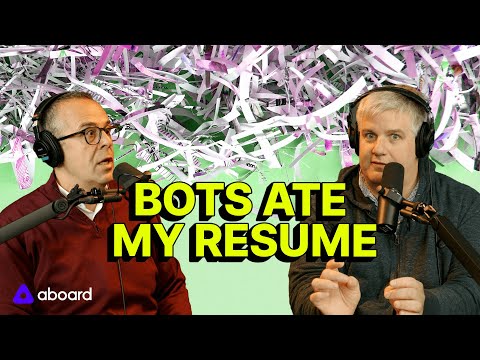
Bots Ate My Resume
Bots Ate My Resume
Summary
Paul and Rich tackle the growing crisis in AI-powered job hunting, sparked by a New York Magazine article titled “The Job Search Has Become a Humiliation Ritual.” The conversation opens with Paul demonstrating how AI-generated spam messages flood inboxes with eerily personalized but hollow outreach, then zooms into the broader dysfunction: job seekers are using tools like LinkedIn’s Easy Apply to spray AI-generated resumes at hundreds of positions, while recruiters are drowning in 700+ applications per role and using AI screening tools that reject sincere candidates. The result is a vicious cycle where nobody connects with anyone.
The hosts explore the economic backdrop — a booming stock market alongside post-pandemic tech layoffs, hiring hesitation driven by AI promises, and tariff-era uncertainty. They argue that we’re entering an era of “total distrust” where AI automation has commoditized everything from resumes to relationships. Their prescription is deliberately old-school: build trust through in-person connections, show effort, put your pants on, and stop treating job applications like ordering pad thai. Rich makes the pointed observation that you didn’t actually get rejected — nobody decided you weren’t good enough, they just never gave you the time of day because of the sheer volume of automated applications.
Highlights
”You didn’t get rejected”
Clip command
yt-dlp --download-sections "*18:10-19:10" "https://www.youtube.com/watch?v=FPbq8yEzV7g" --force-keyframes-at-cuts --merge-output-format mp4 -o "FPbq8yEzV7g-18m10s.mp4"“You didn’t get rejected. Nobody decided you weren’t good enough. They actually didn’t give you the time of day. They didn’t give you any real attention. And that’s because of the sheer volume of what’s going on right now and how everyone’s trying to automate it away.” — Rich Zotti, 18:10
”The job search has become a humiliation ritual”
Clip command
yt-dlp --download-sections "*4:10-5:10" "https://www.youtube.com/watch?v=FPbq8yEzV7g" --force-keyframes-at-cuts --merge-output-format mp4 -o "FPbq8yEzV7g-4m10s.mp4"“The title is great. The title is ‘The Job Search Has Become a Humiliation Ritual.’ Well, that’s not different than it ever used to be.” — Paul Ford & Rich Zotti, 4:10
”We’re entering this world of essentially total distrust”
Clip command
yt-dlp --download-sections "*20:00-21:00" "https://www.youtube.com/watch?v=FPbq8yEzV7g" --force-keyframes-at-cuts --merge-output-format mp4 -o "FPbq8yEzV7g-20m00s.mp4"“We’re entering this world of essentially total distrust. You are going to attempt to build a relationship with me automatically. You are going to have absolutely no respect for my time.” — Rich Zotti, 20:00
”You’re telling people to put their pants on”
Clip command
yt-dlp --download-sections "*24:30-25:30" "https://www.youtube.com/watch?v=FPbq8yEzV7g" --force-keyframes-at-cuts --merge-output-format mp4 -o "FPbq8yEzV7g-24m30s.mp4"“I will work really hard and you can pay me less until I get good and then I would hope you would pay me more. No one writes that. But that’s actually the signal that cuts through.” — Rich Zotti, 24:30
”The equivalent of being dumped by your boyfriend and eating six tubs of ice cream”
Clip command
yt-dlp --download-sections "*8:40-9:40" "https://www.youtube.com/watch?v=FPbq8yEzV7g" --force-keyframes-at-cuts --merge-output-format mp4 -o "FPbq8yEzV7g-8m40s.mp4"“This absolutely like one hundred year event occurred. The markets kind of cratered for a minute and then there’s just this massive spend kicked in. It was like the equivalent of being dumped by your boyfriend and deciding you’re going to eat six tubs of ice cream.” — Rich Zotti, 8:40
Key Points
- AI Spam Epidemic (0:14) - Paul demonstrates the flood of AI-generated personalized messages that fill inboxes of anyone with authority
- Aboard Product Launch (0:58) - Aboard built what they call the best vibe coding tool for business software by accident
- The Cut Article (4:10) - Sarah Thanum Matthews wrote about the job search becoming a humiliation ritual for New York Magazine
- Mixed Economic Signals (4:50) - The stock market is booming while job seekers struggle for months to find positions
- Pandemic Hiring Hangover (8:00) - Post-pandemic over-hiring led to massive tech layoffs in 2023, flooding the job market
- AI Hiring Hesitation (9:40) - Companies are hesitant to hire if they think growth will come automatically from AI prompts
- Tariff Uncertainty (10:20) - Economic uncertainty from tariffs and the Trump administration adds to hiring paralysis
- LinkedIn Easy Apply (12:30) - AI-powered spray-and-pray tool that throws resumes at hundreds of applications
- 700 Resumes Per Position (13:00) - HR recruiters overwhelmed with hundreds of applications for single positions
- Hyper-Transactional Mating Ritual (12:00) - The application process has drifted into a volume-driven, transactional process
- Nobody Got Rejected (18:10) - Applicants weren’t judged and found wanting — they simply weren’t seen at all
- Total Distrust Era (20:00) - We’re entering a world of total distrust where AI spam makes genuine connection nearly impossible
- More AI Coming (21:30) - The bad news is there will be more AI automation in hiring, not less
- Effort as Signal (24:00) - In a low-trust environment, showing real effort is the only way to stand out
- In-Person Connection (25:30) - When vendors come to the office without a professional context, estimation of them increases 5x
- Zero Interest Rate Entitlement (26:20) - During boom times, job hunting became customer service where people expected acknowledgment without effort
Mentions
Companies
- LinkedIn (12:30) - Makes Easy Apply tool; loves volume-based approaches
- Google (8:20) - Let go tens of thousands of employees during post-pandemic corrections
- Aboard (0:52) - The hosts’ company building AI-accelerated software tools
- Lyft (15:50) - Has an option to reconnect with the same driver
Products & Technologies
- LinkedIn Easy Apply (12:30) - AI-powered spray-and-pray job application tool
- Tinder/Hinge (16:20) - Dating apps referenced as examples of depressing transactional relationships
People
- Paul Ford (0:00) - Co-host
- Rich Zotti (0:02) - Co-host
- Sarah Thanum Matthews (4:20) - Author of “The Job Search Has Become a Humiliation Ritual” for The Cut/New York Magazine
Surprising Quotes
“It was like the equivalent of being dumped by your boyfriend and deciding you’re going to eat six tubs of ice cream.” — Rich Zotti on pandemic spending, 8:40
“I was like, ‘Do you think they’re gonna notice?’ He’s like, ‘I don’t think they’re gonna notice that my boss’s boss’s boss was removed.’” — Rich Zotti on Google layoffs, 9:00
“What an employer wants to hear is: I will work really hard and you can pay me less until I get good and then I would hope you would pay me more. No one writes that.” — Rich Zotti, 24:30
“You’re telling people to put their pants on. This is radical.” — Paul Ford & Rich Zotti, 25:00
“You’re not ordering pad thai. They want to see effort, energy, and connection.” — Rich Zotti, 18:30
Transcript
0:00 Hi, I’m Paul Ford. And I’m Rich Zotti. And this is the Aboard Podcast. It’s the podcast about how AI is changing the world of software. And geez is it. But it’s changing other things, too, Richard. Like humans. It really is. It’s changing our behavior. In just a minute, I’m going to start spamming you and that’s going to be really exciting. But for now, let’s play the theme song.
0:43 Richard. Yo. Why are we here? On the earth? At this company on this podcast? At this moment, we work at Aboard. Nice company. Aboard.com. Go to it right now. Yes. And if you go to it right now, you’ll see the second version of our world-class leading software building engine. We built the best vibe coding tool in the world by accident.
1:11 It’s real. Nobody can quite figure that out yet. People keep coming to us and going like, “Why did you do this instead of a bunch of Nordic 22 year olds?” Nothing against Nordic land. No, they’re — that’s one of many countries that’s exciting. But yeah, check it out because what you do is you type in the box and you say what kind of software you need. Business software, not like a game. Like don’t clone Temple Run.
1:35 One of our secret moves was narrowing what it can do. Build you a whole full stack software application. It does. It’s not done. It’s close to done and you can iterate on it and you could tell it to revise things and it doesn’t throw errors and it doesn’t need a half an hour. No, it’s pretty cool. This is free. Check it out at aboard.com.
1:54 Oh, wait. One thing before we move on to the actual podcast. What if I like it and I want to do something with it? You should get in touch with us. We have not made the tool publicly available to everyone. We may do that one day. What we do is we get you going. Pretty much you’re well into spec and build and you’re on your way and then we help you get it done.
2:13 That’s right. We will actually provide the service for you. Why would we do that in a world of AI? AI in general isn’t ready to build a full stack software solution with migrations, integrations, so on and so forth. Also, Paul, let’s talk to each other. Oh, no. Let’s look into each other’s eyes. Well, that’s what we’re going to talk about today on the podcast.
2:27 So, look, let me send you some messages right now. Hey, Rich. Really loved what you said about that sweater in your recent blog post and have been checking things out. Want to send you my resume right now. Here it is. I’m almost flattered and happy to have the attention. Hey Rich, just like you, I have a real interest in business process analysis and I would love to share with you all the things about me. Wow, it’s really nice to meet you.
2:55 Hey Rich, I see you live in Brooklyn. What a cool place. Would love to be there with you soon to share my resume and show you all about myself. This is honestly if you’re at the end of an email inbox these days and you have a position of some authority like you run a company, it’s really bad. Yes, it’s really really bad. It’s really exhausting because everyone is using AI to fake a connection in order to get past your threshold. You read an article about this.
3:30 I did. The article is about the job market. I’m going to pull up my phone. The title is great. The title is “The Job Search Has Become a Humiliation Ritual.” Well, that’s not different than it ever used to be. Sarah Thanum Matthews wrote it for The Cut, New York Magazine. And the article is — first off the job market even though on its surface the economy seems to be booming, asterisk — there are weird signals out there. Well it’s mixed signals, right?
4:20 Market goes up but nobody gets jobs. It is October 2025 if you’re listening to this amazing podcast at the National Archives. There’s not going to be a National Archives. That’s nice. That’s just great. Well, it’s called a SanDisk hard drive is what it is.
4:40 We are at the crest of like an absolute boom in the stock market. We’ve talked about this on recent episodes. Booming. It’s booming, right? And everybody is saying bubble bubble bubble. So people are starting to talk bubble rumblings. AI — the amount of spend around essentially putting servers in kitty pools with ice cubes in them is a thing now. And so there’s this incredible amount of investment and spending going on.
5:10 And unlike crypto, this one is truly locked into the like quote real economy. Yes. There’s a massive boom right now. But at the same time there’s an undertow of like Gen Z, millennials, I bet even Gen X, getting put back out into this job market and really having a hard time like searching for months and months and months.
5:40 Do you think this is truly AI connected or are we going in a different direction? I think it’s a few things. One is — we went through it because we had a company during the pandemic. During the pandemic this rush of cash came at all these companies. I mean they literally gave you a million dollars just for existing from the government. Which was incredibly nice. You had to pay it back in some cases but like for the most part they’re like just please stay in business.
6:20 So this absolutely like one hundred year event occurred. The markets kind of cratered for a minute and then there’s just this massive spend kicked in. It was like the equivalent of being dumped by your boyfriend and deciding you’re going to eat six tubs of ice cream. We were real confused. We were also a digital services firm. I remember watching — there was one company that like planned events. They had a real bad year. They tried to become virtual. It was just a lot of confusion.
7:10 But what ended up happening was on the upswing was massive amounts of hiring. Everybody was hiring like crazy, especially in tech. And so about a year later, forget it’s 2025 right now, at 2023, people are like, “What the hell was that? Who are all these people?” And so massive layoffs actually started to happen. Like tens of thousands were let go by Google. I know someone who was part of that.
7:40 And I was like, “Do you think they’re gonna notice?” He’s like, “I don’t think they’re gonna notice that my boss’s boss’s boss was removed.” Like, it got so out of hand. And this is someone who was let go saying that to you. Yeah. They didn’t feel special on the other side of that letting go.
8:10 That’s understood as like a correction, that’s not a crash. Yeah but the thing is though those people got put in the market. And they’re in the market. And some got jobs and some are still in the market. And then you have frankly this sort of ominous threat about how AI should inform how you hire. Did the robot replace you yet? No. But employers are sort of like, this is pretty wicked stuff. Should I really rush to hire?
8:50 I think there’s another element to it, which is people are hesitant to invest in growth if they think that growth is going to come automatically from a prompt. They think there’s going to be a shortcut. Most companies are either growing or shrinking. Very few are staying still. It’s really hard to stay still.
9:10 It’s a wild time. And so what’s happening is people — the stories I’m hearing, very anecdotal, but people are just sort of like, yeah, we’re going to figure that out. Maybe we can do that with AI. Well what that means is we’re not going to hire five young people to figure it out. That’s right. It’s not that people are making decisions based on the policy. It’s that they don’t know. It’s a very uncertain time.
9:50 The mood of the president and other people and Xi also being in a bad mood can literally turn things sideways. We keep talking to people kind of West Coast types who just are really confused by aspects of our business. They’re like, “But wait, people are your last mile?” Like, what? Humans? No.
10:20 We are designing a business. It’s very New York business. We’re going to automate more and more as time goes on, but we’re keeping that human layer in because that’s crash proof. And pure technology just goes up in smoke. So yeah, humans, relationships, building a company where people know they can call you. Is one of our ways of buffering ourselves against what’s coming.
10:50 Also, the technology doesn’t really support what people say it does. And I want to bring this all together with Sarah’s article. The article essentially acknowledges everything we just talked about, which is it’s a wacky job market. There’s a lot of applications out and also the economy quote unquote is booming at the same time. So, it’s weird.
11:20 But what she zooms in on is that the application process, the sort of mating ritual between recruiters and HR and companies and applicants has sort of drifted into this highly transactional sort of volume-driven process that is melting everybody. So, I’m applying for a job as a — I’m going to write JavaScript at a bank. And so, LinkedIn has a tool now called Easy Apply.
11:50 You said the word LinkedIn. There it is. And what it is, apparently, is a spray and pray AI powered tool to effectively just throw your resume into all these applications. So, it’s essentially mapping. LinkedIn makes this available. In the article she mentions this sort of automated call that the applicants were getting about getting them to the next stage but it was clearly like an AI robot thing going on.
12:20 All this craziness is happening and the net outcome is that everybody’s annoyed. The HR recruiters are like, I don’t know what to do with 700 resumes for essentially one position. This is how LinkedIn solves things. They love a good volume.
12:40 And then the applicants are like, I’m actually kind of depressed and anxious because this is the 9,000th job I’m applying to. Right? And nobody’s calling back. Nobody’s calling back because they have 900 resumes. And also, how are you going to be distinguishable if you are one of 900 resumes?
13:10 For let’s be clear, we all knew this was going to happen, right? Yeah. But there is something particular about getting a job. It is different. Well, you haven’t done it in a while, but man, is it depressing. I’ve done it as a person hiring, and we were a tough interview for years, and I understand it, and I sympathize with it.
13:40 It’s institutionalized rejection. It’s hard. So, what is what’s going on? We live in an amazing time. I can have pad thai in my mouth in like 18 minutes. I can have a car and when he drops off the pad thai, I can add on that he has to take two UPS boxes for me back to the UPS store and send me a picture of the tracking numbers. I can do that.
14:10 Right now, humans are involved, but in the future they may not be. Now, the idea of getting a job in sort of a classic sense, in a low volume sense, was you looked at job applications and opportunities and then you sent the resume through. The idea of layering on automated transactions to an experience of literally joining a place where you are going to interact — when that guy leaves with my boxes, I’ve never seen him again. It is a pure transaction.
14:50 I use Lyft because I’m a good man. And there’s an option to reconnect to the driver, like to get that driver back someday. That’s nice. It is, but I’m never going to do that because I really like the anonymity of the transaction a little bit. I just don’t want to make any new friends.
15:15 And there are articles about how depressing Tinder and Hinge are because you’re just transacting. You’re swiping left, swiping right. Imagine you have decided to apply that same quick transactional experience to establish a relationship that could go on for years between you and other humans. If you really pause, it is madness.
15:45 Because it almost points to this future where we’re going to automate this part of the relationship, then we’ll automate all the other parts. And what value are you saying you bring? Well, let me let all the applicants feel a little better here. You didn’t get rejected. Nobody decided you weren’t good enough.
16:10 There’s too many applications flowing through. You’re using the same template as everyone else, probably. You know, I can see them in my head right now. There’s like three types of templates. There’s the serif one and the sans serif one. And the truth is, nobody decided you’re not good enough. They actually didn’t give you the time of day. They didn’t give you any real attention.
16:40 And that’s because of the sheer volume of what’s going on right now and how everyone’s trying to automate it away. You’re not ordering pad thai. They want to see everyone on both sides wants to see effort, energy, and connection. And right now what’s happened, it’s been crowded out by tools. And that is insane. That is actually fully insane.
17:10 And the article talks about how like I think I need to go out and go to like mixers and events and connect with people. And yeah, you should do that. It’s a good thing. It is how people connect. People connecting is going to still matter because we’re a little depressed right now. Everything is crowding out all sorts of things that build relationships and turning them into transactions.
17:40 I think what’s rough here is if you are applying for a job right now and dealing with processes like this, that tends to mean you’re relatively earlier in your career because you’re not able to focus on a particular space. You kind of got to go broad. And this is part of the sympathy you’re talking about. We saw these technologies come up and eat into how humans interact. There are young people who have no idea there’s another way.
18:10 I have bad news and I have good news. Start with the bad news. The bad news is that from my understanding of the tech industry and the way things go with platforms like this, we’re not done with this process yet. There’s going to be more and more AI automation, not less, for quite a while. It’s going to get goofier.
18:40 Because people just choose to believe. And they’re wrong. I’m telling them straight up they’re wrong. I’m telling them that as a person who uses this technology all day. It’s not going to work. What they’re doing is bad. Don’t do it. But they’re not going to listen to me. They’re going to keep — that team at LinkedIn is nowhere near done with you.
19:10 Okay. So, that’s the bad news. If you’re here and you’re competing with a bunch of AI, you’re going to have to find another strategy to stand out because we can’t stop it. But the good news is that we have a podcast. I keep getting emails from people who want to help me market the podcast or put guests on. And they keep doing these really sharp summaries of the most recent episodes. And the first one I’m like, “Wow, that’s cool. They paid attention.” But the 35th one — you’re not that popular.
19:50 So two things happen. One is straight to the garbage, straight to spam. I’m blocking more now because AI just makes it impossible. So are HR recruiters. Number two is the person who is sincere and real about this, who does listen to the podcast, very very hard for them to break through.
20:15 So we’re entering this world of essentially total distrust. You are going to attempt to build a relationship with me automatically. You are going to have absolutely no respect for my time. You might think that’s not a big deal, but times 30, times 40, times 100, it’s a really big deal. And my solution is always going to be: you’re going to go away. I’m going to block you. I’m going to change my email address if it gets bad enough.
20:50 The sort of downward pressure of this kind of communication and marketing — it’s always been there. There’s always been some automation since the web has been around. But it’s getting faster. So that you see this take off. This is now a national or global story. And it’s only really been happening for a minute. What happens is we’re all building a much better immune system. I can’t believe anything is real. I have to actually know the source, know it’s vetted, use my judgment.
21:20 An introduction by someone else. There we are. Essentially it’s not that we need human connection just in a touchy-feely way. We can’t distinguish effort. How do I know you put a little bit of effort in? We’re also coming out of this phase of culture where everybody’s like I shouldn’t have to put effort in. You should acknowledge that I’ve done the work.
21:50 Talk about that for a second. That is especially for young people — and I don’t mean this as a put down. The idea of having to put that effort in is new. Because what happened during boom times with zero interest rate was you essentially — job hunting became customer service. I have needs and wants. You’re coming out of college into a six-figure salary. That’s right.
22:20 You and I didn’t. We came out of college around the Clinton era and then it went boom. And it was bad. It was like five bad years. I had one year I made like $12,000. It was grim. The problem is that everybody assumed that the arrow goes up, the line goes up, Bitcoin, everything. Everything is a narrative of infinite growth. And that’s because for a very few number of people, if they keep that narrative going, they’re really good at getting in and out.
23:00 But you’re kind of a cog in the machine. And now you got to go get a job. And I’m going to tell you straight up, let’s fast forward. There’s all this mess. Everybody’s getting their — it’s just slop world all day. Here’s the simplest way to offer advice to people who are trying to figure this out, executives and everybody else. You have to start building trust because we’re entering this incredibly low trust environment.
23:30 I don’t trust the resumes. I don’t — I know they’re going to be rewritten. There are all those funny stories of people who are working for five companies at a time. There’s AI coming in and doing the coding for you. There’s remote work — there’s conversations about like are we going to observe people via camera while they’re programming so we know they’re not using AI.
24:00 For better or for worse, large organizations, small organizations have to have trust. Large organizations are going to start to build in all these new trust metrics because it’s so easy to get scammed. So how do you build trust so that you can go get a job? I mean, good advice. No, but that’s not advice yet because nobody knows how to build trust right now.
24:20 Let me be one of these job applicants. I mean, I’m with you. I wrote it myself. My resume, I designed it. It has these bar charts about my different facets and skills. Do you know what an employer wants? And the color scheme — it’s to die for. You want to know what an employer wants to hear? I will work really hard and you can pay me less until I get good and then I would hope you would pay me more. No one writes that.
24:50 But that’s actually the signal that cuts through. Here is my portfolio. It’s on the web. I used AI here but not here. I’d love to work with you. Hey, I know that it’s awkward to meet people in person, but I’d love to sit down and talk with you. I can’t attend your event next Thursday, but could I come by some other time? You’re telling people to put their pants on. This is radical.
25:20 The other thing, too, is duration. Somebody recently reached out and they’ve pinged me like three or four times over the last year. They said, “Hey, your company looks interesting.” And I was like, “We’re not really ready for you yet, but we are more ready for product managers right now.” And so I was like, “Hey, that’s great. Send your resume over and I’ll forward it to the right person.” Boy did they get through.
25:50 You’re making a great point, which is first off, it’s still hard because it’s so noisy out there. Even if you did write a good note and put together a good resume, it’s still going into the pile of 900. There’s a different challenge here. I don’t want to tell people not to use Easy Apply, but it feels like maybe you shouldn’t. You’re not getting a job with that. They’re just going to waste your time and upsell you.
26:20 One of the things I look for when I meet someone for an interview — I’ve interviewed hundreds of people, I’ve hired hundreds of people — is you can tell the effort they put into those 30 minutes is the effort you’re going to get when they come on. You can sort of get a sense of what they’re about and the level of energy and how leaned in they are.
26:50 I’ve met brilliant people who were just so passively uninterested in the conversation. And it wasn’t hurt feelings. It’s like, “Wow, I’m going to sign up with that long term.” During the zero interest rate era people were just so confident. And then you would realize they don’t understand their craft or domain in any way.
27:20 People like to feel important. Employers like to feel important just as applicants like to feel important and wanted and desired. I think you’re — I think what you’re doing is interesting company. That’s okay. Don’t pretend and kiss up but boy it matters.
27:50 We hire vendors, PR, recruiters. And we also open our doors a lot. We have a lot of events. When those people come to the office, sometimes without a professional context just to kind of check in, that increases our estimation of them like 5x. I used to have a rule. I was in sales. If you’re in the same town, you got to go. Don’t Zoom in across town.
28:20 People have negotiated with us as to why that is not necessary. But the reality is, if you can go get a job without talking to anybody, God bless. But if you’re finding yourself at sea and finding yourself exhausted and overwhelmed by all these systems, the thing that’s missing is that connection. Everyone is like, “No, I just want to be here with my dogs.” There’s a million reasons. I get it.
28:50 But as far as I can tell, we’re entering into a world of pure slop where there’s incredibly low trust. And so you have to be in environments in which you can earn trust, show effort, and get people to commit to you. And then you commit back. And that’s old school. And it sucks too because it’s not like big companies are going to be super loyal to you. But at least you can start to get some territory of your own.
29:20 There’s a theme that’s emerging here which is we’ve been calling it slop but what it is is the commoditization of everything. Of images, of essays, of resumes, and the commoditization of you and the relationships you have and the companies you could work for. That is lethal for everyone. You need to reject it as soon as possible and figure out where your value is. It’s your angle. It’s hard. This part’s hard.
29:50 It’s worth noting we are in New York City, we like to throw events, so follow our newsletter. We often announce events where you can come and network. Other people show up and it’s a cool thing. We’re going to do it a lot here at Aboard. And we’re building and growing. We’d love to hear from product managers, engineers, and designers from all over. Hang in there. It’s going to be okay. It’s just going to be another wild ride. Sign up to the newsletter. Check out aboard.com and reach out. We love to talk. Have a wonderful week.