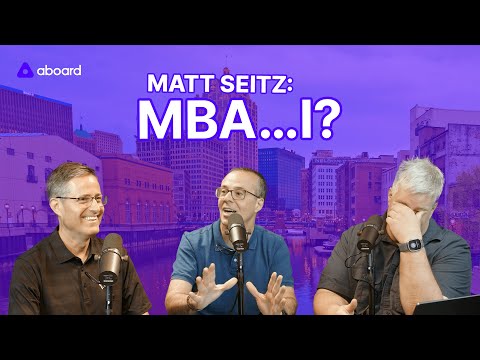
Matt Seitz: MBA...I?
Matt Seitz: MBA…I?
Summary
Paul and Rich are joined by Matt Seitz, Director of the AI Hub for Business at the University of Wisconsin’s School of Business. Matt brings a unique perspective, having spent 14 years at Google (including leading the US retail search business) before transitioning to academia. The conversation centers on how business leaders, employees, and students should navigate the AI transformation, with Matt offering a practical four-point framework: (1) put AI tools in employees’ hands and encourage experimentation, (2) develop functional AI expertise by business domain, (3) embrace AI coding tools, and (4) identify strategic competitive advantages through AI.
The episode features extended roleplay segments where Paul and Rich act as a hat manufacturer CEO and a frustrated 11-year HR veteran, respectively, putting Matt’s advice to the test. Matt introduces Bloom’s taxonomy to explain why AI feels different from previous technology shifts — while Google and Wikipedia only hit the bottom two levels (remember and understand), chatbots hit all the top levels (analyze, synthesize, create). The conversation also tackles the uncomfortable reality of AI-driven layoffs, the Uber/taxi analogy for job displacement and creation, and Matt’s view that vibe coding produces “trinkets” rather than real software.
Highlights
”You’re Not Going to Lose Your Job to AI. You’re Going to Lose Your Job to Someone Else Using AI.”
Clip command
yt-dlp --download-sections "*26:00-27:00" "https://www.youtube.com/watch?v=DyRfO9rlJGs" --force-keyframes-at-cuts --merge-output-format mp4 -o "DyRfO9rlJGs-26m00s.mp4"“You guys know this. We’ve had this statement for three years now: you’re not going to lose your job to AI. You’re going to lose your job to someone else using AI. We’ve been saying this for years. And it was always kind of a cute little line. But it’s real. That’s actually happening.” — Matt Seitz, 26:00
”Bloom’s Taxonomy and Why AI Feels Different”
Clip command
yt-dlp --download-sections "*28:00-29:00" "https://www.youtube.com/watch?v=DyRfO9rlJGs" --force-keyframes-at-cuts --merge-output-format mp4 -o "DyRfO9rlJGs-28m00s.mp4"“Bloom’s taxonomy is a hierarchy of thinking. At the bottom is understand and remember. At the top is create. Google, Wikipedia, YouTube — they were incredible but only hit those two bottom levels. What these chatbots do is they hit all the top ones. You can say analyze this, synthesize this, write a short story.” — Matt Seitz, 28:00
”Shopify CEO: No New Headcount Until You Prove You Can’t Do It with AI”
Clip command
yt-dlp --download-sections "*15:00-16:00" "https://www.youtube.com/watch?v=DyRfO9rlJGs" --force-keyframes-at-cuts --merge-output-format mp4 -o "DyRfO9rlJGs-15m00s.mp4"“The CEO of Shopify says, listen, I am not going to give you new headcount until you prove to me you can’t do this with AI. So one is a push. And then the second is encouragement and legitimate training.” — Matt Seitz, 15:00
”Taxi Drivers Down 75%, But Net Drivers Are Up”
Clip command
yt-dlp --download-sections "*23:00-24:00" "https://www.youtube.com/watch?v=DyRfO9rlJGs" --force-keyframes-at-cuts --merge-output-format mp4 -o "DyRfO9rlJGs-23m00s.mp4"“When Uber came along, the number of taxi drivers is down by 25% of what it was before — 75% loss. Massive loss. But if you look at the net of all the new people now driving with Uber, DoorDash, Lyft, it’s now more than there were taxi drivers before.” — Matt Seitz, 23:00
”Vibe Coding Is Like Giving an Eight-Year-Old a Credit Card”
Clip command
yt-dlp --download-sections "*35:00-36:00" "https://www.youtube.com/watch?v=DyRfO9rlJGs" --force-keyframes-at-cuts --merge-output-format mp4 -o "DyRfO9rlJGs-35m00s.mp4"“I heard this quote: ‘Vibe coding is like giving an eight-year-old a credit card.’ What do you end up with? You end up with technical debt and stuff you can’t unwind.” — Matt Seitz, 35:00
Key Points
- AI Hub for Business (2:30) - Matt’s group at UW is “like light — both a particle and a wave”; supporting research, teaching, and industry connections
- AI is existential to universities (2:00) - Affects how you teach, what you teach, what research you do, how you do research, and what alumni/industry need
- Three cohorts at universities (5:00) - Early adopters, skeptics, and those who pretend AI doesn’t exist; “the classic professor move”
- Nvidia keynote featuring UW (5:30) - UW Madison’s medical research group appeared in Nvidia’s sizzle reel
- 14 years at Google (6:00) - Matt built analytics platforms for retail and led the team for the US retail search business
- Four-point AI framework (14:00) - (1) Put tools in employees’ hands, (2) Develop functional expertise by domain, (3) AI coding, (4) Strategic competitive advantage
- BCG productivity study (14:00) - BCG’s study shows 25% productivity increase when employees use chatbots
- Shopify’s headcount policy (15:00) - Shopify CEO won’t approve new headcount until teams prove they can’t do it with AI
- Secret AI usage (16:00) - Employees are using AI and not telling anyone because they’re afraid of consequences when 7-hour tasks take 2
- Hat manufacturer roleplay (10:00) - Paul roleplays as a $30M custom hat company CEO seeking AI guidance; “I make hats. I have big machines.”
- Nordic financial company (17:00) - Company saved 100,000 hours of effort per year with AI personal productivity tools
- 10,000 agents doing one thing 10,000 ways (17:30) - Companies doing incredible automation but nobody wants to talk about it publicly yet
- Uber vs. taxi displacement (23:00) - Taxi drivers down 75% but total rideshare drivers exceed the original number; self-driving will create another shift
- Cars will become bars (23:45) - Americans spend 300 million hours a year in cars; self-driving opens an entirely new service market
- Bloom’s taxonomy (28:00) - Hierarchy of thinking from remember/understand to analyze/synthesize/create; AI hits all levels unlike previous tech
- Software productivity revolution (30:00) - Paul: “The 1970s Allen Kay dream book is actually in hand for the first time in my life”
- SAP implementations should die (31:00) - The grinding 36-month enterprise software nightmare where no one wins — “we should be able to kill that in our lifetime”
- Strategic advantage (33:00) - Company told Matt they could gain 20 market share points because their competitor isn’t using AI
- Vibe coding critique (35:00) - Examples are always trinkets like “program me a video game to teach my wife Spanish”; for real software you need real engineering
Mentions
Companies
- University of Wisconsin (0:30) - 50,000 students, 7th ranked public university, 17th of all business schools
- Google (6:00) - Matt spent 14 years there; has ~50,000 employees helping companies buy ads
- Nvidia (5:30) - Featured UW Madison medical research in keynote; “keynotes are now like the old Apple keynotes”
- Aboard (36:00) - Hosts’ company; differentiates from vibe coding by creating blueprints and using vetted components
- BCG (14:00) - Famous study showing 25% productivity gain with chatbot usage
- Shopify (15:00) - CEO’s no-new-headcount-until-AI-proves-insufficient policy
- Harvey (17:00) - Legal AI startup transforming the legal industry
- Uber (23:00) - Central example of job displacement and creation through technology
- DoorDash (23:00) - Part of the net gain in drivers after taxi disruption
- Lyft (23:00) - Part of the net gain in drivers after taxi disruption
- OpenAI (32:00) - If they launched an ads business, they’d need thousands of employees
- Amazon (7:00) - One of the retail clients Matt worked with at Google
- Party City (7:00) - Smaller retail client example from Matt’s Google days
- Tractor Supply (7:00) - Smaller retail client example
- SAP (31:00) - Enterprise software whose 5-year implementation projects should be obsoleted by AI
- Oracle (31:30) - Jokingly mentioned as podcast sponsor alongside SAP
- Oliver Wyman (27:00) - Consulting firm mentioned as aspirational employer for business school grads
Products & Technologies
- GEO (8:00) - Generative Engine Optimization; Matt confirms the term has taken off
People
- Matt Seitz (0:30) - Director of AI Hub for Business at UW; 14 years at Google; grew up in Champaign-Urbana with professor parents at U of Illinois; masters from Kellogg
- Clay Shirky (4:30) - Provost at NYU focused on AI; had professors crying in his office; appeared on previous episode
- Jensen Huang (5:30) - Nvidia CEO; “wears that leather jacket, takes the GPU out of the oven”
- Benjamin Bloom (28:00) - Creator of Bloom’s taxonomy — hierarchy of thinking from remember/understand to analyze/synthesize/create
Surprising Quotes
“There’s employees using AI and not telling anyone because they’re afraid to tell their employers that the thing that usually took them seven hours took two.” — Matt Seitz, 16:00
“I just don’t see a future where the robot writes short stories that hundreds of thousands of people want to read. I do see a future where you feed it pictures of your vacation and it writes you a story about your vacation.” — Paul Ford, 29:30
“What I have seen for the last 30 years is that people are grievously underserved by their software and by their content to this day. They can’t get what they need.” — Paul Ford, 30:00
“Google was a great verb. ChatGPT just doesn’t roll off the tongue. There’s a huge opportunity for an AI company to just be a good verb. The nerds snuck it out before the designers got in the mix.” — Rich Zottoli, 8:30
“I’m not going through a rough patch right now. I just had the world change around me. And so this one stings to walk up to my staff and tell them I don’t need a third of you because of these tools.” — Rich Zottoli (roleplaying as CEO), 21:00
Transcript
0:00 Hi, I’m Paul Ford. And I’m Rich Zottoli. And this is the Aboard podcast. It’s a podcast about how AI is changing the world of software development. Rich, have you ever had delicious cheddar cheese? Do you know where it might have come from in America? You ever had fried cheese curds? They squeak a little bit when you eat them. It’s magical.
0:30 I’m showing you a photo of a magical world of ivy-colored buildings. Looks like Belgium. It could easily be Belgium. No, Wisconsin. A land of dreams and wonders and cheese. University of Wisconsin Badgers — truly a world-class computer science, business admin university. Like an industrial force in the world.
1:30 We just did AI summer school and what would be more fitting than to get an actual AI educator into the room. We’re very lucky to have Matt Seitz from the University of Wisconsin. Matt is the Director of the AI Hub for Business. Tell us what that is.
2:00 AI is existential to the university system. It affects how you teach, what you teach, what research you do, how you do research. And everyone who’s graduated from Wisconsin comes to us and says, “How can you help us with AI?” 50,000 students. Seventh ranked of public universities, 17th of all business schools. I have this joke — we’re like light, both a particle and a wave. We’re a shared service supporting and advancing.
4:30 How’s everybody doing? Clay Shirky on the podcast — he’s a provost at NYU focused on AI and he’s had professors crying in his office. You have the early adopters, the skeptics, and then the people who pretend it’s not there. That’s the classic professor move.
5:30 My first month in the job, Nvidia’s keynote — which are now like the old Apple keynotes — University of Wisconsin Madison pops up. That was our medical group using AI for medical research. My daughter’s in fashion and they’re really engaged with the human side of AI.
6:00 I was at Google for 14 years. First 12 years in analytics. We built an analytics platform for retail — you can ask what are the bestselling SKUs in my category, how do I compare on price. If you provide retailers with more information, they buy smarter ads. Last two years I led the team for the US retail search business. Every customer, AI was three-quarters of the conversation.
8:00 We’ve been talking to marketing firms and they’re starting to emphasize GEO. I think they’re seeing if it sticks. It has taken off. It’s really landed. Does anyone know what the G stands for? I think it’s for GPT. Boy, they jammed that one in. Google was a great verb. ChatGPT just doesn’t roll off the tongue. There’s a huge opportunity for an AI company to just be a good verb.
10:00 [Roleplay] I’m going to be a CEO of a hat manufacturer. Custom-made hats with words on them. About $30 million in revenue, 100 employees. I’ve heard AI — people are using it, I’m worried about competition. Matt, I heard all about this AI stuff. You got to help me get my bearings. What do I do?
14:00 I tell people to do four things. Number one: put the tools in the hands of your employees. BCG has the famous study that you’re 25% more productive if you use a chatbot. Encourage, celebrate. There’s a lot of anxiety — “Is this going to take my job?” The CEO of Shopify says “I am not going to give you new headcount until you prove to me you can’t do this with AI.”
16:00 There are employees using AI and not telling anyone because they’re afraid. The thing that usually took them seven hours took two. That first overture is: use it, we encourage you. If you get your day done quicker, there’s always other things to do.
17:00 Legal is being transformed by AI. Harvey’s the fancy startup. If anyone just gets a contract, they can put it into a chatbot and get a quick answer. A Nordics company saved 100,000 hours of effort per year with personal AI tools. Companies are spinning up 10,000 agents to do one thing 10,000 different ways. Nobody wants to talk about it publicly yet.
19:00 [Rich as CEO] My job is to make sure my business is healthy and stable, growing incrementally, margins improving. I used to have 25 people rumaging through resumes. The velocity has accelerated five-fold. I’d love to let a lot of people go. The world’s getting more competitive. My competitors have the tools too. I’m not going through a rough patch — the world changed around me. This one stings.
22:00 There’s no way around it. People are going to lose jobs. There are going to be functions where I had 20 people but now I need five. But there’s also going to be things created.
23:00 Think about taxis and Uber. When Uber came along, taxi drivers are down by 75%. Massive loss. But if you look at the net of all the new people driving with Uber, DoorDash, Lyft — it’s now more than there were taxi drivers before. But then self-driving cars come along and most Uber drivers won’t drive anymore. Americans spend 300 million hours a year in cars. There’s going to be an entirely new market serving people who used to have their hands on the wheel.
25:00 [Paul as HR veteran] I’ve been here 11 years. I’ve gotten really good. Some of the people I vetted are now VPs. And now the SVP that I helped put me on the chopping block. I’m angry. What do I do?
26:00 You’re not going to lose your job to AI. You’re going to lose your job to someone else using AI. We’ve been saying this for years. It was always a cute little line. But it’s real. That’s actually happening. Employers are saying “I want to hire people with AI skills.” If you’re 11 years into your role, embrace the tools. When the CEO goes to your team of 20, they’re going to keep the ones that are most productive.
27:00 When the robot replaced you on the assembly line, it did the labor. There was a physicality to it. What’s tricky here is you went to University of Wisconsin and want to go to Oliver Wyman, but that base is shrinking. It’s not that you’ve entered a disastrous era where there are no jobs. The stats don’t bear that out. You’ve entered an incredibly ambiguous era in which classic paths are changing under your feet. The skill you need is being able to read the room.
28:00 Have you heard of Bloom’s taxonomy? It’s a hierarchy of thinking. At the bottom is understand and remember. As you go up it’s analyze, synthesize, and create. Every technical enhancement — Google, Wikipedia, YouTube — they were incredible but only hit those two bottom levels. What these chatbots do is hit all the top ones. You can say analyze this, synthesize this information, write a short story. That’s why it’s magical. And also unsettling. Because it just did that. I do that. It just did that.
30:00 People are grievously underserved by their software to this day. If you get everybody their report, their analysis, their tool — the actual true 1970s software productivity revolution feels actually close. The Allen Kay dream book is actually in hand for the first time in my life. Because you can tell the computer a thing and it gives you something back.
31:00 SAP implementation that everybody hates — the grinding enterprise software nightmare over 36 months where no one wins. We should be able to kill that in our lifetime. The incumbents will resist in all manner of ways.
33:00 Run through the rest of the four points. One: personal productivity, absolute no-brainer. Two: functional expertise — AI shows up differently in marketing, finance, HR, supply chain. Three: AI coding — be faster and better with these tools. Four: strategic advantage. Where can I get a competitive advantage? A company told me they could gain 20 points in market share because their competitor isn’t using AI.
34:30 Matt has a newsletter called “Explain It Like I’m Busy.” I spend 20 to 60 hours a week paying attention to AI and try to digest it for someone who’s not AI savvy.
35:00 What do you think about vibe coding? I do vibe code. But the examples are always like “program me a video game that teaches my wife Spanish.” I don’t need that. Trinkets. I need a real website and I’m going to work with somebody who knows how to build websites. I heard this quote: “Vibe coding is like giving an eight-year-old a credit card.” What do you end up with? Technical debt and stuff you can’t unwind.
37:00 We’re not a vibe coding tool deliberately. What you get is real software. Go to aboard.com, put in a prompt and it will create a blueprint and build the software from that — components that humans are involved with and that we have vetted. Hit us up at aboard.com. Give us five stars. Never less than five stars. Thank you Matt. Have a great week everyone.