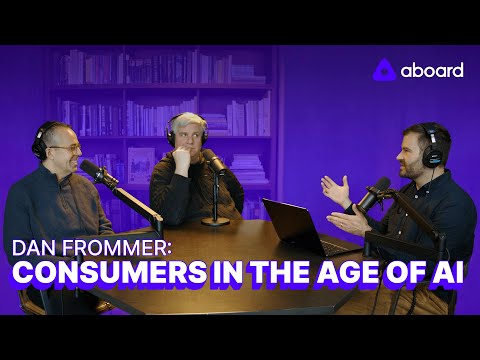
Dan Frommer: Consumers in the Age of AI
Dan Frommer: Consumers in the Age of AI
Summary
Paul Ford and Rich Ziade welcome Dan Frommer, founder and publisher of The New Consumer, to discuss his brand-new Consumer Trends Report for 2026. Frommer shares his journey from tech journalism at Business Insider and Recode to launching his own media company focused on the intersection of technology and consumer behavior. The conversation covers the rise and fall of direct-to-consumer brands, the evolution of e-commerce, and how platforms like TikTok Shop are reshaping retail.
The heart of the episode dives into Frommer’s survey data on AI adoption among American consumers. His research reveals that AI awareness now exceeds that of Doritos and Viagra, with nearly two-thirds of Gen Z and millennials using ChatGPT in the past month. However, there is a striking generational divide: millennials are the most optimistic about AI’s impact on their careers, while Gen Z is notably more skeptical and worried about job displacement. Frommer also discusses how AI is beginning to transform shopping, with in-chat purchasing capabilities emerging through partnerships with Shopify, Walmart, and Etsy.
The episode also touches on broader consumer sentiment, revealing that Americans report feeling worse off than during the Great Financial Crisis despite record holiday spending. Frommer notes a fascinating Venmo-in-the-Northeast, Cash-App-in-the-South regional split in payment tool usage, and the growing trend of health optimization as a status symbol among younger and wealthier consumers.
Highlights
”AI awareness is higher than Doritos”
Clip command
yt-dlp --download-sections "*17:50-18:40" "https://www.youtube.com/watch?v=317XJdJ-src" --force-keyframes-at-cuts --merge-output-format mp4 -o "317XJdJ-src-17m50s.mp4"“More than 90% of people have heard of AI, which is higher than the people who are aware of Doritos, of TikTok, of Viagra, of Ozempic.” — Dan Frommer, 17:50
”Two-thirds of young people used ChatGPT last month”
Clip command
yt-dlp --download-sections "*19:00-19:50" "https://www.youtube.com/watch?v=317XJdJ-src" --force-keyframes-at-cuts --merge-output-format mp4 -o "317XJdJ-src-19m00s.mp4"“Almost two-thirds of Gen Z and millennials use ChatGPT in the last month. 62% of Gen Z millennials say they used AI in the past month.” — Dan Frommer, 19:00
”Gen Z is more skeptical than millennials about AI”
Clip command
yt-dlp --download-sections "*24:50-25:50" "https://www.youtube.com/watch?v=317XJdJ-src" --force-keyframes-at-cuts --merge-output-format mp4 -o "317XJdJ-src-24m50s.mp4"“40% of millennials say very positively about AI’s impact on their career. Gen Z lower — only 27% say very positively. Gen Z seems to be a lot more cynical and less trusting than millennials.” — Dan Frommer, 24:50
”Venmo in the Northeast, Cash App in the South”
Clip command
yt-dlp --download-sections "*28:20-29:10" "https://www.youtube.com/watch?v=317XJdJ-src" --force-keyframes-at-cuts --merge-output-format mp4 -o "317XJdJ-src-28m20s.mp4"“We see actual real differences in what online payments tools they use. There’s kind of a Venmo in the northeast, Cash App in the south vibe happening. That’s a real thing.” — Dan Frommer, 28:20
”Consumers are complaining but spending”
Clip command
yt-dlp --download-sections "*35:00-35:50" "https://www.youtube.com/watch?v=317XJdJ-src" --force-keyframes-at-cuts --merge-output-format mp4 -o "317XJdJ-src-35m00s.mp4"“The American consumer says they’re worse now than during the Great Financial Crisis, than after 9/11. But the holiday shopping numbers exceeded expectations. A lot of things people say they’re just saying and they’re not doing.” — Dan Frommer, 35:00
Key Points
- Dan Frommer’s background (1:49) - Spent 15 years as a tech/financial journalist, helped start Business Insider, was editor-in-chief at Recode, then founded The New Consumer
- Direct-to-consumer brand boom (3:03) - NYC-based companies launched digitally native consumer products like glasses, luggage, and mattresses with different business models
- The Mary Meeker inspiration (7:10) - Frommer’s Consumer Trends report was inspired by Mary Meeker’s famous Internet Trends reports; they’ve published 15 editions
- TikTok Shop’s explosive growth (8:30) - TikTok Shop came from nowhere and is projected to do $15 billion in US sales this year
- Amazon’s enduring popularity (8:50) - Despite narratives that people dislike Amazon, survey data shows consumers love it
- Survey methodology (10:40) - Frommer surveys 3,000 Americans with Toluna, aiming for nationally representative samples across age, gender, income, and geography
- Digital natives feel more like themselves online (9:50) - More Gen Z and millennials feel most like themselves online rather than offline, the reverse of older generations
- Health optimization trend (14:40) - A third of Americans say they’re in health optimization mode; nearly two-thirds of millennials are actively trying to live longer
- AI awareness exceeds Doritos (17:50) - Over 90% of survey respondents have heard of AI, exceeding awareness of major consumer brands
- Shopping inside ChatGPT (20:30) - In-chat purchasing is coming via Shopify, Walmart, Target, Instacart, and Etsy partnerships
- Millennials most optimistic about AI (24:50) - 40% of millennials expect AI to impact their career “very positively” vs only 27% of Gen Z
- Gen Z worried about jobs, not environment (27:00) - When asked why they worry about AI, Gen Z cites job losses and misinformation, not environmental concerns
- Consumer sentiment vs reality (35:00) - University of Michigan survey shows consumers feel worse than post-9/11, yet spending exceeds expectations
- Grocery store economics (13:00) - Brands pay for placement on shelves; some categories consider selling 6 units per week per store a success
Mentions
Companies
- The New Consumer (1:31) - Dan Frommer’s media company covering consumer trends at newconsumer.com
- Business Insider (2:07) - Frommer helped start the publication nearly 20 years ago
- Recode (7:20) - Frommer was editor-in-chief; hosted the Code Conference where Mary Meeker presented
- Coefficient Capital (6:50) - NYC-based VC firm that partners with Frommer on consumer trends reports
- TikTok Shop (8:30) - Projected $15B in US sales
- Amazon (8:50) - Discussed as beloved by consumers despite negative narratives
- Shopify (20:50) - Signed up for ChatGPT in-chat purchasing
- OpenAI / ChatGPT (19:00) - Discussed as the dominant consumer AI tool
- Substack (5:20) - Frommer recently started mirroring content there for subscriber growth
- Instacart (10:20) - Referenced for online grocery shopping data
Products & Technologies
- ChatGPT (19:00) - The biggest consumer AI tool, used by 62% of young Americans monthly
- Venmo (28:20) - Dominant payment app in the Northeast
- Cash App (28:20) - Dominant payment app in the South
People
- Dan Frommer (1:31) - Founder and publisher of The New Consumer
- Mary Meeker (7:10) - Former Wall Street analyst famous for Internet Trends reports at Morgan Stanley and Kleiner Perkins
Surprising Quotes
“People freaking love Amazon. People love Amazon.” — Dan Frommer, 8:50
“A third of Americans say that they are in health optimization mode… almost two-thirds of millennials say they’re actively trying to live longer.” — Dan Frommer, 14:40
“The way you make a consumer digital product is you raise a lot of money and then you give it immediately to Google and Facebook in the form of ads. Maybe eight out of every ten dollars you might spend.” — Paul Ford, 12:30
“Millennials grew up with the internet and saw it as an enabler… Gen Z is coming into the tail end of that now. They grew up during COVID, they played a lot of video games, and they’re just more skeptical.” — Dan Frommer, 26:10
“You know who loves AI? My four-and-a-half-year-old son. You show him a picture of him as a Lego and he’s the happiest guy on the planet.” — Dan Frommer, 36:30
Transcript
0:00 Hi, I’m Paul Ford and I am Rich Ziade and this is the Aboard podcast. It’s a podcast about how AI is changing the world of software and the world in general. How are you Paul? I’m good. Today we have something very special. Let’s play the theme song and I’ll tell you what we’re going to do. But we are about to learn something about the most prevalent…
0:40 Good theme song. Great theme song. Love it. Love that theme song. There is a creature, and if you’re watching on video, there’s someone here to my left. Don’t just ignore them for a minute. There is a creature that stalks our entire country. They’re in every shopping mall. They are a topic of endless discussion. We fear them. We love them. And we want to please them. What is it? The American consumer.
1:05 Oh boy. I know. They are here. And I’ll tell you what, I’ve never been able to understand them. Not one. Yeah. Are you one of them? Of course I am. Everybody is. Everybody thinks they’re not. I’m a reader. I don’t care about a tote bag. Hippies, too. Like I don’t care about brands. I just like Birkenstocks. And you’re just like, there we are.
1:26 There it is. Okay. But we’re not here to talk about the American consumer. We have a world-class expert Dan Frommer who is the publisher of The New Consumer and the writer and the everything. So welcome. Thank you. Tell us a little bit. Help us understand. You were a journalist. Still am sometimes but yes. Well no I mean you mostly wrote articles and now you have your own platform.
1:49 I mostly wrote articles. I spent 15 years as a technology financial journalist writing about the business of tech, mostly Apple, mostly the smartphone industry, the app economy, all that stuff from like 2005 through 2015. For lots of big pubs. I helped start Business Insider when we were All Things Insider almost 20 years ago. And you were very much a New York City guy. Now you’re in LA.
2:15 I was here for 15 years. Then I moved to LA 5 years ago and right before moving to LA I started a new business which I call The New Consumer and I’ve been covering tech for so long but my personal interest is a lot of more consumer oriented things — food and beverage, the hospitality industry, and CPG. Back then we had this boom of direct to consumer brands here in New York. Tell the people what CPG is. Consumer packaged goods. So, you know, everything from paper towels to squeezy olive oil.
2:50 So this is what you’re — you got Apple, you got the iPhone, their keynotes, and you’re like, “God, I just need to do olive oil. I got to get in there.” Got to do it. No, what was interesting was that especially here in New York, there were a lot of these companies that were launching seemingly mundane consumer products like glasses and rolly suitcases and all that kind of stuff. Mattresses. But operating in a completely different way than their predecessors.
3:14 They were digitally native marketers. They were actually good at customer service. They had a product value proposition that turned out to be a little too good to be true. Like the prices were maybe a little too low and the margins were a little too thin. And then the ads got expensive and then they realized, oh, we got to rethink all of this. But anyway, it was a fascinating time, this collision of consumer and tech through e-commerce.
3:40 This was back when Amazon didn’t have fulfillment centers in most states because they didn’t want you to have to pay sales tax. Now you can get an Amazon package in three hours. And that is just a profound shift in how people buy things and spend money. And I saw a lot of people writing about these companies, but not in the way I wanted to. No one was doing actually any analysis of the business models. No one was using math. They were all just talking about how creative and disruptive these companies were. But were they actually?
4:20 So off you go and you make a kind of a Substack kind of dealio, right? Like you’re like, I’m going to start this newsletter. You don’t use that word, but yes, a professional newsletter membership. You’re a platform. I’ve always been on my own actually. I used my 2006 WordPress template code and made it look appropriate. It’s called The New Consumer, newconsumer.com. Actually just started mirroring on Substack earlier this year to see if it juices subscriber growth.
5:20 They do a lot of UX stuff that I would never ever do on my site, like kind of dark stuff, like make it look like you need to subscribe in order to read an article which you don’t actually. You just find the light gray text which I would never do on the site that I own and operate. But people are used to it on Substack. So I figured let’s test mirroring on Substack and treating it more like Twitter. And that has worked.
6:30 In the tech and business world there was a very famous Wall Street analyst named Mary Meeker and she used to put out these incredible reports every year, 400 slides about the state of the internet. She was first at Morgan Stanley and then she was at Kleiner Perkins. She took a very complex topic and made it extremely simple to understand through a slide, usually a chart that tells a great story with just a wiggly line. And she would present 400 slides in like 30 minutes. She was so fast.
7:50 She actually stopped doing them the year we started doing them. So I was chatting with the VCs at Coefficient Capital and they said, we really would love a partner to help us make like the Mary Meeker report for consumer. And I said, “Oh man, that’s what I want to do.” So we started that in 2020. Mary Meeker’s was called Internet Trends. Ours is called Consumer Trends. We’ve done 15 of them now. If you go to newconsumer.com/trends, they’re all free to read.
8:30 We dive deep on a lot of topics in this collision of tech and consumer. TikTok Shop is something that came out of nowhere 2 years ago and is now supposedly going to do $15 billion in sales this year in the US alone. That’s where I buy everything. Or topics like Amazon which is fascinating because there’s this narrative that people don’t like Amazon. People freaking love Amazon.
10:00 There’s kind of three main ways that we get data for our report. One is that we try to curate and triangulate as much publicly available data that exists — the government puts out a ton, companies through SEC filings. The other is we partner with a lot of data companies. And the third and probably the most important thing is we conduct an original survey every few months of 3,000 Americans online. We work with Toluna, one of the most reputable survey companies.
11:00 We always ask where do you feel most like yourself, online or offline? And that is one where there is a vast generational difference. More Gen Z and millennials feel most like themselves online than offline. And then if you look at Gen X and above, it’s the exact opposite. Like 90% of people over 75 don’t think of themselves as online. But that dictates how they think about other things.
12:30 We realized we started to dabble and see if we could make a consumer product. And there was this moment where I realized the way you make a consumer digital product is you raise a lot of money and then you give it immediately to Google and Facebook in the form of ads. And literally maybe eight out of every ten dollars you might spend. Two is for you to build your product and eight is to market it.
14:40 A third of Americans say that they are in health optimization mode. We ask do you consider yourself someone who is actively trying to live longer? And it’s about half of people. But it’s higher among younger people — almost two-thirds of millennials say they’re actively trying to take care of themselves. And then most people see health as a status symbol, too.
15:30 Where people are getting their information is as important to brands as much as the product itself. It’s not like I’ve made something really good I want to tell you about it. The where and the how is just as important. All those brands pay to be on grocery store shelves. It’s very hard to be a brand in a grocery store. You have to do a lot of trade spend.
17:50 Basically everybody knows about AI. More than 90% of people have heard of AI, which is higher than the people who are aware of Doritos, of TikTok, of Viagra, of Ozempic. Like, there’s extremely high awareness of AI. And people are using it. ChatGPT is obviously the biggest consumer AI tool right now.
19:00 Almost two-thirds of Gen Z and millennials used ChatGPT in the last month. 62% of Gen Z millennials say they used AI in the past month. It’s a brush fire of adoption. I mean we’ve never seen anything like it. It’s a real thing and I think people are genuinely using it.
20:00 Shopping is a category where obviously my interest is. In the official data I think it was only like 2% of queries are about specific products but that underrepresents how much people are using it for advice on things that end up driving purchases. It peer pressured me into buying a plane ticket the other day at a specific price and it was right. I’m probably going to switch insurance companies because of it.
20:50 You can buy stuff inside of the chat now. Shopify will enable it for any store that wants to be part of it. Walmart, Target, Instacart, it’s all coming. You’ll be able to make the purchase. There’ll be a cart inside of ChatGPT. And it will be able to drive attribution there.
22:00 How does the concept of AI make you feel? The top two answers are always hopeful and worried. And the people who answer them are very different. Younger people are much more likely to say hopeful than worried. And older people are much more likely to say worried than hopeful. But millennials have the highest expectations for AI of anyone else.
23:00 That particular cohort is now at the manager level. They’re getting a little more senior and they’re like, this thing really helped me boil down that PDF. Whereas Gen Z is just sort of like, I got to answer these phones and help people. Millennials grew up with these phones in their pockets and are not as burned out by the concept as Gen Z is. Gen Z seems to be a lot more cynical and less trusting.
24:50 We ask how do you expect the rise of AI to impact your career and earning prospects. Millennials are the highest percentage saying very positively — 40%. Another 26-27% say somewhat positively. Gen Z lower in both — only 27% say very positively and 23% say somewhat positively. Similarly, 69% of millennials say AI will make life better for the next generation, but only 46-47% of Gen Z.
26:10 Millennials grew up with the internet and saw it as an enabler in many ways. It shrunk the world and it gave us jobs and it created new industries. Gen Z is coming into the tail end of that now. They grew up during COVID, they played a lot of video games, more than two-thirds identified themselves as a gamer, and they’re just more skeptical.
27:00 We asked anyone who was worried about AI why they were worried. We put environmental concerns as one of the possible reasons. No one chose that. It was job losses and spreading misinformation. So it has nothing to do with the cooling and the water. It’s about their own personal goals. It’s going to affect my life. I’m going to university. I’m going to graduate and I’m going to have a harder time.
28:20 We see actual real differences in what online payments tools they use. There’s kind of a Venmo in the northeast, Cash App in the south vibe happening. That’s a real thing. I would have guessed that. I would not have guessed that.
30:00 I think that it is important to learn the language and speak some of it. Hiring really good social media managers who can play the game and are results driven is important. There’s an art to it, but there’s also math and ROI.
35:00 If you look at the main consumer sentiment survey from the University of Michigan, the American consumer on average says they’re worse now than during the Great Financial Crisis, than after 9/11. But people are spending money like they never were before. The holiday shopping numbers exceeded expectations. Gen Z slashing their shopping budgets? No it didn’t happen. A lot of things people say they’re just saying and they’re not doing. So we’re complaining but spending. 100%.
37:00 You know who loves AI? My four-and-a-half-year-old son. You show him a picture of him as a Lego and he’s the happiest guy on the planet. I’ll tell you what loves AI is the group chat. The group chat loves AI.
38:00 Gen Z will tell us they don’t want it, but they secretly do. Well, they don’t have the budgets anyway. Millennials, you want to save your job, check out aboard.com.
39:00 If people want to get in touch and if they want to see this report, they go to newconsumer.com and it’s right there. It’s freely available to all. But if you like it, maybe become a member. Then you get the juice. We’ll do a grocery tour someday. That would be monster social content. Dan in the grocery store being like, “Okay, here’s how this got here.”
42:00 If anybody needs us, hello at aboard.com. Dan, thanks. And safe travels back to LA. And everyone have a safe, lovely holiday. Happy New Year and we’ll see you on the other side.